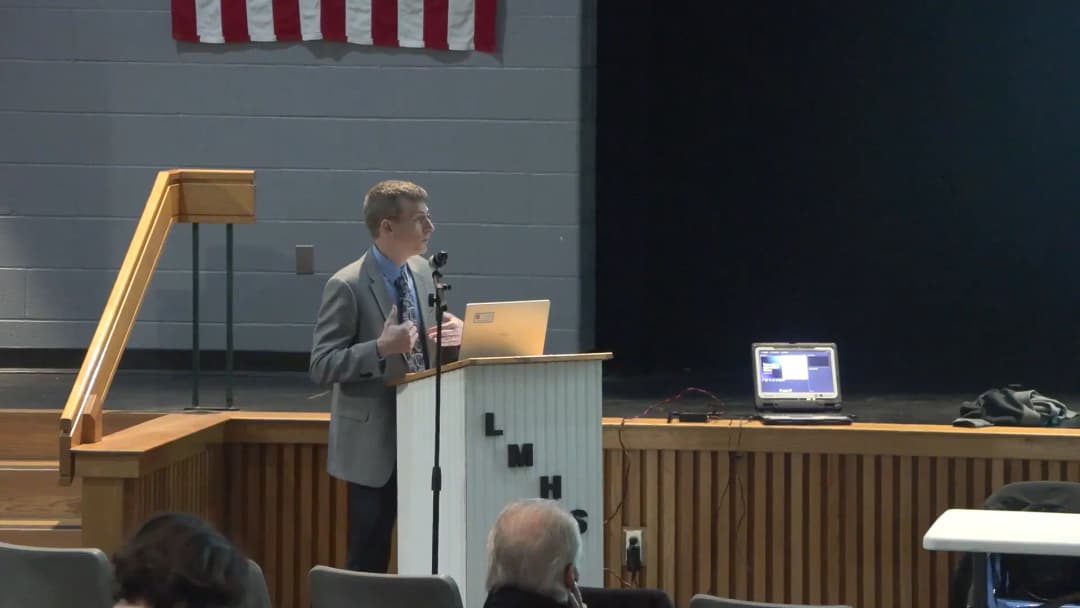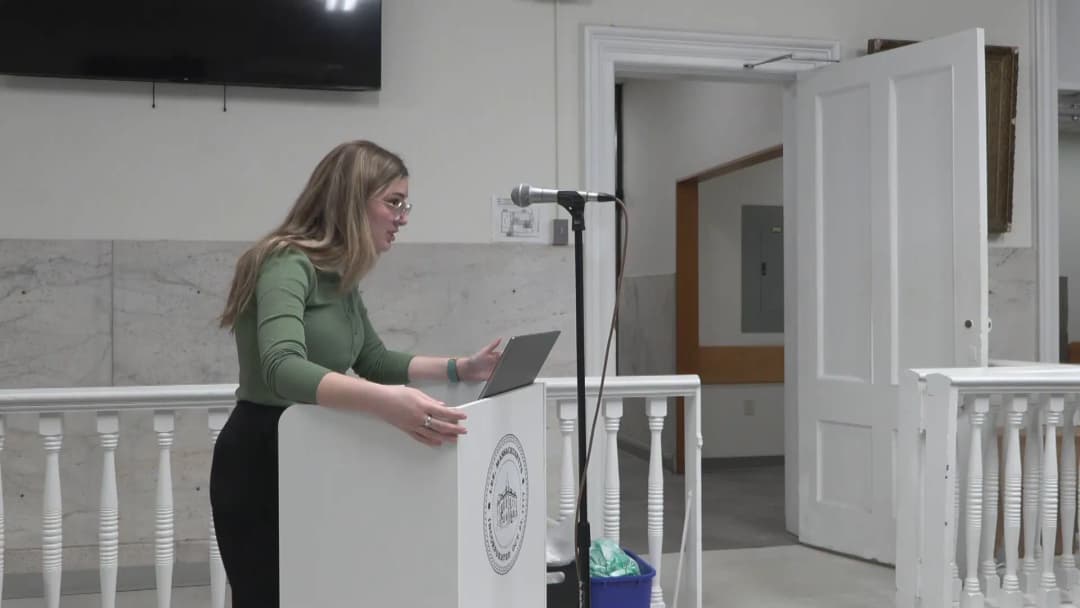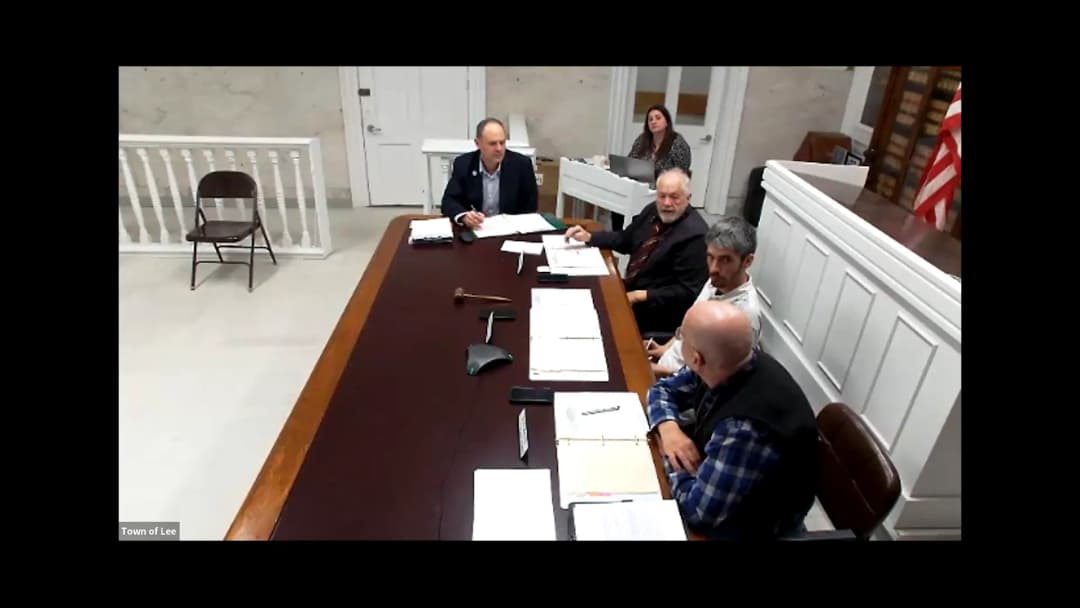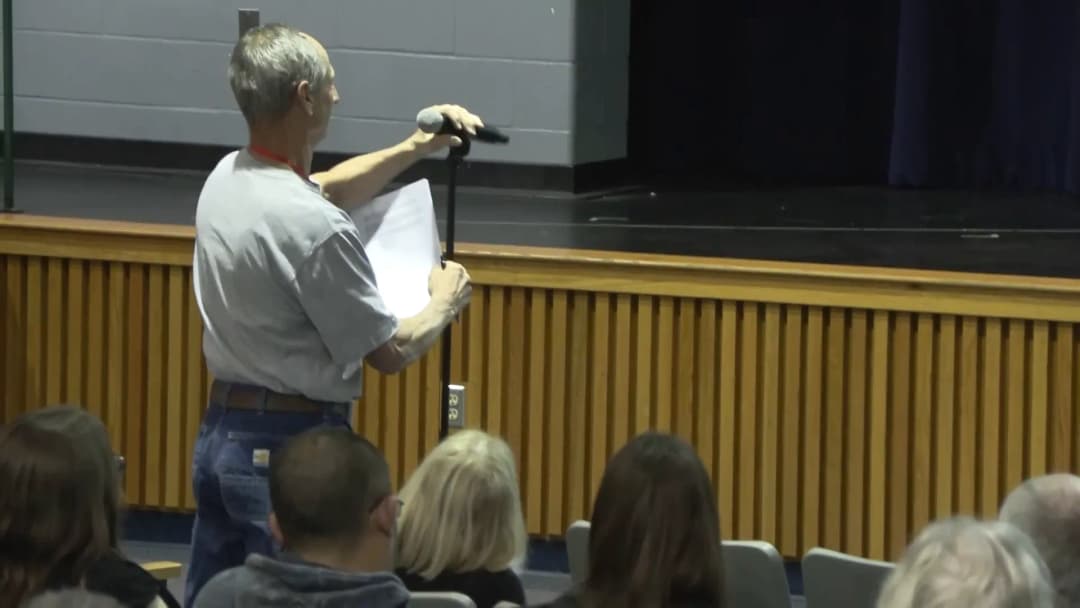
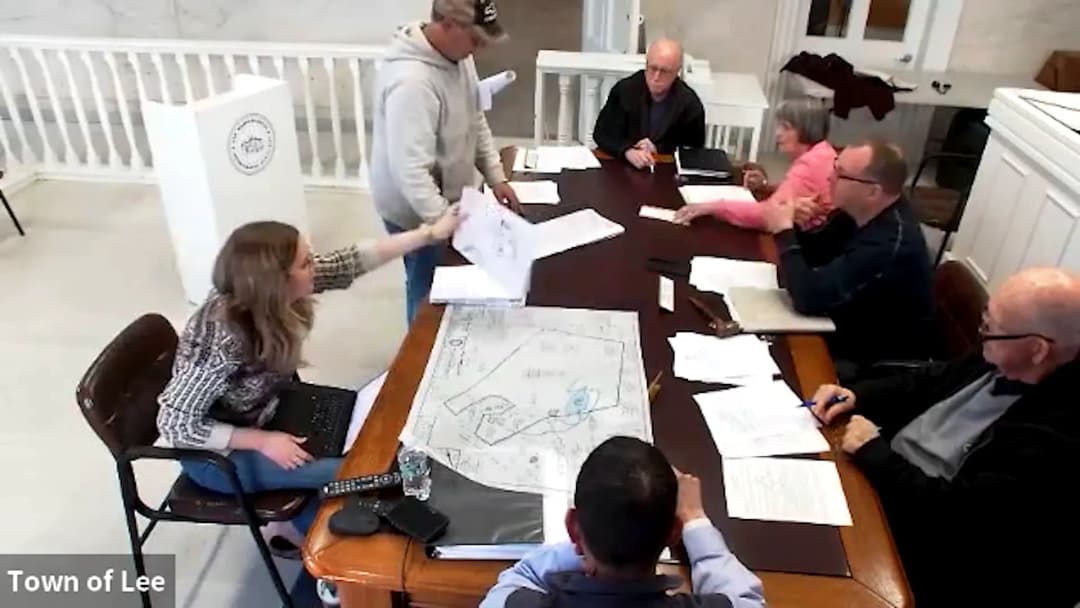
The Lee, Massachusetts, Annual Town Meeting was held on May 14, 2026, from 7:01 p.m. to 8:20 p.m. Registered voters considered all 26 warrant articles under Town Meeting rules; debate was limited to five minutes per member per speech, with a two-speech maximum per motion. Every article on the warrant was approved. Consent Calendar - Articles 1 through 5 passed by a single unanimous vote. These actions received the reports of the Select Board, town accountant, and other town bodies; fixed elected-official salaries for the fiscal year beginning July 1, 2026; transferred $1,100 from cemetery lot receipts to the Fairmont Perpetual Care Trust; authorized blanket grant applications; and authorized FY2027 Chapter 90 road repair and paving expenditures. - A voter corrected the moderator's voting instructions to say "abstain" rather than "absent." FY2027 Operating Budget - Article 6 authorized a total appropriation of $25,770,872.91 for department operations, including $25,570,872.91 raised and appropriated and $200,000 transferred from overlay surplus. The department line items were read in full. - The animal control line was held and amended to $135,500. The sponsor explained that Lee is the lead municipality in a new full-time intermunicipal animal control officer agreement run through Tri-Town Health; other towns reimburse Lee, so Lee's net cost is roughly $18,000 to $19,000. Cornelia Callischer, a Lee resident, asked about the eight participating towns and said a full-time officer would have been helpful when she could not reach someone on weekends. - On the sanitary landfill line, a town official said PFAS testing is a new annual state requirement and will be an ongoing cost. - On Sandy Beach, a resident praised last year's road work but complained about weeds. The sponsor said the small budget decrease was because lifeguards are returning and that weed treatment is funded in a later article. Capital, Enterprise, and Other Appropriations - Article 7 passed the FY2027 general fund capital budget, including police cruisers and body cameras, fire communications equipment, DPW highway trucks/plows/mowing equipment and paving, sewer meter replacements, kennel improvements, IT upgrades, parks and recreation improvements, and school capital. - Article 8 passed the Water Department budget of $1,281,909, funded by $1,186,409 in user charges and $95,500 in retained earnings. - Article 9 passed the Wastewater Department budget of $2,513,046, funded by $2,152,006 in user charges and $361,000 in retained earnings. - Article 10 passed $668,910 from free cash for non-departmental purposes, including $44,000 for Laurel Lake invasive species control shared with Lenox, Chamber of Commerce advertising and gateway/downtown projects, fireworks for Founders Day, bike path matching grants, $50,000 for 250th anniversary celebrations, and $22,000 for the Lee food pantry. - Article 11 passed the Community Preservation Committee's FY2027 budget, with $232,000 in project appropriations and $9,628 in administrative funds, leaving an anticipated reserve balance of $104,895.94. - Article 12 transferred $1,285,145 from the General Stabilization Fund for the FY2027 public safety building bond payment; it required a two-thirds vote and passed. - Article 13 authorized the Select Board to acquire land and easements needed for the Mill Street bridge replacement project. - Article 14 appropriated $235,000 from FY2026 school capital funds for feasibility study and schematic design costs related to a potential Massachusetts School Building Authority accelerated repair project for the Lee Elementary and Lee Middle/High School roofs. - Article 19 appropriated $100,000 to acquire 25 acres at 200 Reservoir Road for municipal/watershed purposes. A resident asked that the land be placed under a conservation restriction; officials said that could be considered for a future meeting. - Article 20 appropriated $2,500,000 for the central fire station and EMS building adaptive reuse project, using $500,000 from free cash and authorizing $2,000,000 in borrowing. The required two-thirds vote passed; a clicker vote was taken for bond counsel, but the numerical tally was not stated in the transcript. - Article 21 transferred $89,000 from the fire special stabilization fund to buy a new fire chief vehicle. Public Comments and Testimony - Cornelia Callischer, a Lee resident, spoke on multiple articles, including support for the full-time animal control officer, questions about recurring PFAS testing, concern about Sandy Beach weeds, questions about wildlife bylaw enforcement, and support for preserving upper reservoir land. - Roger Schurr, president of the Laurel Lake Preservation Association, supported the invasive species control funding. He said it took 30 years to obtain permits, that the recommended herbicide is safe for fish, people, non-target plants, and the endangered snail, and that more than 300 Massachusetts lakes use it. He said treatment lasts three to five years. - A resident from 57 Main Street said Laurel Lake has been degrading since the 1970s and that water chestnuts are spreading; he urged more aggressive action and offered to serve on a lake committee. - On the wildlife bylaw, Lori Kripkowski of Prospect Street supported the law but objected that bird and squirrel feeders are allowed while composting is restricted. Caroline Young of 755 Maple Street East Lee said bears ignore her compost; Mary Teresa Valeri of East Street asked for confirmation that bird feeders would remain allowed. - On the speed limit article, Robert Heinzman of 121 High Street supported lowering the limit but asked about enforcement of speeding on High Street. Mark Livernache of 812 East Street spoke in favor of the 25 mph limit for safety on East Street. - Annie Lee of 104 High Street, chair of the Lee Youth Commission and a reuse committee member, supported the fire station reuse plan, noting there would be historical displays, community rooms, and a commercial kitchen. Discussion Items - The Town Planner explained that the wildlife bylaw's compost language is aimed at improperly handled compost and open or broken garbage containers that attract bears, and that enforcement would be complaint-based with discretion. The wildlife bylaw passed. - Lenny Tiz of 345 Church Street responded on the speed limit article that any town-owned road currently posted at 30 mph would become a statutory, enforceable 25 mph zone after acceptance of MGL Chapter 90, Section 17C. - On Article 20, the Town Administrator said the reuse plan's first floor could hold up to 200 people, nearly all presentation surveys were supportive, and the town has applied for $1.8 million in grants; CPA money could later be used for matching funds to reduce the tax impact. The article passed. - Planning Board Chair Buck Donovan said the Article 25 adaptive reuse overlay district amendments were intended to make the district more flexible for mills; the public hearing occurred after warrant posting, so a handout of grammatical amendments was moved and adopted. The Planning Board had voted 5-0 for the amended version. - On the battery energy storage moratorium, Buck Donovan said the state had set an October 1 deadline but had not finalized model bylaws, and the town has no battery storage zoning. The Town Planner said the moratorium would last six months or until a bylaw is completed. One voter expressed concern that November 14 was not enough time. The moratorium passed. Other Warrant Articles Approved - Article 15: accepted the tax title payment plan bylaw. - Article 17: amended the Community Preservation Act bylaw to add an Affordable Housing Trust member to the Community Preservation Committee. - Article 18: amended the general bylaws relating to fines. - Article 22: accepted MGL Chapter 59, Section 5, Clause 22G, providing a property tax exemption for real estate owned by a trustee or fiduciary for the benefit of an eligible domiciliary. - Article 23: accepted MGL Chapter 90, Section 17C to reduce the speed limit from 30 to 25 mph in thickly settled or business districts. - Article 24: approved, by the required four-fifths vote, transfers from free cash to pay prior fiscal year invoices, specifically $4,766.08 to the Massachusetts Interlocal Insurance Association and $250 to the Department of Public Works. Key Outcomes - All 26 warrant articles were approved; none failed. - The FY2027 operating budget passed, with the animal control appropriation amended to $135,500. - The wildlife bylaw, speed limit reduction, fire station reuse borrowing, adaptive reuse overlay amendment, and battery storage moratorium all passed. - The meeting dissolved at 8:20 p.m.; voters were reminded of the town election on Monday, May 18, 2026, from 7 a.m. to 8 p.m. at Crossway Gym.
Public Meetings - Lee, Massachusetts
Public Meetings - Lee, MassachusettsThe Lee Planning Board met on 2026-05-11 to approve minutes, endorse two Approval Not Required (ANR) plans, prepare for the upcoming Town Meeting, and receive staff updates on a proposed Housatonic Street hotel project, MassDOT parking lots, and state clean-energy permitting rules. No public comment was offered. Consent Calendar - Minutes from the April 27, 2026 public hearing, which included discussion of form-based zoning, were approved by motion of Peg, seconded by Dave. - Correspondence from Lennox was noted, including a notice that McGee Auto Group, the Audi/BMW dealer, purchased Culligan and plans to expand. Recognition & Farewell - Peg, attending her last meeting, thanked voters, board colleagues, town staff, and emergency responders for their support over her 10 years on the committee. Members thanked Peg for her service on this board and other town boards. Discussion Items - Town Meeting preparation: The board noted that the Town Meeting warrant contains 27 articles, with zoning articles last. Brooke explained that for the Adaptive Reuse Overlay District, the board would need to move to amend the posted town-meeting motion using a written, line-by-line substitute amendment. These changes are technical, such as replacing “any” with “all,” and do not change substance. The board agreed to proceed with this approach at the upcoming Town Meeting. - ANR endorsement – 765 Fairview Street (Katie Street LLC): The board reviewed a plan to divide off a 20,013-square-foot building lot with 125 feet of frontage, served by sewer and water in an R30 district. The board endorsed the plan. - ANR endorsement – 730 Pleasant Street (Gordon Bailey): Surveyor Pat McLogan presented a proposal to cut off the back portion of the 730 Pleasant Street lot and deed it to the adjacent 734 Pleasant Street property, owned by Bailey’s wife. The existing house encroaches over the line by 0.4 feet; no new dwellings or lots are created. Peter questioned how a lot with no frontage could be approved, noting that one lot is labeled unbuildable. McLogan explained that the lot is to be combined with lot one and deeds cannot be executed until the plan is approved. Peter said he would vote yes despite finding the situation “messy.” The board endorsed the plan. - Housatonic Street hotel proposal: The board discussed a submitted application involving a teardown and rebuild described as a Fairfield, part of the Marriott group, which would require a 50-foot height special permit. Staff noted extensive stormwater plans, a split-zoning situation, and that the applicant has not yet submitted plans to the Conservation Commission. Brooke is waiting for town counsel on whether one or multiple special permit applications are required. - MassDOT parking lot update: Brooke reported that she, Chris, and Britton met with MassDOT about lots across from the outlets and near Big Y and Hearingham Road. All contractor permits are expiring, and equipment must be removed from those lots no later than June 1, 2026. Future uses, including a possible park-and-ride near the bike path, were discussed. - Clean energy and consolidated permitting: Brooke described a session with Rick Collins, head of clean energy siting at DOER, about the state’s new consolidated permitting process. Towns must designate a local government representative as the single point of contact, all relevant boards must approve unanimously, and if no decision is made within 10 months the application is deemed approved. Members raised concerns that state agencies such as Natural Heritage can take longer than that. Brooke will give a presentation at the next meeting. - Future zoning work: Brooke proposed consolidating solar, battery energy storage, wind, and other clean-energy uses into one section, moving definitions to the beginning of the zoning bylaws, and updating special-permit thresholds. One member encouraged Brooke to bring back recommendations on when special-permit review kicks in for small solar projects. A special town meeting in September or October was discussed, and a possible moratorium warrant related to battery energy storage was also mentioned. - Calendar and next steps: June meetings are scheduled for June 8 and June 22, 2026; there is no meeting on May 25 because of Memorial Day. A new board member is expected after the May election. The Housatonic Street public hearing may potentially begin on June 22 or be opened in July, depending on the special-permit determination. Key Outcomes - Approved the April 27, 2026 meeting minutes. - Endorsed the ANR plan for Katie Street LLC at 765 Fairview Street. - Endorsed the ANR plan for Gordon Bailey at 730 Pleasant Street. - Agreed to proceed with the Adaptive Reuse Overlay District amendment at the upcoming Town Meeting. - Directed staff to prepare the clean-energy consolidated permitting presentation and Town Meeting amendment materials. - Scheduled future meetings for June 8 and June 22, 2026, and set a target of completing the required public hearing in August for the special town meeting.
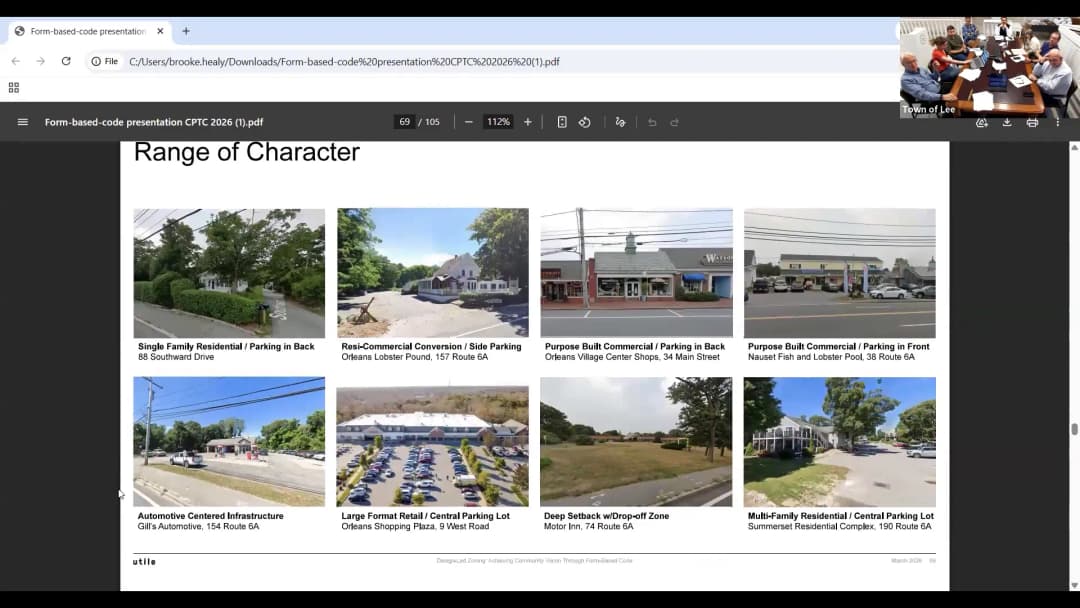
The Lee Planning Board met on April 27, 2026, at 6:15 PM. The meeting included two public hearings, one on the Adaptive Reuse Overlay District (AROD) and one on a temporary moratorium for Battery Energy Storage Systems (BESS), as well as a presentation on form-based zoning. The board unanimously approved the minutes from April 13th and reappointed Brooke as the BRPC delegate. Consent Calendar - Approval of Minutes: The minutes from the April 13, 2026, meeting were approved as distributed after a brief correction from April 15. Members present: Peg, Dave, Stan, Peter, Conrad. Public Comments & Testimony - No members of the public offered comments during the initial public comment period. - Leslie Bassman of the Berkshire Edge stated she would be recording the public hearings. - John Josh Fraker of Spiritus attended the AROD hearing as a potentially interested developer. Discussion Items Correspondence & Reports - Dockridge/Elm Court: The board briefly discussed correspondence regarding the Elm Court property, expressing cautious optimism about the project progressing now that special permits have been obtained. - Brooke's Report: - A significant portion of the next several months will be dedicated to preparing for the state's new clean energy consolidated permitting requirements, with a goal of having a process ready by October 1, 2026. - The Annual Town Meeting is scheduled for May 14, 2026, at 7:00 PM at the high school auditorium. - The town has $50,000 in vacant storefront grant tax credits to nominate by November. An infographic and outreach to business owners is being developed. - The town's website redesign has been delayed due to issues with the designer. - Price Chopper Property / Daycare Discussion: - The board discussed an unsuccessful $1.9 million offer by the town for a portion of the Price Chopper property. - A subsequent discussion covered the critical need for daycare. Peter retracted prior opposition to a development plan after learning the Lee Youth Association (LIA) requires 7,000 to 8,000 square feet and the firehouse is inadequate. The LIA has a waiting list and is losing its current location. The closure of a Lenox daycare is expected to increase demand in Lee. Public Hearing: Adaptive Reuse Overlay District (AROD) Amendments - Brooke and CJ Haas (BRPC) presented proposed amendments to the existing AROD bylaw, originally created in 2008 and used only twice. - Purpose: To increase flexibility for redeveloping large, underutilized properties (e.g., mills) by clarifying permissible uses, allowing mixed uses, and enhancing the applicability of the overlay. - Key Changes: - The overlay is elective (opt-in) and does not override existing by-right uses. - The Select Board, as the Special Permit Granting Authority (SPGA), can determine if a proposed use not explicitly listed is comparable in impact and intent. - The regulation of building demolition and new construction was clarified. - Board Deliberation: - Peter proposed substituting the word "following" with "pursuant to" in Section A1 to clarify that the special permit process is singular. - Gordon expressed concerns about allowing residential uses in Industrial zones and potential "spot zoning" implications, but noted the SPGA's discretion provides a safeguard. - A point of confusion regarding the "five-year building age" requirement was clarified: the building must have been in active use for at least five years, not necessarily vacant. - Vote: The board voted 4-0 (Peg, Dave, Peter, Conrad in favor; Gordon absent) to give a favorable report to the Select Board on the AROD amendments (Update 4/24/26) with the text change from "following" to "pursuant to" in Section A1. Public Hearing: Temporary Commercial Battery Energy Storage System (BESS) Moratorium Bylaw - The board opened a hearing on a proposed six-month moratorium (through November 14, 2026) on permitting commercial BESS facilities. - Purpose: The moratorium provides time for the town to adopt a permanent bylaw for BESS that aligns with upcoming state model regulations (expected July 1, 2026) and the mandatory consolidated energy permitting process (effective October 1, 2026). - Board Deliberation: - The board emphasized the moratorium is a procedural necessity, not a statement against renewable energy. The existing solar bylaw remains in effect. - Peter questioned the enforceability if an application arrives after October 1 but before the town bylaw is adopted. The board acknowledged the risk but viewed it as minimal. - The moratorium applies specifically to commercial, grid-scale systems. - Vote: The board voted unanimously to give a favorable report to the Select Board for the temporary commercial BESS moratorium bylaw. Presentation: Form-Based Zoning (Form-Based Code) - Peter delivered an extensive presentation on form-based zoning, a concept he researched at a Citizen Planner Training Cooperative workshop. - Concepts: This approach prioritizes the physical form and design of buildings (massing, facade articulation, placement, roof lines) over the strict separation of land uses typical of Euclidean zoning. - Case Studies: - Littleton: Adopted a "farmhouse" design code that enforces interconnected roof lines, porches, and shared rear parking to create cohesive village streetscapes. - Orleans: Developed a code for commercial corridor revitalization using build-to zones, facade articulation, floor area ratio analysis, and half-stories for height management. - Discussion: Peter noted that such codes are more prescriptive on design and require greater administrative input, but can enable higher density, walkability, and streamlined permitting for compliant projects. It would be a multi-year, community-intensive effort requiring significant consultant support. CJ Haas added that the primary benefit to developers is removing discretionary review for projects that meet the code standards. - Outcome: Purely informational. The board expressed strong interest in exploring the concept further, with Brooke offering to share the slide deck. Key Outcomes - Unanimously approved the minutes of April 13, 2026. - Reappointed Brooke as the BRPC delegate. - Voted 4-0 to report favorably the AROD amendments to the Select Board for the Annual Town Meeting warrant. - Voted unanimously to report favorably the temporary BESS moratorium bylaw to the Select Board. - Scheduled the next Planning Board meeting for May 11, 2026. The May 25 meeting was cancelled due to Memorial Day.
The Lee Select Board convened on April 21, 2026, for a meeting that included a public hearing for a lodging license, a detailed update on odor complaints from Green Theory, and action on several licenses, permits, and appointments. Consent Calendar - The board unanimously approved the open session minutes from the April 7, 2026 meeting. Public Hearing: Lodging Accommodation License - The board held a public hearing for a lodging accommodation license for the Econo Lodge at 980 Pleasant Street. General Manager Dani Shkandi represented the 28-room hotel. A board member raised a concern about the brightness of the exterior lighting but offered no opposition. With no public opposition, the board voted unanimously to issue the license. Public Comments & Testimony - No members of the public offered comments during the general public comment period. Discussion Items - Green Theory Odor Remediation Update: Green Theory Supply Chain Logistics Manager Tirutra Jraval and CEO Ope Shvatu (via Zoom) addressed recent odor complaints. Jraval stated the Clean Theory system (using chlorine dioxide) affected 5-10% of employees with respiratory issues, leading the company to run the system at reduced daytime capacity. Board member Gordon, who lives near the facility, reported strong odors forcing him and neighbors to close their windows, and noted the issue has persisted for four years. Jraval committed to increasing the system's daytime runtime from two to four hours and raising its capacity from 10-15% to 20%. Shvatu offered to run the system at 100% capacity with a technician present for observation by town officials and promised to install additional mitigation systems if the odor persists. The board expressed that patience is running thin but agreed to monitor the results of the increased system usage before considering further action. - Jeff Jam / Chief Russo Foundation Licenses: The board approved a one-day alcohol license and a Sunday entertainment license for the Jeff Jam fundraiser on May 24, 2026, from 12:30 PM to 6 PM at the Lawn at Onyx, supporting scholarships in memory of former Police Chief Jeff Russo. - Birchard Gas Permit: The board approved a permit for gas service retirement at 58 West Center Street. - Temporary Sign Permit: The board approved a temporary sign permit for the Lee Lions Club 5K Memorial Race on May 26, 2026, and waived the associated fee. - Committee Appointment: Bill Matthews was appointed to the 250th Anniversary Committee, to serve on its book subcommittee. - Town Updates: Town Administrator Chris announced the Annual Town Meeting for May 14, 2026, at 7:00 PM, with the election on May 18, 2026. Ground improvements at the public safety site are complete, with concrete foundations expected by the end of the week. - Hazardous Waste Day: The board announced a Household Hazardous Waste Day on May 16, 2026, from 9 AM to 1 PM at the Great Barrington Transfer Station, requiring registration. Key Outcomes - Lodging License: Approved for Econo Lodge (unanimous vote). - Green Theory: Representative committed to operating odor mitigation system at higher capacity; board agreed to monitor results. - Event Licenses: Alcohol and entertainment licenses approved for the Jeff Jam fundraiser (unanimous votes). - Gas Permit: Approved for 58 West Center Street (unanimous). - Sign Permit: Approved for Lee Lions Club (unanimous, fee waived). - Appointment: Bill Matthews appointed to 250th Anniversary Committee (unanimous). - Adjournment: Meeting adjourned; next regular meeting set for May 5, 2026.
[Introductory paragraph] The Lee Agricultural Commission held a meeting on April 15, 2026, to discuss the state of agriculture in Massachusetts. The meeting featured two presentations: Casey Pease, director of communications for Senator Paul Mark, spoke about the recently passed FARM Act (Fostering Agricultural Resilience in Massachusetts), and Dr. Sarah Gardner, President of Berkshire Grown and Chair of the Williamstown Agricultural Commission, gave a presentation on farmland preservation and the role of agricultural commissions. The meeting was recorded and included active audience participation. Presentation on the FARM Act - Casey Pease outlined key provisions of the FARM Act, which passed the Senate unanimously in early April 2026. He emphasized that the bill is policy-focused with no major budgetary components. Key elements include: requiring the state to create a long-term plan to protect food access; tracking local food use in state programs (such as SNAP and schools); investing in food infrastructure grants for farms, food banks, and schools (covering equipment, storage, distribution, processing); creating a Next Generation Farmers Fund with workforce training and programs for underserved populations; promoting urban agriculture; studying barriers to keeping land in agricultural use, including the impact of solar and renewable energy on farmland; creating a statewide farmland registry and map; expanding farm-to-school grant programs; supporting agritourism (an amendment championed by Senator Mark); and codifying the Healthy Incentives Program (HIP) into law. Pease noted that the bill is now before the House and encouraged attendees to contact their representative to support a yes vote. Presentation by Dr. Sarah Gardner on Farmland Preservation - Dr. Sarah Gardner presented data on farmland loss. She stated that Massachusetts has over 7,000 farms but that farmland is being lost rapidly: in the five years around the pandemic, 27,000 acres were lost statewide, and projections by American Farmland Trust and the Department of Agriculture indicate 50–89% loss by 2040 if current trends continue. In Berkshire County, dairy farms declined from 32 in 1999 to 12 today (4 in North County, about 6 in South County). Gardner noted that two out of three Massachusetts farmers operate at a financial loss. She emphasized that agricultural commissions, though lacking regulatory authority, play a critical social, educational, and political role. She highlighted strategies for farmland preservation: creating a local Agricultural Preservation Fund (using Community Preservation Act funds or other sources), conducting a survey of farms and Chapter 61 land, developing a local farmland action plan, and engaging in buy-protect-sell programs in partnership with land trusts. She commended the Lee Agricultural Commission for its existing work, including its farm brochure, seed library, and plans for community gardening on town-owned land. Audience Discussion and Questions - Audience members raised several issues. A speaker questioned efforts to reduce the mandatory five-acre minimum for agricultural tax classification; Casey Pease offered to look into the status of a Farm Bureau proposal to lower it to two acres. Multiple attendees expressed strong opposition to solar panels on prime farmland, arguing that farmland is finite and should not be replaced by solar development. One speaker described a local case where a field farmed for 100 years was lost to a 10-million-dollar solar installation with only a thousand dollars worth of sheep. Another attendee advocated for revising the blue use law and using brownfields and highway interchanges for solar instead. The need for agricultural education was discussed: one speaker shared their positive experience with 4-H and FFA, noting that only four Aggie high schools exist in Massachusetts, all in the eastern part, leaving western Massachusetts underserved. Another attendee from NRCS (Natural Resources Conservation Service) introduced federal conservation funding available to farmers. Food security was addressed, with discussion of the Healthy Incentives Program (HIP) and the importance of farmers markets accepting SNAP and HIP benefits. Dr. Gardner noted that the FARM Act aims to improve infrastructure for small farms to get food into schools. Key Outcomes - No formal votes were taken. The meeting was informational and educational. - Casey Pease encouraged attendees to advocate for the FARM Act in the House and left his contact information for further questions. - Dr. Sarah Gardner offered continued support from the Agricultural Commission Technical Assistance Project, available through MDAR, including additional resources and site visits. - The Lee Agricultural Commission is working with the Berkshire Regional Planning Commission (BRPC) on a farmland action plan and is exploring a town-owned farm for community gardening and hay production. - Attendees were encouraged to stay connected and to participate in future events such as open farm days and ag day programs in schools.
The Lee Select Board met on April 7, 2026, to conduct town business, including a public hearing, budget review, warrant approval, personnel decisions, and project updates. Public Hearing - The board held a public hearing on a lodging accommodation license for the Black Swan Inn. Owner Mayor Patel presented the application for the 52-room inn. After verification of approvals from the fire chief, building official, and board of health, the board unanimously approved the license. Public Comments - Leslie Gabrielle (Veterans for Peace, Daniel Shays chapter) invited the board and community to a "Deep Dive" event on April 25 in Pittsfield featuring journalist Chris Hedges. She promoted the event as an opportunity to discuss PCB issues and environmental innovation. Board members clarified they would attend as individuals, not board representatives. Discussion Items 1. Large-Scale Solar and BES Moratorium Update - Town Planner Brooke reported that the Planning Board will hold a public hearing on April 27 for a temporary moratorium on battery energy storage systems (BES), but not large-scale solar, as the existing solar bylaw is considered sufficient. Board members expressed support for the BES moratorium due to safety concerns (fire chief noted that BES fires are very difficult to extinguish). A placeholder article for the moratorium is on the warrant. 2. Seasonal Communities Designation - Brooke recommended postponing adoption of the Seasonal Communities designation pending state legislation (Seasonal Communities 2.0) that may impose additional requirements. The board agreed to wait for final state action before including it in a future town meeting. 3. Annual Town Meeting and Election Dual Warrant - Town Administrator Chris presented the warrant articles in detail, highlighting budget increases (health insurance increased 14.4% after removing GLP-1 weight loss drugs from plans, lowering an originally proposed 22% increase; IT consolidation; animal control shared service among 8 towns with Lee's net cost $21,000), capital requests ($799,100 from free cash, including kennel improvements and new parks & rec capital), and various bylaw changes. After discussion, the board voted to sign the dual warrant for the May 14 town meeting and May 18 town election. 4. Police Chief Interview and Appointment - The board discussed the interview of Lieutenant Stephanie Burdick for the position of police chief, succeeding Chief DeSantis who is retiring July 17. Board members praised her interview, experience, and community ties. The board voted unanimously to appoint Lieutenant Burdick as chief effective July 17, pending contract negotiations. 5. Intermunicipal Agreement for Council on Aging Director - The board approved an intermunicipal agreement with Stockbridge to share a Council on Aging director. Current Stockbridge director Katie Sweet will serve 75% for Lee and 25% for Stockbridge, with a new 15-hour assistant. The arrangement saves the town approximately $10,000 per year and maintains existing services. The motion passed unanimously. 6. Other Approvals and Permits - The board approved: a vote to staff polling locations for the town election; opting out of early vote by mail (saving $7,000); renewal of seasonal package store license for Route 102 (extended to January 15); temporary sign permits and fee waivers for the Chamber of Commerce (restaurant week) and First Congregational Church; one-day alcohol license for St. Mary’s School; a utility cut permit for a sprinkler system at 135 Stockbridge Road. - The board also acknowledged that a Berkshire gas permit for Golden Hill was not needed due to private road. 7. PCB Scientific Advisor Designation - The board designated a current town employee (a chemist with PCB experience) as a special municipal employee for a PCB scientific advisory role, with a $6,000 annual stipend. This will supplement the town's consultant and save on hourly fees. Approved unanimously. 8. Appointment and Conflict of Interest - Dorothy French was appointed to the 250th Anniversary Committee as the school committee representative. - The board authorized the chair to sign a conflict of interest disclosure for Ann LeBier, a committee member who may provide printing services. 9. Real Estate Update (Price Chopper Property) - The board announced that the town had offered $1.9 million to purchase the former Price Chopper property (sold at auction for $1.35 million to Xavier, who exercised a right of refusal). The offer was contingent on appraisal and town meeting approval, but it was declined. Board member Bob Gordon expressed interest in hearing resident feedback on spending. A resident (Mayor Patel of Black Swan) commented on the need for property upkeep. Key Outcomes - Approvals: Minutes, lodging license, warrant signing, polling staffing, opt-out of early mail voting, seasonal package store renewal, shared COA agreement, sign permits, alcohol license, utility permit, police chief appointment, PCB advisor designation, and 250th committee appointment. - Decisions: Postponed adoption of seasonal communities designation; will not proceed with Price Chopper purchase at this time. - Next Steps: Warrant and supplemental information to be posted online; town meeting May 14, election May 18; public safety building groundbreaking April 24; Planning Board hearing on BES moratorium April 27. A board member thanked MassDOT for installing a new crosswalk signal on Park Street.
On March 26, 2026, the Lee Select Board and town staff held an informal community forum to present an adaptive reuse plan for the historic Central Fire Station and the adjacent EMS building. Select Board member Bob Jones opened the meeting, and Town Administrator Chris Burton presented the project with architect Carrie Martini, civil engineer Matt Putton, and landscape architect Justin Winters. No formal votes were taken; the forum was intended to gather public feedback before the May 14, 2026 Town Meeting warrant was finalized. Project Overview and Building Reuse - Bob Jones spoke personally in support of preserving the 19th-century fire station, saying Lee changes incrementally and that the building should be passed on to future generations. He said the project cost is minimal compared with other town projects. - Chris Burton said the committee was formed after construction of the new public safety building displaced groups from the building referred to in the transcript as the Araldi/Eraldi Building. The committee included representatives of the Youth Commission, fire company, Historical Commission, VFW, food pantry, Select Board, town staff, and public members. - The options considered were demolition, sale, and adaptive reuse. The committee chose adaptive reuse to preserve local history, maintain local control, house displaced organizations, and create a connection between North and South Main Street, especially with planned housing developments such as Eagle Mill and Canal Street. - The plan proposes demolishing the structurally unstable front half of the EMS building, saving the rear half, and adapting the Central Fire Station for community use while keeping a fire-station theme. Central Fire Station Design - Carrie Martini described a small two-story elevator addition at the rear to provide accessibility, and a new stair in the tower to create two means of egress. - The first floor would include a main community space able to hold about 200 people, exhibit and display areas, and retained overhead doors that can open for indoor-outdoor events. - The second floor would include two meeting rooms with preserved fireplaces, each accommodating roughly 25 to under 50 people, plus shared office/copy space, secure storage areas, and a commercial kitchen located near the meeting rooms. - The design would restore the original arched openings and the historic green base, while preserving the building's masonry and character. - Fire company representatives said the antique horse-drawn steamer and hand-drawn pumper would be centerpiece displays, with fire memorabilia on the walls. They cautioned against leaving the antique apparatus outside because weather and brass maintenance are concerns, though equipment could be wheeled out for special events. EMS Building, Site, and Landscape Design - The EMS building's front half would be removed, with the rear ambulance garage converted into food pantry space. The VFW would use the front offices and could use the food pantry space for meetings during off hours. - A lift would connect the two floor levels of the EMS building for accessibility, and a new front entry porch and ramp are proposed. - Civil engineer Matt Putton said the site would have 18 parking spaces, including 2 ADA spaces, a grass paver driveway to allow fire apparatus access, reduced impervious surface, improved stormwater management, and new sidewalks that avoid ramps where possible. - Landscape architect Justin Winters presented the proposed Lee Fire Station Green, a roughly 28,000-square-foot site with a flexible front lawn, pavilion, terrace plaza with marble seat wall, native pollinator gardens, strolling gardens, children's playground, hedge labyrinth, hillside slide, and community garden. - The landscape plan would preserve the American elm, flagpole, and memorial bench, and could accommodate farmers-market stalls during special events. Justin Winters said the front lawn could hold almost 1,000 people if packed, though the design is meant for multiple smaller activities. Costs, Funding, and Timeline - Chris Burton estimated $2.5 million for the building renovation and minimal outside site work. The town anticipates at least $500,000 in grants, but the amount is not guaranteed. - The Select Board proposal presented for the warrant would use $500,000 in free cash and borrow $2 million over 15 years. The estimated tax impact was about $43 per year on the average single-family home if grants are received, and about $55 per year without grants. - The full park and landscape additions would cost roughly $800,000 more, bringing the estimated tax impact to about $64 per year with grants or $76 per year without grants. - A Town Meeting article is planned for May 14, 2026, to authorize $2.5 million. The existing building is not expected to be vacant until summer 2027, design work would continue in 2026-2027, and construction could begin as early as fall 2028. - Chris Burton said the new public safety building is reportedly ahead of schedule and under budget. - For operations, the town is considering expanding the part-time maintenance position to full-time and creating a stipend event coordinator position to schedule rentals and community programming. Public Comments & Testimony - One community member questioned why the town did not issue an RFP for a long-term lease or sale that could still preserve the building, and called the plan to ask for $2.5 million now and $800,000 later disingenuous. They also suggested opening the building to more natural light for a larger indoor-outdoor event space. - Several attendees raised parking concerns, noting that a 200-person community space would have only 18 on-site spaces. Presenters responded that on-street parking, Railroad Street parking, and parking at the new public safety building would supplement the site. - A resident expressed concern about children's play areas near Main Street traffic and tractor trailers. Designers responded that the playground was moved to the rear for safety, with parked cars as a buffer and urban-park safety standards applied. - A young-family resident strongly supported the downtown public space and playground, saying approved housing across Main Street could bring 400 to 600 new residents, and that families with toddlers currently have only sidewalks unless they drive to other parks. - Several speakers urged simple, maintainable design, noting that deferred maintenance is a recurring town problem. One speaker recommended using Community Preservation Act funds because the project could qualify as historical and open-space work. - One attendee asked to put the full $3.3 million project on the warrant at once to avoid higher costs and doing site work twice. Chris Burton said the landscape work would not be repeated, and another town meeting could occur before final landscape work was done; Bob Jones invited written feedback on whether to fund both parts together. - Other public questions covered a possible first-floor catering kitchen, the elevator addition's materials, the fire-rated tower stair, ADA lift access, the existing generator, and how the outdoor space would be maintained. Key Outcomes - No motion, vote, or formal Select Board decision was made at the forum. - The planned Town Meeting article for May 14, 2026 would ask voters to authorize $2.5 million for the building adaptive reuse and basic site work, with $500,000 from free cash and $2 million in borrowing. - The committee will consider public feedback, including whether to include the additional $800,000 park and landscape work in the same or a later article, before finalizing the warrant. - Feedback forms were distributed and collected at the meeting for use in refining the concept.
On March 23, 2026, the Lee Select Board hosted a public forum on Eversource's smart meter (AMI) deployment. The meeting featured presentations by Eversource Senior Vice President Jared Lawrence, Massachusetts for Safe Technology Director CeCe Du Set, and Building Biology EMF specialist Rex Funk, followed by extended Q&A with residents. The forum aimed to inform the community about smart meter benefits, opt-out options, and health and safety concerns. Public Comments & Testimony - Kathy, representing the Scientific Alliance for Education, questioned the safety, privacy, and surveillance aspects of smart meters, arguing that data collection constituted an unreasonable search and seizure and raised Fourth Amendment concerns. She challenged Eversource’s claim that meters are safe, citing fire hazards and lack of protections against surges. - Travis Toole asked about the calculation of the opt-out fee, potential increases as opt-out numbers shrink, loss of customer control under a monopoly, and cybersecurity risks of a closed network. He also shared personal health sensitivity to meter radiation, including effects on sleep and cognition. - Julie Grome questioned the lack of public vote on the meter change, the lifespan of existing meters, whether the upgrade would lead to employee raises or job losses, and the timeline for promised cost savings. - Eric Vincelette stated that the rollout seemed to have “snuck up” on the public and expressed skepticism about the benefits listed, calling them “fluff.” He asked about consequences of refusing any smart meter and stated he would prefer to see more investment in hardening the grid. - A resident asked about meter placement options to avoid RF near bedrooms, requested notification before installation, questioned the $34 opt-out fee for clustered homes, and asked how appliance-level insights work without smart appliances. - Lois Jensen from Tearingham asked about the non-communicating opt-out meter, whether it can be remotely switched on, whether it collects data, and noted that meter readers currently come only a few times a year rather than monthly, questioning the monthly fee. - Courtney Gillardi shared that her children have EMF sensitivities with physician-documented symptoms (nausea, headaches, rashes), objected that UL listing covers only fire and shock, not biological safety, and stated that the opt-out fee penalizes those with medical needs. She asked about a reduced-fee option for elderly and disabled customers and noted that other states have no-fee opt-outs with customer photos. - Cindy Matthias, via phone, read from an Eversource document suggesting cancer survivors could be at risk and asked for automatic exemptions for those with health issues. - Sarah Basson asked for written guarantee from Eversource that meters are safe for health and expressed concern about lithium-ion batteries in meters, especially in a wood-frame house. - Ben Shavinsky asked whether shielding would block the signal and expressed despair over technology’s health impacts. - Gordon Bailey asked about RF directionality, whether meter boxes can be shielded to reduce RF entering the home, and requested documentation of cost savings. He also raised concerns about lack of transparency with the DPU and questioned why customers do not see a reduction in charges from meter-reading savings. - Jess Jordan asked about renters’ ability to opt out (determined by account name) and when the installation in Western Massachusetts will be complete (within a month). She also noted friends who wanted to opt out after installation but were told to wait. - Multiple speakers, including Courtney Gillardi and Cindy Matthias, called for a no-fee opt-out option and cited medical disabilities. - Gordon Bailey and others reported issues with Eversource subcontractors: lack of identification, failure to knock before accessing property, and lack of notification prior to installation. Discussion Items Jared Lawrence (Eversource) presented the smart meter (AMI) system, emphasizing that it gives customers more control and insights, automated outage detection, remote service connection/disconnection, and future time-varying rates. He stated that over 120 million smart meters are installed nationwide, with 80% of U.S. electric customers having one. He noted that radio transmissions average 60 seconds per day and that meters are UL listed as safe. Lawrence explained that the opt-out fee ($34/month for meter reading, $42 one-time for installation outside cycle) is based on cost causation to prevent non-participants from subsidizing opt-out costs. He reported that 1% of Massachusetts customers have opted out so far. He acknowledged concerns but stressed that customers have the right to opt out. CeCe Du Set (Massachusetts for Safe Technology) presented evidence that RF radiation from smart meters has been linked to cancer, DNA damage, infertility, neurotoxicity, and other health effects, citing the National Toxicology Program and other studies. She argued that FCC exposure limits are outdated (based on thermal effects only from 1996) and that international guidelines recommend far lower levels. She described symptoms reported by people with electromagnetic sensitivity and stated that smart meters are a common trigger. She noted ongoing bills in Massachusetts for a no-fee opt-out and highlighted that Vermont offers a no-fee opt-out. She demonstrated RF exposure from a cellphone and encouraged hardwiring devices. Rex Funk (EMF Check) provided technical background on how smart meters emit pulsed RF and create “dirty electricity” that propagates through home wiring. He shared his personal experience becoming electrohypersensitive after exposure. He listed symptoms such as blood pressure changes, tinnitus, fatigue, and anxiety. He recommended moving meters farther from living spaces and using shielding, but noted that non-communicating opt-out meters still contain circuit boards that may produce dirty electricity. He cited examples of local advocacy in Woodstock, NY, where the opt-out fee was eliminated. Key Outcomes - No formal votes were taken; the meeting was informational. - The Lee Select Board reported they have sent letters to the Massachusetts Department of Public Utilities (DPU) and state legislators advocating for a no-fee opt-out and passed a resolution advocating for no adverse health effects from wireless technology and supporting opt-out rights. - Eversource clarified that customers may opt out at any time but may incur fees if done outside the installation cycle. The opt-out meter has the radio disabled but may still produce dirty electricity and contains a lithium-ion battery. - The town will post presentations from the forum online. - Residents were encouraged to contact the DPU and their legislators to express concerns about opt-out fees and health impacts.
The Lee Select Board met on March 17, 2026, to address a series of resolutions, a proposed moratorium on renewable energy systems, routine approvals, and discussions on the upcoming Annual Town Meeting warrant. All votes taken during the meeting were unanimous. Consent Calendar - Minutes: The Board unanimously approved the minutes from the March 3rd meeting. - Emergency Gas Permit: Approved an after-the-fact emergency repair work permit for a gas leak at 24 School Street, signed off by the DPW and Police Chief. - Sign Permit Extension: Approved an extension for temporary \"For Lease\" signs for Xavier Incorporation (MSA) at 15 Main Street through April 20, 2026. - EMT Appointment: Appointed Felicity Andrus to the position of per diem EMT Basic, endorsed by Fire Chief Ryan Brown. - Committee Appointment: Appointed Joshua Hall, a faculty member at Lee High School, to fill the vacant school staff seat on the town's 250th Anniversary Committee. Public Comments & Testimony No members of the public offered comments during the open comment period. Discussion Items Farmland Protection Plan Letter of Commitment Town Planner Brooke presented a letter of commitment for a grant via the Berkshire Regional Planning Commission (BRPC) to create a Farmland Protection Plan, a pilot initiative for Lee, Williamstown, and Adams. The Plan would inventory farmland and develop preservation strategies. The town's Agricultural Commission supports the effort. Board member Bob questioned the tangible outcomes; the Town Planner explained the plan would support grant applications and provide a strategic tool. The Board unanimously approved the letter. Second Generation Anticoagulant Rodenticides (SGARs) Resolution The Town Planner, alongside John from Mass Audubon, presented a resolution to eliminate the use of SGARs on town property. John detailed the risks of bioaccumulation in the food chain, affecting raptors and domestic animals. The Board noted the town's current practice of not using these products and unanimously passed the resolution to formalize this policy and encourage integrated pest management (IPM) town-wide. Large-Scale Renewable Energy Moratorium The Town Planner recommended a temporary moratorium (six months or until bylaw adoption) on large-scale photovoltaic and battery energy storage systems (BESS). She cited a lack of finalized state guidance and a regulatory gap where state protections supersede outdated local bylaws. Board member Bob expressed concern about clear-cutting for energy projects serving eastern Massachusetts and supported the moratorium. The Board voted unanimously to support the temporary moratorium, which will be forwarded to the Planning Board for the Town Meeting warrant. Smart Meter Moratorium Resolution The Board unanimously approved a resolution requesting a moratorium on wireless smart meter installations by Eversource. The resolution cites resident concerns about radiofrequency (RF) radiation health impacts, consumer privacy, and the financial burden of opt-out fees. It urges an opt-in program and calls for a public forum, scheduled for March 23rd. Upcoming Events and Town Meeting Announcements Town Administrator Chris announced a Smart Meter Forum on March 23rd (6:00 PM, High School Auditorium) and a Central Fire Station Reuse Informational Session on March 26th (6:00 PM, Middle/High School Cafeteria). A draft warrant with approximately 26 to 27 articles, including the operating budget, capital budget, and zoning articles, was distributed. A formal warrant discussion is scheduled for the Board's April 7th meeting. Key Outcomes - Unanimous Votes: All votes taken were unanimous. - Resolutions Passed: Resolution to eliminate SGARs on town property; Resolution requesting a smart meter moratorium and free opt-out. - Moratorium Supported: Board formally supported a temporary moratorium on large-scale renewable energy systems, advancing the effort to the Planning Board. - Appointments: Felicity Andrus (EMT) and Joshua Hall (250th Committee) appointed. - Next Steps: Warrant discussion on April 7th; Annual Town Meeting on May 14th and 26th. - Forums Announced: Smart Meter Forum (March 23rd), Central Fire Station Reuse Info Session (March 26th). - ADCOM Event: \"Farming in the Berkshires\" presentation by Sarah Gardner on April 15th at 6:30 PM in the Lee High School Cafeteria.
The Lee Select Board met on March 3, 2026. The chair stated that an audio/visual recording was being made under Massachusetts general law. The board approved prior meeting minutes, continued an Eversource pole permit hearing subject to conditions, received expert testimony on smart meters, approved routine permits and policy amendments, and set dates for an upcoming smart-meter community forum and a fire station reuse informational meeting. Consent Calendar - Approved the open session minutes of February 17, 2026. - Approved a utility cut permit for Ruder Plumbing at 103rd Street; because 103rd Street is a private road, no police detail was required. - Approved a temporary sign permit for Baby & Corp for lease-space advertising signs. - Approved the ADA transition plan amendment adding municipal website and permitting software accessibility language required by new federal ADA Title II rules; full compliance is required by April 2027, and the town website update is expected within about a month. Public Comments & Testimony - Cornelia Callisher, a Lee resident, asked whether the Board of Health had taken a position, asked for clarification of the pole application, and requested that residents be allowed to be present during meter installations. She also raised concerns about the cost and timing of meter changes. - Kathy Hall of Birch Street asked about the upcoming fire station reuse informational meeting and whether it would be recorded by CTSB; the board confirmed a March 26 meeting and that the recording request had been submitted. - Theodora Scarado, director of the Wireless and EMF Program at Environmental Health Sciences, testified in opposition to RF-emitting smart meters. She argued that FCC exposure limits are outdated, set in 1996, based on short-term behavioral studies, and not protective against long-term or cumulative exposure. She cited study tallies compiled by Dr. Henry Lai showing that the majority of reviewed studies found effects, including 89% of oxidative stress studies, 71% of genetic effects studies, 77% of neurological effects studies, and 84% of reproduction and developmental effects studies; the 258-scientist EMF appeal; and a 2021 federal court ruling that the FCC had not justified its 1996 limits. She recommended keeping analog meters and adopting safer technology. - Patricia Burke cautioned the board that Eversource itself had opposed smart meters during a Massachusetts pilot program and in New Hampshire testimony, and she alleged that health testimony used by the Massachusetts DPU came from an expert who also worked for the tobacco industry. She supported holding a community forum. - A resident named Cindy suggested a moratorium as a delay tactic to stop meter installations while education occurs. The board chair said he preferred not to rush to a bylaw or moratorium before the community discussion. - Courtney, a community member, said she consulted a telecom attorney who advised that federal law does not require smart meters and does not preempt local opt-out decisions; Section 704 of the Telecommunications Act does not apply because smart meters are not cell towers or personal wireless devices. She recommended including a telecom attorney on the forum panel and inviting state legislators, including Senator Paul Mark. Discussion Items - Eversource pole permit hearing: No applicant appeared from Eversource. The board discussed denying the permit, requiring underground wiring, or continuing the hearing. A motion by Gordon Bailey, seconded by Bob, passed to continue the hearing until Eversource meets three conditions: notify all customers of potential health and fire dangers of smart meters; provide smart meter opt-outs at no charge; and add new poles only when underground wires are not feasible. The motion cited MGL Chapter 166, Sections 21 and 22, and stated the hearing would reconvene once Eversource provided proof the conditions were met. - Smart meter community forum: Board members expressed frustration that customers pay opt-out fees, including reported upfront charges and monthly fees in the $34-$39 range, without receiving rate reductions. Residents noted many meters had already been installed. The chair noted the board has limited authority and that a moratorium bylaw would likely be preempted by the state. The board agreed to direct the town administrator to schedule a larger community educational forum later in March, invite Eversource and expert presenters, and consider inviting neighboring towns and legislators. - DPW handbook amendments: The board approved clarifying amendments for highway and water/wastewater DPW policies, aligning union and non-union practices with the Fair Labor Standards Act. The amendments address premium pay and call-ins outside normal schedules when overtime on hours not worked is not permitted. - Wildcat Sports Group update was postponed because representatives could not attend. - Fire station reuse update: The town administrator announced a public informational meeting on March 26, 2026, at 6 p.m. in the high school/middle school cafeteria. The reuse proposal preserves the historic central fire station, reuses the back half of the EMS building, and demolishes the failing front half of the EMS building. It is intended as preparation for a possible warrant article; the new public safety building is anticipated to be completed in summer 2027. Key Outcomes - The Eversource pole permit hearing was continued until the listed conditions are satisfied. - The board directed staff to organize a smart-meter community forum and to invite Eversource, experts, legislators, and neighboring communities. - Approved: utility cut permit, temporary sign permit, ADA transition plan amendment, and DPW handbook amendments. Intermunicipal Agreement Amendment No. 2 adding Marlborough to the shared inspectional and zoning enforcement services was also approved; board member Ernest abstained from the IMA discussion and vote. - The 2026 road toll calendar was announced: April 25 LIA; May 2 Lee Middle and High School Baseball; May 16 Girls Volleyball; May 23 VFW; June 6 Knights of Columbus; June 20 Boys Basketball; September 26 Golf; and October 24 Housatonic River Initiative. Kiwanis Club, Lee Elementary PTO, Sons and Daughters of Italy, Wildcat Sports Group, and Lee Lions Club were guaranteed slots for next year. - The next regular meeting was scheduled for March 17, 2026.