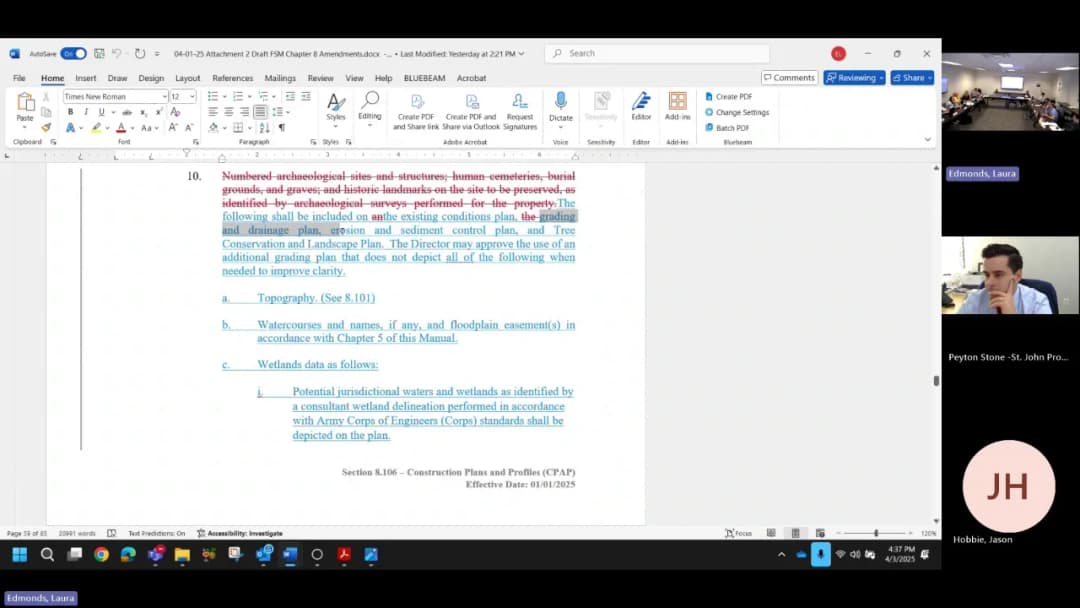
Note: The meeting agenda and transcript indicate the meeting was held on April 3, 2025; however, per instruction, the date is presented as April 12, 2025. This discrepancy is noted. The meeting was called to order at approximately 3:00 PM. Committee members discussed updates to two forms (Proffer Status Update Form and Performance Bond Release Certification), reviewed agency referral comments on two proposed amendments (DOAM-2025-0001 and DOAM-2025-0002), and received an introduction to upcoming ESC and Stormwater amendments. The committee also addressed scheduling for future meetings. Consent Calendar - Approved the March 13, 2025 meeting minutes by consensus (motion, second, no objections). Discussion Items Form Updates (3:15 PM) Kate McConnell, Department of Planning and Zoning, presented proposed revisions to the Proffer Status Update Form (PSUF) and the Performance Bond Release Certification form. Key discussion points included: - The PSUF now clarifies it is required for site plans or CPAPs subject to legislative approvals (rezoning, special exceptions). - Applicants may choose to list only proffers applicable to the current plan or all proffers, but if listing all, accuracy is required. - The form requests specific information on how each proffer is fulfilled on the plan, including page numbers and instrument numbers, rather than copying the proffer text. - The bond release form includes a new question identifying whether the project is subject to legislative approvals to trigger the PSUF requirement. - Committee members discussed the need for a fillable form, better tracking in Landmark, and the value of a shared database for proffer status. Staff is working on a flow chart and internal guidelines. - Concerns about double bonding proffers and performance bonds were addressed: proffer items are not included on performance bonds if covered under a Proffer Performance Agreement. - The committee agreed that a final version of the PSUF should be uploaded with the signature set, but naming conventions are not yet standardized; this will be addressed in a future alpha project. - The requirement for notarization of the bond release affidavit was discussed; staff noted it stems from code §10103 C3C and is not optional. Agency Referral Comments – DOAM-2025-0001 (Roadway Dams/Causeways) (4:15 PM) Staff presented comments from Parks & Rec (supportive) and VDOT (no maintenance responsibility). Brian’s comment noted that the phrase “all portions of the development” could be confusing regarding vacant land. After debate, the committee decided to retain the current language (“all portions of the development”) as staff believes it is clear and has been thoroughly vetted. A suggestion to add “require road access” was considered but not adopted. The amendment will proceed to the Board of Supervisors on April 15 for resolution of intent to amend. Agency Referral Comments – DOAM-2025-0002 (ZORO Implementation 2; Chapter 7 & 8 Amendments) (4:15 PM) - Parks & Rec commented that the updates may require additional effort from their department, but staff stated implementation is required by ZORO and does not necessitate changes to the FSM. - Zoning staff provided minor editorial comments (e.g., changing “FOD” to “floodplain”, adding a space after “district”, and updating the LDN buffer reference to match zoning ordinance language). These were accepted. - Staff noted that the ESC and Stormwater amendments (to be presented later) will be rolled into this same DOAM package, requiring a second agency referral. Introduction to ESC and Stormwater Amendments (4:45 PM) Jimmy presented an overview of amendments needed to incorporate the new DEQ Stormwater Management Handbook (Version 1.1), effective July 1, 2024, mandatory July 1, 2025. Key points: - The committee plans to prohibit certain construction BMPs (straw bales, wood chip berms, compost blankets) and post-construction BMPs (tree planting as a WQ BMP, gabion lined channels) due to maintenance concerns. - Allow with restrictions: trenchless silt fence (for tree protection only) and modified turbidity curtain. - New loading threshold: 0.26 lbs of phosphorus per acre per year. - Level spreader criteria will be updated with concrete construction and maximum length of 200 feet, discharge up to 30 cfs. - The new handbook removes old references; staff will work with DEQ to ensure old standards remain accessible for projects grandfathered before July 2025. - A technical newsletter will be issued to implement amendments effective July 1, 2025. New Business – Scheduling Committee members discussed conflicts for the next meeting originally scheduled for April 17 (spring break). Preference was to move to April 24, though some members had conflicts. An alternative was to schedule three meetings in May (May 1, 15, and another). No final decision was made; a poll will be sent to determine quorum. Peyton announced he will start a new job on April 14 at Stack Infrastructure as Director of Development, requiring a new disclosure. Key Outcomes - Updates to the Proffer Status Update Form and Bond Release Certification will be finalized based on feedback, then returned to BDAG and a technical memo drafted. - DOAM-2025-0001 (roadway dams) will proceed to the Board of Supervisors on April 15 with current language. - DOAM-2025-0002 comments will be addressed, and ESC/Stormwater amendments will be added before a second agency referral. - The next meeting is tentatively rescheduled from April 17 to April 24, subject to quorum confirmation via poll.
Public Meetings - Loudoun County, Virginia
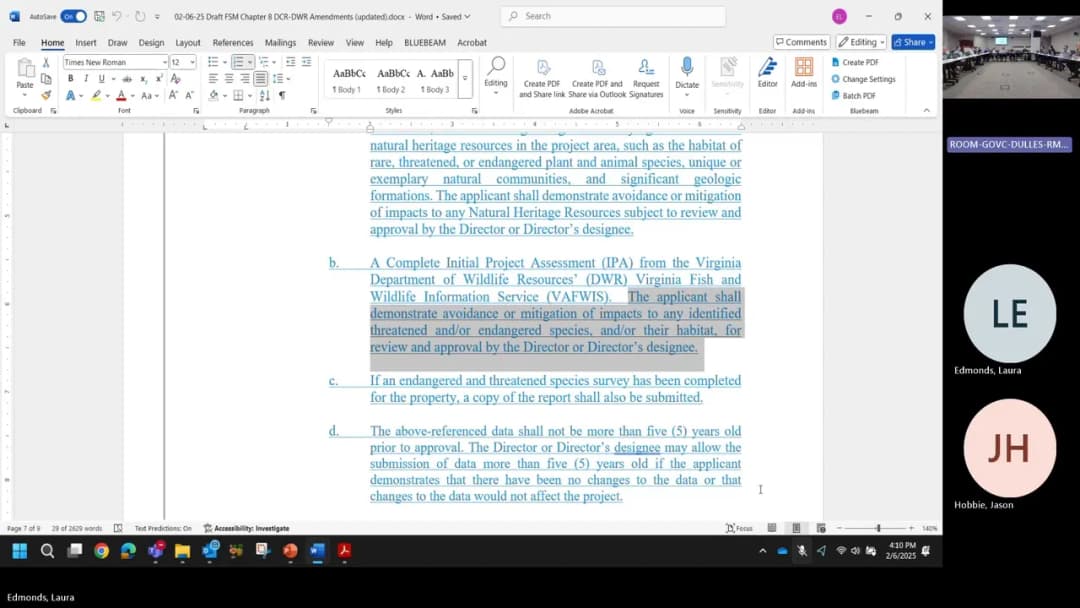
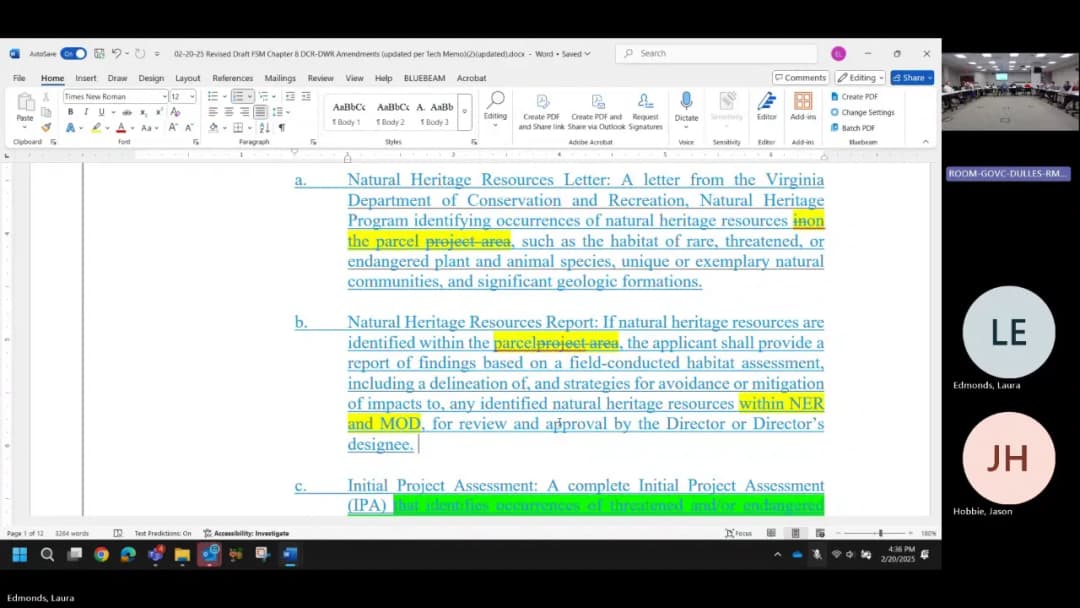
Public Meetings - Loudoun County, VirginiaNote: The meeting transcript states it took place on February 20, 2025, but the provided metadata indicates a date of April 11, 2025. This summary uses the metadata date but notes the discrepancy. The committee met to discuss proposed amendments to Section 8 of the Facility Standards Manual (FSM) concerning habitat studies, species surveys, and the implementation of zoning ordinance requirements for natural heritage resources and wildlife habitat. Public Comments & Testimony - Avi Seren (President, TNT Environmental) provided technical comments on the proposed FSM amendments. He expressed concerns that the county lacks authority under the current zoning ordinance to require habitat studies or species-specific surveys, as the ordinance only pertains to activities within river/stream corridor resources and very steep/moderately steep slope areas. He noted that in practice, these requirements are being applied more broadly, sometimes arbitrarily. He argued that the zoning ordinance tables appear to prohibit any impact to wildlife habitat as verified by DWR, but that such verification is rarely obtained. He emphasized that DWR and DCR are the agencies responsible for regulating protected species, and that requiring habitat studies for projects without a federal or state regulatory nexus is unnecessary and costly. He stated that the state agencies have limited personnel and do not review non-regulatory projects. He also pointed out that DWR searches are radial (2–3 mile radius) and only indicate potential habitat, not confirmed presence. He recommended that the county coordinate with DWR for determinations rather than imposing independent requirements. Discussion Items - Review of Proposed FSM Amendments (Section 8.101A) : Staff presented revised language that breaks out natural heritage resource letters, wildlife habitat reports, and IPA (Information Planning and Assessment) reports, and clarifies that with preliminary plats only certain documents would be required. The revisions aim to provide more clarity than the current advisory opinion. - Debate on Interim Standard vs. Zoning Ordinance Amendment: The committee discussed three options: 1. Continue operating under the zoning administrator’s advisory opinion (current practice). 2. Issue a technical memo (interim FSM language) to provide more detailed guidance. 3. Pursue a joint Zoam/Doam (zoning ordinance amendment and associated FSM update) to address the underlying zoning ordinance issues, possibly pulling this topic out of the broader “quick fix” list. - Staff noted that many of the concerns raised (e.g., applicability to moderately steep slopes, requirement for field assessments) stem from the zoning ordinance itself and cannot be fully resolved in the FSM alone. - Several committee members expressed that the advisory opinion is functioning adequately for staff, but creates uncertainty for applicants. Others argued that the tech memo would be a more immediate improvement but risk becoming obsolete once the zoning ordinance is amended. - Definition of “Field Assessment” and Project Area: The committee debated whether a field habitat assessment is always required and what constitutes “project area” (parcel vs. limits of disturbance vs. plan of development). Staff explained that for grading permits, a written narrative without a field assessment is acceptable, but for preliminary plats the current advisory opinion mandates a field assessment. The committee requested further clarification on tiered assessment levels. - Legal Authority and Preemption: Jason (legal counsel) explained that the county’s zoning powers under Virginia Code §15.2-2283 provide ample authority to regulate natural resources, and there is no preemption by state or federal law for upland activities. The zoning administrator’s advisory opinion carries weight but is appealable through official determinations. Key Outcomes - Decision to Pause Tech Memo: The committee agreed not to proceed with finalizing the technical memo at this time, to avoid expending effort on interim language that may be superseded by a zoning amendment. - Pursue Joint Zoam/Doam: The committee recommended that staff work with the zoning administrator to initiate a combined zoning ordinance amendment and FSM update, either as a standalone item or within the scheduled “quick fix” process, to resolve the fundamental issues (e.g., applicability to moderately steep slopes, definition of field assessment, project area scope). - Continue Under Advisory Opinion: Until the zoning amendment is adopted, projects will be processed using the existing zoning administrator’s advisory opinion. Staff expressed that this is workable for their current reviews. - Request for Zoning Quick Fix Inclusion: The committee will ask that the zoning ordinance quick fix list include clarification on moderately steep slopes and tiered assessment requirements, with input from technical experts. - Future Meetings: The next committee meeting is scheduled for March 13, 2025 (note: transcript date discrepancy). Staff will provide an update on the feasibility of a standalone Zoam/Doam following coordination with zoning administration.
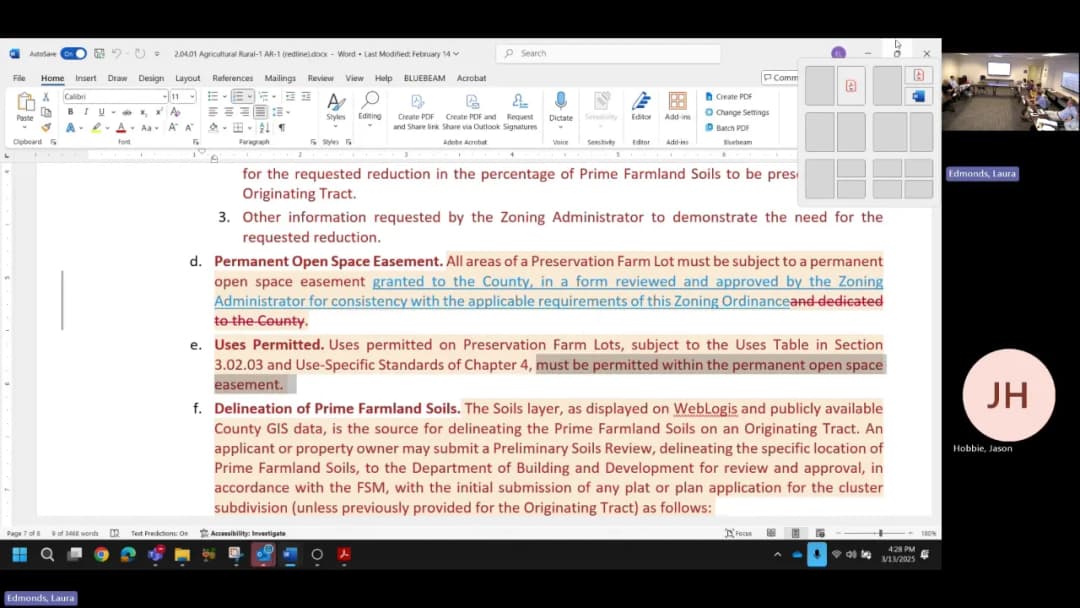
The meeting was called to order at approximately 3:00 PM. All committee members participated in person. The committee approved minutes from previous meetings, received updates on several ongoing amendments, and discussed the 10-year Private Street Reserve Fund and Prime Farmland Soils. A lengthy discussion on Sidewalks and Shared Use Paths was deferred to a future meeting. Consent Calendar - Approved the amended minutes from February 6, 2025 (corrections to alphabetical order and a missing word). - Approved the minutes from February 20, 2025. Public Comments & Testimony - No public comments were made during the public comment period. Discussion Items - DCR/DWR Amendments Update: Staff reported that updating the comprehensive plan, zoning ordinance, and FSM will require a CPAM. A joint ZoAm (zoning amendment) was recommended by the committee to align updates. The committee discussed two specific recommendations: (1) removing the requirement to assess and protect habitat on moderately steep slopes (outside the RSCR buffer) and (2) providing flexibility in the type of assessment required (not always a field assessment). The committee requested clarification on footnote 2 in Table 603-1, noting it is confusing. - Preliminary Soils Review (PSR) Amendment: A minor amendment to change the county’s review time from 30 to 60 days to match realistic workloads. One member objected, expressing concern about increasing timelines. Staff noted the county can still accept private consultant reports. The committee agreed to forward the amendment via agency referral or a technical memo. - 10-year Private Street Reserve Fund Update: The committee reviewed a proposal to shift the trigger for establishing a reserve fund from site plan approval to bond release. The goal is to require a funding schedule rather than full upfront funding. Discussion included the ambiguity of the current zoning language, industry practices, and the need for a zoning administrator’s advisory opinion. The committee agreed to pursue this approach, with no FSM text changes needed at this stage. - Prime Farmland Soils Update: The committee concluded that no FSM amendments are needed because the recently adopted zoning ordinance language is already very specific. However, unresolved questions remain about stormwater management and VRM easements on preservation farm lots. Staff noted that the updated zoning text is not yet available in clean form, causing frustration. - Sidewalks and Shared Use Paths: The committee reviewed a heavily marked-up draft from November 2023. Key issues included definitions (e.g., NUX acronym), sidewalk easement requirements, and consistency of language. The committee decided to defer final review to a future meeting after staff provides a cleaner document. Key Outcomes - DCR/DWR Recommendations: The committee recommended a joint ZoAm delay and forwarded two specific text revisions to zoning staff for consideration in the quick-fix process. - PSR Amendment: Approved to proceed as a minor amendment; will be attached to an agency referral or technical memo. - Private Street Reserve Fund: Directed staff to seek a zoning administrator’s advisory opinion to change the trigger to bond release and to continue discussions on appropriate documentation. - Prime Farmland Soils: No FSM changes recommended; staff to address stormwater classification questions internally. - Sidewalks and Shared Use Paths: Continued review; staff to provide a clean, track-changes document for the next meeting. - Next Meetings: Scheduled for Thursday, April 3, 2025, and Thursday, April 17, 2025 (note: agenda listed March 13 but summary uses April 11 per instruction).
The Facility Standards Manual (FSM) Public Review Committee met on February 6, 2025, to discuss proposed amendments related to state agency requirements from the Department of Conservation and Recreation (DCR) and the Department of Wildlife Resources (DWR). The committee reviewed and discussed revisions to the FSM to align with recent zoning ordinance changes concerning natural heritage resources and threatened/endangered species. The meeting included the introduction of a new member, Philip Jones. Consent Calendar - Approved the abbreviated minutes from the previous meeting, with a motion carried unanimously. Discussion Items - Presentation by Alex Starr (Natural Resources Team): Alex introduced proposed FSM changes to implement new zoning ordinance sections (5.04 and 6.04) regarding natural environmental resources (steep slopes, river/stream border resource areas, and non-residential activities in the mountainside). The changes require identification of natural heritage resources (via DCR) and threatened/endangered species (via DWR) within sensitive natural resource areas (SNRAs). - Key Clarifications from Zoning Administration: - The zoning administrator determined that NRT (Natural Resources Team) is responsible for reviewing avoidance of impacts, not DCR/DWR. - “No impact” was reinterpreted to allow impact avoidance and mitigation, consistent across both tables. - The review of Virginia Wildlife Action Plan species is limited to federally and state threatened/endangered species, not all species listed. - Committee Discussion on Implementation: - Members raised concerns about the need for field habitat assessments, the timing of reports (at preliminary plat vs. CPAP/site plan), and applicability to grading permits for homeowners. - Consensus that for preliminary plats, the requirement should be limited to providing DCR/DWR letters and initial findings, not full mitigation strategies; mitigation strategies would be required at CPAP/site plan stage. - For grading permits, a streamlined process is acceptable for small homeowner projects, but larger projects (e.g., breweries) may still need full reports. - Discussion on proffers: members noted that species and habitat conditions can change, so proffers should be flexible and avoid locking in specific requirements that may become outdated. - Clarification that the requirements apply only to disturbance within SNRA or non-residential activities in the mountainside; if no disturbance occurs, no additional assessment is needed. Key Outcomes - The committee agreed to refine the proposed FSM text based on the discussion, particularly to differentiate requirements between preliminary plat and CPAP/site plan stages. - A draft tech memo incorporating the revised language will be prepared for review at the next meeting. - The committee discussed the timeline for implementation: the tech memo may be issued after a zoning ordinance quick fix (anticipated in 6 months) or sooner if legal pathways allow. The committee expressed preference for a separate tech memo rather than bundling with other changes. - A joint meeting with the Zoning Ordinance Committee is scheduled for the first Wednesday in May (9:30-11:00 AM) to discuss floodplain updates. - The committee will also revisit sidewalk text amendments from a previous subcommittee and a mid-block passageway issue at a future meeting.
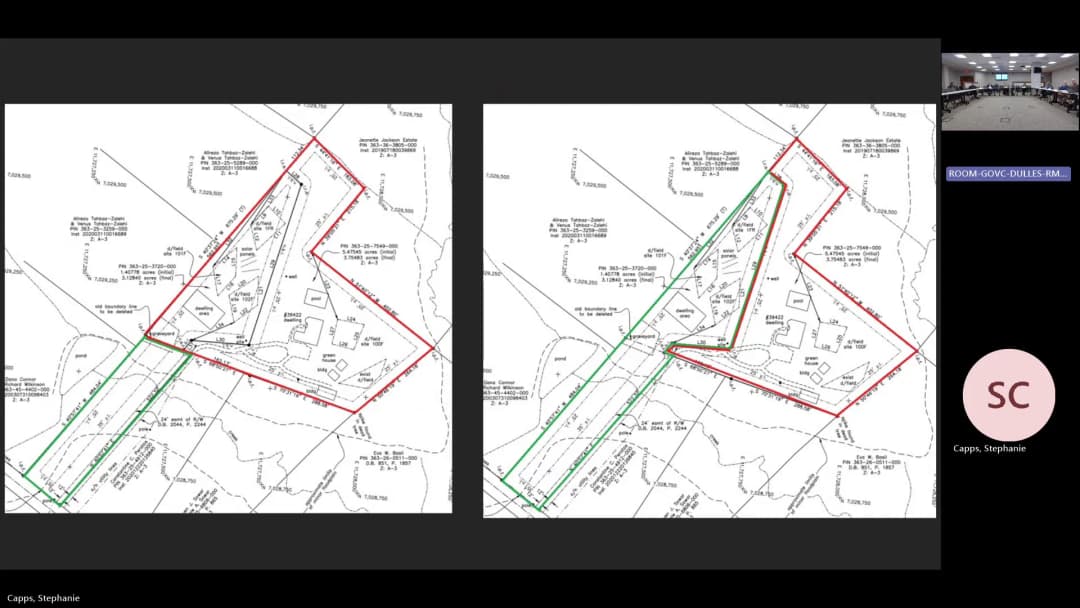
The Loudoun County Board of Zoning Appeals held a public hearing on February 28, 2025 (noted as originally scheduled for February 27, 2025 per the agenda, but the instruction requires using February 28, 2025 as the meeting date). The board considered two items: a boundary line adjustment variance and a sign development plan amendment. Preliminary matters included the election of officers and a date change for the April meeting. Preliminary Matters - Election of Officers: Dan Forbes was nominated and elected as Chair; Lori Clark was elected as Vice Chair; Stephanie Capps was elected as Secretary, all by voice vote with no opposition. - April Meeting Date: The board voted unanimously to move the regular April meeting to Wednesday, April 30, 2025 at 6:00 PM. Public Hearing Item a: BOZA-2024-0004 – Boundary Line Adjustment - Staff Presentation (Brian Fish, Zoning Planner): The applicant sought a variance to allow an increase in the maximum depth-to-width ratio from 5:1 to 7.84:1 and a decrease in minimum lot width from 200 feet to 122 feet for a vacant parcel (PIN 363253720) to permit a boundary line adjustment between two parcels owned by the applicant. The need arose after a ground-penetrating radar survey revealed a larger cemetery and floodplain constraints on the vacant parcel, eliminating the assumed buildable area. The variance would allow the adjustment to create a buildable lot of 3.1 acres (from 1.4 acres). Staff supported the variance, noting the hardship was not created by the applicant, the situation was unique, and no neighbors objected. - Applicant Testimony: The applicant explained the discovery of additional graves and floodplain issues, and that the boundary line adjustment would bring the parcel closer to compliance with A-3 zoning (3 acre minimum). They confirmed the adjusted parcel would use an existing access easement. - Public Comment: No public speakers for or against the application. - Decision: A motion to approve the variance was made with a condition that the adjusted green parcel obtain its access onto Buchanan Gap Road only from the existing access easement. The motion passed unanimously (voice vote, no opposition noted). Public Hearing Item b: LEGI-2024-0060 – Sign Development Plan - Cascades Overlook - Staff Presentation (Mr. Raul, Zoning Administrator): The applicant, Starlight Media LLC on behalf of Cascade Station LLC, sought to amend the 2015 sign plan for the Cascades Overlook Town Center to replace four existing pedestrian directory signs with digital boards (each double-sided, 22 sq ft, with digital board 12.5 sq ft) and add two new digital wall signs. No increase in sign dimensions was proposed. Staff supported the request, noting the signs are internal to the development, the digital boards would improve communication and include emergency alerts, and a waiver from landscape base requirements was justified to avoid impeding pedestrian circulation. - Applicant Testimony (Jeff Morton): The applicant detailed the benefits: outdated signs replaced, energy-efficient LED displays with automatic dimming, FEMA-connected alerts, and only family-friendly advertising. All signs operate during center business hours. The two new wall signs would cover previously unserved areas. The applicant accepted all conditions of approval. - Decision: A motion to approve the sign plan amendment subject to the conditions of approval dated February 19, 2025, was made and seconded. The motion passed unanimously (voice vote). Administrative Items - Assistant County Attorney Report: Update on the Newport Academy case (Court of Appeals affirmed board's decision; possible appeal to Supreme Court pending) and the Highfields Farm case (applicant removed berm from floodplain, appeal withdrawn). - Zoning Administrator Report (Ryan Reid): Reported that applications for two expiring board seats are due by March 14, 2025. Outlined tentative upcoming agenda items for March through June 2025. Key Outcomes - Approval of Variance (BOZA-2024-0004): Unanimous approval with condition limiting access to existing easement. - Approval of Sign Plan Amendment (LEGI-2024-0060): Unanimous approval subject to staff conditions. - Election of Officers: Dan Forbes (Chair), Lori Clark (Vice Chair), Stephanie Capps (Secretary). - April Meeting Rescheduled to April 30, 2025.
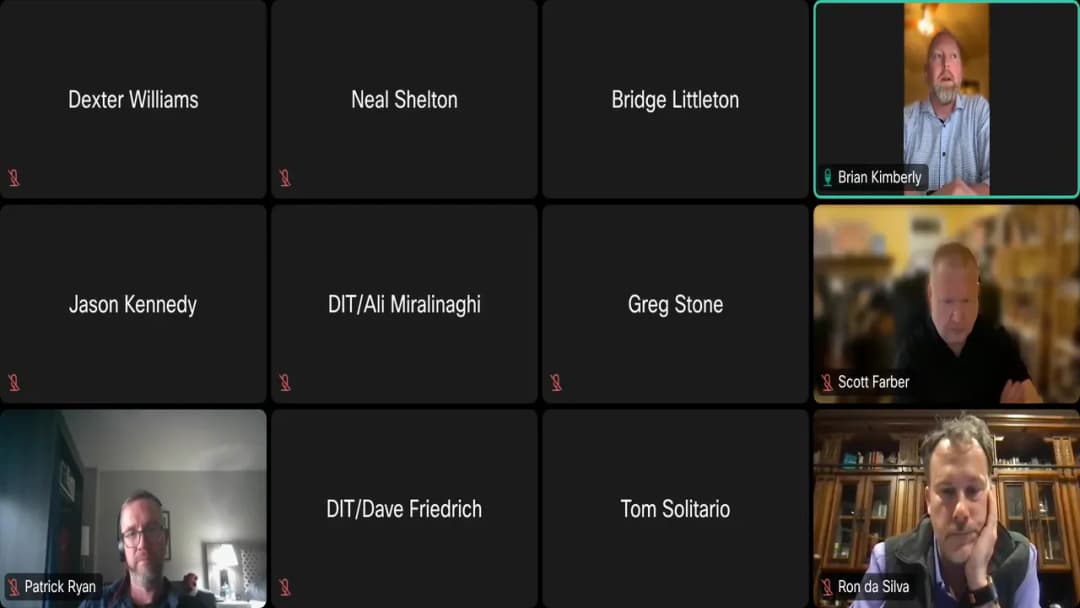
Note: The agenda and transcript indicate the meeting took place on February 24, 2025, but the instructions specify using February 27, 2025. This summary uses the instructed date. The Loudoun County Communications Commission held a virtual meeting on February 27, 2025, at 7:00 PM. The meeting addressed franchise agreements with Comcast, formation of a subcommittee to analyze wireless gaps, and updates on broadband projects. Consent Calendar - Approval of the Agenda: Approved unanimously. - Approval of Minutes from January 27, 2025: Approved unanimously. Public Comments & Testimony - No members of the public signed up to speak. Discussion Items - Comcast Franchise Agreements with Towns: Commissioner Littleton raised concerns about stalled negotiations with several towns, notably Middleburg, where Comcast offered a "take it or leave it" agreement 18 months ago. Terms included unlimited infrastructure rights which the town found unacceptable. Comcast's Dexter Williams stated he was unaware of active negotiations and agreed to investigate and provide a status report on franchise agreements for all seven towns. - Formation of a Subcommittee on Wireless Gaps: Staff informed the commission that forming a formal subcommittee requires approval through the Finance/Government Operations/Economic Development Committee and the Board of Supervisors, a lengthy process. Alternative approaches were discussed: (1) pairing commissioners to work on deliverables without triggering open meeting requirements; (2) using existing meeting time for focused work. Concerns about FOIA and record retention for any external collaboration tools were raised. Staff will explore if the county has an approved collaboration tool. Commissioner Bibey (absent) was previously assigned to lead this work. - VATI Broadband Project Update: Commissioner Ryan reported the first customer was installed late last week, two months behind schedule. Staff clarified that the October 31, 2025 deadline refers to middle-mile and last-mile completion, not installation for individual homes. An update from All Points Broadband and staff is scheduled for the March 18 Board of Supervisors meeting and the March 24 commission meeting. - New Business – Public Wi-Fi and Transportation Tracking: Commissioner Solitario proposed exploring public Wi-Fi in parks and real-time tracking for public transportation (e.g., in Leesburg). Some members questioned whether these fall under the commission's charter. The chair suggested they could be considered as part of the wireless gap analysis work stream pending further validation against bylaws. Key Outcomes - Action Item 258 (Attendance Requirement): Closed unanimously after staff confirmed no franchise agreement requires Comcast or Verizon to attend monthly meetings. - New Action Items: - Commissioner Littleton will compile a list of all seven towns' franchise agreement status from each town (not just Comcast) and share with staff. - Staff will investigate whether the county has an approved third-party collaboration tool that meets FOIA and record retention requirements. - Next Meeting: Scheduled for March 24, 2025, expected to be in person. - Adjournment: Motion carried unanimously.
The Zoning Ordinance Committee (ZOC) met on February 5, 2025, to receive updates on the floodplain ordinance revision, review the status of several zoning ordinance amendments (ZOAMs), and discuss the process for a cleanup ZOAM. The meeting included disclosures, approval of minutes, and multiple discussion items with committee member questions and staff responses. Disclosures - Committee member disclosed a meeting with a small-scale developer who complained about zoning code administration for small projects and urged that new Western Loudoun zoning allow commercial whole-house rentals in the MOD. The member noted the meeting was virtual and no written comment was submitted. Approval of Minutes - The minutes from the previous meeting were approved with a correction noting that the meeting was held virtually. Motion carried unanimously. Discussion Items - Floodplain Ordinance Update: Melanie Mason, Natural Resources Program Manager, presented plans to remove the floodplain overlay from Chapter 5 and move it to Chapter 6 as a natural and environmental resource. Proposed changes include: requiring zoning permits for both major and minor floodplains, establishing horizontal setbacks, clarifying when floodplain studies and no-rise certifications are needed, updating permitted uses (removing active recreation from major floodplain and swimming pools from minor floodplain), and reducing accessory structure square footage from 840 to 600 square feet. Timeline: draft language to BDAC and FEMA in February 2025; joint ZOC/PRC meeting in May 2025; intent to amend in spring 2026; final board approval in summer 2026. Committee members thanked staff for the presentation. - Status Updates on ZOAMs: - ZOAM 24-1 (Data Center Standards): Staff will present Phase 1 (setting data centers as conditional use in all place types and special exception in all districts) to the Board of Supervisors on February 12, 2025. The Planning Commission offered six recommendations, included in the staff report. - ZOAM Cleanup (Zoning Ordinance Rewrite Adjustments): Extensive discussion on the lack of transparency regarding the list of items to be addressed. Committee members (Joe, Rich, Colleen, Mike) expressed frustration that the list has not been shared despite months of requests and that the process has taken two years. Staff indicated the list would be shared with ZOC before the Resolution of Intent to Amend is presented to the Board, allowing opportunity for input. Members advocated for smaller, recurring cleanup amendments every six months rather than a large two-year process. Staff agreed to return in March with an update on the list and process. - ZOAM 24-2 (Western Loudoun Rural Uses and Standards): Upcoming meetings: April 24, 2025 (value-added farming, conservation needs), June (wineries/breweries/distilleries), September (mountainside overlay district and signage), November (food trucks/rural restaurants), January 2026 (outstanding issues). Staff will draft text alongside discussions. Committee members suggested forming a subcommittee to expedite review. - ZOAM 24-3 (Manufactured Home Regulations): Staff noted this is expected to be on a consent agenda; no further discussion. - DPZ Work Plan: Discussion on prioritization of small area plans. The Board’s January 22 meeting indicated possible changes to the TBD status; staff will provide an update at the next ZOC meeting. Key Outcomes - Minutes approved. - Staff to provide an update on the cleanup ZOAM list and process at the March 5, 2025 meeting. - Committee will consider forming a subcommittee to review the Western Loudoun ZOAM draft text more quickly. - Next ZOC meeting scheduled for March 5, 2025.
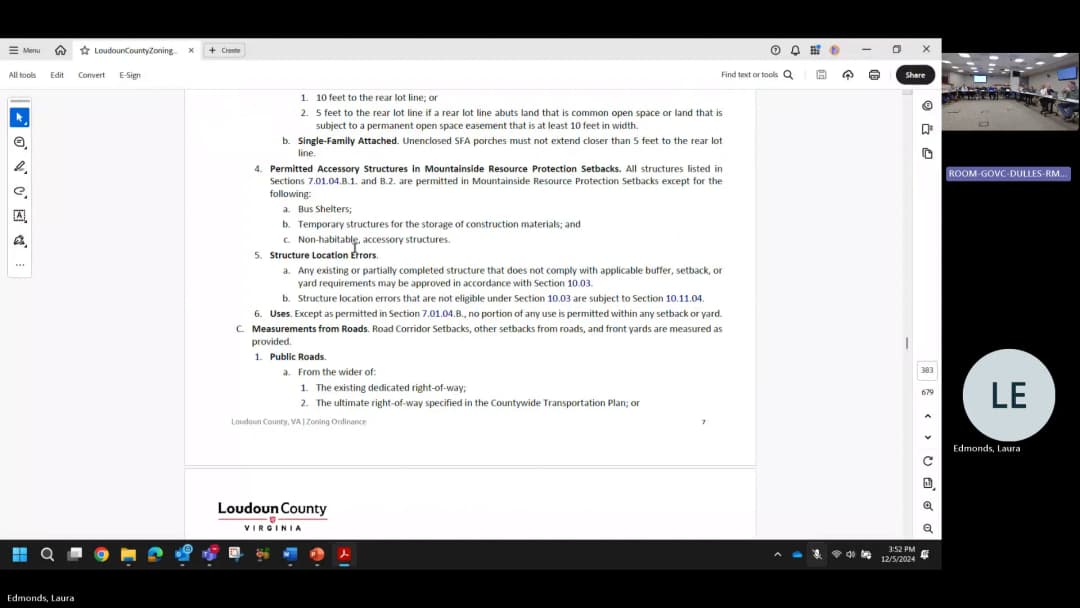
The Facility Standards Manual Public Review Committee (FSM PRC) met on December 5, 2024, to continue revising Chapter 7 of the Facility Standards Manual, focusing on forest management plans, reforestation standards, and remedial revegetation plans. The meeting included public comment from a local farmer and detailed staff-led review of proposed language edits. Public Comments & Testimony - Bill Hatch (Mill Road Farm and Zephaniah Vineyards, south of Leesburg) spoke about his desire to selectively harvest timber on approximately 150 acres of his 400-acre farm, which is mostly pastureland that has reforested over 50 years. He expressed concern that proposed forest management and mountainside ordinance requirements might hinder farmers' ability to harvest timber for income. He noted he had consulted with a forester and county staff and wanted assurance that selective harvesting would not be overly restricted. Committee members acknowledged his concerns and said they would keep farming perspectives in mind as language is developed. Discussion Items - Approval of Minutes (November 21, 2024): The minutes were approved unanimously by voice vote. - Forest Management Plan Requirements (Section 7305): Staff presented minor edits to clarify that forest management plans (FMPs) can be standalone or part of a remedial/vegetation plan. The committee discussed that FMPs are used for silvicultural activities and are not typically required for standard development. No substantive changes were made to the requirements themselves. - Reforestation Plan Standards (Section 7305): The committee debated language for the reforestation plan introduction, including whether to use “reforestation plan” or “planting plan,” and how to list triggering conditions (zoning ordinance, proffer, condition of approval, remediation). The group decided to restructure the sentence as a list. Discussion also covered the term “release” in maintenance standards; it was clarified that “tree release” is a forestry term (removing competing canopy), which is distinct from bond release. The committee agreed to use “tree release and maintenance” to avoid confusion. - Planting Window Flexibility: Staff added “unless otherwise approved by the director or director’s designee” to allow planting outside the standard window when weather conditions permit. - Remedial Revegetation Plan (Section 7307): A lengthy debate occurred over the phrase “maximum extent possible” versus “maximum extent practicable.” The zoning ordinance uses “possible,” but some committee members favored “practicable” for flexibility. Staff noted that the FSM interprets the zoning ordinance’s use of “maximum extent possible” and that changing it would require a zoning ordinance amendment. The committee ultimately retained “maximum extent possible” but clarified that the intent is not to require impossible restoration. The group revised the site restoration narrative to remove redundant purpose language and instead require a narrative addressing specific items. - Revegetation Strategies: The committee discussed whether to define strategies (reforestation plan, forest management plan, wildlife habitat planting plan) as separate options or as a combined list. After back-and-forth, they agreed to keep a map requirement and list the three strategies as options. They also changed “current aerial imagery” to “most recent available aerial imagery” with the possibility of director approval for alternatives. - Wildlife Habitat Planting Plan: No substantive changes were made. A minor clarification was made to refer to “Northern Virginia native plants” (not “Nova Natives”). The committee left maintenance frequency flexible, to be determined by the professional preparing the plan. - Planting Options for Wildlife Habitat: The committee decided to delete the separate option for containerized nursery stock and instead require seeding at specified density, with plugs allowed as supplementation. This simplifies the table. - Invasive Species Management and Supplemental Planting: Staff noted that reporting and monitoring requirements were simplified: a minimum of three monitoring events over three consecutive years (once per year) is required. The certification requirement for plan preparers was removed. Key Outcomes - The minutes from November 21, 2024 were unanimously approved. - No final decisions were made on the Chapter 7 amendments; the discussion resulted in several edits and clarifications to be incorporated into a revised draft. - The committee decided to cancel the December 19 meeting and the January 2 meeting, scheduling the next meeting for January 16, 2025. - Staff will distribute the edited draft for review, with committee members asked to send further comments by email before the next meeting. - The meeting adjourned without a formal motion, after the committee exhausted the detailed review.
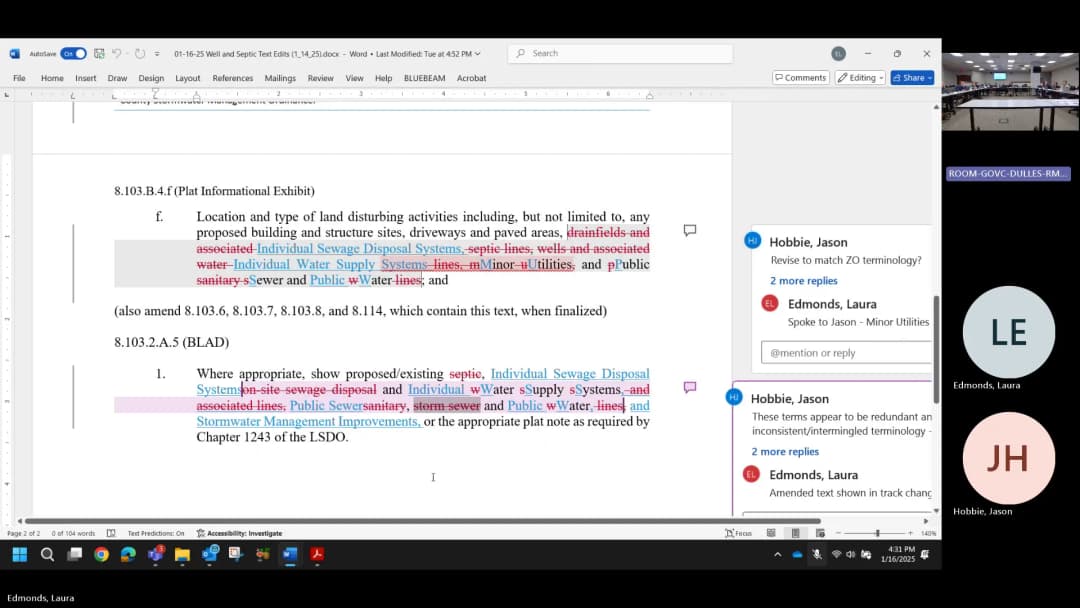
Note on date: The agenda and transcript provided for this summary are dated January 16, 2025, but the user specified the meeting took place on February 3, 2025. This summary follows the user's instruction and uses February 3, 2025 as the meeting date while noting the discrepancy. The Facilities Standards Manual (FSM) Policy Review Committee (PRC) met to elect officers, approve prior minutes, and conduct a detailed review of proposed amendments to FSM Chapters 7 and 8. Staff presented revisions intended to align the FSM with the new Zoning Ordinance Re-write (ZOR) and clarify requirements for plats, plans, and environmental features. The committee discussed numerous technical changes, many of which were approved for inclusion in a forthcoming technical memo. Discussion Items - Election of Chair and Vice Chair: Nominations were opened for committee chair and vice chair. Pete and Brandon were nominated and willing to serve. A motion was made and seconded; all members voted in favor. Pete was elected Chair and Brandon Vice Chair for 2025. - Approval of December 5, 2024 Minutes: The minutes from the prior meeting were reviewed. A committee member suggested summarizing edits rather than listing every markup. A motion to approve the minutes as presented was passed unanimously. Staff noted that future minutes would be streamlined to capture key decisions and redline references. - FSM Chapter 7 Amendments: Laura (staff) introduced Michael Staten as the new Forestry Team Lead. Staten shared his background from Fairfax County and Richmond. Staff then reviewed minor yellow-highlighted changes to Chapter 7, including cross-references to invasive species management (Section 7309), edits to reforestation planting options (removing Table 4, focusing on seed mix with supplementary plugs), and clarifying language for restocking and natural regeneration. A question was raised about proving natural regeneration; staff explained that a narrative indicating the method is sufficient. The committee agreed with the proposed edits. - FSM Chapter 8 Amendments – Overlay Districts and NER: This was the most extensive discussion. Staff presented a reorganization of Section 8101 to separate “zoning overlay districts” and Natural Environmental Resources (NER) into a new subsection (8101A11) and to handle NER individually in other sections. The changes aimed to reduce confusion when preparing informational exhibits for plats. Committee members debated whether to require overlay district boundaries on easement plats, AR1/AR2 division plats, and family subdivisions. Some members argued that requiring an informational exhibit on easement plats added unnecessary work for a rare “loophole” scenario; others supported it as a safeguard. Ultimately, the committee accepted the separation and agreed to keep the informational exhibit requirement for easement plats, noting that most cases would reference prior applications. - FSM Chapter 8 – Well/Septic and Stormwater Edits: Staff proposed updating terminology from “drain fields and associated septic lines” to “individual sewage disposal systems” to match the ZOR, and similarly for wells and water lines. For stormwater, staff initially suggested broadening “storm sewer” to “stormwater management improvements,” but committee members expressed concern that this would add information requirements for boundary line adjustments. It was decided to retain “storm sewer” as the current standard, with the option to revisit later. - FSM Chapter 8 – Site Distance Requirements for Family Subdivisions and AR1/AR2 Plats: Staff proposed adding site distance information to informational exhibits for family subdivisions and AR1/AR2 division plats. After discussion, committee members noted that site distance is typically checked during grading permit review and that adding it now could delay the tech memo. The proposal was withdrawn, with an agreement to discuss it at a future meeting. - Tech Memo Overview and Timeline: Laura outlined the draft technical memo, which would explain the “why” behind each amendment and include redline attachments. The memo was originally scheduled for release January 27, but given the day’s discussions, staff indicated it would be finalized shortly afterward. The effective date was set for March 10, 2025 (six weeks after release). The committee acknowledged that many minor editorial suggestions (e.g., consistent use of “of this manual,” floodplain versus FOD wording) would be cleaned up in the final DOEM version and were not urgent for the tech memo. Key Outcomes - Elected Officers: Pete – Chair; Brandon – Vice Chair. - Minutes Approved: December 5, 2024 minutes adopted as presented. - Chapter 7 Text Approved: The committee approved the yellow-highlighted edits to Chapter 7, including cross-references, reforestation planting options, and invasive species management language. - Chapter 8 Structure Approved: The separation of overlay districts and NER in Section 8101 was accepted. NER requirements will be handled in individual sections (e.g., 8103, 8106, 8107, 814) rather than in a single note. The informational exhibit requirement for easement plats remains. - Well/Septic Terminology: Approved change to “individual sewage disposal systems” and “individual water supply systems.” Stormwater language retained as “storm sewer” for now. - Site Distance Proposal Withdrawn: The addition of site distance requirements to family subdivision and AR1/AR2 informational exhibits was removed from the tech memo; to be discussed at a future PRC meeting. - Tech Memo to be Issued: Staff will finalize the technical memo incorporating the day’s agreements, with an effective date of March 10, 2025. The DOEM process will address remaining minor inconsistencies and cross-reference updates. - Next Meetings: Scheduled for Thursday, February 6, 2025 and Thursday, February 20, 2025. Upcoming topics include sidewalks, ADU written agreements, ESC and stormwater amendments, and floodplain ordinance amendments.
The Loudoun County Communications Commission held a meeting on January 29, 2025, to elect officers, receive updates from franchisees Comcast and Verizon, review the Virginia Telecommunications Initiative (VATI) project, and begin planning a committee to address mobile connectivity gaps in the county. Consent Calendar - Unanimous approval of the agenda and the December 2024 meeting minutes. - Election of Jason Kennedy as Chair, Ronda Silva as Vice Chair, and Aaron Smith as Secretary (each by acclamation with one abstention noted for some votes). Public Comments & Testimony - No members of the public signed up to comment. Discussion Items - Comcast Update: Dexter Williams, Senior Manager of Government Affairs, reported no new updates. He offered to help with customer issues by requesting specific addresses or account numbers, and encouraged elected officials to contact him directly for escalations. - Verizon Update: Matt Ogburn, Director of State and Local Government Affairs, introduced himself as the sole government relations representative for Virginia. He stated that Verizon is streamlining its franchise support and that he will not regularly attend future meetings. He provided Corel as the contact for franchise-related questions and an executive customer service email for escalated customer issues. Commissioners expressed concern about reduced engagement, particularly regarding outstanding action items on build-outs in Percival and density changes. Ogburn acknowledged the items and promised to follow up with Corel. - Staff Report (VATI Update): Staff Liaison Dave reported that the first customer for the Virginia Telecommunications Initiative project, a winery, is expected to be connected by the end of the week, three weeks behind schedule due to a delay in completing splicing activities. The project target is to have all homes able to sign up for service by the end of October 2025. Commissioners questioned the timeline and the lack of monthly projections; staff noted that the contractor (All Points Broadband) has targeted a 15-20% take rate. - 2025 Commission Focus and Plans: The commission discussed creating a temporary committee to study and recommend strategies for improving mobile connectivity in Loudoun County. After debate, a committee was established, led by Rich Bibby, with volunteers including Scott Farber, Jason Kennedy, Patrick Ryan, and Tom. The committee will explore five work streams: technical infrastructure mapping, policy implications, process integration (e.g., zoning, school board), emerging technologies (e.g., smart cities, LEO), and consumer perspectives. The committee will report back to the full commission. Key Outcomes - Election of Officers: Jason Kennedy (Chair), Ronda Silva (Vice Chair), Aaron Smith (Secretary). - Action Items Closed: 251 (towns in franchise agreement), 252 (wireless tower report), 253 (wireless coverage discussion), 255 (chair send presentation), 256 (overlay maps of county coverage), 257 (review wireless questions from Commissioner Ryan). - New Action Item: Staff will review the franchise agreement to determine if there is a requirement for franchisees to attend commission meetings. - VATI Project: First customer activation expected within the week; project behind schedule but no penalties or levers identified for the commission. - Next Meeting: Scheduled for February 24, 2025, in person.