The Zoning Ordinance Committee (ZOC) met virtually on January 15, 2025, to receive updates on several zoning ordinance amendments and comprehensive plan amendments, approve a letter of issues and concerns, and discuss meeting logistics and staffing changes. The committee reached quorum with nine members present. Consent Calendar - Approval of Action Report (December 6, 2024): The committee approved the action report from the December 6, 2024 meeting by unanimous voice vote. (Note: The transcript references an "action report from December 4th," but the agenda lists the date as December 6th, 2024.) Public Comments & Testimony - No members of the public spoke during the public input portion of the meeting. Discussion Items - Status Updates on CPAMs and ZOAMs: - Data Center Standards & Locations (CPAM/ZOAM-2024-0001, Phase 1): Staff reported that the item is scheduled for the Board of Supervisors public hearing on February 12, 2025. The Planning Commission recommended denial of Phase 1 due to limited scope and provided six recommendations for the Board's consideration, including grandfathering, effective date, data center campus modification, flexibility, additional CPAM guidance, criteria where specs would not be required, and proposed amendments to place type maps in the Arcola and Goose Creek Club areas. - Clean-Up ZOAM (Zoning Ordinance Rewrite Adjustments): Staff provided a preliminary schedule: project plan to the Board in April 2025, resolution of intent to amend in May/June, draft text to ZOC in July, Planning Commission in September/October, and Board consideration in November/December. The cutoff for submitting cleanup items for the first round has already passed; additional suggestions can be sent for future rounds. - Western Loudoun Rural Uses (CPAM/ZOAM-2024-0002): The upcoming Transportation and Land Use Committee (TLUC) special meeting on January 29, 2025, will focus on ag processing and farm-related lodging. Future TLUC meetings are planned for April 24 (value-added farming), June, September, November, and January (dates to be confirmed). - Manufactured Housing (ZOAM-2024-0003): This expedited amendment to clarify regulations will be before the Board of Supervisors on February 12, 2025. - ENCODE Platform Update: Staff reported ongoing work on the public-facing ENCODE Plus platform but did not provide an anticipated launch date, though it is expected within 2025. - Rural Historic Village Classification: This CPAM-only item is also scheduled for the February 12 Board public hearing; the Planning Commission forwarded it without action, noting that additional districts added should receive written notice. - ZOC Involvement in Data Center Standards: Staff clarified that Phase 1 was not originally intended for ZOC review, but if the Board chooses to expand scope, ZOC will be involved. Phase 2 will include ZOC input. - 2024 List of Issues/Concerns Draft Letter: The committee reviewed and approved a draft letter outlining ZOC's issues and concerns to be presented to the Planning Commission at a future work session, likely in February 2025. - ZOC Bylaws and Vacancies: The Visit Loudoun representative position has been filled (Beth). One vacancy remains for an architect (Subject Matter Expert). The committee discussed encouraging qualified individuals to apply. - Meeting Date Change: The committee discussed changing the meeting date from the first Wednesday to accommodate a member's conflict with a winery board meeting. Staff noted difficulty finding consistent room availability and that virtual meetings are capped at two per year. The affected member offered to try to move the winery meeting instead. - Staffing Transitions: Ryan provided updates on interim appointments: Brian Wagner as Acting Assistant Director for Planning and Zoning, Teresa Miller as Acting Zoning Administrator, Rick Hancock as Interim Customer Service Center Program Manager, and Josh Elkins as Interim Deputy Zoning Administrator. - Process Consistency Request: A committee member expressed concern about the lack of a standard process for special projects (data centers, rural, cleanup) and requested process maps or consolidated timelines for current items to improve transparency. Staff agreed to provide a consolidated timeline for the four main projects in the next meeting packet. Key Outcomes - Approved: The action report from December 6, 2024 (unanimous). - Approved: The 2024 List of Issues/Concerns draft letter (unanimous). - Next Steps: Staff will compile a consolidated timeline and process map for the four active projects for the next ZOC meeting. The February 5, 2025 meeting will be held in the Dulles Room at 9:30 AM. - Adjourned: The meeting adjourned at approximately [time not specified].
Public Meetings - Loudoun County, Virginia
Public Meetings - Loudoun County, VirginiaThe Zoning Ordinance Committee (ZOC) convened on December 4, 2024, at 9:30 AM in the Dulles Room. The meeting covered updates on several Comprehensive Plan Amendments (CPAM) and Zoning Ordinance Amendments (ZOAM), a discussion of the committee's 2024 issues list, and a motion to request involvement in the Clean-Up ZOAM list. Committee members expressed strong frustration with the county's ad hoc planning processes and the lack of effective use of ZOC's expertise. Consent Calendar - Approval of Action Report for November 6, 2024: The committee unanimously approved the action report from the previous meeting. Public Comments & Testimony - No public comments were made during the public input period. Discussion Items - Data Center Standards & Locations (CPAM/ZOAM-2024-0001): Staff reported that the Planning Commission held work sessions on November 14 and 26, and a public hearing on November 22, with additional work sessions scheduled for December 5 and December 12, 2024. The commission is focusing on vesting and grandfathering rules specific to data centers, as well as areas where data centers should remain by-right. Committee members noted that the 2023 ordinance has not yet been tested by applications and questioned the rush to move to special exception. Planning Commissioner Myers stated that the commission aims to finalize by January 2025. - Clean-Up ZOAM (Zoning Ordinance Rewrite Adjustments): Staff indicated that the resolution of intent to amend is expected to be brought to the Board of Supervisors in early 2025, with adoption likely in late spring or early summer. Committee members expressed frustration that the list of issues has not been shared or prioritized. A motion was made by Rich and seconded by Joe, requesting the chair to seek approval from the Board of Supervisors and Planning Commission leadership for ZOC to review the preliminary Clean-Up ZOAM list and provide comments to assist staff. The motion passed unanimously. The committee also discussed broader process failures, with multiple members criticizing the board's ad hoc approach to CPAMs and ZOAMs, which they said undermines the planning commission, ZOC, and public trust. - Western Loudoun/Rural Uses and Standards (CPAM/ZOAM-2024-0002): Staff updated that the Transportation and Land Use Committee (TLUC) held the first of seven special stakeholder meetings on November 21, focusing on equestrian uses. The next meeting is January 23, 2025, on ag processing and rural lodging. Committee members noted that the stakeholder group was skewed toward business/tourism (6 of 9) and lacked residential representation, and that the process did not adequately incorporate the four years of comments (80 organizations, 1,400 individuals, 5,000+ comments) from the Zoning Ordinance Rewrite. One member recommended that staff acknowledge the existing comments upfront in future meetings. - Manufactured Housing (ZOAM-2024-0003): The Board of Supervisors approved a resolution of intent to amend on November 7, 2024, to clarify that only one manufactured home may be developed as a principal use per lot, and that it can also be an accessory dwelling. The item will be presented to the Planning Commission on December 12, 2024, and is not expected to come to ZOC due to its simplicity and expedited nature. Committee members noted that this could have been bundled with other simple fixes. - 2024 List of Issues/Concerns: The subcommittee presented a draft letter and matrix of unvetted issues for the Planning Commission and Board of Supervisors. Members discussed adding a paragraph about the broken process and the need for a joint meeting between ZOC and the full Planning Commission. The chair agreed to revise the letter and circulate it for final comment before sending. - ZOC Bylaws: The bylaws were approved by the Board of Supervisors on November 7, 2024, with a motion to make the "Visit Loudoun" stakeholder position non-voting (which failed 1-8). No further action was needed. Key Outcomes - Motion on Clean-Up ZOAM List: The committee passed a motion (unanimous) requesting the chair to seek approval for ZOC to review and comment on the preliminary Clean-Up ZOAM list to assist staff, with the goal of reporting back by the February 2025 meeting. The motion emphasized that this should not delay the process. - Letter Draft: The chair will update the draft letter to include a paragraph on process concerns and the desire for a joint meeting with the Planning Commission, then circulate for final approval. - Upcoming Meetings: The committee decided to cancel the January 15, 2025 meeting unless a need arises. Staff will survey members on preferred meeting times (morning vs. afternoon) and explore alternative dates. The next scheduled meeting is February 2025. - New Member: Bill Hatch, a 75-year dairy farmer and winery owner from Western Loudoun, was welcomed as a new member, having been unanimously approved by the Board of Supervisors the previous evening.
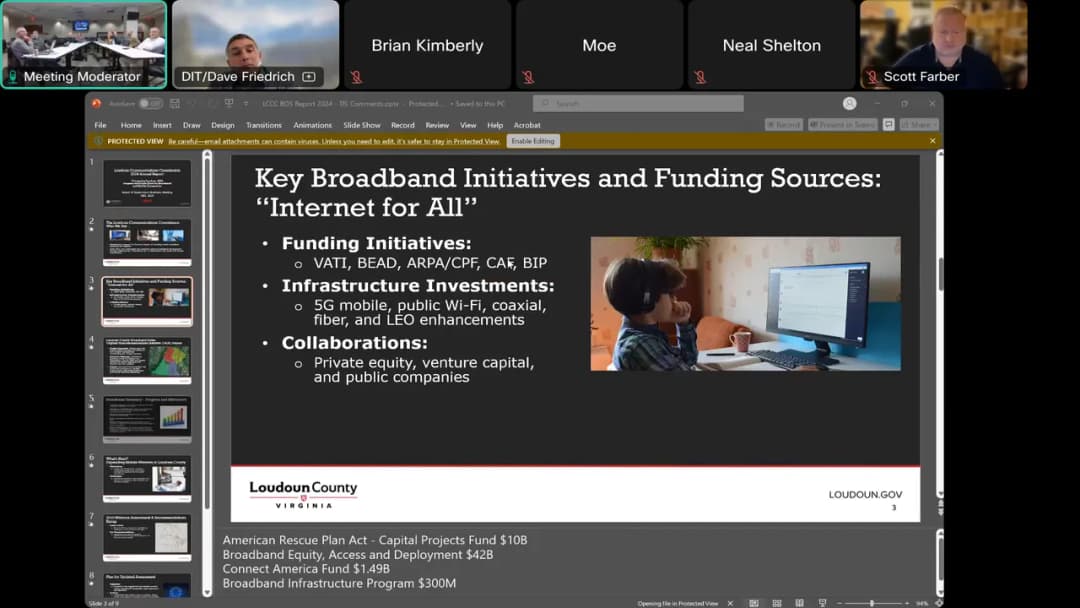
The Loudoun County Communications Commission met to approve routine items, welcome new Ashburn Commissioner Bert Green, receive franchisee updates, review Virginia Telecommunications Initiative (VATI) broadband progress, and discuss the future role of wireless technology in the county. Note: the agenda and raw transcript identify the meeting as Monday, December 2, 2024, while the provided meeting timestamp says 2024-12-04; this summary follows the provided date. Consent Calendar - The commission unanimously approved the agenda as presented. - The commission unanimously approved the October 28, 2024 meeting minutes as drafted; no written copy of those minutes was included in the provided source materials. A commissioner asked how email correspondence is captured, and the chair/secretary explained that formal actions must be brought to a future meeting for official adoption, while information exchanges are subject to FOIA. Introductions and Public Comment - New Ashburn District Commissioner Bert Green was introduced and welcomed; current commissioners and staff briefly introduced themselves. - No public commenters signed up or spoke. Franchisee Updates - Comcast: Dexter Williams, Senior Manager of Government Affairs for the Beltway Region, reported no official updates, said he has been working with staff on issues, and offered to take questions. No commission questions were raised. - Verizon: Staff reported they are still trying to coordinate with the new Verizon representative; no update was presented. Staff Report: VATI Broadband Update - The VATI grant project is expected to connect its first subscriber before the end of 2024 near Hillsborough. The project covers 8,629 formerly unserved addresses, mostly in Catocton and Little River districts. - The first tranche includes 63 or 64 home addresses, with one known request for service so far. County permits have been approved; the cabinet pad was poured before the holiday, and Segra is expected to connect the cabinet by mid-December. - The Dominion Energy memorandum of understanding for middle-mile fiber through towns has not been finalized since late October; two are closer to completion and one remains outstanding. - Staff said the broadband definition at the time of the 2022 application was 25/3 Mbps and has since changed to 100/20 Mbps. Commissioner Patrick Ryan asked whether 90-day notices had been mailed and cautioned that a year-end connection could be more ceremonial than a true start to construction. - A February 2025 update is planned, with more detailed metrics expected. Discussion: Wireless Alternatives and Project Oversight - Commissioner Tom Saltero questioned whether the fiber-first VATI approach is still the most cost-effective and timely way to serve rural residents given 5G fixed wireless options, and asked whether the county could pivot or redirect funds. - Staff and other commissioners responded that the contract is already awarded and funds are being spent; Loudoun County contributed $12 million to the roughly $70 million project but will own no infrastructure and is essentially a subsidy. County CIO Nate Wentlin said pivoting mid-project would likely kill the project, ARPA dollars are tied to it, and VATI is no longer available as a program. The project has already been delayed 15 months, pushing completion to October 2025. - Commissioner Patrick Ryan raised concerns about past schedule messaging, saying All Points Broadband appeared to give the commission and board conflicting information. Staff said the county is not the project program manager, receives limited data from All Points and Dominion, and roughly $2 million has been released so far. - Commissioner Scott Farber noted political and school-board opposition to new cell towers, including a Woodgrove-area tower built but not allowed to deploy, and cautioned against assuming wireless is a simple substitute for fiber. - Commissioners discussed making wireless coverage gaps and competition a future focus, using tools beyond funding such as zoning, permitting, right-of-way access, and advocacy to the Board of Supervisors. Action Items and New Business - No formal action items were recorded from the prior meeting; staff will circulate the outstanding action-item list for review in January. - LCPS representative Aaron Smith reported that the Comcast HD channel is now available with a six-month SD overlay, and the Verizon channel is expected by late January. - Staff provided a BEAD program update: Loudoun County is not the applicant; ISPs apply directly to DHCD. The county can provide letters of support worth about 10 percent of an application score, and Comcast, All Points, and Verizon have expressed interest. - Commissioners briefly discussed e-rate, with county staff noting a 50 percent reimbursement on eligible internet costs, and the county-managed public-safety LMR system with FirstNet as backup. - The chair reminded members about FOIA best practices for commissioner email accounts and said officer elections will be held at the next meeting. Key Outcomes - Agenda and October 28, 2024 minutes approved unanimously. - No public comment was received and no formal action items were assigned. - First VATI subscriber connection is expected before the end of 2024; a February 2025 update with dashboard-style progress metrics is planned. - The next meeting is scheduled for January 27, 2025; the commission may use up to three virtual meetings per year. - Chair and vice-chair elections will take place at the January meeting. - The meeting adjourned.
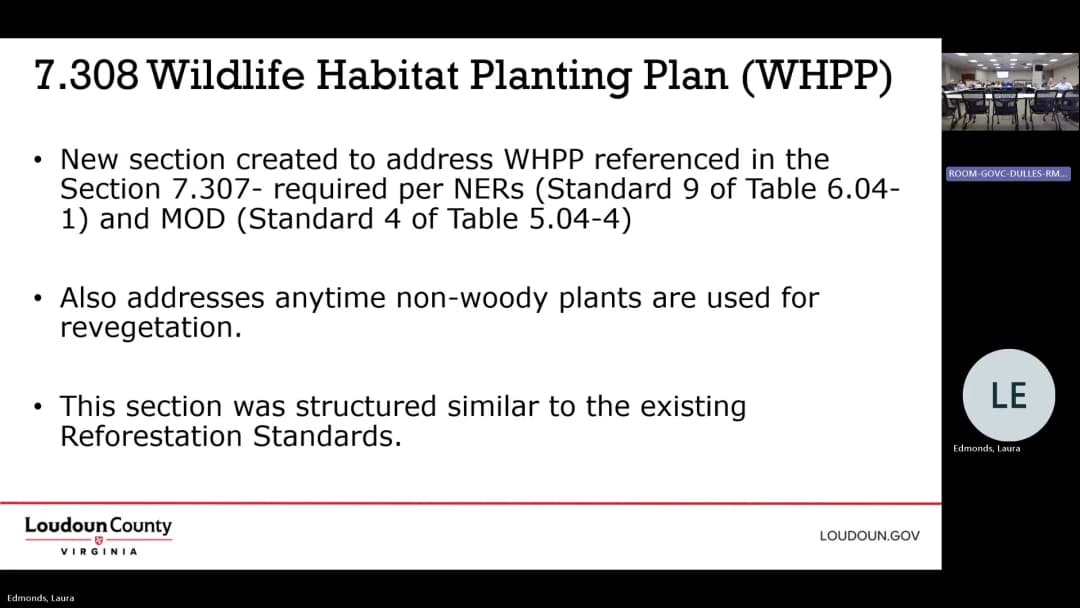
The Facility Standards Manual (FSM) Public Review Committee (PRC) met on December 2, 2024, to review proposed amendments to Chapters 7 and 8 of the FSM. The committee reached consensus on Chapter 8 revisions and discussed significant new sections for Chapter 7, including a remedial revegetation plan and invasive species management standards. Staff will return in December with revised language based on committee feedback. Consent Calendar - Annual Report Update: The annual report was approved by the Board of Supervisors on the consent agenda during the PRC's previous meeting on November 7, 2024. - Approval of Minutes: Minutes from the November 7, 2024, meeting were approved unanimously by voice vote. Public Comments & Testimony - No public comments were offered. Discussion Items - Chapter 8 Amendments (Revisit): Staff revisited the informational exhibit language in FSM sections 8.103, 8.103.6, 8.103.7, and 8.103.8. They proposed copying the text from section 8.103 into sections 8.103.6 (easement plats), 8.103.7 (dedication by plat), and 8.103.8 (AR1/AR2 division plats) with minor adjustments for each context. A committee member noted that most easement plats already have an associated application. The committee reached consensus to proceed with this approach. - Chapter 7 Amendments – Staff Presentation: Kyle Dingus, a natural resources engineer, presented updates driven by the new zoning ordinance adopted December 14, 2023. Key changes included: - Minor edits to sections 7.304 (forest management plan) and 7.305 (reforestation standards) to update references and rename positions (e.g., “county urban forester” to “director’s designee”). - A completely new section: Remedial Revegetation Plan (RRP) – required for zoning violations where land disturbance occurs outside approved limits, particularly in the Mountainside Overlay District and Natural Environmental Resources (NERs). The RRP includes three strategies: 1. Reforestation plan (planting trees). 2. Forest management plan (for sites too steep or rocky to plant). 3. Wildlife habitat planting plan (for areas where woody vegetation is precluded by easements). - A new Invasive Plant Species Management Plan section, referenced by the zoning ordinance for the Mountainside Overlay District and limestone/karst overlay districts. - Committee Discussion on Chapter 7: - Scope and Applicability: Members clarified that the RRP applies only to zoning violations in sensitive areas, not to routine development. The plan triggers when ENS inspectors find unauthorized grading. - Terminology: A member expressed concern about the phrase “maximum extent possible” in the zoning ordinance, suggesting “maximum extent practicable” to avoid infinite obligations. Staff acknowledged the concern but noted they cannot change zoning language. - Planting Densities: Staff corrected an error: “100 plants per square foot” was unintentional; the correct rate is one plant per square foot, based on NRCS guidance. Planting windows (March–April and October–November) were discussed; members asked whether “shall” could be softened to allow flexibility. Staff agreed to consider adding “unless otherwise approved by the director.” - Professionals Required: Staff proposed changing the requirement from “landscape architect, professional forester, or certified arborist” to “qualified professional” to reduce burden for small-scale invasive species removal. Committee supported this change. - Easement Review: Language requiring review of all easements (including VRM) was debated. Staff agreed to refine this to apply primarily to legislative applications and large-scale proffers, not voluntary homeowner activities. - Structure and Clarity: Members found the organization of the RRP sections confusing because the forest management plan is listed separately but can also be a stand-alone silviculture plan. Staff will add an introductory paragraph to clarify the hierarchy and when each strategy applies. Key Outcomes - Chapter 8: Consensus achieved to adopt the revised informational exhibit language across sections 8.103.6, 8.103.7, and 8.103.8. - Chapter 7: Staff will incorporate committee feedback and return with a revised draft at the next meeting on December 5, 2024. Specific revisions will include: - Clarifying the structure of the RRP section. - Changing “100 plants per square foot” to “one plant per square foot.” - Softening planting windows to allow director approval for timing exceptions. - Broadening professional qualifications to “qualified professional.” - Adjusting easement review requirements to match project scale. - Next Steps: The PRC will reconvene on Thursday, December 5, 2024, and January 2, 2025. Upcoming topics include sidewalks and shared-use paths, DCR/DWR information, 10-year private street reserve fund, ADU written agreements, AHU/ADU conversion process, and ESC/stormwater amendments.
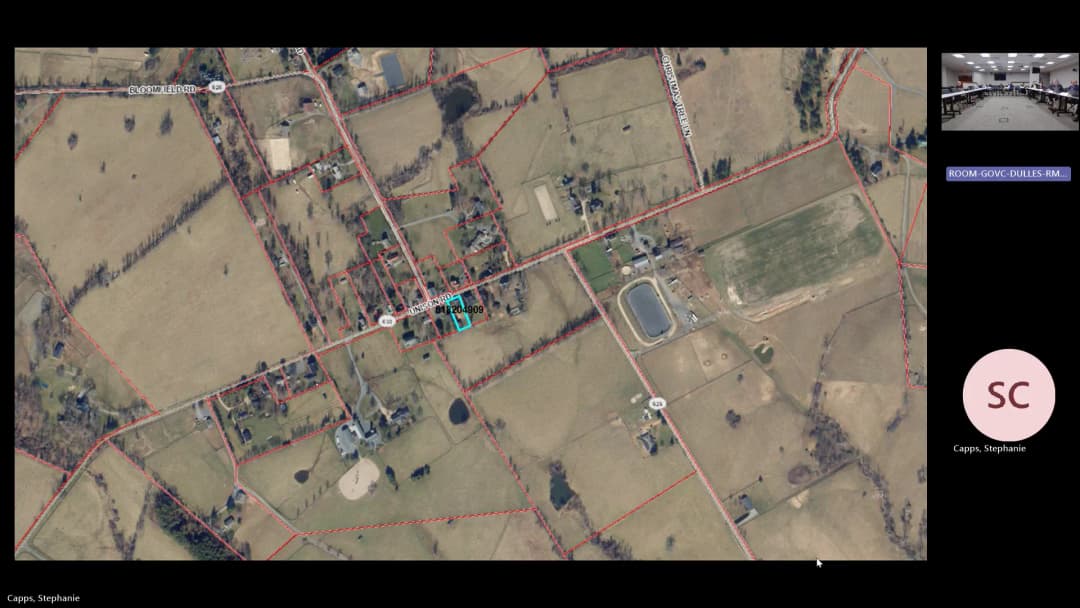
The Loudoun County Board of Zoning Appeals (BZA) met on November 25, 2024, for a public hearing. The board considered two agenda items: an appeal of a zoning determination (APPL-2024-0001) and a variance request for lot coverage (BOZA-2024-0003). The board dismissed the appeal on procedural grounds and approved the variance with conditions. Note: The agenda and transcript list the meeting date as November 21, 2024; however, the provided date is November 25, 2024. This summary uses the provided date. Preliminary Matters - The board addressed a request from the applicant in APPL-2024-0001 (Mr. Sankara) for a continuance due to illness. After discussion, the board voted unanimously to deny the continuance. - The board then heard a motion to dismiss the appeal on the grounds that the underlying notice of violation (issued January 25, 2023) was not appealed within 30 days, making the subsequent zoning determination letter a "thing decided." The motion passed unanimously, and the appeal was dismissed without reaching the merits. Public Hearing – APPL-2024-0001 - The board opened the public hearing for the appeal. No applicant or representative appeared. The board heard no public testimony and closed the public hearing. - A motion was made to deny the appeal based on the failure to appeal the original notice of violation within the statutory 30-day period. The motion carried unanimously. Public Hearing – BOZA-2024-0003 (Farren Addition) - Staff presented a variance request from Linda Farren to increase residential lot coverage from 10% to 23.29% on a 0.29-acre parcel in the AR2 zoning district to allow construction of a bay window, entry porch, covered porch, and carport. Existing structures already cover 17.6%, exceeding the 10% limit. - The applicant, Linda Farren, testified that she purchased the property in 2023 and wished to add the improvements to her historic stone house. She stated she had notified neighbors and received support. - Public comment: Jennifer Don, president of the Unison Preservation Society, expressed concern about the historic character of the Unison village, noting ongoing efforts to establish a county-level historic district and village designation. She asked the board to consider conditions to ensure the additions respect historic character, but did not specify concrete conditions. Discussion & Key Outcomes – BOZA-2024-0003 - Board members discussed the appropriateness of imposing conditions based on speculative future historic designations. The majority concluded that no formal historic district application was pending and that the applicant had shown willingness to work with neighbors. - A motion was made to approve the variance as requested, based on the findings in the staff report (Section 6, A-F). The motion was seconded and passed unanimously. - The board noted that the variance is limited to the specific plans shown in the application and that future historic district efforts would not affect this approval. Administrative Items - Assistant County Attorney Hugh Green reported that two group home cases remain pending before the appellate court, with arguments heard on August 20, 2024. Other appealed matters are stayed pending those decisions and have not been assigned to a judge. - The Zoning Administrator reported no cases for the December meeting, but noted a holiday party and business meeting scheduled. Adjournment - The meeting was adjourned following a motion.
The Transit Advisory Board (TAB) held its regular business meeting on November 18, 2024, at the Transit & Commuter Services Office in Leesburg, Virginia. The meeting was chaired by Ray Delpesche, who arrived late, and was led initially by Rushi Shah. A large public turnout was present, primarily to address rumors that the county's commuter bus service would be eliminated entirely. Staff and board members clarified that no such elimination was planned, and that only underperforming routes were being cut. The board approved the September 11, 2024 meeting minutes and the 2024 Annual Report, discussed the 2025 meeting schedule, and received updates on ridership, service changes, and a planned microtransit pilot. Consent Calendar - Approval of September 11, 2024 Meeting Minutes: Motion by Vlad Ovchynnikov, seconded by Dorri O'Brien, approved unanimously (10-0-1, Raine Terry absent). - Approval of 2024 Annual Report: Motion made and seconded, approved unanimously. The report includes accomplishments such as growth in local and paratransit ridership, recommendations passed at the May 2024 Transit Summit (fare-free local transit, defined paratransit service area, and suspension of commuter bus revenue neutrality), and future goals. Public Comments & Testimony - Jeff Huber: Commuter bus rider, expressed concern about losing service. He described his current commute (Ashburn Metro to Farragut West, costing $8 each way, 2–2.5 hours one way) and stated that without the commuter bus he would need to change work hours or drive, adding $245 per day in costs. He urged reconsideration of any route cuts. - Juan Romero: Commuter bus rider, asked for clarification on rumors that the contract with Kelios (expiring June 30, 2026) would not be renewed. He noted that the board waived cost neutrality, subsidizing 50% of service, and urged the board to ensure continuation. - Sandra (last name not given): Commuter bus driver for nine years, stated that two of her morning runs are being cut (averaging 2-3 riders). She reported that affected riders said they would switch to PRTC (out-of-county buses) and noted safety concerns on Metro, emphasizing the comfort and security of commuter buses. - Sean Cernay: Expressed relief that service was not being eliminated entirely. He highlighted economic and environmental benefits, and urged that if buses fill up, the county should add routes. - Patrick Fellows: Asked where the list of eliminated routes is published (Loudoun.gov/buschange). - Jennifer Rohrbach: Asked about the timeline for contract renewal (Kevin Gross responded that decisions must be made soon, as an RFP typically takes a year). - Ben (last name not given): Advocated for preserving the commuter bus as a premium service that attracted him to Leesburg. He urged long-term planning over short-term cuts. - Matt (last name not given): Stressed the importance of route choice and robust transit, noting that ridership growth through transit-oriented development takes decades. He asked for multi-year notice if major changes were coming. - Additional speaker: Asked about changing the revenue neutrality policy; Scott Gross explained it is a board policy and urged riders to contact their supervisors. Discussion Items - 2025 Meeting Schedule: The board discussed holding one meeting per year at the Loudoun County Government Center for accessibility. A motion was made and seconded to hold the January 8, 2025 meeting at the Government Center, if possible, and to keep the regular dates (second Wednesday of bi-monthly months) for the rest of the year. Approved. - Staff Updates (Scott Gross): - Ridership: Commuter bus ridership is steady but low (average 19.8 riders per bus in 2024 vs. 40 pre-pandemic). Local bus ridership is increasing; paratransit is surging (24,000 rides projected this year, up from 13,000 two years ago). - Service Changes Effective December 2, 2024: 10 underperforming commuter bus trips (averaging less than 10 riders) are being eliminated. One new evening route is added. The Brambleton park-and-ride lot will no longer be served by buses, but the lot remains open for carpools. The Dulles Transit Center (1200 spaces, currently 200 cars) is available nearby. - Fare Increase: Commuter bus fares will increase by $1 on January 2, 2025. A second $1 increase was approved for 2026 but will be delayed to December 2025. - I-66 Toll Revenue: Six commuter trips are fully funded by I-66 toll grants, but overall the county subsidizes about 43-44% of commuter bus costs. - Microtransit Pilot: Planned for Leesburg (5.2 square miles), tentatively starting June 2025. Four buses will provide on-demand service within the town, using virtual stops and app-based booking. The pilot aims to test efficiency and public acceptance. - Metro Security: A board member raised anecdotal concerns about crime on Metro. Gross noted that crime is up on public transit nationally but that Metro ridership data does not show a disproportionate increase; many incidents involve homeless people at stations. Michael Kurtzke, a daily Metro rider, reported few personal issues. Key Outcomes - Approved minutes of September 11, 2024. - Approved the 2024 Annual Report (to be forwarded to the Board of Supervisors). - Approved the 2025 meeting schedule with the January 8 meeting at the Loudoun County Government Center (pending availability). - Staff clarified that the commuter bus service is not being eliminated; only underperforming routes are cut, and the contract renewal process will begin soon. - Next meeting: January 8, 2025, at 7:00 PM, likely at the Government Center. Officer elections (Chair and Vice-Chair) will occur at that meeting. - Adjourned by motion.
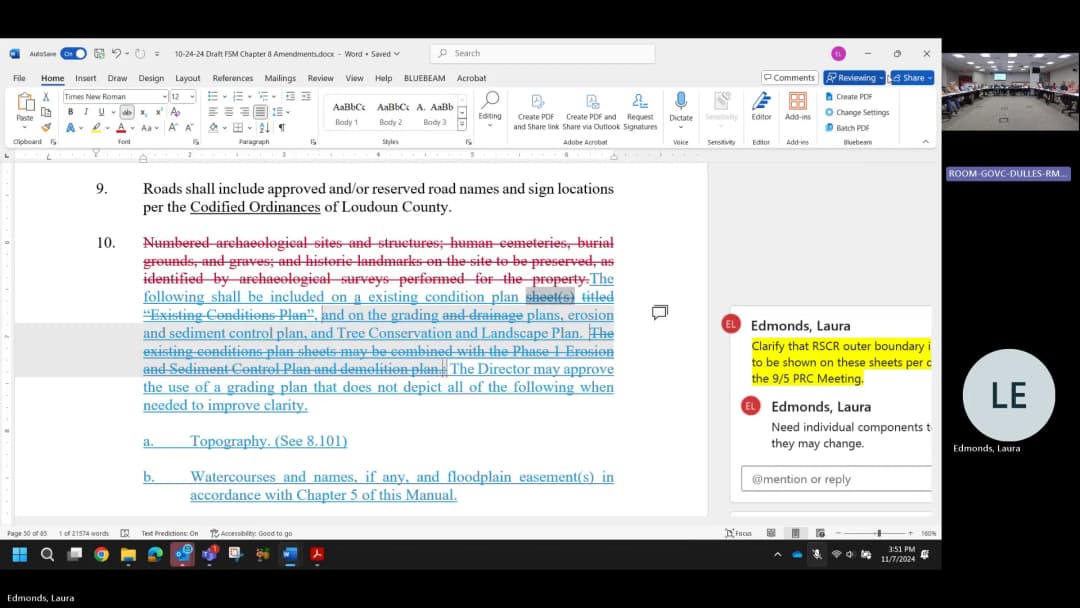
Note: The agenda and transcript list the meeting date as November 7, 2024, but the official meeting date provided is November 8, 2024. This summary uses the provided date. The Facility Standards Manual (FSM) Public Review Committee met to discuss amendments to FSM Chapter 8, particularly sections 8.106 and related items. The committee approved the previous meeting minutes, received updates on the annual report and two DOAMs (Development Ordinance Amendments), and engaged in extensive deliberation on grading plan requirements, existing conditions plans, and informational exhibits. Consent Calendar - Approved the October 17, 2024, meeting minutes via motion and unanimous voice vote. - The annual report was placed on the consent agenda for the Board Business Meeting later that day and was expected to be approved. Discussion Items - DOAM Updates: Two DOAMs (inundation zone amendments and zoning implementation amendments) were presented to the Planning Commission on October 22, 2024, and recommended for approval unanimously. They are now scheduled for a December 11, 2024, public hearing before the Board of Supervisors. - FSM Chapter 8 Amendments – Grading Plan and Existing Conditions Plan: - The committee discussed whether existing environmental features (e.g., steep slopes, Resource Protection Areas, floodplains) must be shown on all grading plan sheets. Staff argued that showing them on all grading sheets ensures consistency and avoids review conflicts, while some committee members and applicants expressed concern about plan clutter and constructability. - A compromise was reached: the language will be revised to allow additional grading plan sheets that do not depict all environmental features when needed for clarity, subject to approval by the director or designee. The specific text was agreed upon as: "Modified grading plan sheets that do not depict all of the following may be provided when needed to improve clarity, subject to approval by the director." - The committee also agreed to simplify the existing conditions plan requirement by removing the phrase "may be combined with phase one ENS and demolition" and instead stating that existing conditions can be shown on a plan (not necessarily a titled "Existing Conditions Plan"). - Other minor edits to lists of required features on grading, erosion control, and tree conservation plans were accepted. - Informational Exhibit: Staff requested retention of the informational exhibit requirement for three rare application types (easement plats, plot plans, and certain zoning permits) because it facilitates locational clearance. The committee did not object but asked to revisit the language at the next meeting to ensure it does not impose new standards on already-built projects. - Plot Plans (FSM 8.114): Updates were made to reference the new Zoning Ordinance (Section 61000 to 1004) and to correct yard/setback references. The committee agreed to defer floodplain-related edits to a future floodplain amendment package. Key Outcomes - The committee directed staff to incorporate the agreed-upon language changes for grading plan sheets (including the director-approval flexibility) into the draft FSM amendments. - Staff will prepare clean versions of the revised sections for review at the next meeting (November 21, 2024). - No formal vote was taken on the entire Chapter 8 amendment package; further discussion will continue at the November 21 and December 5, 2024, meetings. - The committee acknowledged the need to update the Erosion and Sediment Control Handbook references due to upcoming changes, but deferred detailed review. - Upcoming topics include sidewalks, shared use paths, invasive species management, ADU written agreements, and ESC/stormwater amendments.
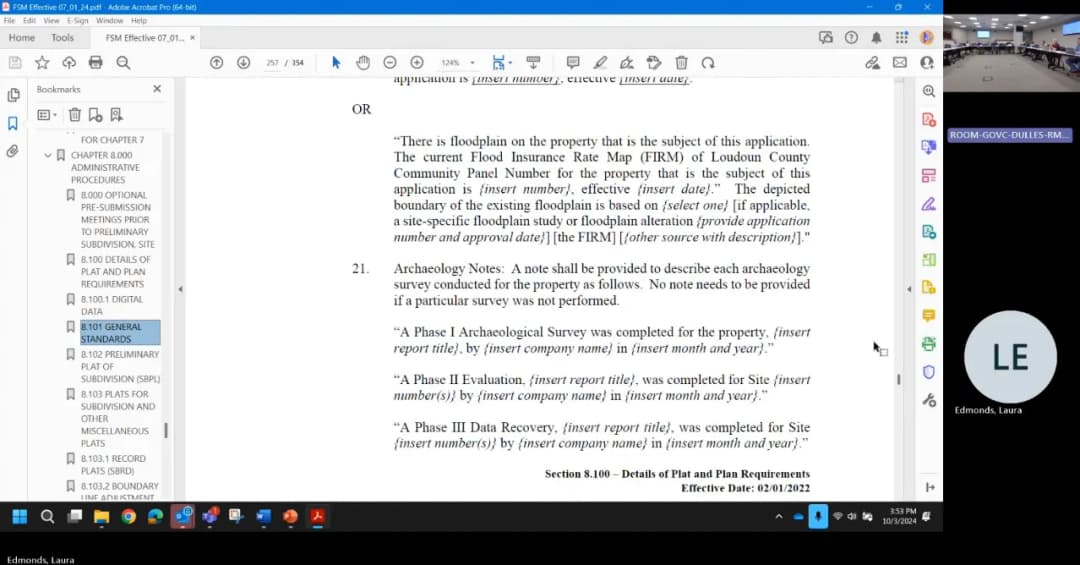
The Facility Standards Manual (FSM) Public Review Committee (PRC) met on October 3, 2024, beginning after a delayed start due to the absence of a quorum. A quorum was eventually achieved, and the committee proceeded with agenda items including approval of previous minutes, an annual report update, continued discussion of FSM Chapter 8 amendments, an update on the 10‑year reserve fund for private streets, and formal recommendations for two Development Ordinance Amendment (DOAM) items. Public comment was not received. Public Comments & Testimony - No public comments were offered or received during the meeting. Discussion Items - Annual Report Update: Staff presented a minor change to the annual report, converting from a calendar year to a fiscal year format. The report is scheduled for the Transformation and Landings Committee on October 17, 2024, on the consent agenda. - FSM Chapter 8 Amendments (sections 8.101 through 8.103 and beyond): The committee discussed revisions to plat and plan requirements, focusing on: - Requiring limestone mountainside and Natural and Environmental Resources (NERS) to be shown on an informational exhibit rather than on the plat, with a note referencing the exhibit or associated application number. - Adding an existing conditions sheet (section 8.106/8.107) to consolidate topography, watercourses, wetlands, NERS, overlay districts, cultural resources, pollution sources, and other features. - Clarifying the use of topographic analysis for steep slopes: if a preliminary plat uses a contour interval of two feet or less, a topographic analysis is required; otherwise, Web‑based GIS (Logis) data may be used. - Revising language to allow floodplain boundaries to be shown using Logis when no floodplain study or alteration is required. - Adding the requirement to show the location and purpose of land‑disturbing activities on informational exhibits. - The committee discussed the need for notes to alert property owners to the presence of overlay districts or NERS, ultimately agreeing to require a note without prescribing specific wording, allowing flexibility (e.g., referencing subject property or specific lots). - An extended debate occurred on whether to include site plans in cross‑references; staff agreed to add site plans to relevant sections. - 10‑Year Reserve Fund for Private Streets Update: Members reported ongoing research into state law requirements and proffer examples. The committee noted that while Virginia law requires a reserve study, it does not mandate upfront funding. A proffer in Fairfax County was cited as an example of an HOA contribution required at settlement. The update is still being compiled for presentation to the F‑2 Technical Advisory Group. - Approval of Previous Minutes (September 19, 2024): The minutes were approved by acclamation after minor wording adjustments. - DOAM Recommendations: Staff requested the committee’s formal position on two DOAMs: - DOAM 2024‑002 (Dam Break Inundation Zone amendments) and DOAM 2024‑003 (Zoning Ordinance Implementation – three tag‑line amendments). The committee recommended approval of both amendments for the Planning Commission public hearing scheduled for October 22, 2024. Key Outcomes - Minutes Approved: The September 19, 2024 meeting minutes were approved unanimously by acclamation. - Chapter 8 Amendments: The committee agreed to: - Use informational exhibits for selected features (NERS, overlay districts) with a flexible note requirement. - Allow Logis data for floodplain depiction when no study/alteration exists. - Require topography analysis for preliminary plats using ≤2‑ft contours. - Add location and purpose of land‑disturbing activities to exhibits. - Include site plans in cross‑references for easement plats. - DOAM Recommendation: The committee voted to recommend approval of DOAM 2024‑002 and DOAM 2024‑003 to the Planning Commission. - Reserve Fund Update: Staff will compile further research and present findings at the next meeting (October 17, 2024). The committee may invite representatives from the F‑2 zone to discuss funding mechanisms. - Next Meetings: Scheduled for Thursday, October 17, 2024, and Thursday, November 7, 2024. Upcoming topics include sidewalks/shared use paths, DCR/DWR information, remedial revegetation, and ADU conversion processes.
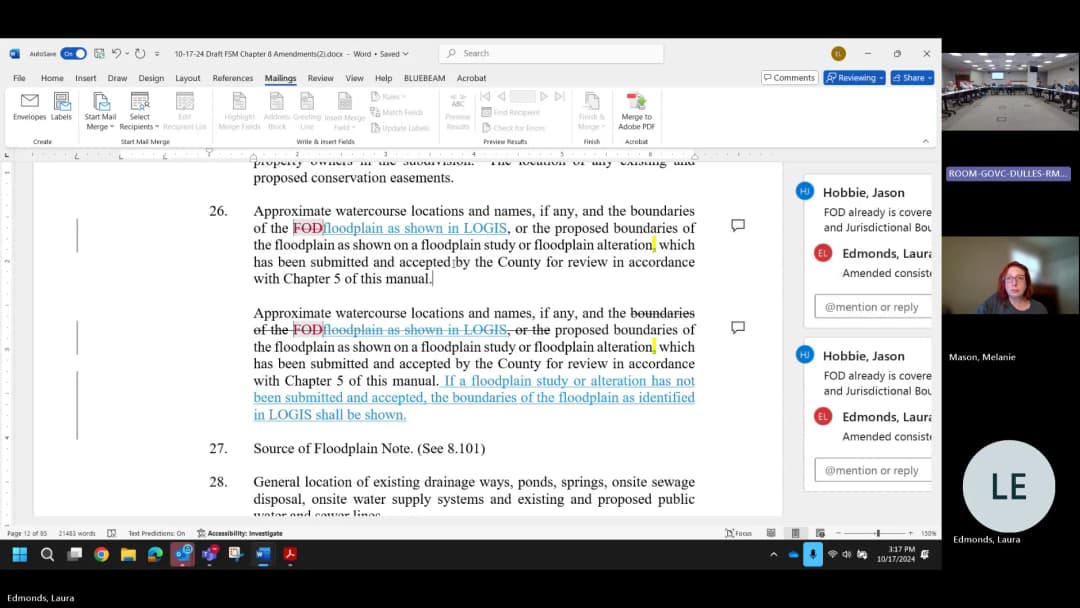
The Facility Standards Manual Public Review Committee (FSM PRC) met on November 6, 2024, to continue its review of FSM Chapter 8 amendments. Note: The agenda and the call to order state the meeting date as October 17, 2024, while the timestamp provided for this summary says November 6, 2024. Committee members participated remotely, and staff included Natural Resources Program Manager Melanie Mason online; Natural Resources Team Leader Anna Dharty was expected to join after a staff training. The agenda listed 3:15 p.m. as the target time for beginning Chapter 8 amendments. No public comment was offered, and no separate minutes document was provided for this session. Administrative Items - Committee members disclosed that they are members of one or more affected groups, with declarations kept on file. - The committee approved the October 3, 2024 minutes by consensus; no one opposed. - The PRC annual report was placed on the Transportation and Land Use Committee (TLUC) consent agenda for 5:00 p.m. that evening. It was reformatted from a PowerPoint presentation into a two-page Word document because the county no longer accepts PowerPoint reports. The chair and one member planned to leave about 10 minutes early to attend that meeting. Discussion Items - Floodplain boundary source language (FSM 8.102 and 8.103): Staff proposed giving precedence to a floodplain study or alteration that has been submitted and accepted by the county over Logis-mapped floodplain boundaries. Committee members discussed whether accepted-but-not-approved studies should be usable on preliminary plats, the risk of relying on unapproved engineering, and whether the change would force applicants to update earlier plats. The committee decided to leave the current text unchanged and flag the topic for future floodplain amendments rather than resolve it now. - Easement plat exhibits (FSM 8.103.6 and related sections): The committee discussed whether easement plats should be required to show environmental features such as steep slopes, resource protection areas, and other natural resources when they had not been shown on a previous application. Some members questioned the burden for simple easements (e.g., bus shelters, VRM easements), while others emphasized early notification to avoid approving easements that cannot actually be developed. The committee agreed to restore the full list of application types - including site plans, construction plans, grading permits, and other miscellaneous plats - to the accompanying-plat text. - Grading and drainage plan terminology: Members noted that the current phrase grading and drainage plan implies a single combined plan, whereas drainage plans have become extensive engineering documents under DEQ requirements. They discussed changing references to grading plans only and not requiring environmental features on standalone drainage plans. Staff agreed to check with the appropriate county staff before revising the language. - Existing Conditions Plan proposal: Staff proposed consolidating environmental resource information on existing conditions plan sheet(s) and on grading, erosion and sediment control, and tree conservation/landscape plans. Members raised concerns about forcing a specific sheet title, allowing combination with a Phase One ENS plan or demolition plan, and keeping plans legible. The committee did not reach a final decision and agreed to revisit the language with additional input from committee members and staff. Key Outcomes - Minutes approved by consensus. - Annual report placed on the TLUC consent agenda as a Word document. - Floodplain boundary language left as-is; future floodplain amendments will revisit. - Easement plat exhibits will restore the prior list of application types. - Grading/drainage plan terminology change deferred pending staff check. - Existing conditions plan language to be revised for flexibility; committee and staff will continue discussions.
Note on Date: The agenda and transcript indicate the meeting was held on Monday, October 28, 2024. However, the user has specified that the meeting took place on October 30, 2024. This summary reflects the user-provided date, but the discrepancy is noted for accuracy. The meeting was called to order at 7:00 PM. The commission welcomed a new member, Tom Solitario, from the Leesburg district. The agenda was modified to include introductions. The minutes from September 30, 2024, were approved with minor corrections (one abstention, six yes). The meeting included updates on the Virginia Telecommunications Initiative (VATI) project, preparation for the 2024 Board of Supervisors (BoS) Commission Status Report, and discussion of next steps for wireless assessment. Consent Calendar - Approval of the agenda as amended (with introductions). - Approval of the September 30, 2024, meeting minutes after a roll call vote: 6 yes, 1 abstain (Rich Bible). Public Comments & Testimony - One member of the public, Melissa, attended but did not make any comments beyond introducing herself. VATI Update - Dominion Energy (Ed Diggs): Presented the middle mile fiber progress. Out of 168 planned miles in Loudoun County, 88 miles are complete, 68 miles are under construction (with 25-30 miles expected to be complete by end of 2024), and 12 miles are on hold due to pending franchise agreements with the towns of Hamilton, Purcellville, Round Hill, and Hillsborough. Dominion has granted permission for All Points Broadband to attach to over 5,000 of approximately 8,800 poles. Ed Diggs noted that negotiations with the towns are ongoing, with a meeting scheduled within two weeks. - All Points Broadband (Tom Innes): Provided an update on last-mile construction. The project aims to serve about 8,600 unserved locations with 700 miles of fiber. The first customer activation is targeted for December 2024 in an area northwest of Hillsborough (Loudoun 2, hub 0007), with approximately 64 locations initially. Tom Innes expressed 90% confidence in meeting the Q1 2025 milestones for Loudoun 2 and 4, and Q2 2025 for Loudoun 1, 3, and 5. The project is expected to be fully built out by October 2025. He discussed the mapping of fiber service areas, the poll attachment process, and the upcoming marketing mailers. The standard installation fee is $199, with no extra charge for long driveways (up to 1,000 feet underground; $2/foot beyond). Monthly pricing was not specified but will be included in a future presentation. All Points also plans to address 176 locations outside the VATI project through a separate RFP funded by the county. Discussion: Preparation for 2024 BoS Commission Status Report - The commission reviewed and revised the draft slide deck for the BoS report. Key points of discussion: - The deck should focus on the commission's activities (broadband progress) and the proposed shift to addressing wireless gaps. - The phrase "pro-wireless" was debated; some members preferred "pro-communications" or "pro-infrastructure." Ultimately, the deck was adjusted to avoid an overly promotional tone. - The commission agreed to remove a slide with detailed VATI statistics, as the board already receives that information directly from staff. - The final slide will present the commission's next steps: conducting an updated assessment of wireless needs, collaborating with staff to define scope, and potentially identifying funding for a third-party study if needed. The commission emphasized that this is an informational update, not a formal request for funding or action. - The deck was approved by voice vote (all in favor) with the understanding that minor edits would be made by the chair (Ron) and vice chair (Jason) before submission to the county administrator by end of business the next day. Key Outcomes - VATI Project: The first customer activation is confirmed for December 2024 in Loudoun 2. The commission will receive a follow-up update in February 2025 after the initial launch. - BoS Status Report: The deck was approved as amended. It will be submitted for the November Finance Committee meeting and likely placed on the December consent agenda for the full Board of Supervisors. - Next Meeting: The next commission meeting is scheduled for December 2, 2024, at 7:00 PM in person (with hybrid option available upon request). The usual November and December meetings are combined. - Action Items: A new action item was added to clarify the policy for providing presentation materials to commissioners in advance of meetings. The existing action item on mapping resources (from July) was marked complete. - Wireless Assessment: The commission will proceed with planning an assessment of wireless coverage gaps, working with staff to determine scope and potential costs. No formal request for funding was made.