OPENPUBLICA · PUBLIC MEETING RECORD
Record of Proceedings
Economic Matters Committee Meeting, November 4, 2026: Outdoor Dining Regulation Update
City Council — Wednesday, November 4, 2026
BodyAnnapolis, Maryland
SessionCity Council
DateWednesday, November 4, 2026
StatusNEW · FILED
Video Record
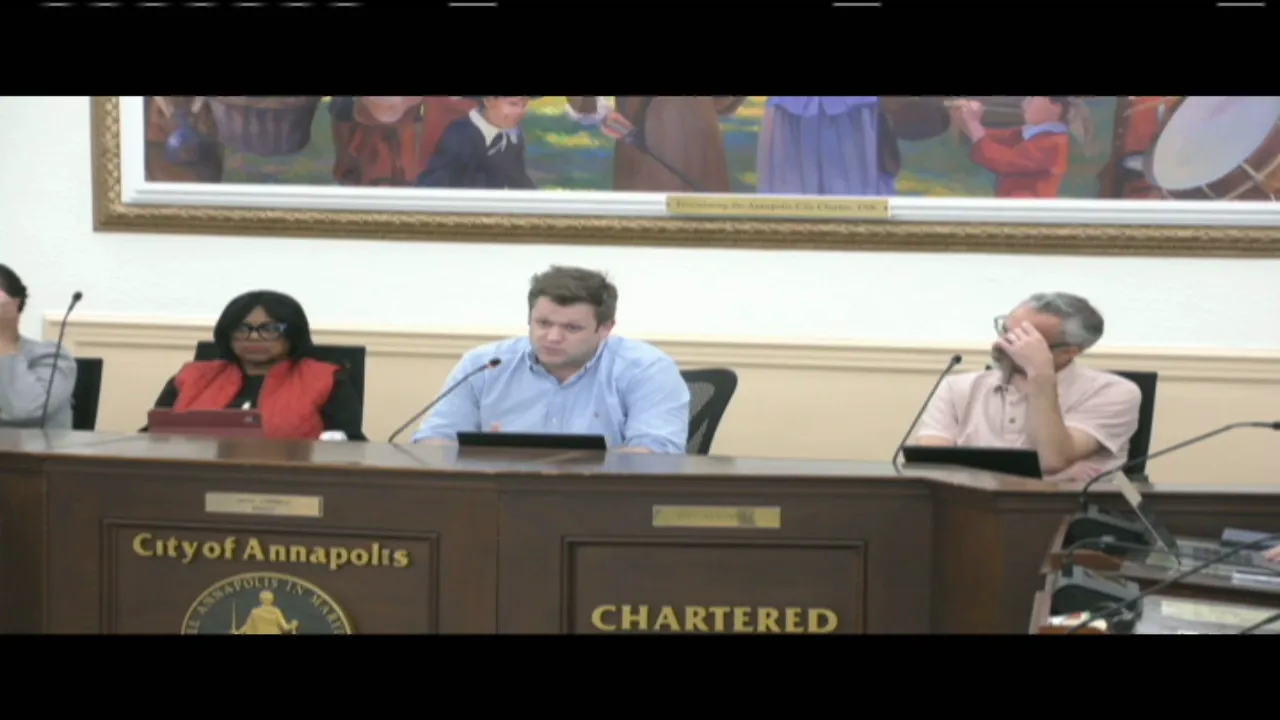
STREAMING COPY IN PREPARATION — RECORDING AVAILABLE FROM THE ORIGINAL SOURCE
Transcript — Verbatim
Speaker numbers apply only to this recording.
Discussion Breakdown — Share of Meeting
Outdoor Dining Regulation26%
Public Safety19%
Public Engagement15%
Zoning11%
Zoning And Development8%
Fire Prevention8%
Procedural7%
Legal Issues2%
Economic Development2%
Summary of Proceedings
Economic Matters Committee Meeting, November 4, 2026: Outdoor Dining Regulation Update
The Economic Matters Committee met on November 4, 2026, at 6:00 PM in the City Council Chambers to discuss and vote on legislation O-29-26, which updates the city's outdoor dining regulations after the first year of operation. The meeting included extensive public testimony from restaurant owners, residents, and business advocates, followed by a series of amendments and a final favorable recommendation. The committee also approved the agenda and minutes from the October 7, 2026 meeting.
Consent Calendar
- Approved the agenda as amended (removing Item ID-8-26 Economic Development Update).
- Approved the October 7, 2026 meeting minutes (Alderman Schandelmeier abstained due to absence).
Public Comments & Testimony
- Camden Baudrin (109 East Bayview Drive, Annapolis) spoke on behalf of restaurant operators, emphasizing the need for consistency so customers understand expectations. He argued that the current law often forces servers to interpret whether standing is allowed, creating confusion and potential conflict.
- Mike Tomasini (212 Eastern Avenue, Annapolis resident) expressed support for allowing standing service, noting that the issue of standing is not a significant problem and that enforcement should not be a focus.
- Kevin Kolbeck (Chester Avenue, owner of Davis' Pub for 20 years) stressed the burden on staff when they have to enforce differing rules from one restaurant to another. He cited that 7,593 restaurants went out of business in the first six months of 2026, highlighting the fragility of the industry. He opposed enforcement via the Alcoholic Beverage Control (ABC) Board, arguing it creates challenges with photo-based complaints.
- Will Kuna (406 Jefferson Street, Annapolis) echoed the need for consistency and noted that unenforceable rules are as bad as no rules.
- Phil Dales (Dales Associates, 209 West Street) supported the bill's intent but raised concerns about enforcement standards being subjective. He advocated for clear, enforceable rules and suggested grandfathering for existing operations that predate the legislation. He also questioned the public purpose of requiring parking for three months of the year.
- Richard Frano (29 Eastern Avenue, Boatyard Bar and Grill) supported the comments of his colleagues and stated that outdoor dining has gone well.
- Tom Creek (14 Murray Avenue, president of Ward One Residents Association) opposed aspects of the bill, particularly the removal of language requiring consistency with the residential, maritime, and historic nature of the city. He argued that allowing standing on sidewalks would harm residents, citing noise, disorderly conduct, and lack of enforcement. He urged the committee to step back and gather data on complaints before proceeding.
Discussion Items
- O-29-26 Outdoor Dining Update (First Reader): Sponsored by Aldermen Thorp and Savidge, the bill aims to clarify definitions, streamline permitting, update seating and occupancy standards, and address enforcement. Key areas include:
- Standing vs. Seated Service: The original bill required patrons to be seated for service. Alderman Savage introduced amendments to allow standing service in all outdoor dining areas, but with restrictions: in sidewalk and street cafes, no designated standing areas would be permitted, and patrons could not block pedestrian passageways or vehicular lanes. After debate, the committee adopted a substitute amendment that permits standing service in sidewalk and street cafes (with no designated standing areas) and clarified that the minor modification process for special exceptions applies to allowing standing service.
- Enforcement: Alderman Thorp proposed that the ABC Board handle complaints regarding violations, arguing it could consider a restaurant's overall record. Others, including the city attorney and several restaurant owners, expressed concern that the ABC Board lacks the resources and expertise for such enforcement, and that enforcement should remain with planning and zoning professionals. The committee ultimately did not change the enforcement structure, but discussions raised concerns about capacity tracking.
- Barriers and Streetscape: Amendment 2 (Savage) clarified barrier requirements, prohibiting barrels, cones, and similar items, and requiring that protective barriers be finished with planters or wood/metal. The committee approved this amendment.
- Special Exception Process: Amendment 5 (Savage) attempted to automatically override conditions in existing special exceptions that required seated service. This was withdrawn; instead, the committee adopted a new amendment declaring that allowing service to standing patrons is a minor modification of a special exception, to be handled administratively by the planning director. This was intended to avoid the costly and lengthy (10-month) special exception process.
- Fire Marshal Review: Amendment 7 (Savage) required the Fire Marshal to submit written recommendations on seating occupancy before a Board of Appeals decision, citing specific code provisions. The committee approved this amendment despite concerns from Alderman Thorp about limiting the Fire Marshal's authority.
- Capacity Tracking: Alderman Thorp proposed an amendment (8) requiring restaurants to keep a count of patrons for capacity enforcement. The amendment received no second and was not adopted.
Key Outcomes
- Amendments Approved:
- Amendment 1 (Savage): Retained original language “in our commercial districts and shopping centers” instead of “consistent with residential maritime and historic nature.” (Favorable vote)
- Amendment 2 (Savage): Strengthened barrier requirements, prohibiting barrels and cones, requiring finished barriers with planters or wood/metal. (Favorable vote)
- Amendment 3 (O'Neill) was replaced by a committee substitute: Allows standing service in sidewalk and street cafes, but prohibits designated standing areas and requires that patrons not block passageways or travel lanes. (Favorable vote on substitute; original amendment received unfavorable recommendation)
- Amendment 7 (Savage): Requires Fire Marshal to submit written comments on seating occupancy citing specific code provisions before Board of Appeals decision. (Favorable vote; Alderman Thorp abstained)
- New amendment (economic matters): Explicitly treats “allowing service to standing patrons” as a minor modification of a special exception, to be administered by the planning director. (Favorable vote)
- Amendments Rejected or Withdrawn:
- Amendment 4 (Savage) – unfavorable recommendation (conflicted with new committee amendment).
- Amendment 5 (Savage) – unfavorable recommendation (replaced by new amendment).
- Amendment 6 (Savage) – died due to lack of second (required concurrence from Public Works and Transportation for street cafe location distances).
- Amendment 8 (Thorp) – died due to lack of second (capacity tracking requirement).
- Final Vote: The committee voted unanimously (with one abstention) to approve O-29-26 as amended, sending a favorable recommendation to the full City Council.
- Next Steps: The Office of Law will coordinate with the Fire Marshal to review Amendment 7, and with the city attorney to finalize the language for the minor modification provision. The bill will proceed to the City Council for final consideration.
Meeting Transcript
Matters. Currently, here is myself, Alderman Savage and Alderwoman Alsip Johnson. And then we are joined by our guest Alderman Frank Thorpe. Before we begin our approval of the agenda, we are going to remove ID 826 economic development update. Can I get a motion to approve the agenda as amended? So moved. Second second. All in favor. Aye. So up next, can I get a motion to approve the meeting minutes from our October 7th meeting? So moved. Can I get a second? All those in favor? And I will abstain because I was not present. First on the agenda. Alderman Thorpe, this is your legislation. If you could please start us off, and then we have several people in the audience who wish to provide testimony. So I will let you begin the conversation, then we'll bring folks up who wish to testify. Sure. Thanks, Mr. Chairman. I think this is the continuing evolution of the outdoor dining laws here in Annapolis. A lot of people wanting to clarify a large scope of what's going on in outdoor dining and make it consistent across all of Annapolis. That's a pretty huge undertaking. Based on was it March or April, four of my colleagues uh introduced uh basically a one-liner uh I think it was Alderman Savage's initiation to change the code uh to allow standing up across the the board that caused this uh this effort to try to align ourselves with what uh the residents uh are looking for. I spent a lot of time talking to the residents, uh business owners, um, and resisted quite frankly, a lot of effort to expand uh the legislation larger because the goal is to get this done uh by the end of the year so that uh the restaurants can uh begin the year with a plan. Um we made that commitment, and uh I think we're on track uh to fulfill that commitment. It basically ended up uh we focus on uh three areas, uh the standing up, sitting down effort, uh decision, uh, as well as uh the uh enforcement, how that's enforced, and then the third uh area quite frankly is is some administrative cleanup, uh like who's responsible for uh for outdoor dining on the city staff, public works was responsible for street and sidewalk cafes, and uh planning and zoning was responsible for uh parking lot, uh outdoor dining, and it that kind of put a delay in the system because public works, before they approved it, needed to get a lot of inputs from planning and zoning. So let's just make planning and zoning in charge. Um things like that, and it we uh also at the same time uh got some feedback about the look and uh what what the restaurants are looking at. So when it comes down to the the uh the legislation initially uh the main legislation calls for a lot of people pointed out that there's a big difference between outdoor dining on somebody's property um and outdoor dining in a public space, specifically a street or a sidewalk. Um this gets really into the big question is uh what what do we want uh our city to to be and and the the walk and the feel of it? Um I want to be pretty clear, and I've been a bar attendee ever since I was 18. Um, and uh so it's not about uh bars or restaurants or whatever, but when you walk into uh a restaurant or a bar, you make the conscious decision to to uh engage in into that, and uh, whereas when you're walking down the street, um you don't, and so that's the real differentiator. It's clear that a lot of people don't agree with that. Um, and I think once we agree to the facts, um, then uh the city council will be in a position to decide whether uh we can stand at uh at sidewalks on sidewalks uh or street cafes. I don't think anybody disagrees with that's not true. Not many people disagree with standing up in uh outdoor dining in a parking lot. And then the enforcement part, um, and I again I'm not criticizing anybody that that worked on this before, it's a continuing evolution. But I think what we've learned over the last year from an enforcement standpoint is we don't necessarily want people standing uh city staff standing at bars, uh counting people or making sure that they're conforming to the law. Um we have an alcoholic beverage control board that's highly respected, uh group of volunteers, um, and uh it really puts the onus on uh on uh the restaurant to conform to the laws, and then any complaints can go to the alcohol beverage control board, and we're not handing out citations because we think there was one or two people uh uh more or something like that. So that's the legislation. Um I'll just wrap up by repeating I think what what this whole conversation is about is um is what what do we want our city to be. Um in none of the options is the city gonna die. Um uh and so we we probably ought to take a step back and make sure we have a conscious uh uh understandable view of of what the difference is. It's it's uh do we want to be a city where you walk up and down the sidewalks, Main Street uh specifically, um, but any other city, uh any other street in the city where you've got the potential of people um crowded into a bar, much like you have crowded into our popular inside our popular pubs that we have now. Uh so I hope that makes sense.
SUMMARIZED BY OPENPUBLICA AI
TRANSCRIPT VIA PUBLIC VIDEO
openpublica.com
openpublica.com