OPENPUBLICA · PUBLIC MEETING RECORD
Record of Proceedings
Athens City Council Meeting - September 8, 2026
City Council and Boards — Tuesday, September 8, 2026
BodyAthens, Ohio
SessionCity Council and Boards
DateTuesday, September 8, 2026
StatusFILED
Video Record
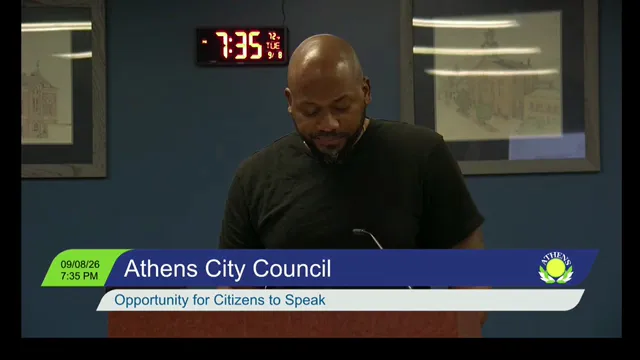
STREAMING COPY IN PREPARATION — RECORDING AVAILABLE FROM THE ORIGINAL SOURCE
Transcript — Verbatim
Speaker numbers apply only to this recording. Names come from transcript evidence. “Possibly” marks uncertain attribution.
Discussion Breakdown — Share of Meeting
Procedural24%
Public Engagement17%
Budget Equity Analysis16%
Water And Wastewater Management15%
Urban Planning7%
Public Safety5%
Economic Development5%
Technology and Innovation4%
Racial Equity4%
Summary of Proceedings
Athens City Council Meeting - September 8, 2026
The Athens City Council convened on September 8, 2026, beginning with a Finance and Personnel Committee meeting followed by a regular session. Council addressed significant appropriations for the city's medical fund, adopted a resolution on respectful civic dialogue, and heard public testimony regarding stormwater infrastructure failures and the economic impact of the Richland Avenue construction project.
Announcements and Communications
- Member Sherwood acknowledged the passing of Dolly Parton on August 25th and highlighted the Imagination Library program's connection to Athens County, noting the city has been a financial supporter for several years.
- Member Wood recognized volunteers and neighbors for rebuilding stairs in the Near North Side neighborhood.
- Mayor Patterson issued proclamations for Welcome Week (September 10-19) and National Hispanic Heritage Month (September 15-October 15), encouraging participation and inclusion.
Consent Calendar
- The agenda was amended and approved, adding Ordinance 86-26 for first reading.
- July 2026 financial reports and June 2026 credit card transactions were accepted.
- Appointments of Laura Olbers and Eden True to the Community Relations Commission were approved.
Public Comments & Testimony
- Mount Zion Black Cultural Center (Susan Riggy, Building Chair, and Ada Woodson Adams, President): The speakers described repeated stormwater flooding damage to the newly renovated basement at 32 West Carpenter Street, with four feet of water on June 18th and 18 inches on August 11th, alongside a sinkhole forming on the property. They stated that runoff from North Congress Street is the source, citing a lack of catch basins on the entire hill. The speakers argued the West End is not receiving the same attention as Richland Avenue and requested the city install catch basins, raise the curb, and repair a broken pipe carrying water from other properties across theirs. They expressed frustration that they were expected to pay for repairs to city infrastructure.
- Adam Lewis (Owner, Taco Johns on Richland Avenue): Stated that the Richland Avenue construction project caused a 40% to 50% revenue loss for businesses along the corridor, forcing three of his employees to quit due to reduced hours. He criticized the city's advanced notice as ineffective (stating no direct warning was received before signs appeared), the timing during Ohio University move-in, and public messaging advising motorists to avoid the area. He argued the city saved money on its own construction budget by transferring costs onto local businesses and workers. He demanded mandatory early engagement with businesses, direct written notice for future projects, and immediate corrective signage directing customers that businesses are open.
- Susan Riggy (Second comment on Richland Avenue): Expressed support for Mr. Lewis's position, stating it is inappropriate for the city to rely on public media and websites to notify residents and businesses of disruptive projects.
Discussion Items
- Medical Fund Appropriation and Transfers: Council Member Jessica Thomas and the Auditor presented the Finance and Personnel Committee discussion on Ordinances 85-26 and 86-26. The Auditor explained that the city is transferring $1 million into the medical fund from various departmental personnel lines where funds were projected to go unused, rather than taking a bulk transfer from the general fund as done the previous year. An additional $250,000 was allocated for departmental wages. The Auditor described the detailed ordinance as a necessary roadmap for auditing. Ordinance 85-26 corrects bookkeeping from the early retirement buyout program, moving approximately $487,000 back to the medical fund. A request to suspend the rules to pass Ordinance 85-26 immediately failed because only five of seven council members were present, requiring a supermajority. A special session was requested for the following week.
- Resolution 0626 (Promoting Respectful Interactions): Introduced by all council members, this resolution encourages collaboration and respectful dialogue among the city, schools, Ohio University, and community organizations. Public support was voiced by Judge Todd Grace, who noted the importance of dignity in municipal court, and Superintendent Chad Springer, who called kindness the foundation of respect. The resolution passed unanimously.
- Richland Avenue Construction Communication: Council Member Thomas clarified that the city published roadmaps and notices on social media and the city website starting in May 2026. President McCarry acknowledged Mr. Lewis's concerns and suggested the administration could provide more periodic updates to council on community engagement for construction projects.
Key Outcomes
- Resolution 0626 (Promoting Respectful Interactions) was adopted unanimously.
- Ordinance 76-26 (Additional appropriations for police, fire, street lights, and IT) passed unanimously.
- Ordinance 79-26 (Right-of-way permit at 144 Grosner Street) passed unanimously.
- Ordinance 80-26 (Cybersecurity policy update) passed unanimously.
- Ordinance 82-26 (Traffic code penalty amendment) was read for the second time.
- Ordinance 84-26 ($30,000 sewer fund digital oxygen sensor) was read for the first time.
- Ordinances 85-26 and 86-26 (Medical fund transfers and major appropriation) were read for the first time. A special session was requested for the following week to pass 85-26 after the suspension of rules failed due to insufficient attendance.
- Council directed staff to follow up with the Mayor's administration on the Mount Zion flooding concerns.
- Meeting adjourned at 7:45 PM.
Meeting Transcript
Good evening and welcome to Athens City Council. Today is Tuesday, September 8th, and we have one finance and personnel committee meeting before we proceed to regular session. And we'll have uh everyone stay at the dais since we'll just have that one committee meeting. And I will turn things over to the chair of finance and personnel, Jessica Thomas. Uh thank you. So tonight we just have one item on the finance and personnel committee. Uh I've sent out notes previously just explaining what we're talking about tonight. Um if you recall from last committee and what's up for first reading tonight was some addressing of the medical fund with what the early retirement buyouts and how that needed to get shifted around. So in looking at all that, they need to make some more uh the auditor's office is asking to make more changes addressing the medical fund. Um they're all referenced in the ordinance two medical fund two that will be named obviously later. Um but basically the medical fund this time last year we've had to address by moving money out of funds out of the general fund into the medical fund to support rising cost of prescriptions, care, um, and general medical costs for the city's insurance. So in looking at this last year, if you looked back on the ordinances that I referenced, we sent out had to move over 750,000 from the general fund to bolster that for the end of the year. This year, while they were looking to see you know how much would be needed, they went through all of the budgets, looked through to see what was available in existing appropriated funds, and found that they could transfer most of it over from previously uh appropriated funds that were not going to be needed to last through the end of the year, that there was an excess in some of the various departments. Um so if you go through that list that was sent, you can see where they're all coming from. But basically $611 is coming from various previously appropriated funds in the general fund, and then another 300 plus coming from various other funds throughout the city. So what you'll have is a million dollar transfer into the medical fund to get us through the end of the year. And thankfully, none of that is going to be new appropriations that go directly to the medical fund. In that same ordinance, there are some other appropriations that are going to be used to cover um wages in a few departments that while they're going through looking at medical fund costs, they notice that there's a few departments that need bolsters for uh their wages for the end of the year. So there's another 250,000 that will be transferred to uh various departments, and that's in the first section of the appropriation that you'll see. Um but that is the basics of what we were talking about for this appropriation. And for that, I'm gonna move next to the auditor for any additional comments. Um not too many additional comments. That's that basically sums it up. Again, when we looked at doing this this year, last year we just did a bulk $750,000 general fund to medical. This year, when we talked about that, the deputy auditor said I have a different idea. Um she said, let's go through a lot of these different account lines, the personnel lines, and find where every year we have excess in in wages in certain areas. And as opposed to just letting that sit there the rest of the year, her suggestion was to do what we're doing here. And it's it's a long ordinance. Um, but what it does is it basically moves the money from those lines where we know the money's not going to be well, we're not gonna say we know, but we feel com feel fairly confident that the money is not gonna be needed for the rest of the year. So instead of just letting it sit there, let's basically repurpose those appropriations and move them into the medical fund. It's a long drawn-out ordinance, but the reason it's that way is because this is just you know, sort of the way it needs to go, is to take that money. You know, when you look at it, what we're doing is we're re we're reducing the appropriate, let's just use my I'm gonna use my office as an example. If you look in section two, auditor 10102. This $30,769 was was money that we had in our personnel lines. We done did the math for the rest of the year. We determined this money is just gonna sit there. We we we're over by that much. So instead of leaving it in that personnel line, let's move it to the transfer line. That's what section two does, and then from the section three takes it from the transfer line into the medical fund. And we basically did this for all these different lines that you're seeing on here. Um again, it's kind of a long ordinance. The reason we did it this way, Clerk Walker helped us with this. This is a perfect roadmap for us that when we do actually make the changes in the system, if we go line by line and follow this, we know we're getting it right. If the stated auditor comes in later and says, we'd like to see this, we have a nice roadmap for them to follow that they can see all of our changes right here in this ordinance. So it is long, but that's why we did it that way. Um but again, we kind of thought that was a better approach as opposed to just saying let's just take straight $750,000 out of the general fund right from the start. If we worked with money that we had already appropriated.
SUMMARIZED BY OPENPUBLICA AI
TRANSCRIPT VIA PUBLIC VIDEO
openpublica.com
openpublica.com