Bend City Council Work Session and Regular Meeting – November 1, 2023
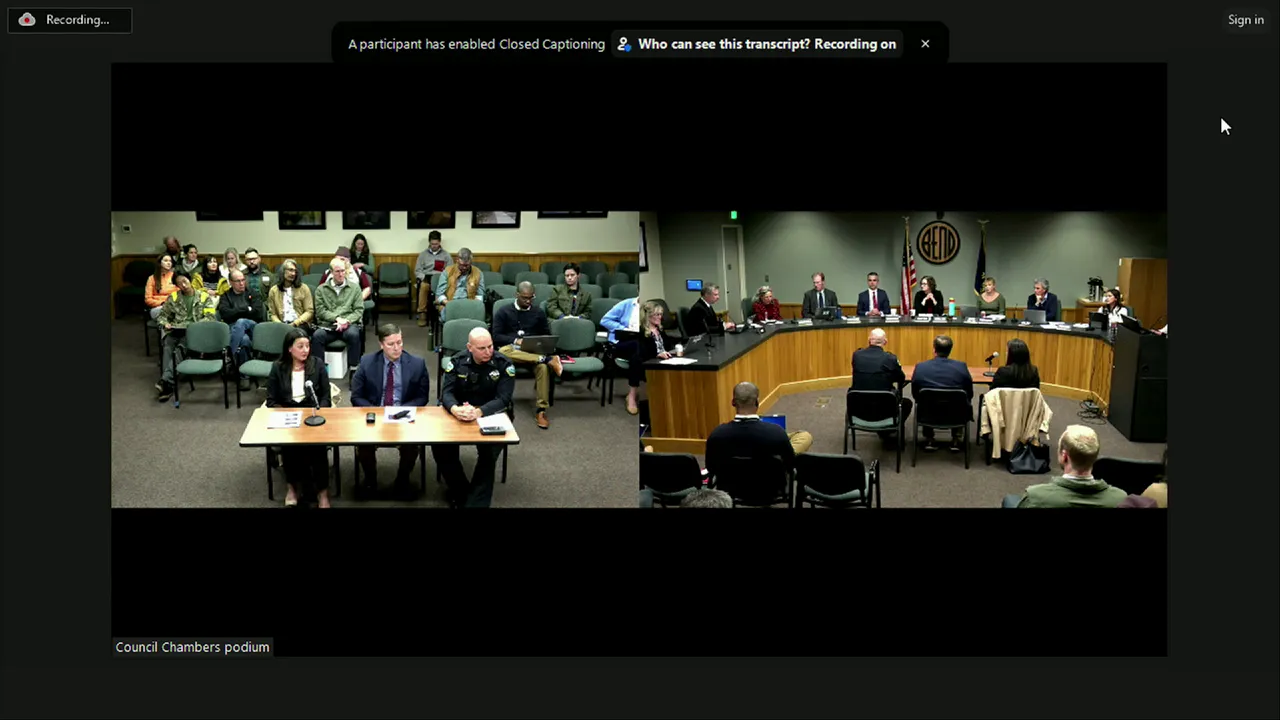
STREAMING COPY IN PREPARATION — RECORDING AVAILABLE FROM THE ORIGINAL SOURCE
Bend City Council Work Session and Regular Meeting – November 1, 2023
The Bend City Council held a hybrid work session starting at 4:30 p.m. and a regular meeting at 7:00 p.m. on November 1, 2023. The work session included an intergovernmental meeting with the Tribal Council of the Confederated Tribes of the Warm Springs Reservation, an update on the public safety system, and an Envision Bend update. The regular meeting featured a public hearing on housing code amendments, approval of design contracts for pedestrian and bicycle infrastructure, and adoption of a nondiscrimination policy for discretionary funding.
Intergovernmental Meeting with Warm Springs Tribal Council
- The City Council hosted the Tribal Council of the Confederated Tribes of Warm Springs for the first formal intergovernmental meeting. Tribal Secretary-Treasurer Bobby Bruno provided an overview of the tribe’s treaty (June 25, 1855), which ceded 10 million acres of land (including the City of Bend) while reserving rights to fish, hunt, gather, and pasture livestock. He noted that 444,000 acres of the 640,000-acre reservation are forested.
- Vice Chairman Ray Moody emphasized the tribe’s focus on water quality, land use, and the impact of growth on treaty resources. He stated, “We are very cautious to watch what you’re doing” and asked that the city keep the tribe in mind when making decisions.
- Mayor Melanie Kebler and City Manager Eric King expressed commitments to annual meetings and a future “tribal harmony workshop” (a 2.5-day cultural and educational session). The council agreed to meet next in Warm Springs.
Public Safety System Update
- Chief Mike Grant (Bend Police) described the complexity of modern policing, noting that the department responds to approximately 45,000 calls for service annually. He distinguished between policing (relationships, crisis intervention) and law enforcement (citations, arrests, reports).
- District Attorney Steve Gunnels reported that the DA’s office files about 5,000 criminal cases per year, with 24.5 FTE prosecutors and 9.5 victim advocates. He highlighted that Measure 110 reduced methamphetamine possession charges by 90% (from 633 to 62 cases) and heroin possession by 97% (from 257 to 6 cases). Violent crime spiked during COVID: murders rose from 1 in 2019 to 8 in 2022, but are down to 3 in 2023. DUI filings exceed 1,000 per year.
- Judge Beth Bagley (Deschutes County Circuit Court) explained that the court handled 14,442 total cases in 2022, including 54 jury trials and 382 bench trials. She noted a significant increase in “aid and assist” cases (competency evaluations) and civil commitments. The court worked through a backlog of over 1,000 warrants from the COVID period, and the warrant queue is now nearly cleared.
- Councilors discussed the adult treatment court, which was suspended due to workforce shortages. DA Gunnels expressed hope for its resurrection. Chief Grant clarified that the city council does not direct police enforcement; officers follow state law, city ordinances, and constitutional protections.
Envision Bend Update
- David White (Envision Bend Board Chair) and Matt Munchin (Executive Director) presented the vision action plan, developed from 17 months of community input. The plan includes 28 strategies, with the City of Bend listed as lead or co-lead on 10.
- Strategic Initiatives Manager Mickey Dirting reviewed the 10 strategies: 4 align with current council goals (e.g., housing innovation, tree canopy, complete communities), 1 is a “maybe” (thriving urban tree canopy), and 5 are not currently in goals (railroad safety/redevelopment, city of belonging, alliance on equity partners, adapting to climate change). Staff recommended that the city not lead on railroad relocation (requires 5–10 years) or the equity alliance (best led by other organizations).
- Councilors expressed support for using the plan to inform future goal-setting but noted resource constraints. Councilor Perkins raised concerns about overburdening under-resourced equity organizations.
Consent Calendar
- Items A–D (minutes, OLCC report, quarterly investment report, monthly financial report) were approved unanimously.
- Item E (acceptance of $577,500 grant from COIC for rapid rehousing at the Rainbow Motel, including a $1 sublease at 181 NE Franklin Ave.) was pulled for discussion. Housing Director Lynn McConnell explained that the grant allows relocation of support services to the adjacent Blue Dog RV site, freeing two rooms for shelter beds during the Lighthouse Navigation Center renovation. The motion passed unanimously.
Public Comments & Testimony
- Freddie Finney Jordan (organizer, Deschutes Youth Climate Coalition) thanked the council for progress on electrification and bike routes, urging continued action.
- Rowan Lucas (19, Bend resident) requested the council adopt policies requiring 50% electrification of buildings by 2030 and all-electric new construction by 2025, and strengthen the city’s right-of-way law to create a climate justice fund.
- Ann Women (Bend resident) thanked the council for the upcoming vote on the nondiscrimination policy, saying it will make the city more welcoming.
- Linda Johnson (nearby resident) expressed gratitude for the revision of the city sponsorship policy, noting her church had faced barriers when applying for a parade permit due to its social justice programs.
Discussion Items
- Housing Code Update (PLTEXT20230479): Staff presented amendments to remove maximum density in high-density residential zones (RH), allow single-room occupancies (SROs) in all residential districts (per HB 3395), and streamline middle housing land divisions. Planning Commissioner Suzanne Johansson reported a unanimous recommendation from the Planning Commission. Council adopted the ordinance on first reading.
- Olney Pedestrian and Bicycle Improvements: Engineer Carrie Goldstein presented the final design amendment (Phase 2) with Parametrix, Inc. for $1,437,547. The project will add curb-protected bike lanes on both sides of Olney Avenue, sidewalks, and a safe crossing at 2nd Street. Total project cost is estimated at $10.4 million, with a $1 million gap from the GO bond. Council approved the contract.
- Crosstown Bikeways (Bend Bikeway): Engineer Kevin Howard introduced a $786,820 design contract with David Evans and Associates. The project will create a connected north-south and east-west protected bike network, including shared-use paths, neighborhood greenways, and modal filters. Construction is targeted to finish by June 2025. Council approved the contract.
- Resolution on Discretionary Funding Policy (CP007): Council adopted a resolution affirming nondiscrimination in city-sponsored events and programs. The policy clarifies that “public purpose” includes additional protected classes and renames the “Christmas Parade” to “Holiday Parade” (effective next year) to align with the prohibition on promoting religion. Councilors noted that the 2023 parade will proceed as planned.
Key Outcomes
- Votes: All consent agenda items approved (unanimous). Housing code update (first reading) approved (unanimous). Olney Bicycle/Pedestrian contract approved (unanimous). Crosstown Bikeways contract approved (unanimous). Resolution CP007 approved (unanimous).
- Directives: Council directed staff to schedule a work session on tolling building and land use permits due to high interest rates and construction slowdowns. Staff will also explore amendments to the municipal court judge’s contract (Judge Rocco) recognizing excellent performance.
- Next Steps: The second reading of the housing code ordinance is scheduled for November 15, 2023. The council will hold a January 2024 work session to discuss cost overruns in the capital improvement program. The second intergovernmental meeting with Warm Springs will occur in 2024.
- City Manager’s Report: Upcoming events include a climate-friendly areas open house (Nov. 7), Habitat for Humanity capital campaign celebration (Nov. 2), and construction updates: Wilson Avenue closure extended through June 2024; Neff-Purcell intersection expected to open after Nov. 28.
Meeting Transcript
I mean, and when we're ready and we're broadcasting. All right. Yeah, let's go ahead and sit down together. Thanks, everyone, for being here. We're gonna get started with this very important meeting. Um the Benn City Council is honored today to host uh the tribal council of the Confederate tribes of Warm Springs. This is the first of what we hope will be many intergovernmental meetings between our two governments to talk about shared issues and concerns. And we are so grateful to have um our tribal council members here today with us and ready to listen and learn and start to forge this relationship. So thank you, everyone, for being here today. Um we're gonna get started with an invocation, and I believe Wilson you're gonna lead us through that vino true. Shomas Pachu with Sunday show Namash Pachu with Sunnah with Pama Kwan Shah Pachu with Sunnah with today as we start this um meeting with this song among our people. We don't sometimes use word prayers to carry our message to the creator because our prayers, our wants, our needs, our asks are all within the songs that we sing and the words that we sing to the creator. So asking for his divine presence today for the words that he places in our heart that guide us each and every day, and that those things that we learn from our prayers will carry us on into the future is um a little bit the interpretation of the song that I sing to start this meeting. Thank you. Thank you very much, Tribal Council Member and everyone. So as we get settled here, we're going to start with a brief overview of the tribe by Secretary Treasurer and CEO Bob Bobby Bruno. Thank you, Bobby. Okay, thank you, Mayor. Can you guys hear me okay? Yes. Okay, great. So uh yeah, thank you for the invitation and having our tribal council meet with your your city council here, and now I'm gonna talk about the the tribes just briefly here in um better tribes of warm springs. Uh we have a treaty uh that was June 25th, 1855. In that treaty, we reserved rights to fish, hunt, gather our cultural foods, and to pasture livestock on unclaimed lands. And so that's our our treaty of 1855. In the treaty, uh we ceded 10 million acres of lands to the U.S. government uh to exercise these rights in off the reservation. And uh those area here, the city of Ben is within our seated land. So it's uh it's really important to uh to know that and uh to thank you guys for having having all of us here to uh in our our seated lands here where we exercise our rights. Um very very happy about that. And uh the treaty also has a 10 million acres, it also identifies the the reservation, which is uh north of here, about 50 miles, and the reservation is uh 640,000 acres in size or a thousand square miles in size. Uh most of the reservation is uh forested lands. Uh, I know if you have driven through warm springs, uh you see a lot of ranged lands there, and a lot of folks think that that it's uh mainly rangelands, it is not uh the reservation. There's 444,000 acres of land is in forested lands. So uh there's uh we have a lot of forest area. A lot of people are very surprised by that uh because they only see the the dry part of the reservation when they drive highway 26 to Portland. So that's the uh that's the warm springs and our little bit about our treaty, and uh there's three tribes on the reservation. There are confederate tribes of warm springs, there's the warm springs people, the Wasco people, and the Paiute people. So those are the three tribes that make it the Confederacy of Warm Springs. Great, thank you very much. Um, in turn, we were gonna go over just very briefly the structure of the City of Bend government and the city council. Um, this slide here just shows some of our core areas of service that the city government provides. We're a city manager council form of government, so we sit as a policy board, and um our city manager Eric King does all of the day-to-day hiring, firing, and running of the city's operations. Um there are seven members on the city council, including a directly elected mayor, and we're all elected at large by the whole city. And these are the things that we do for our city every day, um, public safety, basic infrastructure, including water, roads, um, and all sorts of other um things that make the city run, as well as you know, trying to think about how we protect our environment and how we promote economic development and work on housing strategies for our for our um residents. Every two years when the council is elected, every two years about half of the council is elected in an election, and every two years we set goals for a two-year period. Um, and this graphic here just represents some of the areas that we've set our goals in and some of the values that overlay our goals. So we have accessible and effective city government, affordable housing and sustainable development, environment and climate, transportation and infrastructure, and public safety. And in each of those, we have specific goals that we want to work on in the next two years, um, overlaid by those values you see there as well. So that's sort of how we're set up, and I think there's a lot of the shared values and goals between um both of our governments and our constituents, and um I think we're gonna continue to talk about that as we move through the meeting.
openpublica.com