Bend City Council Meeting - March 20, 2024: Building Electrification, Tax Exemptions, and Transportation Fee
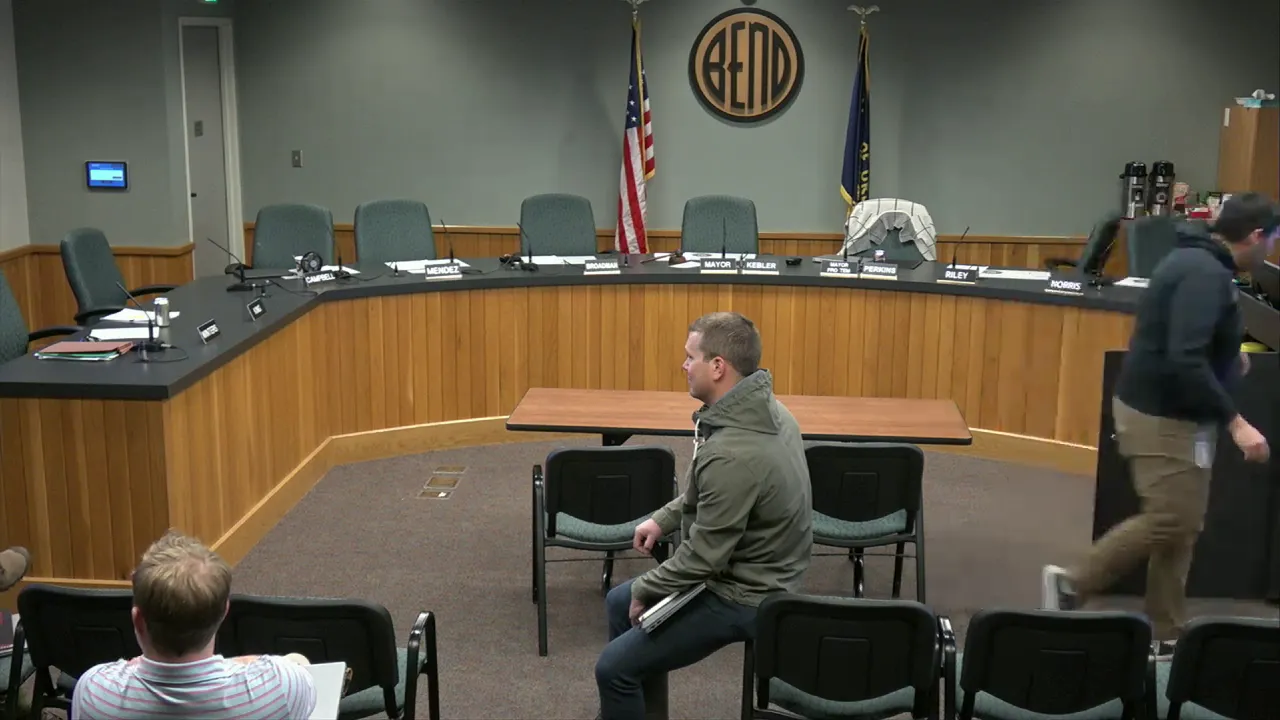
STREAMING COPY IN PREPARATION — RECORDING AVAILABLE FROM THE ORIGINAL SOURCE
Bend City Council Meeting - March 20, 2024
The Bend City Council held a work session and regular meeting on March 20, 2024, starting at 5:30 p.m. The work session focused on building electrification policy options. The regular meeting at 7:00 p.m. included proclamations, approvals of property tax exemptions for the Timber Yards and Central Oregon Veteran and Community Outreach, street preservation contracts, and a public hearing and first reading on the new Transportation Fee.
Consent Calendar
- Approved minutes from February 26, February 29, March 6 (work session), and March 6 (regular meeting).
- Authorized a contract with Taylor Northwest, LLC for the Silver Sage Sewer Project ($2,747,537.85).
- Authorized a contract with Walker Macy for conceptual design of the NW Brooks Street and Mirror Pond Plaza Improvement Project ($235,643) after a brief discussion about using funds for the Drake Park footbridge. Council directed staff to bring back an application with a substantial city match for the Visit Bend Sustainability Fund. The contract was approved with language requiring a form approved by the city attorney.
- Authorized application for FAA grants for Taxilane Pavement Rehabilitation ($315,000) and Taxiway Rehabilitation and Lighting ($300,000).
- Approved a resolution amending the Clean Water State Revolving Fund Loan with DEQ to increase it to $1,525,000.
- Approved an intergovernmental agreement with Oregon State Fire Marshal for use of a fire apparatus.
Public Comments & Testimony
- Roberta Silverman (Land Use Chair, Southern Crossing Neighborhood District) opposed the Timber Yards MUPTE application, arguing that the 11% open space requirement duplicates the master plan's 10% requirement and constitutes "double dipping." She questioned the transparency of the MUPTE program.
- Judy Trigo (resident) commented on the Transportation Fee, expressing understanding of the need but advocating for expanding the utility billing assistance program to include those paying more than 30% of gross income on housing, noting that even small fee increases burden low-income households.
- Katie Brooks (CEO, Bend Chamber) commented on the Transportation Fee, supporting the need but urging an effective appeals process, continued evaluation of commercial property assessment methods, and exploring alternative funding sources (e.g., gas tax, visitor fees) before phase three.
Discussion Items
- Building Electrification Policy Options (Work Session): Senior Management Analyst Cassie Lacey and City Attorney Michael presented a two-step analysis process to explore voluntary and regulatory options for building electrification. They outlined legal uncertainties (EPCA preemption, state building code, HB 3409) and proposed a timeline: step one (broad assessment) by October 2024 using a consultant and the Environment and Climate Committee, step two (deep dive on narrowed options) by August 2025. Councilors expressed support but sought faster action on city-owned building commitments. Council directed staff to proceed with step one and to bring back options for formalizing city-level electrification commitments sooner.
- Multiple Unit Property Tax Exemption (MUPTE) for Timber Yards Phase A: Staff presented a 10-year tax exemption for a 246-unit mixed-use development in the Core Area TIF district. The applicant (Kennedy Wilson) demonstrated financial need (5.3% ROI without exemption, 5.9% with; threshold 6%) and public benefits: 11% publicly accessible open space, enhanced native landscaping, and a wrapped parking structure. Council debated the lack of deed-restricted affordability versus the need for middle-income housing. A motion to approve passed 6-1 (Councilor Norris opposed).
- Nonprofit Property Tax Exemption for COVO: Les Bivens (Board President, Central Oregon Veteran and Community Outreach) requested exemption for eight properties providing housing to veterans and low-income individuals at ≤60% AMI initially and ≤80% subsequently. All taxing districts (Deschutes County, Bend Park & Rec, Bend-La Pine Schools) had approved. Council approved unanimously.
- Street Preservation Contracts (Items 8-10): Transportation Director David Abbas presented three contracts for 2024 pavement maintenance: chip seal ($548,556), paving ($3,699,000), and slurry seal ($359,359). Abbas noted that these treatments extend road life cost-effectively and that the Transportation Fee is essential to reverse the trend of declining pavement condition. Council approved all three contracts unanimously.
- Transportation Fee Public Hearing and First Reading: Chief Operations Officer Rose Grayson and Senior Management Analyst Sarah Hudson presented the fee framework (Phase 1: $5 million annual revenue). The ordinance creates Chapter 3.110, sets residential rates ($6.25/1,000 sq ft for non-residential up to 50,000 sq ft), includes discounts for utility billing assistance recipients, and mandates accountability measures (public dashboard, annual reporting). Council discussed future phases (usage intensity factors for non-residential, alternative funding like gas tax). Public comments were heard. Council then passed three unanimous motions: (1) first reading of the ordinance, (2) adoption of the fee schedule resolution, (3) adoption of the staffing schedule resolution adding 3 FTE.
Key Outcomes
- Building Electrification: Directed staff to proceed with step one analysis (consultant procurement in April/May, report to council by October 2024) and to explore faster city-level commitments for city-owned buildings.
- Timber Yards MUPTE: Approved (6-1). The 10-year tax exemption will forego approximately $8.37 million in residential property tax revenue but generate $3.3 million in system development charges and, after exemption, over $20 million in tax increment over the TIF district's life.
- COVO Tax Exemption: Approved unanimously. Exempts eight properties from all taxing district property taxes (city portion ~$7,000 annually), savings used to keep rents low and fund services.
- Street Preservation Contracts: All three contracts awarded unanimously. Total combined cost $4,607,251.05, treating approximately 59 lane miles.
- Transportation Fee: First reading of ordinance passed unanimously; fee schedule resolution adopted unanimously; staffing schedule resolution adopted unanimously. Phase 1 rates take effect after second reading and approval. Staff directed to report back with progress on usage intensity factors, alternative funding options, and a public dashboard by March 2026.
Meeting Transcript
Okay, so we are going to get started with our Ben City Council work session. Um, and we have a presentation on building our electrification policy options. Someone echoing, no, we're good. Okay, so let's get into it. Okay. Um, good evening, City Council. I'm Cassie Lacey, senior management analyst in the city manager's office, and staff liaison to the environment and climate committee. Um, we're here to share with you a proposed process and timeline for how we want to analyze options to pursue electrification policies and programs for the city. So, for some background, we're having this discussion today because um included in council goals are developing new policies to support sustainable development that are responsive to community concerns, including policy related to natural gas and building electrification. The goal behind electrification is to try and get buildings to use technologies that use electricity rather than natural gas or other fossil fuels for their power needs. There are many potential benefits of electrification. The primary climate benefit is that we have well-established renewable and carbon-free electricity sources that can be used, which we don't have at the same level in scale of availability for natural gas in buildings. There are also emerging research areas about the human health and safety benefits of electrification since electricity doesn't require fossil fuels to be combusted right on site within homes and buildings. Electrification supports our existing climate action goals because it has the potential to significantly reduce greenhouse gas emissions in buildings, especially when paired with renewable electricity strategies. Electrification programs generally fit within our existing community climate action plan because we have several strategies for promoting energy efficiency, which electrification does. There's been a lot of community interest in this topic. Most recently in the fall, there was the Youth Climate Coalition campaign that requested that the council adopt an electrification ordinance. In addition, the ECC has uh previously identified electrification as a gap in the existing CCAP and had intended to look into it further during the upcoming CCAP update. There's been just a general increased community awareness about various electrification policies and programs, in large part because other cities, both in Oregon and outside of Oregon, are pursuing the are pursuing these or starting to study them over the last couple of years. At the same time, we've also heard questions and concerns about what the potential unintended consequences might be of these policies. So we're hoping to launch this project now with the goal of better understanding our options so that we can consider what the best ways are for promoting electrification in Bend. There are both voluntary and regulatory options to that can be considered. And on the regulatory side, there's an evolving legal landscape that needs to be taken into consideration, which Michael's gonna speak to in a moment. So the goals for the goals for today's discussion are to propose a recommended scope of work and process to consider electrification policies for Bend and to seek direction from counsel on whether to go ahead and initiate that process as recommended, or here if you all want us to take a different approach. So counsel, I have uh some background on the legal framework. It's somewhat technical and complicated. Uh so pardon me as I look down and read some notes from the case. Um, and I'd also ask if you don't mind to hold your questions until the end uh once you finish hearing my slides and Cassie's, we can go back over because again, some of this is complicated. So the legal framework, um despite being complicated, is also unsettled. Uh, and so things are constantly changing. Uh they generally involve a layer of local authority as well as state and federal law. So the basic legal principles at play here are familiar, you've heard these before. Uh it's general home rule authority and preemption. So then as a home rule city, uh, we have very broad leeway to regulate in areas that protect and the health protect the health and safety, uh, unless we are preempted by state or federal law. Preempted basically means superseded. So if there is a federal law, which is the supreme law of the land, or a state law, which is higher than the local authority, if they say we can't do something, then we can't do it. But generally, otherwise we have the authority. Uh as we go through this, I'm gonna cover a federal law and a couple state laws that are important, but it's really important to remember number one is that we're legislating in Oregon, so it's Oregon law that's important. So the rules that apply in Washington or New York don't inform the analysis here in Oregon. Number two, often there are other levels of government that are acting. So in other states, it may be a county acting or a state acting. And so while those might inform some of our policy choices, it's not a good analogy for what we can do because they may have a different level of authority than we have. So there's some some basic principles. Let's turn first to federal law. So through the through the supremacy clause of the federal constitution, federal law is the supreme law of the land. Uh the main law that's going to bear on our authority to regulate in this sphere to electrify in buildings is the Energy Policy and Conservation Act. Uh that act sets energy conservation standards for certain consumer appliances, such as refrigerators, water heaters, furnaces, furnaces, washers and dryers, and other products. Uh and this law has been around for a while. It's been on the book since 1975. It has been subsequently amended, so it's changed a bit, but this has been the law of the land for quite a bit of time.
openpublica.com