Special Meeting of Bend City Council: Q&A with Dr. Gregg Colburn on Homelessness and Housing - May 10, 2024
STREAMING COPY IN PREPARATION — RECORDING AVAILABLE FROM THE ORIGINAL SOURCE
Special Meeting of Bend City Council: Q&A with Dr. Gregg Colburn
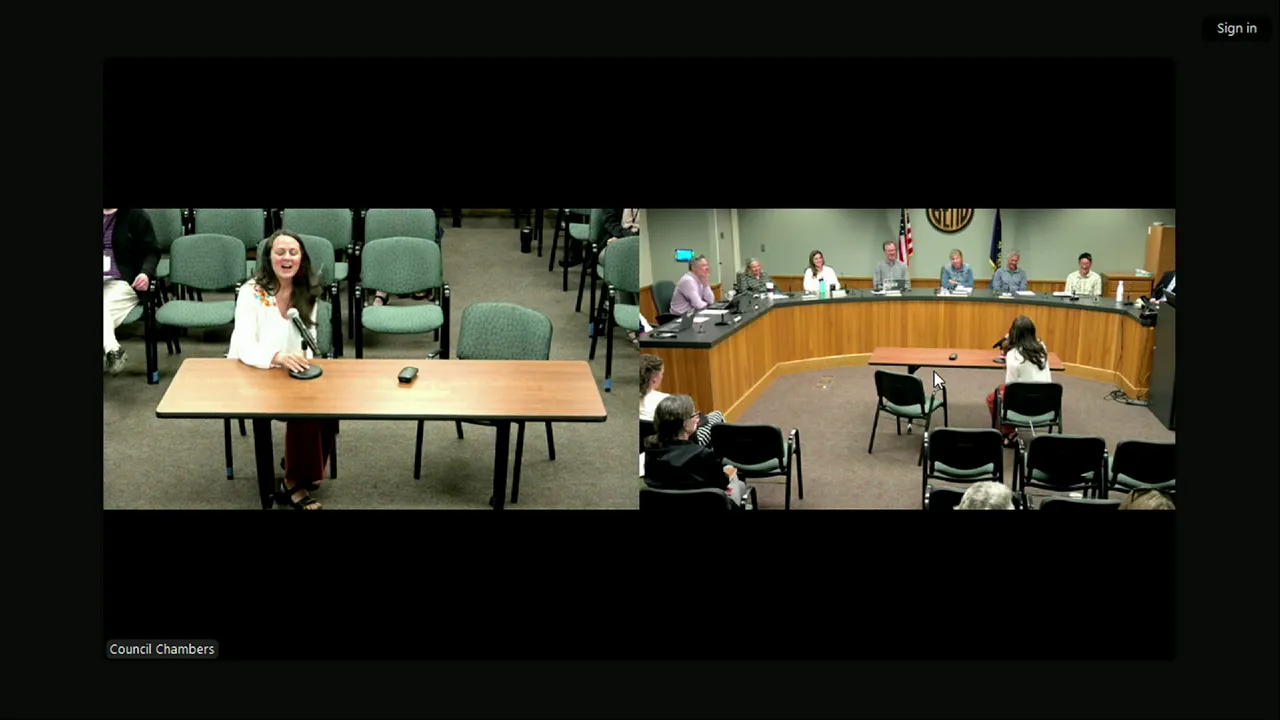
On May 10, 2024, the Bend City Council held a special hybrid meeting in the City Council Chambers at Bend City Hall. The sole agenda item was a question-and-answer session with Dr. Gregg Colburn, author of "Homelessness is a Housing Problem," hosted by Building a Better Bend. Council members, city staff, and invited partners engaged in a dialogue about the root causes of homelessness, local housing challenges, and potential strategies. No formal votes or decisions were taken.
Discussion Items
- Musical Chairs Analogy: Dr. Colburn explained his metaphor: homelessness is like a game of musical chairs where individuals are vulnerable due to personal challenges (like a hurt ankle), but the root cause is a lack of chairs (housing). He emphasized that factors like poverty, addiction, and mental illness are precipitating events, not causes, and that they layer on top of insufficient housing supply.
- Local Housing Production: Council members noted that 90% of homes in Bend are built by for-profit developers, with 10% deed-restricted affordable housing. Bend has approximately 14 building permits per 1,000 residents, double that of Houston and five times San Francisco. Dr. Colburn praised these efforts but stressed the need to accelerate production to match population growth.
- Funding Challenges: A council member asked about generating revenue for crisis intervention, shelters, and capital investment. Dr. Colburn cited Seattle's billion-dollar housing levy (renewed every six years) as a successful local example, noting that crisis conditions often drive voter support. He also mentioned Portland's housing bond. He cautioned that local jurisdictions are often starved of resources and must rely on scarce federal and state funds.
- Bottleneck in Exiting Homelessness: The discussion highlighted that while Bend has expanded shelter and transitional housing, a lack of affordable housing units prevents people from exiting homelessness. Dr. Colburn compared this to a cranberry processing bottleneck: the system backs up because there is nowhere for people to move to.
- Effectiveness and Communication: A council member asked how to know if local efforts are enough. Dr. Colburn emphasized the need to communicate incremental wins and counterfactuals (what would have happened without intervention). He pointed to Denver's "House 1000" initiative, which housed a thousand people and built public goodwill, unlike Seattle, where lack of visible progress has eroded trust.
- Land Use and Growth Boundaries: Deschutes County Community Development Director Peter Gutowski asked about urban growth boundaries and population growth. Dr. Colburn showed slides comparing cities like Charlotte, San Antonio, Austin, and Dallas (which have more land and lower homelessness) versus Boston, San Francisco, and Seattle. He argued that jurisdictions with fixed growth boundaries must either expand or densify to avoid housing crises, but noted that denser development is more environmentally sustainable.
- Incentives and Financing: Another staff member asked about effective incentives. Dr. Colburn recommended low-cost financing (e.g., 1–2% loans) to keep developers building during high interest rates. He cited Amazon and Microsoft's $2 billion housing loans in Seattle as a model, emphasizing that such loans are recycled and can be tied to affordability requirements.
- Competing for Federal Funds: Affordable housing staff asked how smaller communities like Bend can compete for federal resources. Dr. Colburn criticized outdated HUD formulas that favor older cities in the Midwest, and urged Oregon's congressional delegation to advocate for reform. He noted that political attention favors larger cities.
- Multifamily Absorption and Market Rate Housing: A council member raised concerns about multifamily absorption and community skepticism. Dr. Colburn argued that any new housing helps relieve pressure, but market-rate development alone is insufficient; it must be paired with affordable housing. He called for innovation in construction to reduce costs.
- Regional Collaboration: A council member asked about siloed bureaucracies and the need for collaboration across city, county, health, and school systems. Dr. Colburn highlighted the regional homelessness authority in King County as an example of breaking down silos, and noted that untreated homelessness is expensive, with costs distributed across emergency rooms, police, and fire.
- Mobility and “Our People” vs. “Their People”: Dr. Colburn addressed the narrative that homeless individuals come from elsewhere. He cited a UCSF study finding 90% of homeless Californians originated in California. He stressed that mobility is largely local, not cross-state, and that regional approaches are needed to avoid a race to the bottom.
Key Outcomes
- No formal votes or resolutions were adopted. The meeting was a learning and discussion session.
- Dr. Colburn reiterated that increasing housing supply is a necessary but not sufficient condition to solve homelessness; it must be combined with services and supportive housing.
- The council and staff gained insights into funding mechanisms (levies, bonds, low-cost loans), the importance of communicating incremental successes, and the need for regional and cross-sector collaboration.
- The meeting concluded with thanks to Dr. Colburn and the sponsors of the Building a Better Bend lecture series.
Meeting Transcript
There's Eric. I'm trying to pick that up at the bias, but I say anyway. Okay. And then you'll be quite basically the sound working. So we have the sound working with a couple of microphones out there, so people in the audience have questions. I will call to order this special meeting we have. And I believe that Alison is going to start us off. Yeah, and hi, everyone, good morning. My name's Alison Platt. I work for the City of Bend. And in our community and economic development department, this meeting we pulled together a lot of internal city staff as well as a quorum of council members are here. Um he holds a BA from Albion College and an MBA from Northwestern. And I'll let Greg uh introduce himself as well if he has any more to add. Hopefully, I got the nothing else. Um but the goal of this is to kind of be a dialogue. We do have speakers um in around the room, so folks uh can hear online. This is technically a public meeting, so everything is going to be recorded and available online afterwards. Um we do have speakers going on, so just be mindful of kind of side conversations because those might get picked up. Um but feel free to ask questions. Um we kind of gave a process of those who are from the public have a question, just funnel those through staff. And are people online allowed to ask questions? No, okay. Yeah. Um you're the boss, Mayor Pro Tim. Yeah, and then just really quickly, I did want to just note that this is this event is being hosted by Building a Better Bend, um, which is let me share my screen, which has many sponsors that are supporting this event. Sorry, I have to do the quick little sponsorship. Um share. Um so just want to thank all of our sponsors again. Um, Hayden Homes and Polish Homes are co-sponsoring the lecture series as title sponsors. Um the first lecture was um sponsored by Ashley and Vance Engineering. We also have sponsorships from the Ben Chamber, Pinnacle Architecture, Miller Lumber, Cascadia Partners, Central Oregon Land Watch, Killian Pacific, Shearshaw Group, as well as partnering sponsors from Project PDX, Walker Macy, Echo Northwest, Palmer Homes, DKS and Associates, Dow Engineering, Kittleson and Associates, C O I C, CalCon, Sun West Builders, CEA Consulting Engineers, KPFF, LRS Architects, Semic Design and Architecture, Hand in Hand Productions, First Inter Saving Ten Over Studios. So thank all the sponsors for supporting the building a better bend. Yeah. I grew up in a small town where I went to a lot of livestock feed shows. Thank me for that. Um, but just want to thank all the sponsors who helped put on these building a better butter bend lecture series and bringing Dr. Colburn here to have this conversation with staff and partnering agencies. Um that I'll turn it over to Dr. Colburn to kind of intro just the topic and again just open dialogue, so maybe we can open it up to counselors for questions first. Well, I think do I have to turn this on? No, no, okay. Um, I I mean many of you saw me last night, so I don't need to um reiterate the main points here. I think I think the the key issue here is um this is a difficult topic and challenge, and if this were easy, we would have fixed it a long time ago. And so I'm looking forward to your questions, and I will answer them to the best of my abilities. And if I could solve this for you, I would. Um, but that's gonna take a lot more than than my responses. And um, and so I do I do think um the but having these types of meetings is super super important, right? And having these conversations because ultimately a broader understanding and a narrative shift about this will allow for for greater action. So I'm I'm very hopeful uh for your community uh and for the folks that you're uh serving. I guess we'll start with any counselors.
openpublica.com