Bend City Council and BURA Work Session and Regular Meeting - May 15, 2024
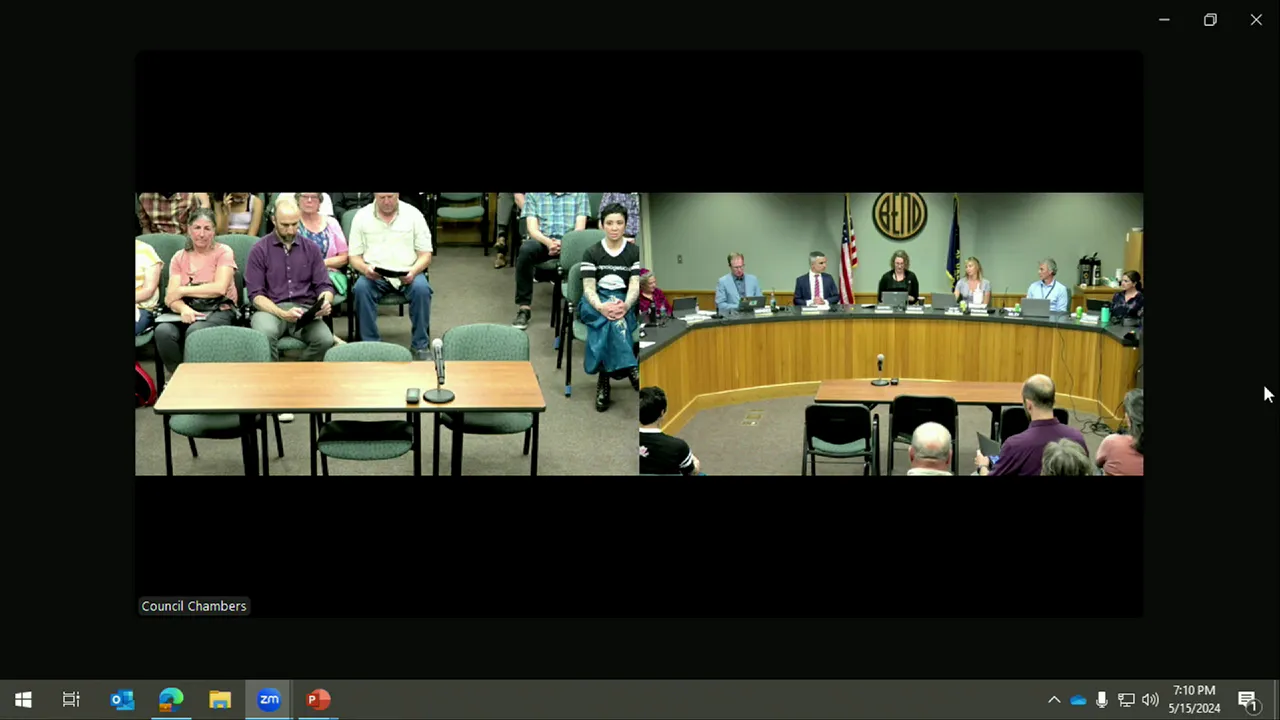
STREAMING COPY IN PREPARATION — RECORDING AVAILABLE FROM THE ORIGINAL SOURCE
Bend City Council and BURA Work Session and Regular Meeting Summary - May 15, 2024
The Bend City Council convened on May 15, 2024, for an afternoon work session, a joint work session with the Bend Urban Renewal Agency (BURA), an executive session (closed for real property negotiations), and a 7:00 p.m. regular meeting. Key actions included discussing a Citizen Assembly MOU on youth homelessness, reviewing housing tax incentives, approving updated neighborhood codes, authorizing an Air Traffic Control Tower project, and adopting second readings of ordinances.
Citizen Assembly Memorandum of Understanding (Work Session)
- Representatives from the Central Oregon Civic Action Project (COCAP) and Healthy Democracy presented a proposal for a Citizen Assembly on youth homelessness.
- Project Description: Approximately 30 randomly selected residents (lottery from ~10,000 invitations) will deliberate over two weekends in September/October 2024. Participants will receive a daily stipend (~$100), and coverage for childcare, elder care, and transportation. The City would commit to receiving and publicly debating the recommendations without financial obligation.
- Key Discussion/Speaker Positions: Councilors expressed support for signing the non-binding MOU. Councilor Méndez and others emphasized the need for a well-crafted framing question to ensure recommendations align with jurisdictional responsibilities (city, county, COIC). Mayor Kebler noted the importance of the assembly being community-driven. Council agreed to proceed with the MOU.
Update on Tax Incentive Programs (Joint Council/BURA Work Session)
- Staff presented options to incentivize housing following the pause of the MUPTI program.
- ADU and Middle-Income Tax Exemptions: Staff proposed adopting state-enabled, five-year property tax exemptions as a city policy to spur ADU and middle-income housing development. This requires 51% approval from other taxing districts. Council directed staff to pursue these policies. Councilor Riley requested adding a data collection component to track rents.
- Site-Specific Tax Increment Financing (TIFF): A proposed flexible tool to replace MUPTI, allowing limited parcels to use tax increment financing for affordable housing. Staff modeled achieving 20% affordable units at 60-120% AMI (e.g., 1 of 4 units in a quadplex at 70% AMI). Staff requested BURA assign policy formation to the Stewardship Subcommittee.
- Key Outcomes: Council directed staff to continue work on the ADU and Middle-Income tax exemptions. BURA agreed to pursue the Site-Specific TIFF policy and assigned its development to the Stewardship Subcommittee.
Public Comments & Testimony (Regular Meeting)
- Jim Christo (Southeast Bend Neighborhood Association Chair): Expressed opposition to several aspects of the proposed neighborhood code changes, including potential mandatory name changes, lack of clear guidelines for district formation, and the structure of appeal fees which he argued asymmetrically burden neighborhood groups.
- Ted Bayer (Aubrey Butte Neighborhood Board Member): Expressed support for the code changes and urged the city to do more to increase community awareness of the neighborhood district program.
Discussion Items (Regular Meeting)
- Neighborhood Code (First Reading – Item 10): Staff presented an ordinance amending Chapter 1.70 resulting from a two-year assessment. Key changes include renaming "associations" to "districts," adding a purpose statement, establishing a minimum size of 1,000 households for new districts, and requiring annual neighborhood surveys. Council passed the first reading with two amendments moved by Mayor Pro Tem Perkins: adding "or other assistance" to the restrictions on use of city resources in Section 060, and replacing "community" with "neighborhood" in the survey language of Section 050(D).
- 2024-2025 CDBG Annual Action Plan (Item 6): Staff presented the plan. The Affordable Housing Advisory Committee recommended funding for Thrive Central Oregon, Volunteers in Medicine, J Bar J Loft, Bend Church, and Bend-Redmond Habitat for Humanity. One applicant (Homeward Network) was not recommended due to organizational maturity. Council approved the plan unanimously.
- Air Traffic Control Tower (Items 7 & 8): Airport Manager Tracy Williams presented that the Bend Municipal Airport (3rd busiest in Oregon, ~141,000 annual operations) will break ground on a 115-foot tower. Staff recommended contracts with Corp Inc. ($9.6M construction), Morrison-Maierle ($1.77M construction management), and CEC ($125k sole source electric infrastructure), and application for $11.29 million in FAA grants. Total project cost is ~$14 million, under initial estimates. Council authorized the contracts and grant applications unanimously.
- Full Faith & Credit Obligations (Item 9): Staff requested amending Resolution 3362 to increase maximum allowable interest rates (from 6% to 7% fixed, 12% to 15% variable) due to current market conditions. Council approved the amended resolution.
- Surplus Property Sale: Council President Riley moved to accept a bid of $151,903 from MK LLC for surplus property near SW Donovan Avenue, allocating proceeds to affordable housing programs. Approved.
Key Outcomes (Regular Meeting)
- Second Readings Adopted:
- Ordinance amending BMC Chapter 1.55 (Public Contracts) – Adopted (Councilor Broadman abstained).
- Ordinance amending BMC Chapter 1.10.040 (Council Member and Mayor Compensation) – Adopted (Councilor Broadman abstained). All councilors declared a potential conflict of interest.
- City Manager Evaluation Kickoff: HR Director Rob Vaughn presented the process for the 2024 review of City Manager Eric King. Council will solicit feedback from direct reports and hold a discussion on June 5, 2024.
- Proclamations: Council proclaimed Public Works Week (May 19-25), Asian American and Native Hawaiian/Pacific Islander Heritage Month (May), and National Preservation Month (May).
- Council Reports: Councilors provided updates on the Greg Colburn housing event, committee meetings, attendance at local events, and upcoming Pride festivities.
Meeting Transcript
All right, so we're gonna go ahead and get started with the first item on our Bend City Council work session. Um I think we got a couple people to pull over online for our next presentation. And I'll open this up with Yeah, nice to see you, Lynn. Nice to see you, Josh. I'll let them introduce themselves here in a moment, but just want to set the stage for this item. Uh the concept of citizen assemblies was something that was brought to us, I think, via counselor Broadman uh last year and Claudia, and I'm gonna blank on Claudia's last name. Swalice from uh is from Spain, and we did a no sorry. Um we did an informational session about a year ago, and uh some counselors attended, but for for those that aren't familiar with the concept, there was a city club recently that talked about citizen assemblies as well. So I think you'll hear a little bit of of uh some background and what they are. Um, really what we are talking about today, though, is a potential arrangement or agreement between the City of Bend and the Central Oregon Civic Action Project. Um and there's an MOU that's attached to your packet, so you can see the terms outlined in that MOU. I would say one of the main pieces of that is an agreement that we would receive a recommendation from a citizen assembly that that's what we're basically committing to in the MOU and some other things as well. Um so I want to make sure you're comfortable with that. So I'll circle back after the presentation, and so we want to have a discussion on this path forward in partnership with um Central Oregon Civic Action Project or C have a COCAP COCAF is what the acronym is. Um just would I think want to make sure council is comfortable with the approach that's being taken. So I'm gonna turn it over to Josh and to Lynn, and they'll walk you through that presentation and we'll circle back with questions. Well, thank you very much. Um as you can tell uh by my propensity to use acronyms. Uh I am a retired military officer, spent 25 years in the Air Force, uh retired colonel, and uh also a proud resident of Central Oregon here in Bend, and thanks for the kind introduction. And it's good to see so many familiar faces that we've already spoken with about this topic, but it's also a great opportunity for my colleague Lynn Davis, who's a co-director of Healthy Democracy, one of our core partners and I, to give you just a little bit more insight and detail about what this is about, what progress we've made to date and what our plans are for the future. Um so as we stated, I'm the sort of the head of the Central Oregon Civic Action Project, or COCAP, where our vision is helping shape a more civically engaged and vibrant community where everyone is empowered to help determine our shared future together. And our mission and sort of the way we look at doing that is by opening doors, building bridges, and co-creating spaces for deliberative decision making for all members of the community, even those who may not be here in Bend, as you can tell by the name. Our ambitions are big to work throughout the uh Central Oregon region. What we're gonna be talking about tonight, as you can see. I don't know if our if our slides are available to pull up on the screen, but we will have to do the yeah, maybe Lynn, if you can share those slides, that would be helpful. Um, but I'll keep on going in the meantime. We'll get them back eventually. Um and if we don't, I can always, I think we've got to do that. I can I can share them while you're talking about it. Yeah, but I'm gonna hire that. Um our overall objectives, and we'll talk about this again toward the end of the presentation, are to help bridge social divides, to help restore faith in our institutions here locally and regionally, and also to help achieve better governance outcomes uh alongside all of our elected and administrative officials here. You know, I think we are extraordinarily fortunate, and I'm finding out more every day about the rich tradition of civic engagement here in Central Oregon and Bend from service organizations to nonprofits to the peaceful demonstration I drove past in the park on the way out here. People are involved, and that is tremendous. And we've seen it through uh the committee members who join your council uh and and any number of other people who are involved. But just like anywhere, typically those are people with special interests, they're key stakeholders, they're people who have the time and the resources to get involved, and that leaves probably the majority of our community and those outside of Bend and in the county who don't have those opportunities and perhaps don't feel as if they're heard, don't feel as if they have a seat at the table. And that's what we want to do is provide them that seat at the table. There we go. What great timing, our little tagline under our under our logo. Uh, and we'll be talking specifically about today one aspect of what a civic engagement hub can do, which is holding a civic assembly. In this case, it'll be on youth homelessness. I'll give a little bit more detail later on how we've arrived at that topic and and where we're headed. But in spite of that rich tradition, we kind of need it right now because as many of you know, Bend and Central Oregon are sort of emblematic of a lot of the divisions that exist within our country right now, whether those are political divides, socioeconomic divides, the strains that exist under rapid growth and being a great place to live means that we have more and more people arriving and the difficulty of handling that influx. Um we have been very fortunate that we are now well into negotiations with the city with our your colleagues at the county and in other jurisdictions around the area to uh formulate memorandums of memoranda of agreement to move forward on a civic assembly, and also then we have our core foundational uh partners who you saw in the previous slide, Democracy Next, where Claudia Schwales is the founder and director, which is an internationally renowned uh think tank and action um organization focused on citizens and civic assemblies, OSU Cascades and the Center for the American Conversation are another core partner, and then of course Healthy Democracy, which is based out of Portland and Eugene, who have been some of the key and lead practitioners of deliberative democracy in the United States and particularly on the West Coast over the past 10 to 15 years. So without any more of me talking right now, because I'm not the expert on civic assemblies. I'm gonna hand it over to Lynn to provide a bit more background information. Thanks. Thanks so much, Josh. We're gonna be there in person and thank you, count members. Uh great to meet you virtually uh and be here. Uh we're thrilled to uh be potentially, hopefully working on I should say definitely working on a project in um upcoming in Central Oregon for the first time.
openpublica.com