Bend City Council, Urban Renewal Agency, and Regular Meeting Summary - August 7, 2024
STREAMING COPY IN PREPARATION — RECORDING AVAILABLE FROM THE ORIGINAL SOURCE
Bend City Council, Urban Renewal Agency, and Regular Meeting Summary - August 7, 2024
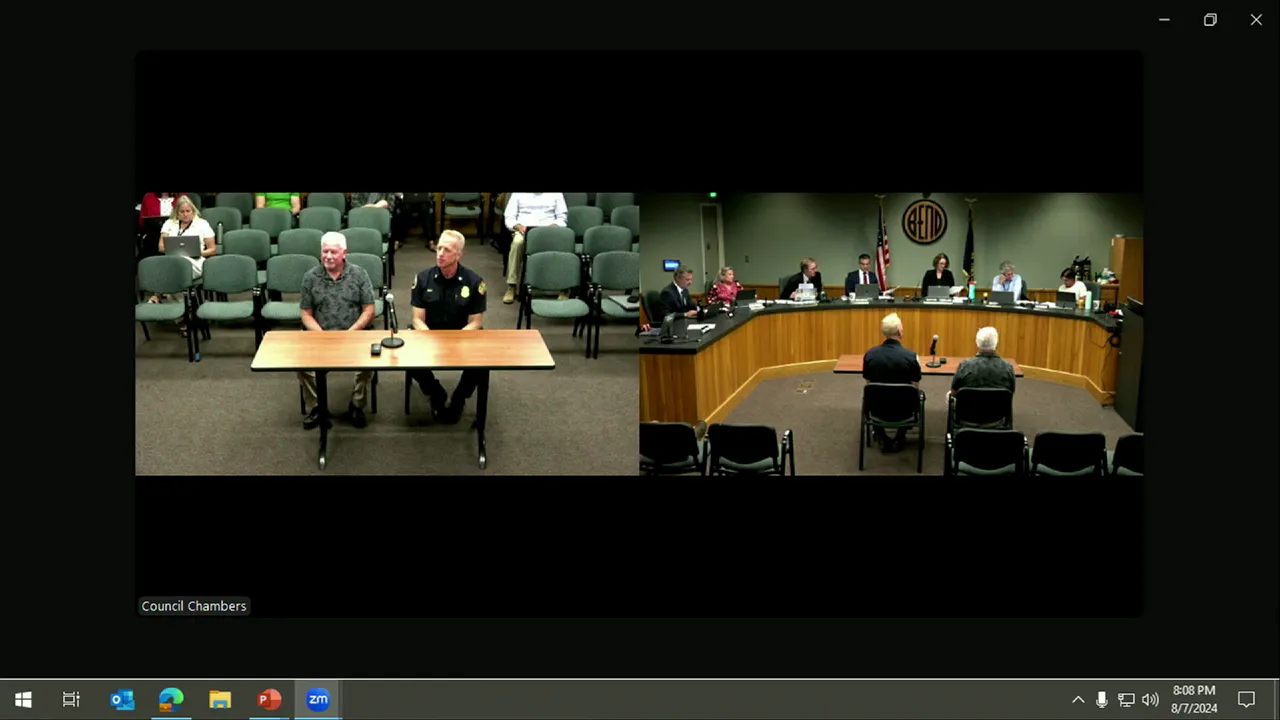
The City of Bend held a hybrid work session beginning at 5:00 p.m., followed by an Urban Renewal Agency work session, an executive session, and a regular council meeting at 7:00 p.m. on August 7, 2024. The evening included a fire season update, selection of a preferred bridge type for Hawthorne Bridge, a preview of draft Tax Increment Financing (TIF) policies, public testimony on the Milepost 132 fire and other neighborhood concerns, approval of contracts, and adoption of ordinances.
Work Session: Fire Season Update
- Emergency management director Kerry Carl reported 88 large fires burning nationally and 33 in Oregon (about 37%), with more than 9,000 personnel assigned.
- Fire Chief Todd Riley said the Milepost 132 fire began at 2:30 p.m. on Friday, August 2, 2024, near 64010 North Highway 97, and burned 78 acres. The origin was a campfire/cooking fire at an encampment on private property; no structures were lost.
- Real estate director Matt Stewart described ongoing management of city-owned land at Juniper Ridge, including distribution of fire extinguishers at about 50 camps, firebreak work along the North Interceptor sewer line, and coordination with the county. Council supported exploring defensible-space work near affected neighborhoods and a possible code change to allow fire-resilience mitigation with fire department approval.
- A joint meeting with Deschutes County commissioners is scheduled for September 5 to discuss long-term management of Juniper Ridge.
Work Session: Hawthorne Bridge
- City engineer Garrett Sabron and DOWL engineer Jared Trowbridge reviewed four bridge types: two-tower cable-stay, single-tower cable-stay, extra-dosed, and steel truss.
- About 400 people completed the public survey; the steel truss received the highest preference, followed by the extra-dosed option. The 75-year lifecycle maintenance estimate was about $1 million for the truss, $5 million for the single-tower cable-stay, and $7 million for the two-tower cable-stay.
- Council consensus selected the single-tower cable-stay bridge, with direction to keep design within available funding of about $32.1 million and return with aesthetic options.
- Council also directed staff to work with ODOT to amend the Parkway Plan to close the Hawthorne exit. The public survey found 67% support for closure; safety and connectivity were cited as key reasons.
Urban Renewal Agency Work Session: Draft TIF Policies
- Staff presented draft site-specific Tax Increment Financing policies aimed at lowering rents and encouraging good-paying jobs.
- Key data cited: average Bend market rent is about $1,800 per month; an entry-level teacher can afford about $1,200; a target vacancy rate of 8% is considered healthy; an additional 1,000 multifamily units are needed.
- Proposed housing incentives would require 15% of units in participating multifamily projects to be rented at or below 90% of Area Median Income, with a 10-year minimum compliance period and clawback provisions.
- Council asked staff to clarify the distinction between minimum requirements and desired additional criteria, to avoid making energy efficiency and supplier diversity hard requirements initially, and to bring a revised policy back on August 21.
Executive Session
- Council convened an executive session under ORS 192.660(2)(e) to deliberate with real property negotiators. No decisions were made, and the council returned to open session before the 7:00 p.m. regular meeting.
Regular Meeting: Consent Agenda
- The consent agenda was approved unanimously, including the July 17, 2024 meeting minutes, OLCC report, quarterly investment report, and an agreement with AKS Engineering & Forestry, LLC for Neff Corridor Improvement design in an amount not to exceed $393,020.
Public Comments & Testimony
- Jonathan Curtis questioned Greenwood repaving and bike-lane spending, and raised concerns about emergency vehicle access.
- Carl Schumacher described a disturbing incident he witnessed in a downtown pizza parlor.
- Alicia Reynolds, property manager at Cedar West Apartments, requested action on camping and trash along Watt Way, saying it affected safety and occupancy.
- Nancy Kerfman and Brian Frankel urged safer pedestrian crossings on Franklin Avenue, including a rapid flashing beacon at 6th Street and mid-block crossings at 5th and 7th streets. Frankel noted a neighborhood plan endorsed by 30 residents and questioned why Franklin was excluded from crossing solutions used on other minor arterials.
- Tyler Reynolds, Craig Rinkert, Linda Cook, Sherry Van Dyke, Troy Anthony, and Cameron Alderson spoke about the Milepost 132 fire and Juniper Ridge. They described evacuations, fear, gunfire, and frustration; many said current actions are inadequate. Rinkert said preventing ignition is the best mitigation; Van Dyke and an online commenter called for professionally managed sanctioned camps; Alderson said the council was scapegoating homeless residents and criticized growth and evacuation planning.
Regular Meeting: Public Hearings and Action Items
- Item 6: The council adopted a resolution adding a $600 payment-in-lieu-of-tree-replacement fee to the FY2024-25 fee schedule. Councilor Norris recused.
- Item 7: A contract with DOWL, LLC for Reed Market Corridor preliminary engineering and environmental review services was approved, not to exceed $1,749,765.84.
- Item 8: An intergovernmental agreement with Deschutes County Rural Fire Protection District #2 for fire protection services and funding was approved unanimously. Fire district executive director Gary Marshall reviewed the 1999 IGA, recent levy history, and planned expansion of Station 6.
- Item 9: An ordinance adopting the fire code (BMC Chapter 8.10) was adopted by roll call vote, 7-0.
- Item 10: An ordinance amending Title 16, grading/excavation/stormwater management, including new erosion control and tree preservation chapters, was adopted by roll call vote, 7-0, with an emergency declaration. Councilor Norris declared a potential conflict but voted.
Council Reports and City Manager's Report
- Councilors reported on committee updates, a Central Oregon Employers Council meeting, MPO meetings, the Bend Police Department swearing-in and National Night Out, the Southern Crossing Block Party, and a meeting on youth mental health needs.
- City Manager Eric King reported CityFest on August 15, Greenwood Avenue chip seal completion and full reopening planned for August 14, upcoming paving work on Deschutes Market Road, Milwaukee Avenue, and Reed Market, and continued coordination with the Confederated Tribes of Warm Springs on water issues.
Key Outcomes
- Council selected the single-tower cable-stay design for the Hawthorne Bridge and directed staff to proceed with ODOT on closing the Hawthorne exit.
- Staff will pursue defensible-space work, a potential code change for fire mitigation, and a September 5 joint county-city discussion on Juniper Ridge.
- URA staff will revise the draft TIF policy to separate minimum requirements from desired enhancements and return on August 21.
- All contracts, the fee resolution, and both ordinances were approved. The fire code and Title 16 ordinances passed unanimously on roll call.
Meeting Transcript
All right. We are ready to begin our work session tonight, and we are starting with a fire season update. So we'll have our staff come on up for that. And just to provide some introductory comments here, so really we had scheduled this a couple of weeks ago. We've been kind of in the pattern of providing a water update in the spring and a fire update in the height of the fire season. So obviously there's some significant concerns that we're seeing across the region, across the state. So with that, I want to introduce uh Todd Riley, Fire Chief, and Kerry Carl, our emergency management director. Thanks so much for having us here tonight. Um I'm gonna talk with uh about kind of a general overview of where we stand across kind of Oregon, but also maybe uh at the national level, and then Todd will take us a little bit closer in. Uh so you can see shared up on the screen is the Oregon State Um Oregon Department of Emergency Management's uh fires dashboard, and that kind of gives you a perspective of how many fires are burning across uh Western United States. Um that's important to think about because a lot of the resources that we utilize in order to fight fires are uh not just located within one state, they are shared across states. Uh and the governor's declaration allows us to use emergency management assistant compact, which allows us to bring resource resources in across state boundaries. Um the bright yellow circles are the fires that have been ignited within the last 24 hours or have been identified. So you can see that there's you know, storm systems that are moving through uh with lightning causing uh natural caused fires, and then there's also human-cause fires on the landscape. So as we kind of zoom in a little bit, um, the bigger fires or the bigger circles, those are gonna give us kind of our large fire perspective. Uh if it's and by large fire, I mean if it's a timber fire, it's over a hundred acres. If it's a grassland fire, it's over three hundred acres. Um when we think about large fires, that means more complexity, there's more resources, there's things that are needed in order to address that. But looking at all these these kind of circles or points really gives us this perspective that a lot of resources come in in alignment with those fires needs, and that means resources are constrained as well. Uh and resources are personnel to fight the fires, equipment, air assets, all of those things uh uh that we need in order to deal with fire suppression or also uh handle initial attack. When we look at the nation, there are 88 uh large fires that are burning in uh um United States. Uh but when we look at Oregon, 33 are located here. Uh so that's about 37% of the large fires that are occurring in the nation are actually occurring within the state of Oregon. Um again, that speaks to the resources that are here. We have over um 9,000 personnel working these different uh large-scale fires uh that are impacting the landscape. So it's it's a it's a pretty huge undertaking. Uh it's a lot of resources, uh but there's a lot of coordination that's been happening at the state level, so the emergency coordination center has been activated for quite a while to actually really help us through this process to bring these additional resources in. Uh, and of course the governor's declaration helped with uh um I believe it's operation uh plan smoky smoky, I always think that backwards for the National Guard, but other resources to be available that we may not normally have uh in a fire season. So that's kind of the larger perspective, those different bigger fires that are happening. And Todd, do you want to take us down to maybe the local level? Absolutely. So a year ago I was in front of you and delivered a similar update, and there wasn't a lot to report last year. Um this year, unfortunately, is a very different story. And that was just fortunate. If they were committed to another incident, they would not have been available for this one. So when the mile marker 132 fire started, um, we knew it was going to have the potential to get big. So we did send a lot of resources to it and had a ton of help from partner agencies. So the cooperation worked. Um, the communications plan worked, the evacuations worked, but again, it was a high profile, uh high anxiety event for a lot of folks in our town and continues to be. Um it's not not lost on us, even though we did not lose any structures. We are can tremendously fortunate to end up where we did. At the end of that fire, well, about three hours into it, we did lose those two task forces that were helping us because they had to go fight yet another fire that was in the area, and now there's the conflagration that's happening in Jefferson County west of Madras, and we again supported that cause as well. So resources are stretched thin, just like Carrie was saying. And so what we like to do is remind individuals what they can do, because oftentimes you get into the state of we live in central Oregon, we're in the wildland urban interface, and conditions are extreme. So there is still personal responsibility and ownership that people can take to help keep their homes, their neighborhoods, and their communities safe. So please pay attention to our our defensible space standards, and they're outlined in the own your zone strategy or own your zone initiative that we have published on our website. And also sign up for the dischutes alerts. That's one of the best ways that our community members can stay aware of what's happening. And it's it's not always a progression from level one to level two to level three. And those folks that live on the north end of end, their first indication of this fire was level three, get your stuff and get out.
openpublica.com