Bend City Council Meeting - September 4, 2024: Development Code Updates, Airport Fees, and Housing Actions
STREAMING COPY IN PREPARATION — RECORDING AVAILABLE FROM THE ORIGINAL SOURCE
Bend City Council Meeting - September 4, 2024
The Bend City Council met on September 4, 2024, for a work session at 5:00 PM and a regular meeting at 7:00 PM. The work session focused on development code updates, including potential prohibitions on auto-dependent uses in convenience commercial zones and restrictions on short-term rentals in neighborhood commercial zones. The regular meeting included a public hearing on airport fee amendments, approval of a $5 million PRO Housing grant, initiation of a right-of-way vacation, and adoption of water/sewer connection standards for middle housing land divisions. Public comments addressed homelessness, transient fires, e-bike safety, and parking.
Consent Calendar
- Approved minutes from August 21, 2024.
- Accepted the OLCC Report.
- Approved the Monthly Financial Report for July.
- Authorized an agreement with North Industrial, LLC dba Coatings Unlimited for the Outback 2 and Rock Bluff Reservoir Rehabilitation Project in the amount of $1,786,500.
- Authorized agreements with Polydyne, Inc. and Solenis, LLC for dewatering polymer purchase, cumulative amount not to exceed $400,000.
- Authorized an agreement with Temp-Rite Mechanical, LLC for the Water Reclamation Facility Headworks Odorous Air Ductwork Replacement Project in an amount not to exceed $360,479.
Public Comments & Testimony
- Juan Barrasa (secretary director of Latino Funders) invited the council to join the Pitch Latino event on October 1, featuring entrepreneurs competing for $10,000.
- Jessica Gamble (service provider) opposed the proposed 24-hour camping rule, asking that people not be required to move every 24 hours to allow time for service delivery.
- Jonathan Curtis criticized spending on a pedestrian bridge, bike lanes, and electric vehicles, arguing funds should be used for homelessness management and that e-bikes are dangerous.
- Eli Harris urged improving quality of life and culture to address homelessness, suggesting a focus on community swag.
- Samuel Facey expressed concern about paid parking downtown, stating it hurts businesses.
- Arthur described e-bikes and e-scooters as dangerous, citing a personal injury incident, and questioned their benefit to tourism.
- Sherry Van Dyke (city resident) criticized the council for prioritizing bridge design and roundabout artwork over the homelessness crisis, citing multiple transient fires, shootings, and unsafe conditions near Dirt World. She urged action.
- Linda Cook (city resident) detailed repeated fires, gunshots, and property damage from squatters near her home, emphasizing the daily toll on residents.
- Chuck Hemingway (Homeborn Network) expressed concern that the proposed change from 3 days to 24 hours for vehicle camping violates city code (Chapter 4.05.010, paragraph 4), which acknowledges sheltering for extended periods. He provided a counter-proposal and urged reconsideration.
Discussion Items
-
Development Code Updates (Work Session)
- Auto-dependent uses in Convenience Commercial (CC) zones: Staff proposed prohibiting auto-dependent uses (gas stations, car washes, etc.) in CC zones to support council climate goals. Council discussed impacts on existing non-conforming uses, the need for a comprehensive approach via the upcoming growth plan, and whether to pause new auto-dependent uses for 2-3 years until the growth plan is complete. Council directed staff to develop code amendments removing auto-dependent uses from CC zones, with language that existing uses are not considered non-conforming.
- Short-term rentals in Neighborhood Commercial (CN) zones: The CN zone exists in only three locations (five properties). Council discussed applying the same 500-foot concentration limit as residential zones, effectively preventing new short-term rentals in these areas. Council directed staff to amend the code to apply the 500-foot limit to short-term rentals in CN zones.
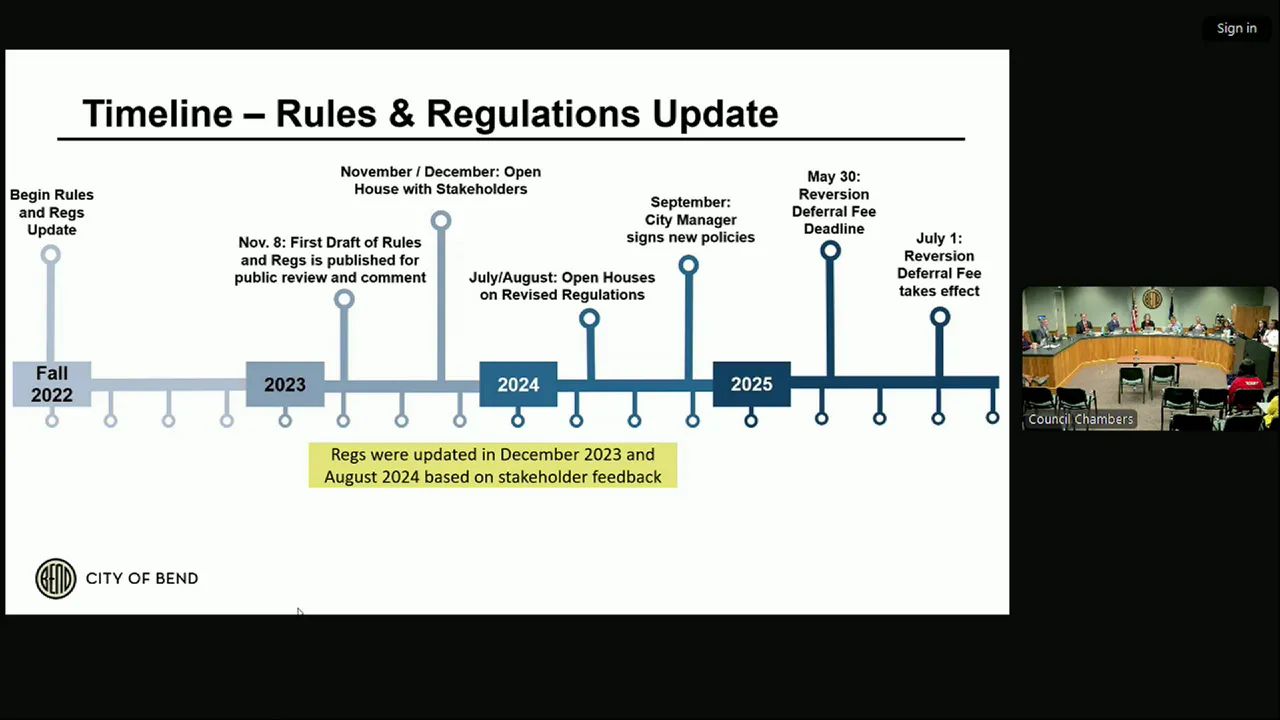
- Future code updates: Staff outlined upcoming state-mandated and council-initiated code amendments, including floodplain updates, implementation of several Senate and House bills (SB 8, HB 2984, HB 3151, HB 4063, SB 1537), accessory dwelling unit standards, and a cleanup package. A timeline was provided, with most updates expected by early 2025.
-
Airport Fee Resolution (Public Hearing)
- Airport Manager Tracy Williams and Real Estate Director Matt Stewart presented a resolution to amend fees for FY 2024-2025, including a new Reversion Deferral Fee program, Assignment & Transfer Fee (3% of sale price, capped at $10,000), and annual contractual increases. The deferral fee allows tenants to extend leases up to 49 years, deferring reversion of improvements to the city. The opt-in fee is $500, with a deferred rate of $0.50/sq ft/year (discounted to $0.35/sq ft until May 30, 2025). If all 112 eligible ground leases opt in, estimated annual revenue is $197,000. The program is intended to generate near-term revenue ($2 million over 10 years) to support $20 million in capital improvements, while providing lease certainty to tenants. Public comment from John Thielen (Friends of Bend Airport) and Kim Minch expressed support, noting the collaborative process and urging approval.
-
PRO Housing Grant
- Affordable Housing Coordinator Melissa Gamache presented a request to authorize the City Manager to accept the $5 million HUD Pathways to Removing Obstacles to Housing (PRO Housing) grant. The grant will identify and address barriers to affordable housing. Activities will be rescaled from the original $10 million proposal, with adjustments to activities 1-3, while activities 4 and 5 remain unchanged. The grant runs through 2029.
-
Vacation of Excess Right-of-Way (Country Club Drive and Woodside Court)
- Staff requested initiation of vacation of excess right-of-way to facilitate the Obsidian Heights subdivision by Hayden Homes. The excess right-of-way resulted from a 1982 road realignment that was never formally vacated. The applicant committed to providing two deed-restricted affordable housing units on the vacated land. The subdivision would include a multi-use path and sidewalk, improving connectivity. Council initiated the vacation and directed staff to schedule a public hearing.
-
Water and Sewer Connection Standards for Middle Housing Land Divisions
- Staff presented two items: a resolution updating Standards and Specifications Sections 4.3 and 5.2, and a first reading of an ordinance amending BMC Section 15.10.020. The changes allow separate water and sewer service connections for each dwelling unit when a developer intends to subdivide via middle housing land division, even if the subdivision hasn't yet occurred. This addresses inefficiencies where developers install one connection but later need to subdivide. Council adopted the resolution and approved the first reading.
-
Historic Sites Inventory Amendment (Second Reading)
- Second reading and adoption of an ordinance amending Table 3-1 of the Comprehensive Plan to add the A.J. Tucker Blacksmith Shop at 200-202 NW Greenwood Avenue to the inventory of historic sites. Adopted by roll call vote (7-0).
Key Outcomes
- Development Code Updates: Council directed staff to prohibit auto-dependent uses in CC zones and apply the 500-foot concentration limit to short-term rentals in CN zones. Staff will return with code amendments.
- Airport Fee Resolution: Adopted unanimously (7-0). The resolution amends fees and charges for FY 2024-2025, including the Reversion Deferral Fee program, Assignment & Transfer Fee, and annual increases.
- PRO Housing Grant: Council authorized the City Manager to accept the $5 million grant (7-0).
- Right-of-Way Vacation: Council initiated the vacation and scheduled a public hearing (7-0, Councilor Broadman recused due to conflict of interest).
- Water/Sewer Standards: Resolution adopted unanimously (7-0); first reading of ordinance approved unanimously (7-0).
- Historic Sites Ordinance: Adopted on second reading by roll call (7-0).
- Council Reports: Council noted upcoming meetings, including a joint meeting with Deschutes County on homelessness and managed camping, and the stewardship subcommittee meeting on ARPA and deflection programs.
Meeting Transcript
Zone and the andor the commercial neighborhood zones. And then after that, uh we'll kind of transition into several other scheduled development code updates that we have that we wanted you to be aware of that we're working on and we'll be working on for the next six or eight months. So the first part of this work session is implementing a part of a current city council environment and climate goal, and that is to develop new policies to support sustainable development in a variety of ways. One of which is to look at autodependent uses in commercial zones. So that's that part of the policy we'll be talking about today. That does uh generally relate to some longer term work that the growth plan um growth management divisions working on and for our complete community strategy. So as part of updating the city's growth plan over the next couple of years, that team will be looking at community-wide strategies to create new key destinations to reduce vehicle miles traveled. As part of that, they'll be looking at our residential areas and how we can facilitate uh the right size and right type of commercial nodes within those residential areas that can support pedestrian compact friendly mixed-use development patterns. So, just so the council knows this longer term, like holistic look at small commercial nodes within residential districts will occur over the next few years. So we're approaching this current work effort to be pretty narrow to look at um reconsidering allowance of auto-dependent uses in the convenience commercial zone. And with that, I'll hand it off to Beth. Okay. So the convenience commercial zone, it right now it conditionally allows auto-dependent and auto-oriented uses. Auto dependent uses are means automobiles and or other motor vehicles that are served by the use, and the use would not exist without them, such as vehicle repair, gas station, car wash, and auto and truck sales. Auto-oriented is more focused on um where the motor vehicles are an integral part of the use, uh, like drive-ups, drive-ins, and drive-through facilities. Um, both of these require conditional use permit in the convenience commercial zone, which is a type two process with public notice, and there are specific um physical orientation standards and whatnot that um that would apply to these auto-dependent and auto-oriented uses. And so the auto-dependent uses, um, gas stations, car washes, truck sales, mechanics, um, are um they're found in about we have about 28 locations of CC zoning throughout the city, and um we tried to throw them all up in one map so you can see that they're pretty dispersed uh throughout the within with throughout the city limits. Um there are approximately um 87 acres of CC zoning, and about 37 acres are vacant or underdeveloped. So that would mean about 50 are um are developed with um convenience commercial uses. So the question here is um in support of the council goals, does council want to prohibit auto-dependent uses in the CC zone moving forward? Great. And did you all want to pause here and just have us discuss that? What would be the easiest before we go forward? Okay, so council this um was part of our goals. We also had the um hearing with the appeal on the gas station that the community was very interested in that was in one of these zones. So um does anyone have comments or suggestions or desire to um to do this prohibition at this point? Do we still think that that's what we want to do? Floor is open. Could you go back to the map? Certainly, thanks. And I will say um if council does want us to make any changes to allowed uses in the commercial convenience zone, we can add language as we've done and other amendments to the land use tables that would specifically say that if there's any existing auto-dependent uses in the CC zone, they can continue to exist and operate, they wouldn't be non-conforming uses. So if there's any concern about how this might impact existing CC zone developed properties, your decision would then primarily affect those 15 or so properties that are vacant or underdeveloped. That's fine. Right. So for those that are existing today, that would come up if the property sold or somebody proposed some kind of redevelopment. I mean, we can't just because we change the use, we're not gonna go in and shut somebody down, right? That's not a to start with, right? This is so what would trigger something where it would be quote non-conforming if we didn't do that? What kind of action would get us to a place where you could sort of challenge it or somebody would not put in the code language that explicitly said existing autodependent uses in the CC zone may continue to operate and are not considered non-conforming. If we didn't do that, then they would become non-conforming, and there's limitations on how much they can add to the building and how much they can intensify the nonconforming use on the site. So it does put more parameters on a non-conforming use. Would it cause do we even know if it would cause business problems for them if they went out for a loan or they went I think they might know? Yeah, sometimes I can. So if there is that kind of if it's a non-conforming, it could affect financing and other business decisions. So it's it is a risk. Um this was mentioned. Um I just wanted to make the point that we have talked about and are going to be engaging on a large growth plan that's going to include comprehensive plan amendments that's going to include a lot of things the state is telling us, but that we also want to do to create complete neighborhoods, walkable neighborhoods that serve the folks who live across our city. So to me, this is sort of a very short term. Do we want to just pause on these properties on this map for now? Understanding we're going to be coming back to what do our zones look like where in the city is as it um comes to complete communities, and that you know, this this designation may be updated or changed as part of that work as well.
openpublica.com