Joint Meeting of Bend City Council and Bend Park and Recreation District - October 29, 2024
STREAMING COPY IN PREPARATION — RECORDING AVAILABLE FROM THE ORIGINAL SOURCE
Joint Meeting of Bend City Council and Bend Park and Recreation District - October 29, 2024
The Bend City Council and Bend Park and Recreation District (BPRD) held a joint meeting on October 29, 2024, at Bend City Hall, beginning at 4:00 PM with a break from 5:30-6:00 PM, and adjourning after 7:00 PM. The meeting focused on coordination in planning for growth, infrastructure projects, childcare, and affordable housing. No public comment was taken. Staff presented updates on the BPRD Comprehensive Plan update, the City's growth management strategy (including one-time UGB expansion, 20-year growth plan, and urban reserves), coordinated trail and infrastructure projects (Bend Bikeways, Riverfront Street, Hawthorne Bridge, etc.), childcare initiatives (Kids Inc. and outreach), and the partnership on affordable housing, specifically the BPRD SDC waiver program set to expire in December 2024.
Planning for Growth
Sara Anselment (BPRD) presented the midterm update to the BPRD Comprehensive Plan, noting that population growth has exceeded projections. A 2023 community survey found that 69% of respondents preferred serving higher density with new parks and facilities rather than enhancing existing parks. The update added new park search areas in the Stevens Road tract, core area, and climate-friendly areas, and identified 13 targeted trail crossing improvements. Brian Rankin (City) outlined the City's three-phase growth management strategy: a one-time 100-acre UGB addition for affordable housing (site selection in December 2024), a 20-year growth plan to 2045, and urban reserves for 2055-2075. He emphasized coordination with BPRD on land needs and infrastructure. Councilor Broadman asked about the process for addressing the 13 grade trail crossings; Anselment noted coordination with the City's transportation mobility department. Director Hovekamp inquired about integrating BPRD plans into the City's comprehensive plan; Rankin indicated flexibility but willingness to explore more direct incorporation.
Coordinated Infrastructure Projects
Russ Grayson (City) and Henry Stroud (BPRD) presented examples of joint infrastructure projects. They discussed the 2021 Trail Planning and Management Agreement covering 122 miles of trail (BPRD maintains 88 miles, City 5 miles). Specific projects included the Bend Bikeways (north-south and east-west spine, construction starting in 2025), the Hawthorne Bridge (30 million funding, design phase), the North Unit Irrigation Canal trail (60% design, property acquisition), the Drake Park and Deschutes River Trail Improvement Project (completed 2024, $10M investment), the Riverfront Street redevelopment (50-50 funding, design phase), and the Gilcrest and Drake Park bridges (preliminary designs). Coordination on stormwater management and water conservation was also highlighted. Director Hovekamp raised the issue of public safety and enforcement on trails; Grayson noted monthly meetings with the police chief to explore partnerships.
Coordinated Efforts to Increase Childcare and Outreach
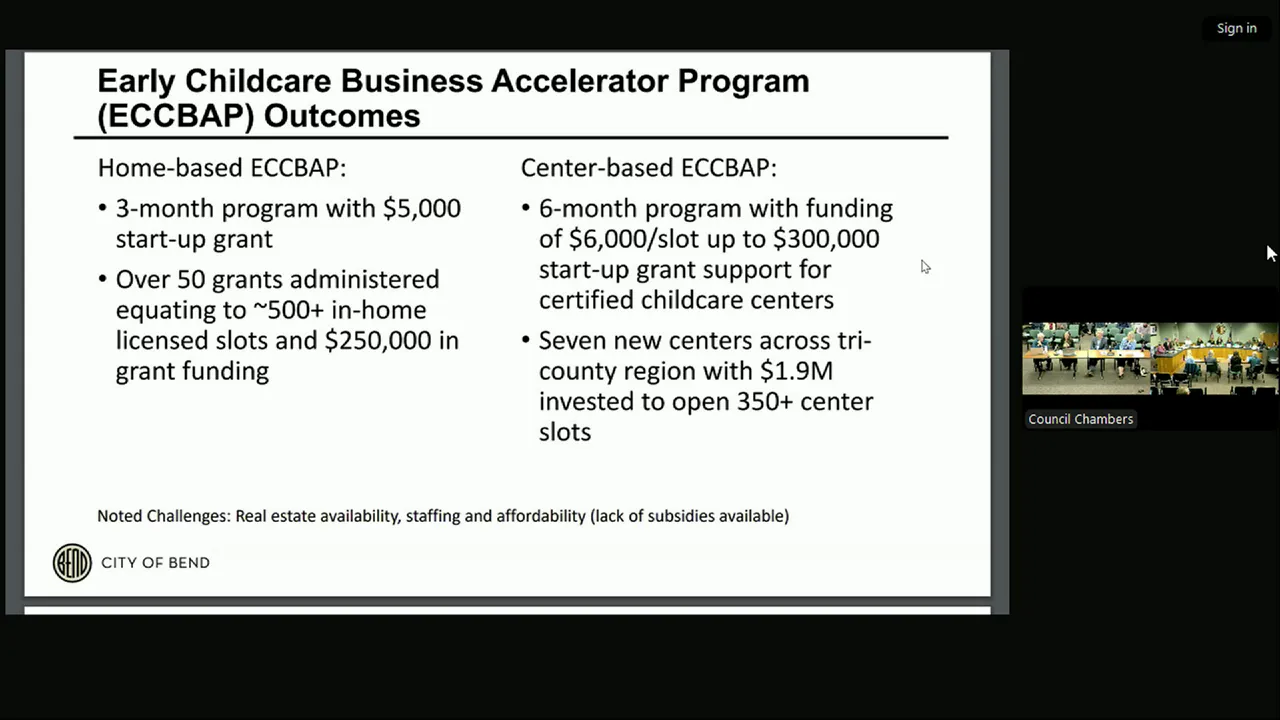
Allison Platt (City) and Matt Mercer (BPRD) presented on childcare. Platt reported that the City has removed SDCs for childcare facilities and supported a business accelerator program that created 350 new center slots regionally, with 422 new slots in Bend alone. Challenges remain: lack of real estate, staffing, and affordability. Mercer detailed BPRD's Kids Inc. after-school program, serving nearly 1,400 kids at 14 elementary schools (21% of Bend elementary students), with a waitlist of 300 families. Summer programs served over 3,100 youth. BPRD provided $485,000 in scholarship support for childcare programs (total $720,000), and 75% of the scholarship fund is supported by general fund taxes. Outreach efforts targeted low-income and Latino populations. Mayor Kebler and Councilor Norris expressed support for continued partnership, with Norris noting the need for living wages for childcare workers.
Partnership in Advancing Affordable Housing
Michelle Healy (BPRD) and Rachel Baker (City) presented on the partnership for affordable housing. Baker reported that the City has foregone over $12 million in SDCs for affordable housing, resulting in over 700 units developed. The Oregon Housing Needs Analysis indicates a need for 14,000 affordable units in Bend over 20 years. BPRD has foregone approximately $4 million in SDCs since 2019, supporting 592 deed-restricted housing units and shelter units. The BPRD SDC waiver program is set to expire at the end of 2024. Healy outlined BPRD's fiscal constraints as a special district and noted that the board adopted a resolution in spring 2024 to provide criteria for considering waivers. Upcoming decisions: on November 19, 2024, the board will consider a request for additional 28 waivers from Housing Works and a tax exemption request; in December, the board will decide on renewal of the SDC waiver program. Council members expressed strong support for continuing the program, with some urging scaling up and including middle-income housing. Board members expressed general support but emphasized the need to balance with core services and fiscal responsibility. Director Barram noted that the board has not yet made a decision but committed to considering longer-term options. Director Hovekamp raised concerns about transparency and the impact of foregone revenue on park services. Councilor Méndez argued that the program is successful and critical for addressing the housing crisis, and that continuing the partnership will strengthen the community's case for state support.
Key Outcomes
- No formal votes were taken, but the BPRD board will consider the following at upcoming meetings: (1) November 19, 2024 – request for additional 28 SDC waivers for Housing Works and a tax exemption request; (2) December 2024 – renewal of the SDC waiver program, with possible changes to duration and unit caps.
- The City and BPRD will continue monthly leadership coordination meetings to align on housing and planning issues.
- The City will present a housing data hub at the November 6, 2024 council meeting, and a broader funding work group may be formed in 2025.
- Staff will continue to coordinate on trail maintenance agreements, transportation fee phase 2, and grant opportunities.
- The meeting highlighted ongoing collaboration on growth planning, infrastructure, and childcare, with a commitment to continued partnership.
Meeting Transcript
Let's go ahead and get started here. We good, Morgan. Okay. So we'll call to order this joint meeting of the Venn City Council and EPRD board. Um let's go ahead and just do introductions down the line for the record. So Councillor Norris, you can start with yourself. Megan Norris, Venn City Council, she her. Kerry Schneider been Parks and Rec Director. Mike Riley, Ben City Councilor, he him. Donna Owens, Ben Parks and Rec co-chair. Jody Barum, Ben Park and Recreation District Board of Directors, Chair. Melanie Huber, Mayor Ben, she hers. Megan Perkins, Ben City Councillor, sheb shown, Ben Park and Recreation District, Board of Directors. Anthony Broadman, Ben City Council. Nathan Holkamp Rec. Ariel Mendes, Ben City Council. Ben City Council, she her. Great. So we are all here, both boards all here. So we're gonna start with some information from both of our staffs about growth. So I'm taking away. O'Brien and Sarah. I'm starting as that. I'm Sarah Anselman. I am one of the planners for Ben Park and Rec. And today I will be sharing an update on our midterm comprehensive plan update. And I will also touch on how our efforts contribute to broader planning goals, including Oregon's statewide land use planning goals, as well as the city's comprehensive plan goals. So you may be aware that the state has 19 land use planning goals, and the park district is the designated service provider for goal eight, which is recreation, which requires that local governments plan for the recreation needs of residents and visitors. And we also support the city on meeting goal 12, which is transportation by providing bicycle and pedestrian trails, which of course increase transportation options. So our current comprehensive plan was adopted in 2018 and it was developed over the course of about two years and included a lot of public outreach. The primary components of our plan include a community needs analysis, which starts with a community-wide statistically valid survey that we use to determine the community's park and rec needs. So in 2023, we began a fairly limited update to the plan. And since the update is limited, the scope of the update is limited, sorry. This update was planned, but it has become especially important because population growth has exceeded projections, and we learned from our community survey that the increase that there's been a pretty significant increase in need for park and rec amenities. There's also been changes to state and local planning as well as changes in land use development patterns. So we're seeing a stronger emphasis on mixed use zoning districts. We're also seeing residential development in areas that were previously non-residential, like the core area or the proposed climate-friendly areas. We've also been able to incorporate an equity map into our decision making since 2018. District staff has developed an equity map that we've used to help us prioritize projects, and we've also been able to use that in our day-to-day decision making when needed. There were two primary reasons for updating our park search area map, which I'll show you on the next slide with our midterm update. One of those was to respond to newly planned areas of residential development just to ensure that residents in those areas will have access to a park. And the second reason for updating our park search area map was that when we ask people how they would like us to serve increased density, the response is that they would like us to add more parkland as opposed to use existing parks and just increase, enhance the parks to increase access or increase the facility to serve more people versus rely on existing parks and potentially decrease our level of service. So we asked this question in both 2017 and 2023, and the results here are from 2023, and 69% of people responded that they would prefer that we serve higher density with new parks and facilities. So this is our park search area map, and it is one of the largest functional components of our comprehensive plan. It shows areas where we either currently are or will actively be looking to develop new parks. It also shows crossing improvement areas. The park search areas are the orange, yellow colored areas, and the crossing improvement areas are the ones in blue. And crossing improvement areas are areas where acquisition of new parkland would likely be either difficult or cost prohibitive. There are also areas that are near an existing or a planned park. So rather than acquire and develop parks in these areas, instead, we will work to increase access to a park nearby.
openpublica.com