Bend City Council Meeting - April 2, 2025
STREAMING COPY IN PREPARATION — RECORDING AVAILABLE FROM THE ORIGINAL SOURCE
Bend City Council Meeting - April 2, 2025
A combined work session and regular business meeting of the Bend City Council on April 2, 2025, addressed transportation standards, a target sector analysis for economic development, and the second phase of the transportation utility fee. The regular session included approval of an eminent domain resolution, a street preservation paving contract, and other routine business.
Consent Calendar
- Approved the minutes of the March 19, 2025 meeting, the OLCC report, and the monthly financial report for February 2025.
Public Comments & Testimony
- Kyler Palmer, a Bend resident, expressed support for the city's road safety work, advocating for slow speeds, traffic calming, and separated corridors.
- Chuck Hemingway, a homeless advocate, requested a rolling closure of the China Hat area instead of a hard May 1 closure, citing a failure in the Forest Service's environmental assessment.
- Eric Gardy, from the Bend Equity Project, urged the council to coordinate with the Forest Service to delay the China Hat closure, referencing a court ruling in Grants Pass.
- Ricardo Waits, representing Stop Northwest Gas Expansion, urged the city to adopt safety precautions for natural gas pipelines and consider Ashland's model of charging pollution fees on gas appliances in new construction.
Discussion Items
- Street Standards Visioning (Work Session): Staff presented the transportation ecosystem, noting a $1 billion funding gap over 20 years with about $500 million unfunded. Councilors discussed priorities including safety, quick-build projects, congestion, and balancing travel modes. Direction was given to develop a work plan and involve committees like TBAC.
- Eminent Domain Resolution for Franklin Avenue: The council adopted a resolution authorizing the use of eminent domain for up to eight parcels needed for the Midtown Multimodal Connections Project. However, council directed staff not to finalize any acquisitions until a 60% design check-in scheduled for July 2025.
- 2025 Street Preservation Paving Contract: Approved a $3,484,643 contract with Knife River Corporation for 16 lane miles of paving. A debate on changing the striping on 8th Street to remove the center turn lane failed; the motion to approve as presented passed 5-2, with Councilors Franzosa and Platt voting against.
- Romaine Village Way Vacation: The second reading of the ordinance vacating a portion of right-of-way was adopted by roll call vote (7-0).
- Bend Target Sector Analysis & Economic Development Strategy (Work Session): Staff presented data identifying target sectors: health systems, building for growth, technology/innovation. The council directed the Bend Economic Development Advisory Board (BDAB) to begin the Invest Bend project to develop a 10-year economic development strategic plan by December 3, 2025.
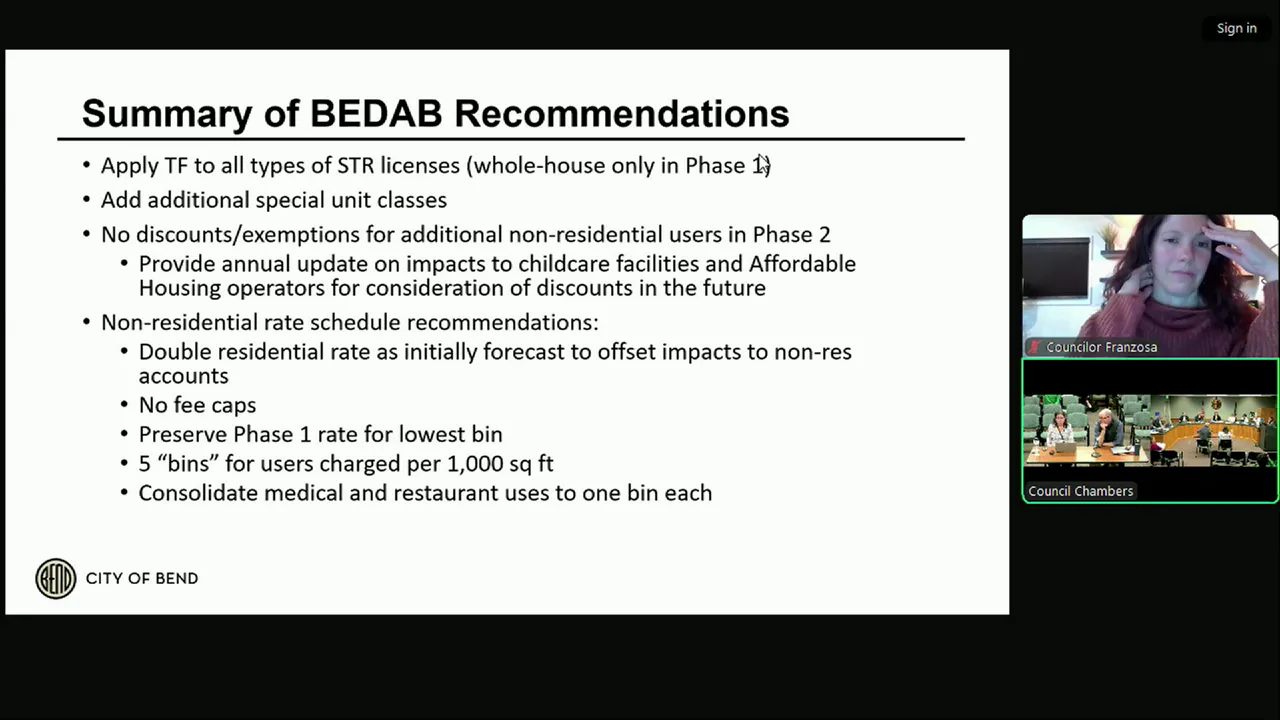
- Transportation Fee Phase 2 (Work Session): BDAB presented their recommendations after five meetings, including: a doubling of the residential rate (shifting allocation to ~60% residential, 40% non-residential), no new discounts or exemptions, five bins with a floor of $625 per 1,000 square feet, and consolidating medical and restaurant uses into lower bins. Council was divided on the allocation split; direction was given to staff to run models for both the existing 53/47 split and the proposed 60/40 split, while also adding true doubling of the lodging fee and moving child care down a bin. Staff will return on April 16, 2025 to finalize options for public comment.
Key Outcomes
- The street standards visioning will proceed with a work plan and committee engagement.
- The eminent domain resolution was adopted, with a condition to wait until the July design check-in before acquisitions.
- The 2025 paving contract was approved (5-2).
- The Romaine Village Way vacation ordinance was adopted.
- The Invest Bend economic development strategy was launched, with a target completion date of December 3, 2025.
- Transportation Fee Phase 2: Staff will present two rate scenarios at the April 16 meeting to allow council to choose one for public outreach.
Meeting Transcript
So we are gonna call this um work session of the density council for order. And we are starting with a work session on transportation standards with Russ and Janet. I'm going to say welcome to the evening of transportation. Russ Grayson Chief Operations Officer. I'm here with uh Janet Ruby, who's the assistant city engineer in our transportation and mobility group. This this topic covers a lot of the different operating departments. Um and so we want to talk holistically about how standards work and make sure that we are in alignment with council goals and direction. So what I'm gonna we'll talk about the council, the new council goals and the action items are related to this. Um we want to talk about the entire kind of the role of the of the standards and specs and how we do transportation just to make sure you understand how this all works, define the issues that we're trying to address to make sure that we have alignment there, and then we just want to discuss how how best to work with council and the committee structures as we start to move through this discussion, and then we'll talk about how we're gonna take this information and develop the next steps around moving this item forward. So on the transportation landscape, when you talk about the the new biennial um council goal action items, these are four kind of kind of related action items that all touch uh what our standards and specs and our specifically our transportation standards address in relationship to your action items. So what we're doing with this discussion too is make sure we have alignment, then we're creating the work plan for your council goals, um, and we're gonna take the information that we receive here, drop that into the work plan so that we can start to schedule when when and what we're gonna be talking about as we move through these action items. Just to give a high-level understanding of how this all works and relates, um, this is kind of the ecosystem of transportation. Um it starts with our comprehensive plan, which kind of is that overall overarching document for the city on how the city will grow, where we're gonna see density and different types of uses from that document, and a component of that is the transportation system plan, which really talks about how that infrastructure is going to support the growth plan, what kind of system the communities it wants, it identifies projects, programs, capital needs, funding, and the inputs from that document then roll into our standards and specifications, which make sure that they are aligned aligned with those visioning documents, and then we use the standards and specs to start to figure out how we run our programs and capital projects as well as how we work with the operations and maintenance. So standards and specs are kind of that that linkage from the vision documents down to actually how we build things in the field. I'm gonna turn it over to Janet and she's gonna talk about um what the transportation system plan is and what the major goals in that are. Which all of you are well familiar with, but that to kind of go back up to the policy level to set the umbrella of the conversation. Our aim is to build uh transportation system that has travel options where you can walk, bike, take transit, drive, and improve the system so that we can do it safely. We're aiming towards vision zero and reducing our serious crashes and fatalities and the projects in there and the programs prioritize getting people where they want to go first, right? We can't build it all, so look at connecting people to housing jobs, schools, parks, and major destinations, and then doing it a way where we're building a safe and comfortable network to encourage more people to do things other than drive alone in a car, and at the same time trying to create reliable travel times because that's when people that's when we have pressure and struggles when there's congestions and people don't know how long it's gonna take them to get places. So the the challenge to build all that and operate all that is creating sustainable funding sources. And so the transportation plan, the important note of all this is the transportation plan when we're building it, recognized that we can't build everything to the full ultimate uh cross section, right? That's just cost prohibitive. So the plan looked at developing a few spots where we were building more of a full cross section, but more places where we were building gap connections and spot improvements in order to achieve the goals of safety and providing travel options like faster along our 20-year timeline. So even with that kind of parsing out, we still have some funding challenges. Yeah, which I'll go into. So this is all because this is gonna go into the conversation around standards and specs and what we're hearing from uh input from the public and through public comment conversations we have with council of we're trying to figure out how to balance how much we're building, what are this the standards and specs of what we're building with what we can afford. So this is just a snapshot out of that 2020 transportation system plan that just illustrates our funding gap. You've seen this before. We use this in the um the transportation utility fee conversations of over the next 20 years. We had about a billion dollars worth of funding needs, and our existing resources had about half of that figured out. So this just goes back to translating how do we want the standard, where do we want the standards and specs to hover in the conversation of what systems do we build, how much do we build in relationship to what we can afford. Yeah, Russ, just there was a single asterisk on 9942 and then double asterisk to the rest. Is that just should that have been a double asterisk or yeah? The nine, sorry, the 942 that comes out of the TSB. Sorry, the double the double asterisk is just I saw that one was just the operation. Sorry, yeah, didn't have the single asterisk there. So that's just referring to coming out of the TSP. Correct. Yeah, thank you. So you'll see in the middle that is that where the standards and specs live. What happens is those two higher level documents, the comprehensive plan and the transportation system plan provide those guiding policy direction for us. And what that is used is to translate into what our development code needs to look like to be able to implement the goals of those guiding policy documents, and it also relates into what capital improvement projects we're going to do as well. The standards and specs basically are the engineering directions to our our engineers, consultant engineers, the development community on literally getting down sometimes to nuts and bolts. What nuts and bolts do we use to put up a street sign? What street sections do we use? What's our pavement thickness, all those things that all those in the standards and specs. The goal is you want those standards and specs as clear as you can get them, but they do operate under kind of that 80-20 rule. They're not gonna they're not gonna be there to satisfy all situations, and that's where down below the city engineer through authorizations and the standards and specs and our code, they they have the discretion to modify that through waivers and deviations. What we're seeing a lot of, and Janet's gonna get into this is we're we're we're we're seeing a lot of of those type of requests go into the city engineer, and we'd also like to bring those back into alignment where we've got the majority of our information in the standards and specs that's providing the guidance, and we we're not always dealing with all these waivers and modifications. Also, just a note on this council um has direct involvement in adopting the items in green, which are those guiding policy documents, the development code, and when we do major updates of the standard and specs, we do bring them to council for acknowledgement.
openpublica.com