Bethlehem Community Development Committee Meeting on Data Center Zoning Amendment - August 11, 2026
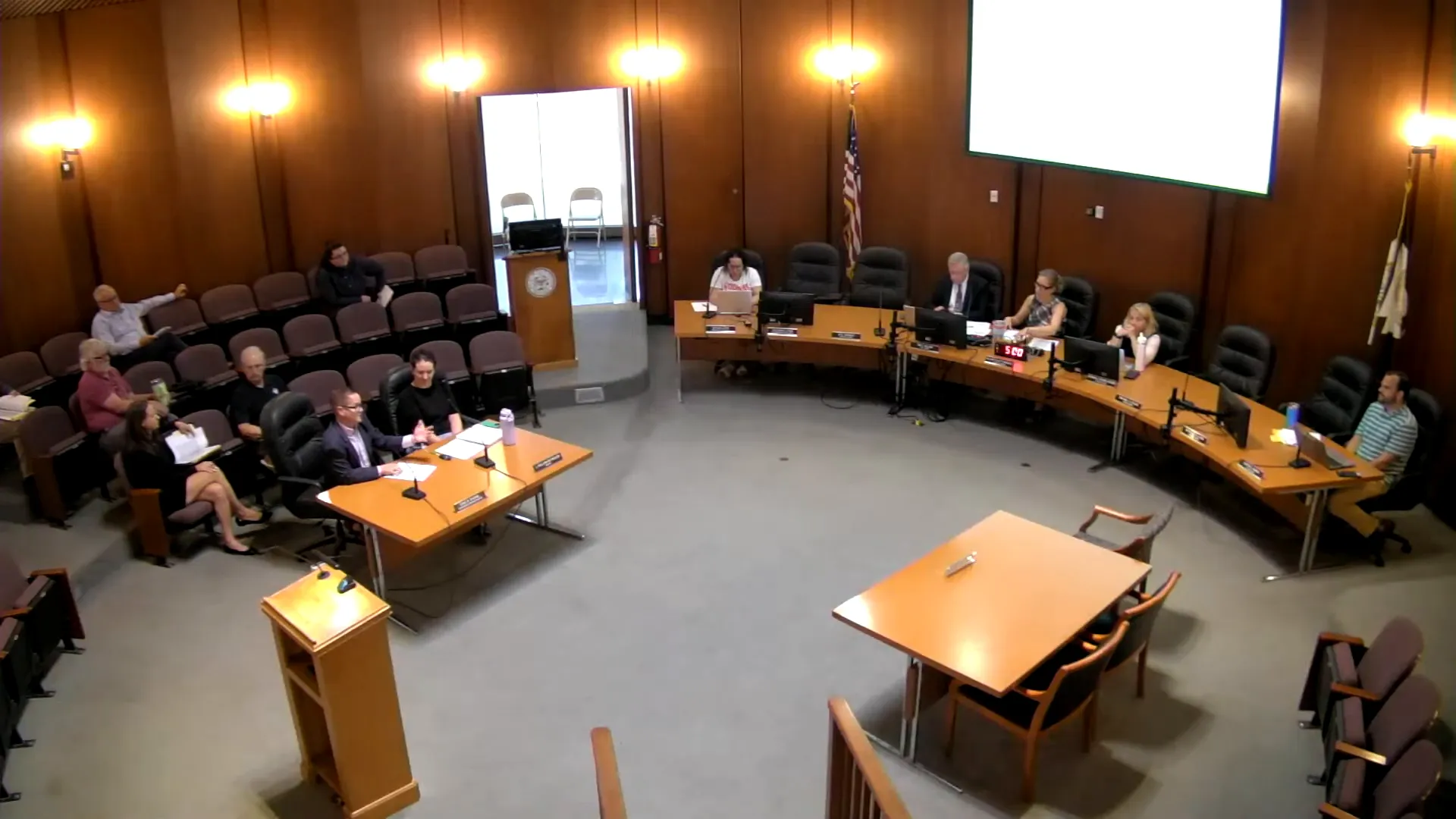
STREAMING COPY IN PREPARATION — RECORDING AVAILABLE FROM THE ORIGINAL SOURCE
Bethlehem Community Development Committee Meeting – August 11, 2026
The Community Development Committee of the Bethlehem City Council met on August 11, 2026, to consider a proposed zoning text amendment regarding data centers. Chair Hilary Kwiatek and member Justin Amon were present, along with Council President Rachel Leon and City Solicitor Stephanie Stewart. Councilwoman Daniels was unexpectedly absent, so item one (a proposed ordinance on yard setbacks) was postponed. The sole discussion item was the proposed amendment to the city’s zoning ordinance to regulate data centers. Following a presentation by administration staff, council questions, and public comment, the committee voted to refer the amendment to full city council for further review.
Discussion Items
- Proposed Zoning Text Amendment for Data Centers – Kathy Fletcher, Director of Planning and Zoning, presented the amendment. Key points:
- Data centers are an industrial land use that must be allowed under state law. The amendment proposes to allow them only in the Industrial District as a special exception (requiring a zoning hearing board review).
- Required submissions include: environmental impact assessment, water utilization report, wastewater disposal documentation, energy management plan, power usage effectiveness analysis, electronic waste and decommissioning plan, emergency response plan, thermal impact mitigation plan, sound study, vibration study, and photometric study.
- Setbacks: Minimum yard setbacks of 80 feet (same as other industrial uses). For parcels adjacent to non-industrial districts, a 200-foot setback is required; if adjacent to a residential district or sensitive receptor (dwelling, school, daycare, park, hospital, community recreation center), a 1,000-foot setback from the lot line of those uses is required.
- Height limit: 80 feet inclusive of rooftop structures.
- Buffer yards: Increased from 15 feet (minimum) to 40 feet.
- Building coverage: Graduated scale – 50% for buildings under 50,000 sq ft, decreasing to approximately 33-35% for 50,001–250,000 sq ft, and 20% for additional square footage above 250,000 sq ft.
- Noise limits: 60 dBA daytime / 55 dBA nighttime measured from the lot line, consistent with existing residential zone limits.
- Water usage context: Bethlehem Steel once used ~8 million gallons/day; current average water throughput is 14 million gallons/day. A golf course uses ~450,000 gallons/day. Cooling technologies (once-through vs. closed-loop) affect water and sewer demands.
- Council Member Questions:
- Justin Amon asked about size limitations – the city cannot prohibit large data centers if they meet dimensional requirements. He also questioned how the city can verify a developer’s self-reported power draw and enforce noise compliance. Staff explained that third-party reports are required, but the city must accept utility provider (PPL) confirmation of available power. For noise, the city can issue violation notices and take legal action if needed.
- Hilary Kwiatek asked about thermal impact mitigation plans and photometric (light) studies – these require applicants to manage heat and light emissions. She also raised concerns about water cycle impacts, but staff (Ed Bascola, Director of Water and Sewer) noted that the city’s system has capacity and that data centers often evaporate water, putting minimal load on sewers.
- Further discussion addressed the practical effect of setbacks: most industrial parcels remain buildable, and because Bethlehem is largely built-out, any future data center would likely involve adaptive reuse of existing buildings rather than new construction on vacant land.
Public Comments & Testimony
- Mr. Shire – Commented generally that the city should prioritize affordable housing over data centers. He questioned the reliance on the zoning hearing board for special exceptions, suggested increasing minimum parking from 5 to 10 spaces, and noted a potential typo in the ordinance regarding building area thresholds.
- Owen LeVan Uhler (Food & Water Watch) – Acknowledged the ordinance as a good start but recommended strengthening it. He urged requiring independent third-party certification of studies rather than just “qualified professionals,” including water used for electricity generation in water reports, requiring closed-loop cooling systems (as Allentown does), enhanced geotechnical studies due to sinkhole risk, a public-facing website from applicants with all documentation, and a decommissioning bond of at least 125% of decommissioning cost with reassessments every five years (citing Bradford County).
- Mary Collier (Wilson resident) – Expressed appreciation for the proactive ordinance. She asked whether data centers could be required to use a percentage of renewables, whether the 200-foot setback could be increased, and whether ongoing annual/semi-annual studies (sound, water, energy) could be mandated. She also asked about the legislative process. Chair Kwiatek clarified the amendment is not yet being voted on; it will go to the planning commissions and then a public hearing before full council.
Key Outcomes
- Motion and Vote: Councilmember Amon moved to refer the data center zoning text amendment to city council for further processing (review by the City Planning Commission, Lehigh Valley Planning Commission, and a public hearing). The motion was seconded by Chair Kwiatek and passed unanimously (2-0).
- Next Steps: The ordinance amendment will be forwarded to the full city council, which will schedule a public hearing and ultimately vote. The committee acknowledged that the process is prescribed and that additional public input will be sought.
- Item 1 (Yard Setback Ordinance) Postponed: Due to the absence of Councilwoman Daniels, who sponsored the amendment, that agenda item was postponed to a future meeting.
Meeting Transcript
I will call to order the community development committee meeting. I'm Hilary Kwiatek, Chair of the Community Development Committee. The other committee member present tonight is Justin Amon. Other council member present this evening is Council President Rachel Leon. And City Council solicitor Stephanie Stewart is also present this evening. The clerk will please call the role. Ms. Quiotech present. Mr. Raymond. Present. Ms. Daniels. So I will note the absence of councilwoman Daniels. She took ill shortly before this meeting and unexpectedly will not be able to be here. For that reason, we will be postponing item one of the agenda, which is the proposed ordinance for yard setbacks. Is an amendment that councilwoman Daniels is uh has put forward and she was to present on it tonight. So we will find another time to do that. And so we will move on to agenda item two, which is the proposed amendment to the zoning ordinance regarding data centers. And uh there will be an opportunity for public comment following the uh administration's presentation and questions by um council committee members and uh members of of the council. Um everybody will get you know a five-minute opportunity, and we'll talk about that um when we get there. So I will now recognize a representative of the administration to discuss this proposal. Good evening, council members. I am Kathy Fletcher. I'm the director of planning and zoning here at the city. Um I am joined by a number of city staff as well as an LVPC representative. So um I'm going to run through a presentation and then we all might come up and answer questions as they come. So I just wanted to highlight who is all here with me. Um, we have Laura Collins, who's the director of the Department of Community and Economic Development, Craig Piffer and Dave Taylor, who are part of the planning and zoning bureau staff. Um, Ed Bascola, who is the director of water and sewer services, Matt Deschler, who is the assistant city solicitor, and then Jill Seitz, who is the representative from LVPC. She is the chief community and regional planner there. So as they come up, you might you'll you'll see all their faces. Um, so tonight we are going to be talking about the zoning text amendment um regarding data centers. And before we really get into what is being proposed as part of Bethlehem's zoning text amendment, um, we wanted to start by kind of grounding us with what data centers are to give a little bit more information. Also go over what we can and can't do under the law regarding data centers, and then move into the text amendment itself. So starting with what are data centers. Um data centers have existed for decades. They're facilities of one or more buildings that house physical hardware to support digital systems. More recently, the function of data centers has expanded into areas such as streaming, cloud storage, and now support everyday activities such as virtual meetings, online shopping, um, remote learning. So although they've existed for a long time, they've really changed in their function over that time. Um, so this really brings us to this conversation. Um there's a variety of data center types based on their purpose, which impacts their energy demand and their physical size. This figure shows the differences between the purpose, energy demand, and size. Hyperscaler scale data centers, which is shown all the way to the right on this figure, is really what's been getting a lot of press. Um, so those are the types that you've probably been hearing about the most. They're typically larger in size and require a higher energy demand. But, you know, as this figure shows, they can really look differently. So there's not a one-size-fits-all regulation or set of regulations for them. And you can't really copy and paste it across communities. So this is really where we have to be mindful of what they could and would look like in Bethlehem specifically.
openpublica.com