Joint City Council and RDC Working Session on Hopewell South PUD - April 16, 2026
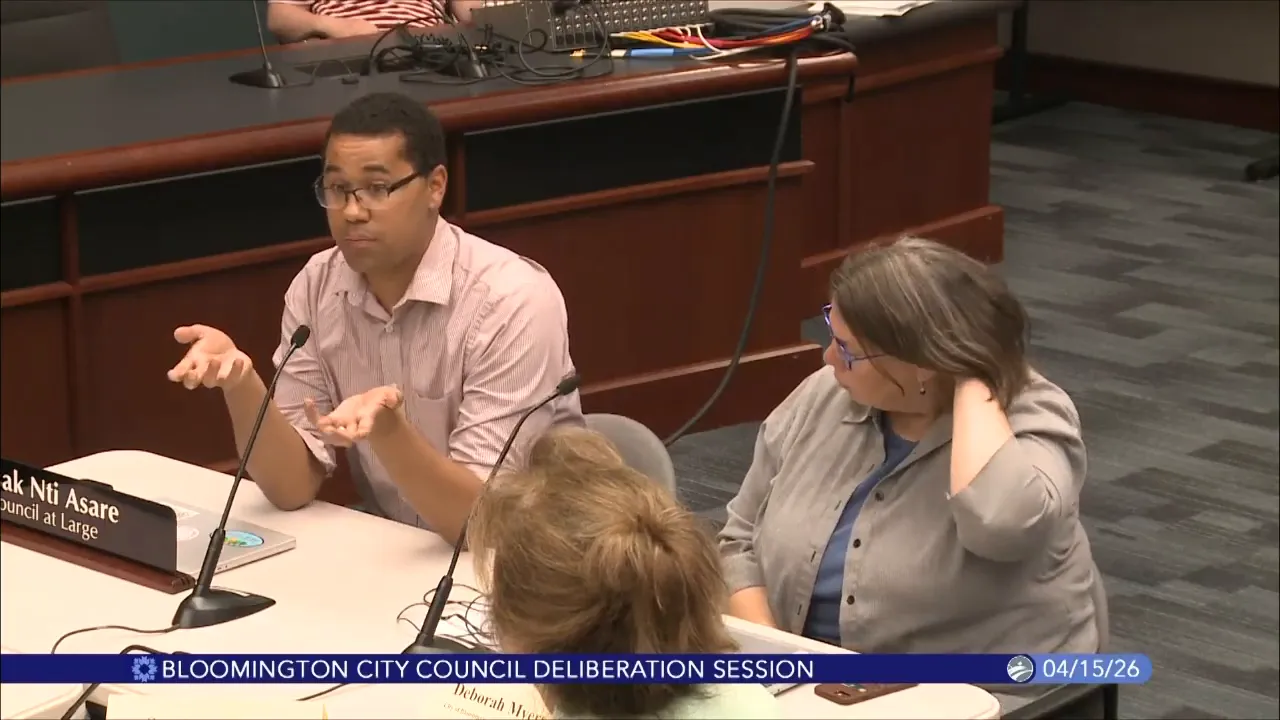
STREAMING COPY IN PREPARATION — RECORDING AVAILABLE FROM THE ORIGINAL SOURCE
Joint City Council and RDC Working Session on Hopewell South PUD Reasonable Conditions - April 16, 2026
The Bloomington City Council and the Bloomington Redevelopment Commission (RDC) held a joint working session on April 16, 2026, to discuss the reasonable conditions for the Hopewell South Planned Unit Development (PUD). The session focused on potential trade-offs associated with each condition, including impacts on housing supply, affordability, accessibility, and sustainability. No formal votes were taken; the meeting was intended to facilitate discussion in advance of a potential final vote on April 22, 2026.
Public Comments & Testimony
- No public comments were made. The meeting was a working session between the council and RDC.
Discussion Items
Reasonable Condition 6 (Electrification)
- Councilmember Flaherty, the sponsor, proposed shifting this condition from a requirement to a written commitment, citing state preemption concerns and a preference for voluntary measures. He noted that the administration had previously agreed to all-electric development.
- Councilmember Rosenberger expressed concern about litigation risk from state-level lobbying but supported electrification if done cost-effectively.
- Allie from Flintlock Labs stated that offering gas as a utility is not necessary and that the RDC could decide as a developer to exclude gas, which is common. She noted that making electrification a statutory requirement carries higher legal risk.
- Consensus emerged to pursue a written commitment rather than a condition in the PUD ordinance.
Reasonable Condition 7 (Energy Efficiency)
- Councilmember Flaherty explained the intent to exceed base code, referencing the UDO’s sustainable development incentives. He expressed flexibility, suggesting a later model energy code (e.g., 2021 IECC) or a HERS rating as alternatives.
- Councilmember Rosenberger cautioned that LEED certification adds cost and that Indiana’s energy code is a minimum standard; additional requirements could jeopardize affordability.
- Anna from Flintlock noted that HERS ratings add $1,000–$3,000 per unit for modeling and blower door tests, but with only 16 unique plans, digital modeling could cost under $20,000 total. She recommended using pre-approved plans with energy-efficient designs (e.g., ducts inside envelope, exterior rigid insulation) and requiring ENERGY STAR appliances.
- Councilmember Rollo suggested using the Department of Energy’s Home Energy Score as a simpler, lower-cost tool. Discussion concluded that digital modeling of plans and requiring ENERGY STAR appliances could achieve efficiency without excessive cost.
Reasonable Conditions 8, 9, 10 (Sidewalk Widths and Tree Plots)
- Councilmember Flaherty (sponsor) clarified that conditions 8 (6-ft sidewalk minimum) and 9 (8-ft pedestrian paths on block 9) did not intend to widen right-of-way beyond what is needed for the sidewalk itself. He argued that 6-ft sidewalks provide meaningful pedestrian comfort and safety compared to 4- or 5-ft. Condition 10 required a tree plot on Wiley Street.
- Allie from Flintlock presented trade-offs:
- 6-ft sidewalks: achievable on most streets with minimal unit loss; may require swapping unit types on Jackson Street.
- 8-ft internal sidewalks on block 10 would cost 2 units (including 3 accessible units). On block 9, 8-ft is dimensionally possible without losing units.
- Tree plot on Wiley: would require removing existing mature trees, which provide immediate character and shade. The PUD currently has a monolithic sidewalk there to preserve trees.
- Councilmember Rosenberger raised concerns that the city requires tree plots and 6-ft sidewalks from other developers, and allowing the RDC an exception sets a bad precedent for safety and consistency.
- RDC Commissioner McRae highlighted the value of existing trees for neighborhood character. Councilmember Stasberg noted that preserved trees would be in the right-of-way and would become city street trees, but maintenance responsibility was unclear.
- Councilmember Flaherty proposed tree plots wherever physically possible (including Wiley), with the city engineer adjudicating feasibility. He withdrew condition 11 (lane width) after discussion with the fire chief determined it is not feasible at this stage.
Reasonable Condition 12 (Rogers Street)
- Councilmember Flaherty clarified that the planned cross-section (10-ft drive lane, 5-ft bike lane, 5-ft tree plot, 10-ft sidewalk) fits within the already planned 31-ft right-of-way from centerline. The PUD currently shows a 5-ft sidewalk; updating to 10-ft matches the general urban street typology. This will bring the sidewalk close to the existing 714 building but is feasible. No parking is proposed on this block.
Reasonable Condition 13 (Short-Term Rentals)
- Councilmember Flaherty suggested this condition would be better suited as a voluntary written commitment due to state preemption issues. No further discussion.
Reasonable Condition 4 (Permanent Affordability)
- Councilmember Stasberg, co-sponsor, advocated for 50% of units to be permanently affordable, with 15% at or below 90% AMI and 35% at or below 120% AMI. She argued that using city tax dollars should benefit multiple generations, not just first buyers.
- RDC Director Anna Hansen stated that the administration has committed to 25% permanent affordability but needs flexibility because final costs depend on other reasonable conditions. She emphasized that silent second mortgages and right-of-first-refusal (as used by Habitat for Humanity) are effective tools, while deed restrictions are difficult to enforce and secure mortgages against.
- Councilmember Dattilo questioned whether 50% is feasible; he noted the PUD’s own text says at least 50% of homes will be “naturally affordable” at or below 100% AMI. He stressed that permanent affordability maximizes taxpayer benefit over time.
- Councilmember Zulik pointed out that condition 5 (which included similar affordability mechanisms) failed on April 1, but she supports silent second mortgages and right of first refusal.
- RDC Commissioner Cassidy broke the issue into three components: percentage of affordable units, duration (e.g., 50 or 99 years), and equity-sharing mechanism. He noted agreement on at least 25% at 90% AMI to meet current UDO standards.
- Councilmember Ruff emphasized the complexity of pricing lots and ensuring naturally affordable units remain affordable, urging careful deliberation rather than rushing.
- The group agreed to continue refining the affordability condition, with councilmembers to provide updated language by April 17 for potential final action on April 22.
Key Outcomes
- Electrification (RC6): Shift to a voluntary written commitment from the RDC rather than a PUD condition.
- Energy Efficiency (RC7): Use pre-approved plans with digital modeling and require ENERGY STAR appliances; no mandatory HERS rating or blower-door test on every unit.
- Sidewalks and Tree Plots (RC8-10): 6-ft sidewalks minimum sitewide; 8-ft internal sidewalks on block 9 where feasible; tree plots required wherever physically possible, with city engineer determination; condition 11 (lane width) withdrawn; condition 12 (Rogers Street) updated to 10-ft sidewalk within existing right-of-way.
- Short-Term Rentals (RC13): Convert to written commitment.
- Permanent Affordability (RC4): Target of at least 25% of units permanently affordable, with a preference for silent second mortgages and right-of-first-refusal mechanisms. Councilmembers to propose updated language by April 17 for final consideration on April 22.
- Next Steps: Councilmember Flaherty will email updated reasonable conditions by April 17; final PUD vote possible on April 22.
Meeting Transcript
So we will call uh to order this large table work in session, joint working session between the RDC and the Bloomington City Council. Before I guess we get started, I'll just ask if if Clerk Bolton, if you'd be able to just call the role and then um and then we'll have just a couple of ground rules or just general level setting, and then we'll move on straight into discussion. I'm gonna do this on the fly. So council member Rosenberger. Here. Clarity. Here. Stasberg, here. Pete Motzman. Here. Zulik. Here. Daily? Here. Rahlo? Here. Asari. Here. And Ruff. He said thank you very much. And then we're also joined by our colleagues at the RDC. I don't know if you all need to do roll or or what, but yeah, yes, please do. So go ahead. So we'll let you all start and we'll end up this right machine. We're just doing a roll call. So if you want to. Lori McRabby here. Wonderful. So thank you all for taking the time to meet with us and thank you all for being here for this repurpose deliberation session. As you saw on the agenda, uh our hopes uh here, and hopefully we'll also be joined by um uh Flintlock Labs and I think David uh Hiddle will also be joining us. Um our goal here is to is to really oh there you are. Uh David Hiddle is here. Um the goal today is just to discuss um the um the reasonable conditions now with information as as hopefully you all had a chance to see in the packet um surrounding potential trade-offs um that might be associated with each of these reasonable conditions. Um we want to keep the conversation about the reasonable conditions um and so lawyers are not allowed to talk. Uh I mean other than the lawyers who are on the council. Um but no, we're not with just uh just to have uh uh hopefully a productive conversation just around um um how we might uh potentially move forward um uh with reasonable conditions. The only other thing that I'll I'll mention um you all might have noticed that um uh our former deputy mayor, former city attorney Larry Allen is here, and um we're just very grateful um we've somehow convinced him to um help um uh city council out um on a part-time basis um in this interim period and so uh uh Mr. Allen, thank you so so very much uh for your service, continued service uh to the city um and long suffering. Uh so now we um I'll I'll hand over um uh to you. Oh uh thank you. Just again welcome and glad to have everybody at the table here tonight. Uh looking forward to hearing from Flintlock. I know they've prepared some slides for us to look at and looking at how we can talk about the Hopewell South PUD and focus on opportunities for housing supply, affordability, and accessibility within the Hope Well South project. So is Hopewell is uh Flintlock gonna be presenting initially. Okay. Fantastic. Okay, so so if there's if there's no objection, I think the the way um that we'll do this, um uh we we will ask Allie to give sort of like a 30,000 foot overview, um, you know, just sort of level setting, and then we can go sort of reasonable condition by reasonable condition. Um the person who's proposed it uh spend a few minutes just sort of explaining what it is we're trying to achieve here. I think as we've done uh but I think it's just useful um to talk about that, and then um then we'll have uh sort of uh a media response from Allie as as outlined in the slides and then um RDC response and then some discussion. Um does that seem like a good way of structuring the conversation?
openpublica.com