Bloomington City Council Fiscal Policy Committee Meeting - May 12, 2026
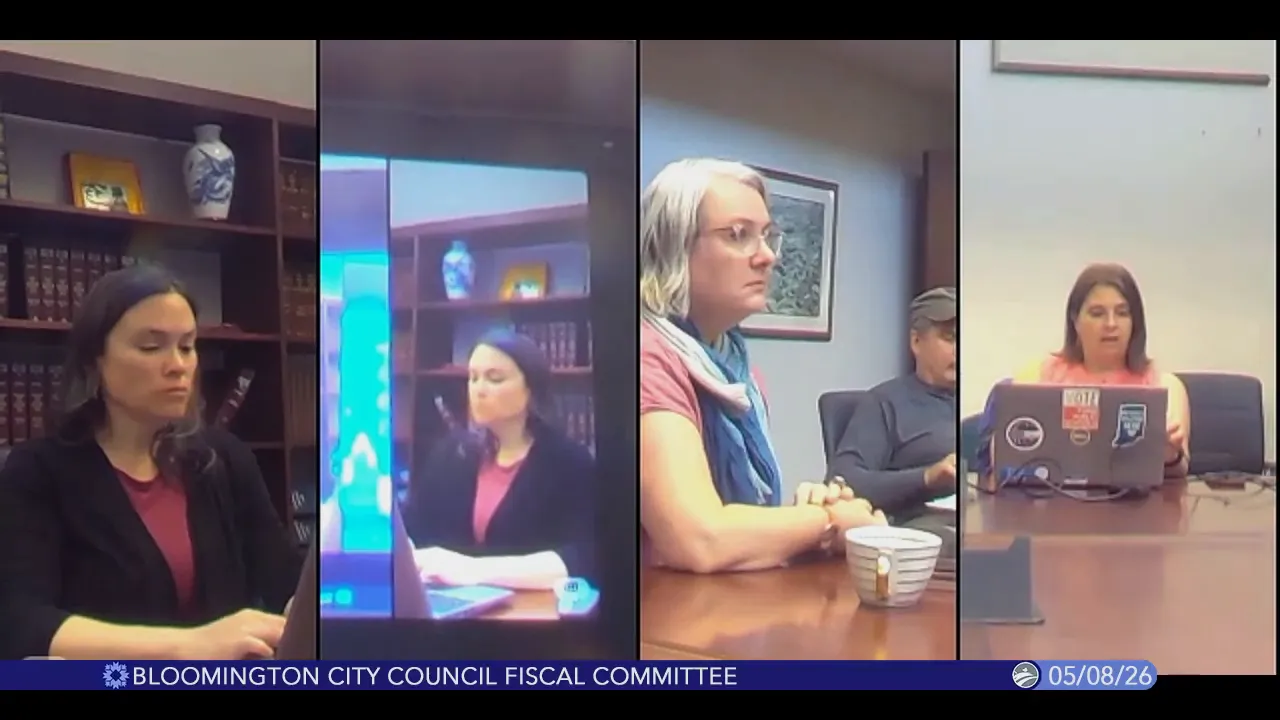
STREAMING COPY IN PREPARATION — RECORDING AVAILABLE FROM THE ORIGINAL SOURCE
Bloomington City Council Fiscal Policy Committee Meeting - May 12, 2026
The committee met on May 12, 2026, from approximately 2:23 PM to discuss employee transportation benefits, the elected official compensation framework, budget scheduling, and future meeting plans. Discussions included refining guiding principles for compensation, collecting comparative data from other cities, and addressing equity concerns in parking benefits. A public commenter opposed market-based benchmarking for council salaries.
Public Comments & Testimony
- Kevin Keo spoke during public comment, opposing the use of market-rate benchmarking for council compensation. He argued that in a one-party-dominant political environment, professionalizing the council could deepen the divide between government and citizens. He urged the committee to reject HR-style benchmarking and instead use median income as a reference, keeping compensation as a modest stipend and emphasizing fiduciary duty over a paycheck.
Discussion Items
- Employee Parking/Transportation Benefits: The committee discussed redesigning the existing sustainable commuter incentive (currently a taxable $4/day up to $500/year) into a broader transportation benefit options program. Key points included equity concerns for employees without alternative commute options (e.g., those living in the county), the difficulty of quantifying the value of free parking, and the administrative burden of time-tracking. Suggestions included offering a one-time annual opt-out of parking passes in exchange for a cash benefit (e.g., $500), making the program simpler and more accessible. Tax implications were noted, and references were made to similar programs at Indiana University (Anna Dragovich) and best practices (Jeff Jackson). The program’s goal was framed as both an HR benefit and a TDM policy, with a focus on equity.
- Elected Official Compensation Framework: Councilmember Isabel presented revised guiding principles for salary setting, separating the document into values (accessibility of public service, quality community service) and process (informed decisions based on relevant objective data, transparency, consistency). The committee expressed approval. Councilmembers Obi and Dave reported progress on narrowing the list of comparison cities (second-class Indiana cities plus others like Tippecanoe County, Ellisville, and Indiana state legislators). They plan to collect data on regular meetings, committee assignments, and other responsibilities, adjusting for per-meeting compensation. A question was raised about whether self-directed work (e.g., legislative creation) should be factored in, and how to handle uneven committee assignments across council members. Further research is needed.
- Budget and Scheduling: Controller Jeff Jackson noted that all departments submitted their first budget cuts. The next committee meetings are scheduled for May 22 (likely an administrative presentation) and June 12 (discussion of sanitation rates). The committee agreed to maintain a twice-monthly meeting schedule and take a summer recess from June 12 to July 24, with the first meeting back on July 24. The break will allow time for comparative city research.
Key Outcomes
- The revised guiding principles for council compensation (presented by Isabel) were accepted by the committee without edits or objections.
- The committee directed Obi and Dave to continue collecting salary and meeting data from comparison cities, with results to be reported after summer recess.
- The employee transportation benefit program will be further explored, with recommendations to simplify administration (e.g., moving away from time-tracking to a one-time annual option). Future conversations may include input from Anna Dragovich and Jeff Jackson.
- The meeting schedule was set: May 22 and June 12 sessions, followed by a summer break until July 24. The May 22 meeting will address a financial plan update (possibly from the administration), and June 12 will cover sanitation rates.
- Public comment on the compensation framework was heard; no formal action was taken in response.
Meeting Transcript
All city employees, and what do you do about people who work in utilities plants, right? Or like places where the value of a free parking space that would be the same as the value of a free parking space downtown. So that does that's the top gating factors. I'm not saying uh a straight up cash out is the right structure. Um and what what was settled on was something like what exists now of some kind of you know uh dollar benefit. I think it changed once or twice. Like there was like a slight iteration on the policy design. Um I don't qualify, I would like so equity equity is kind of a central purpose. I would could characterize it as a TDM policy of sorts, but I don't know probably any HR benefit could like health care, like I don't know, like there's lots of I guess although I'm I don't have an opinion about where it should live with respect to like I mean, but that's super helpful because if it's if it is that and it's not about changing behavior, that that makes a lot of things more like that already is a huge amount of clarity and and other kinds of HR benefits, for example, um you know, quitting smoking or wellness, those have direct impacts on our health church rate. And so it's a perfect and live in HR because HR has an interest in keeping our pool as healthy as possible for all kinds of reasons, you know, ethical and also costs. So um was like that's kind of we look at you know what's the what's the goal and who's in the best position to you know make that happen, and and HR also looking at you know, how can we make administering these various different kinds of programs um simple for them and also clear to employees, like what are all the things and does everybody understand what they're for and you want and yeah. Someone watched that might be Anna Dragovich as well, because she ran the programs at IU formerly that did this, and they had a structure that's a little more traditional, where like good policy, it's like basically you forego the the parking the parking spot benefit, uh and usually to make it workable for folks. There's some like you can buy up to 20 day passes a year with a certain cost, you know, some flexibility, right? Or things like that. But um generally it's the idea is you're giving off a benefit a bit or not taking advantage of a benefit that other folks get, and you get this other benefit instead. So you're picking your benefit, right? Basically, and it's hard to visualize the parking benefit because we own the land and we're not sure quantifying that somewhere with the budget. Just for awareness of everyone in this room, um, you know, whenever we bring up um whenever there's an uh whenever anyone has access to something that someone else feels that they cannot have access to, yeah, different questions of equity get rates. And so we have a ton of employees who live in the county, like Willington organizations, and um occasionally occasionally we hear from those folks who are like, well, it's unfair because I have no other option. But they give the free parking benefit. So they have the but their point is you want me to work for you and ergo, you should give me a parking spot because there's no bus option and it's too far to ride by for you know whatever the other reasons are, no one lives near me to carpool. And it's happening with staff have to get right to find free parking. I think just the journalist is the thing, like HR, but is it accessible to police everybody? And uh everyone, uh even if it's four dollars a day, someone somewhere is like man at four dollars a day, give you something four dollars a day. So um just just for your awareness and not lobbying. No, I understand. I wonder about from an educational standpoint and a vacuum standpoint. I think packaging these things has always made sense to me. It's like when you're talking about here's how to get a parking spot for the year, it's like that's the conversation changes. It's like here are your transportation benefit options. You can choose a free parking space in downtown Bloomington, or you can choose a $500 cash out, or you can, you know, like those are your options, and these are roughly similar value. So based on your own situation, you pick the benefit you want and need. Well, that's also interesting because the the other thing that I have been thinking about as you're looking at it is you know, you're checking this off the time track, and let's say either lives in HR. Is that really the way to do it, or should it just be a $500 once a year? Like you saw something committed to say, right, this is what I'm doing, and I I commit that you know, 50 50% of the days of the year, I'm going to or I'm not gonna take a parking pass. Or or yeah, um, that would be another way to try that actually that's actually really good practical easy slowly. That was like virtual. Like, okay, somebody who lives in M County could say make a choice to not have a parking pass and arrange to park at the mall, carpool, you know, like like somebody could literally like park in some other public parking, like like there's always tons of mall parking spots opening. Or they're gonna park it. Right, and and then like take a bus in or I mean all they can provide track your car. Like I'm just saying that that's a choice that they can make is awesome powerful one. Yeah, yeah, yeah. Yeah, right. Work for a just the messenger, but to be the voice of you are um a working family and you have kids that have to be in daycare with this oh yeah, oh yeah, we work at this logo, and then you have a meeting that's off site that's five minutes after that. Sometimes driving is your only option. Oh, yes. And the best benefit for you is the remarking space area. Yeah, if that you could, you know, in that scenario, they'll go like, oh, I don't have all these other priority factors. So I will choose to park somewhere far your way, and then like I actually have a friend who didn't want to get enough pay for the IU parking spot who was like, Can I leave a bike at your house and then leave my car at your house? Like in on these days, I'll say, Yeah, that's fine with people.
openpublica.com