Bloomington City Council Meeting Summary – July 23, 2026
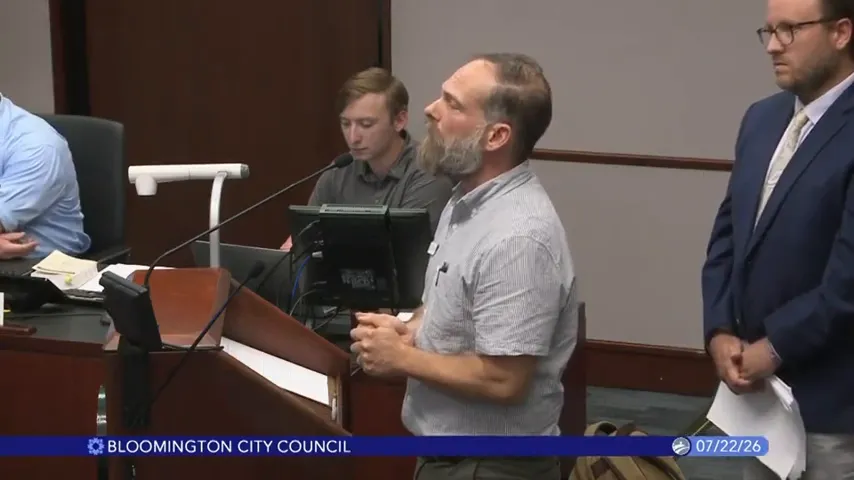
STREAMING COPY IN PREPARATION — RECORDING AVAILABLE FROM THE ORIGINAL SOURCE
Bloomington City Council Meeting Summary – July 23, 2026
The Bloomington City Council met on July 23, 2026. The raw transcript opens with a reference to "Wednesday, July 22nd," but the meeting date used here is 2026-07-23 as provided. The council received reports and human rights awards, held first and second readings, tabled one resolution, authorized Bloomington Housing Authority bonds, and failed to override the mayor's veto of the carless Kirkwood ordinance. No minutes were presented for approval, so there was no consent calendar.
Council Reports & Mayor's Presentation
- Councilmember Stasberg reported on summer travel to Belize, saying infrastructure differences such as "sleeping policemen" speed bumps showed that communities adapt to different tools and that success can look many ways.
- Councilmember Piedmont Smith expressed dismay that a land swap between the city redevelopment commission–owned College Square site and the CIB-owned Seminary Point site appeared to have fallen through because the two bodies issued requests for proposals on different timelines.
- The council president (also transcribed as Councilmember Zulik/Asari) expressed concern about the Bloomingtonian's Facebook page being taken down by an AI bot without process, welcomed its reinstatement, and encouraged community support for local journalism. He also reported a suspected hate crime at People's Market's greenhouse, stated opposition to all forms of violence, and called for policy and economic responses.
- Emma Williams, chair of the Bloomington and Monroe County Human Rights Commission, presented the 2026 Human Rights Awards: Melanie Davis received the individual award for LGBTQ+ advocacy, including founding the Front Door LGBTIQ Center; Mother Hubbard's Cupboard received the organizational award for food access and dignity.
Public Comments & Testimony (First Period)
- County Commissioner Madeira and County Commissioner President Julie Thomas requested the council's support for an expedited combined jail/justice facility (transcribed as "GL facility") on the Hopewell property. They said the county cannot wait for a full plan commission and city council review because that would add at least nine months. They asked for referral to the city's redevelopment commission, copies of geotechnical studies, and said they are open to purchasing the property or a land swap involving the Thompson property.
- Chris Remgie, of the Greater Bloomington Chamber of Commerce, said the city's audit of development review and permitting confirmed members' experiences: excessive review times, poor coordination, conflicting comments, inconsistent code interpretations, and a culture of mistrust where reviewers acted as "gatekeepers rather than collaborators." He said the city appears appropriately staffed, called for improved coordination and a "path to yes," and welcomed new plan department leader Lynn Coyne. He cited an example of a small business facing $130,000–150,000 in exterior/site costs for adaptive reuse.
- Megan Betts, of Mother Hubbard's Cupboard, invited the council to summer programs, including kids' garden, kids' cook, fermentation and sourdough workshops, and garden work days.
First Reading: Fire Merit Commission Ordinance (2026-15)
- Ordinance 2026-15 amends Title II of the Bloomington Municipal Code to delineate duties between the Board of Public Safety and the statutorily created City of Bloomington Fire Merit Commission. Attorney Allen explained that state law changed to add merit board systems for police and fire, the police department opted to continue with the Board of Public Safety, and the fire department adopted the merit system, so the code needed updating.
- Wes Martin, president of Local 586 PAC (the firefighters union), spoke in support, saying the union welcomes additional oversight over promotions and disciplinary action.
- The council advanced the ordinance to second reading at the July 29, 2026 meeting with no opposing votes.
Resolution 2026-12: Alcohol Permit District Rules – Tabled
- Resolution 2026-12 would establish rules, procedures, and public interest guidelines for alcoholic beverage permits where the city has authority, discretion, or influence. After introduction, a councilmember moved to table the resolution indefinitely. The motion passed 8-0.
Resolution 2026-13: Bloomington Housing Authority Bond Authorization (Second Reading)
- Nathan Ferrera, executive director of the Bloomington Housing Authority (BHA), and Chris Cashman, bond attorney from Ice Miller, presented the resolution. It authorizes BHA to issue up to $100 million in bonds to acquire five properties from Hometown Group: Woodland Springs, Basswood, North Crest, Kingston Manor, and Summit Point, totaling 924 units of workforce housing.
- The resolution synopsis states rents are at or below 100% of area median income; Ferrera clarified that the target is an average of 100% AMI with a ceiling of 140% AMI. The bonds are authorized with interest not exceeding 9% and a maximum term of 45 years, but the authority is modeling interest around 4.75%–6.75% and a 10-year term. BHA plans to assume roughly $65 million in existing Fannie Mae debt, with a purchase price around $72 million, which could make the actual bond issuance about $32 million.
- The bonds are payable solely from project revenues and surplus BHA funds, are not city obligations, and do not count against the city's bond limit. Ferrera said approximately $9 million in capital expenditures will address code violations, roofs, exteriors, and staircases; renovations may take up to two years. He projected about $1 million in annual revenue after construction and said future LITEC or RAD conversions could create deeper affordability.
- Councilmembers asked about repayment timelines, risks, displacement, property tax exemption, due diligence, and why city council approval is required. Ferrera said appraisals and final pro formas are still in progress and that if the deal does not cash flow, there is no path forward. Legal counsel advised that the resolution sets outside parameters to allow flexibility when marketing the bonds. A councilmember raised concern about language saying bonds "shall be payable from the proceeds of bonds"; counsel said it should be read conjunctively and could be revised to say "in part."
- Public comment included Mary Morgan, BHA board member and executive director of Heading Home of South Central Indiana, who voiced full-throated support. Randy Cassidy, a citizen, questioned the loss of about $830,943 per year in property tax revenue if the properties become tax-exempt. Kevin Keogh, an online commenter and CPA, urged the council not to "fly blind" without an independent appraisal, multi-year operating proformas, and an independent risk assessment, saying "Good intentions do not pay off bonds. Sound math does."
- The resolution was adopted on an 8-0 roll call vote.
Second Reading: Carless Kirkwood Ordinance 2026-12 (Veto Override)
- Co-sponsors Councilmember Rosenbarger and Councilmember Daly presented Ordinance 2026-12, which would codify a seasonal carless schedule for specific blocks of Kirkwood Avenue and give businesses predictability to invest in outdoor infrastructure. The council considered an override of the mayor's veto.
- Councilmember Rosenbarger cited public support data, including 90% of respondents to pop-up "puffball" surveys during Safety Week favoring permanent or seasonal car-free Kirkwood. She said the Sustainability Commission recommended unanimously and the Transportation Commission recommended 5-1, though she initially said the Transportation Commission vote was unanimous. She also described Indiana's Creating Places matching grant program as a low-cost way to activate public spaces. She acknowledged the ordinance did not appear to have enough votes to override the veto.
- Councilmember Daly said the sponsors agreed to press pause after the veto but brought the ordinance forward after continued community outreach; he voted yes and said work would continue.
- Councilmember Flaherty strongly supported the proposal, arguing it is a "street conversion" rather than a street closure, that pedestrian zones improve accessibility when designed properly, and that the best data show overwhelming support. He noted Kirkwood is part of the high-injury network for vulnerable road users and said the council should lead on the issue.
- Councilmember Zulik (Asari) urged colleagues to support the ordinance, saying inaction erodes confidence in local government and that the ordinance could be amended over the next year.
- Councilmember Stasberg voted no, saying success depends on administration and city department buy-in, and suggested starting with a smaller pilot block.
- Councilmember Rallo said he had supported the measure previously but was reversing his vote to no, calling for collaborative deliberation sessions and more community input rather than an adversarial veto override.
- Councilmember Ruff voted no, saying he had heard significant opposition from businesses and residents, was not convinced of the sustainability or safety benefits, and believed the burden of proof had not been met.
- Councilmember Piedmont Smith voted no, citing limited city budgets, state revenue cuts, and the need for dedicated funding such as parking meter revenue before committing to ongoing activation costs.
- Public comment: All Russell said the issue is not over and appreciated the mayor's listening session. Steve Volan, a Transportation Commission member, corrected the commission vote to 5-1 and argued that parking meter rate adjustments could generate significant revenue for a downtown circulator or Kirkwood activation. Buff Brown, online, urged a yes vote, said "This will work, and the earlier you start the better," and criticized council members he called "establishment Democrats" for blocking change.
- The veto override failed on a 4-4 roll call vote. Voting yes: Councilmember Flaherty, Councilmember Zulik (Asari), Councilmember Daly, and Councilmember Rosenbarger. Voting no: Councilmember Stasberg, Councilmember Piedmont Smith, Councilmember Rallo, and Councilmember Ruff. The mayor's veto therefore stands.
Key Outcomes
- The 2026 Human Rights Awards were presented to Melanie Davis and Mother Hubbard's Cupboard.
- Ordinance 2026-15 (Fire Merit Commission) was introduced and advanced to second reading on July 29, 2026.
- Resolution 2026-12 (alcohol permit districts) was tabled indefinitely by an 8-0 vote.
- Resolution 2026-13 (BHA bond authorization) was adopted by an 8-0 vote, authorizing up to $100 million in bonds for the acquisition of 924 housing units.
- Ordinance 2026-12 (carless Kirkwood) failed to override the mayor's veto on a 4-4 vote; the veto stands.
- The county commissioners' request regarding the Hopewell justice facility was received during public comment; no formal council vote was taken on the request itself.
Meeting Transcript
I'm gonna call to order this meeting of the Bloomington City Council on Wednesday, July 22nd. The agendas are printed out on the clerk's desk, and there are some posted on the doors. We have fairly straightforward meeting today. First, uh we'll have some minutes for approval, I believe, and then uh reports. Um, I'm sorry, I always um I'm even reading it right here. The first thing that will happen will be a roll call. And so, in which case, um, Clerk Bolden please call roll. It's fine. Uh Councilmember Flaherty. Here. Stasberg. Here. Pedmon Smith. Zulik. Here. Daily. Here. Rallo? Here. Rough. Rosenbarker. Here. Thank you. All right. So back to the agenda summation. Then we have one piece of legislation for first reading and three pieces of legislation for second reading. There will be two times of public comment. All right. So with that, let's go. If there are any uh minutes for approval, do we have any? I don't think we did, right? Okay, we don't have any minutes for approval, so moving swiftly along. Um council members, any reports? Please, Councilmember Stasberg. I'll just go at go ahead and say welcome back to our first uh meeting after recess. Um I spent my recess uh traveling to a few different places, and it's one of those interesting things when you get out of Bloomington. Um now I I look at lots of elements and pieces of uh the places where I was, and sometimes that makes me go, wow, look at all the things Bloomington has. And sometimes it makes me go, oh, look at all the things Bloomington doesn't have. Um, but I mostly uh wanted to take a minute to celebrate some of the things that that we have in terms of our infrastructure. Um one of the places that I went to was Belize, and it was very interesting. Um, but there was also uh uh transportation infrastructure was not the same. And it was really interesting. Uh the elements that I thought to myself, oh, it'd be you know, like like we have a lot better infrastructure in some of these ways in terms of our transportation infrastructure. And then in other ways, they had um some sleeping policemen. If you've ever been to Belize, maybe you've heard about the sleeping policemen. Uh they are speed bumps in the middle of 50 mile an hour roads. Um, and you learn to expect them, you learn where they are, and everybody just goes with it. And it is one of those interesting pieces of infrastructure that we want to like. I hear lots of complaints about complaints about speed bumps, um, but it it is uh definitely a tool that slows you down on Belize and highways when you are approaching a bus stop in the middle of a 50 mile an hour road. Um, and it can really be utilized as a tool, and people just get used to it.
openpublica.com