Bloomington Common Council Meeting - August 6, 2026
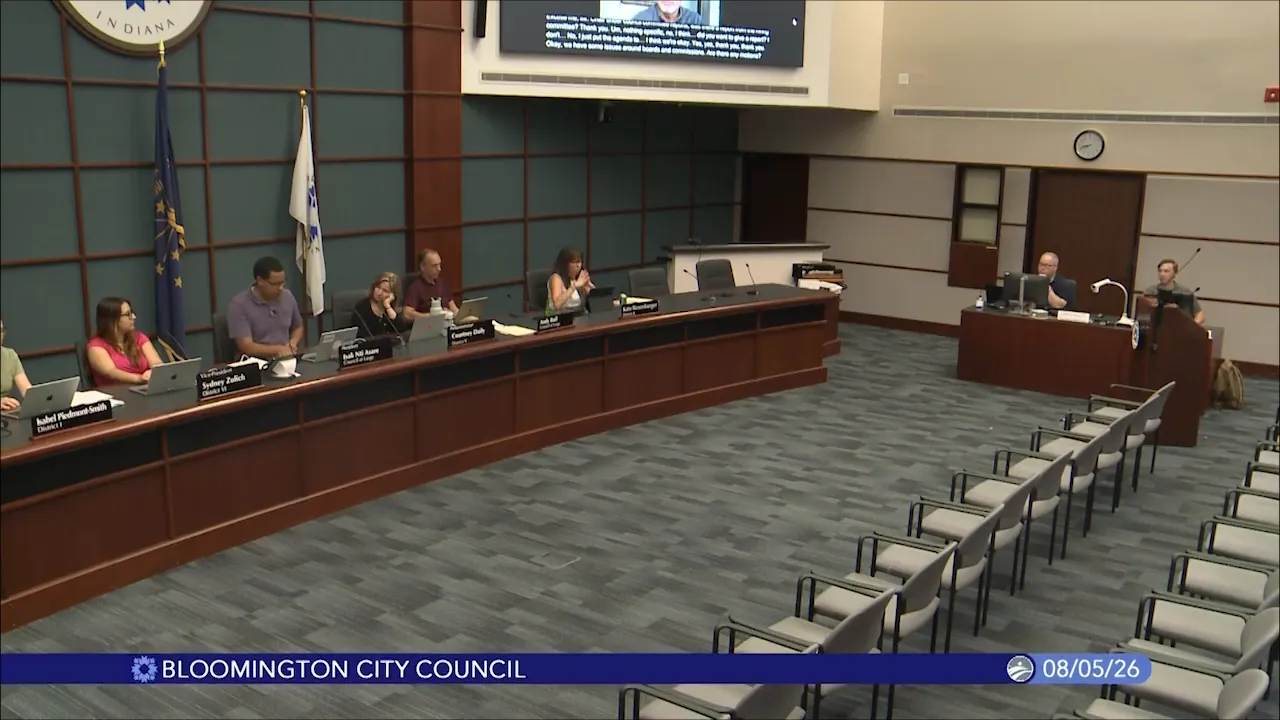
STREAMING COPY IN PREPARATION — RECORDING AVAILABLE FROM THE ORIGINAL SOURCE
Bloomington Common Council Meeting - August 6, 2026
The Bloomington Common Council held a regular meeting on August 6, 2026, beginning at approximately 3:41 PM. The meeting included reports from the Mayor, a community survey presentation, a parking rate study, and a fiscal committee update, followed by first and second readings of several ordinances and a resolution. Public comment was heard on multiple agenda items. All legislation was passed, and the meeting adjourned after scheduling announcements.
Consent Calendar
- There was no consent calendar; all items were discussed individually.
Public Comments & Testimony
- Steve Volan, Chair of the Transportation Commission, thanked council members for their advocacy for students and stated that the commission will vote on the parking report recommendations in September. He noted the report contains good recommendations but he personally disagrees with some.
- Terry Amsler, a Bloomington resident, commented on the community survey, urging clarity in how data from open participation is presented and emphasizing the importance of honest public engagement.
- Christopher MG (Greater Bloomington Chamber of Commerce) provided two comments: first, promoting the Women Xcel Bloomington event; second, encouraging the fiscal committee to find permanent cost savings in the budget, such as consolidating functions and reducing vacant positions.
- Paul Rousseau criticized the community survey for excluding most IU students, citing the tragic death of Nathaniel Stratton as an example of student involvement with city services. He recommended that future surveys ask respondents about their frequency of using different mobility modes.
- Kevin Keogh questioned the survey’s random sampling methodology and suggested that the sample was judgmental. He advocated for free public transportation for Bloomington residents and strategic parking pricing.
- Galen Cassidy, co-owner of Uptown Cafe, strongly supported the alcohol permit ordinance, stating that the current high cost of permits (250,000–300,000) is a barrier for young entrepreneurs. He argued that existing permit holders opposing the measure are being selfish.
- Rainey Cassidy, local citizen, supported the alcohol permit ordinance, praising its potential to maintain the independence and diversity of Bloomington’s food culture.
- Chris Turmje (Greater Bloomington Chamber of Commerce) commended the work on the alcohol permit ordinance and urged safeguards against speculation while keeping administration simple. He raised concerns about living wage provisions for tipped employees and overly rigid restaurant definitions.
Discussion Items
- Mayor’s Report (Kerry Thompson): The Mayor reported that the Bloomington Police Department received Tier 1 CALEA accreditation for the third time, a distinction held by only 5% of police departments. Updates on Showers West included agreements with remaining tenants and a need for over $1 million in HVAC and wiring improvements. The city was awarded a $7 million Ready 2.0 grant ($3 million grant + $4 million match from IU and partners) for creative artist studios in the Showers Admin Building.
- Community Survey Presentation (Jeff Anderson, ETC Institute): The survey, conducted February–April 2026, received 561 responses from a random sample of Bloomington residents. Key findings: 72% are at least slightly likely to recommend Bloomington as a place to live. Top concerns: lack of affordable housing (76% dissatisfied), unhoused population, and street/sidewalk conditions. Satisfaction was highest for fire protection, sanitation, and police protection. The survey methodology intentionally excluded most IU students to focus on “year-round residents,” drawing strong criticism from multiple council members (Strasberg, Zulik, Piedmont Smith, Rosenbarger) who argued it disenfranchised a significant portion of the population and undermined the survey’s validity. Council members noted disparities between respondent demographics and census data (e.g., 53% homeowners vs. 34% actual; 61% single-family homes vs. 34% actual). The response rate was 4–5%.
- Parking Rate Study (Walker Consultants – Lauren Sturdevant & John Martin): The study, received June 2026, recommended four areas: organizational (centralize appeals, adopt mission statement, data-driven decisions), policy (zone-based pricing with higher core rates, incremental rate increases, reduce evening enforcement to 8 PM), technology (replace single-space meters with kiosks, implement mobile license plate recognition, upgrade off-street equipment), and communications/wayfinding (improve signage, marketing). Council members discussed turnover concerns, dynamic pricing, and the timeline for technology replacement. Clerk Bolden critiqued the study for inaccuracies (e.g., stating appeal turnaround as 2–4 weeks when actual average is 3.4 days) and noted her office was not adequately consulted. Councilmember Zulik confirmed the clerk’s office had only a one-hour introductory meeting and was not given the link to provide feedback.
- Fiscal Committee Report (Councilmember Strasberg): Presented analysis of state property tax cuts and local income tax (LIT) options using projections from AIM and READI Financial. Key data: Under a county-wide maximum LIT (1.2%), Bloomington would see a surplus, but Monroe County Community School Corporation (MCCSC) faces a $17–18 million deficit and Richland-Bean Blossom (RBB) a $4.5 million deficit, with no recourse. A break-even scenario (LIT ~1.03%) shows the average homeowner in Bloomington Township would save about $372 per year, but residents in Steinsville would pay more. Councilmember Strasberg highlighted the regressive nature of the shift.
- First Reading – Ordinance 2026-18: Establishes guidelines for three-way alcohol permits in historic and downtown redevelopment districts. Councilmember Asari and Director Jane Cooper Smith presented the ordinance as a way to lower permit costs (from $250,000+ to $25,000–40,000) and support economic development. Council members raised concerns about the 60% food sales requirement, living wage compliance, vague criteria, and potential exclusion of bar-only concepts. The ordinance was advanced to second reading on September 2, 2026.
- Second Reading – Ordinance 2026-16 (Police/Fire Salary Ordinance): Reclassifies one sergeant position to a lieutenant. Estimated full-year cost $19,969, offset by unspent appropriations. Chief Deacoff explained the need for an additional lieutenant to manage training and special projects. The ordinance was adopted after correcting typographical errors via amendment.
- Second Reading – Ordinance 2026-17 (Salary Ordinance for Non-Union/AFSCME): Reclassifies HR position from grade 5 to 7 and Public Works position from grade 8 to 9, with cost offsets from reduced consultant and contract expenses. Controller McKim detailed fiscal impacts: HR upgrade costs $22,299/year but saves over $41,000 in consulting; Public Works upgrade costs $11,168/year, offset by savings in the Centestone contract. Director PayChak acknowledged not notifying the council office about the regrading opportunity, drawing criticism from council members. The ordinance was adopted with amendments.
- Second Reading – Resolution 2026-14: Amends the legal representation agreement with Attorney Allen, extending the contract with no minimum hours and setting a maximum amount not to exceed $85,440 (the salary for the vacant deputy attorney position). Council members praised Attorney Allen’s service but noted that hourly billing exposes inefficiencies. The resolution was adopted.
Key Outcomes
- Agenda amendment to move hiring reports passed unanimously.
- Motion to allow public comment on the community survey and parking study reports passed unanimously.
- Ordinance 2026-18 (Alcohol Permits) passed first reading and was advanced to second reading on September 2, 2026.
- Ordinance 2026-16 (Police/Fire Salaries) was adopted unanimously after amendments.
- Ordinance 2026-17 (Salary Ordinance) was adopted 8–1 (Councilmember Rosenbarger voted no) after amendments.
- Resolution 2026-14 (Legal Representation) was adopted unanimously.
- Next meetings: Executive session on August 12, 2026; budget sessions on Mondays and Wednesdays beginning August 19, 2026 at 5:30 PM; fiscal committee meeting on August 8, 2026 at 8:30 AM.
Meeting Transcript
I would like to call this meeting of the common council on whenever David's August 5th to order. Will the clerk please call the roll? Yes, Councilmember Strasberg. Here. Piedmont Smith. Here. Zulik. Here. Sorry. Here. Daily? Here. Rollo. I'm sorry, I didn't hear. Huh. Okay, we'll come back to you when you get your sound fixed. Ruff. Here. Rosenbarger? Here. Flarity is absent. And back to Councilmember Ruff. Or Rallo, did we get your sound? I'm here. Oh, now we can hear you. Thank you. Excellent. The um agendas are posted there on the clerk's desk on the front doors as well. Um today um we that's a fairly straightforward meeting. We have a handful of reports, um, including a report from the mayor, um, a report from council committees, um, and then um some issues related to appointments to boards and commissions. And we have one in one item for uh first reading, which we'll uh we will possibly discuss today, and we have three items um uh for second reading, um uh two ordinances and one resolution. There'll be two times of public comment. Um, and so we eagerly look forward to all of that. So with that, um I move to amend the agenda to um move any um reports about hiring, which is currently added to number five to move that to council committee reports under number four sure, second. All right, there's a motion in the second, any discussion. All right. Um uh will Clerk Colleen please call the rolls clerk Williamson, thank you. Do you even notice? Umberg. Here. Piedmont Smith. Yes. I was like, what am I doing? Yes. Piedmont Smith. Yes. Zulick? Yes. Sorry. Yes.
openpublica.com