Bloomington City Council Study Session - February 9, 2026
STREAMING COPY IN PREPARATION — RECORDING AVAILABLE FROM THE ORIGINAL SOURCE
Bloomington City Council Study Session - February 9, 2026
This study session of the Bloomington City Council was held on Monday, February 9, 2026. The meeting included staff presentations on the animal shelter, railroad quiet zones, and an update on the city's response to federal immigration enforcement (Operation Metro Surge). No formal votes were taken, but the council provided policy direction on several items.
Animal Shelter Presentation
- Deputy Chief Damon Bitney presented on the future of the city animal shelter, which is scheduled for demolition in 2028. The shelter handles approximately 2,000 animal calls per year and impounds about 500 animals annually. The city currently covers 100% of facility costs and 93% of staffing costs. Partner agencies (Airport, Richfield, Eden Prairie) account for 32% of usage but only 12% of revenue.
- Three options were outlined: (1) maintain current operations with minimal investment, (2) build a modern city-owned facility with regional cost-sharing, or (3) reduce city services and contract with private/nonprofit providers.
- Council direction: Multiple council members expressed support for Option 2 (new facility) and encouraged exploring regional partnerships, charitable gambling grants, volunteer programs, and veterinary service partnerships. Councilmember Nelson cautioned against expanding beyond animal control services without firm private partners. The mayor encouraged creative thinking, including possible reuse of existing buildings.
Railroad Quiet Zones Discussion
- Jeremy Melquist and Kirk Roberts of Engineering presented on establishing quiet zones to mitigate train horn noise. Bloomington has 26 grade crossings served by two railroads: CPKC and Progressive Railroad. CPKC trains have operated overnight more frequently since 2024, prompting resident complaints.
- To establish a quiet zone, a safety study costing $60,000–$85,000 and taking six months would be needed. Upgrades per crossing range from $50,000 to $400,000. Nearby cities (Edina, St. Louis Park, Golden Valley) have already begun studies; St. Louis Park's recommended improvements total $12 million.
- Council discussion: Several members expressed concern about the potential $10–15 million total cost. Councilmember Dalessandro suggested focusing on the four or five most impacted CPKC crossings first. Councilmember Nelson noted the city has no regulatory authority over railroad operations and questioned whether the investment is justified given the inconsistent train schedules. Councilmember Rivas and the mayor questioned prioritizing quiet zones over other infrastructure needs. The council agreed to request copies of the Edina and St. Louis Park studies, consider a Let's Talk Bloomington community input page, and revisit the topic after reviewing that data.
Police Chief Remarks on Immigration Enforcement
- Chief Hodges addressed the council regarding Operation Metro Surge. He stated unequivocally that the Bloomington Police Department does not cooperate with ICE, does not enforce federal immigration law, and does not have access to federal immigration databases. He expressed frustration with misinformation and noted that such rumors discourage crime reporting among immigrant communities.
- Chief Hodges reported that overall crime in Bloomington was down 10% in the previous year, and he emphasized that BPD's role is to maintain public safety, not to assist with immigration enforcement. He described the current federal tactics as "ridiculous" and harmful to community trust.
- Council members expressed strong support for the chief and the department, acknowledging the challenges faced by officers and the importance of clear communication with the public.
Listening Session Summary and Staff Recommendations
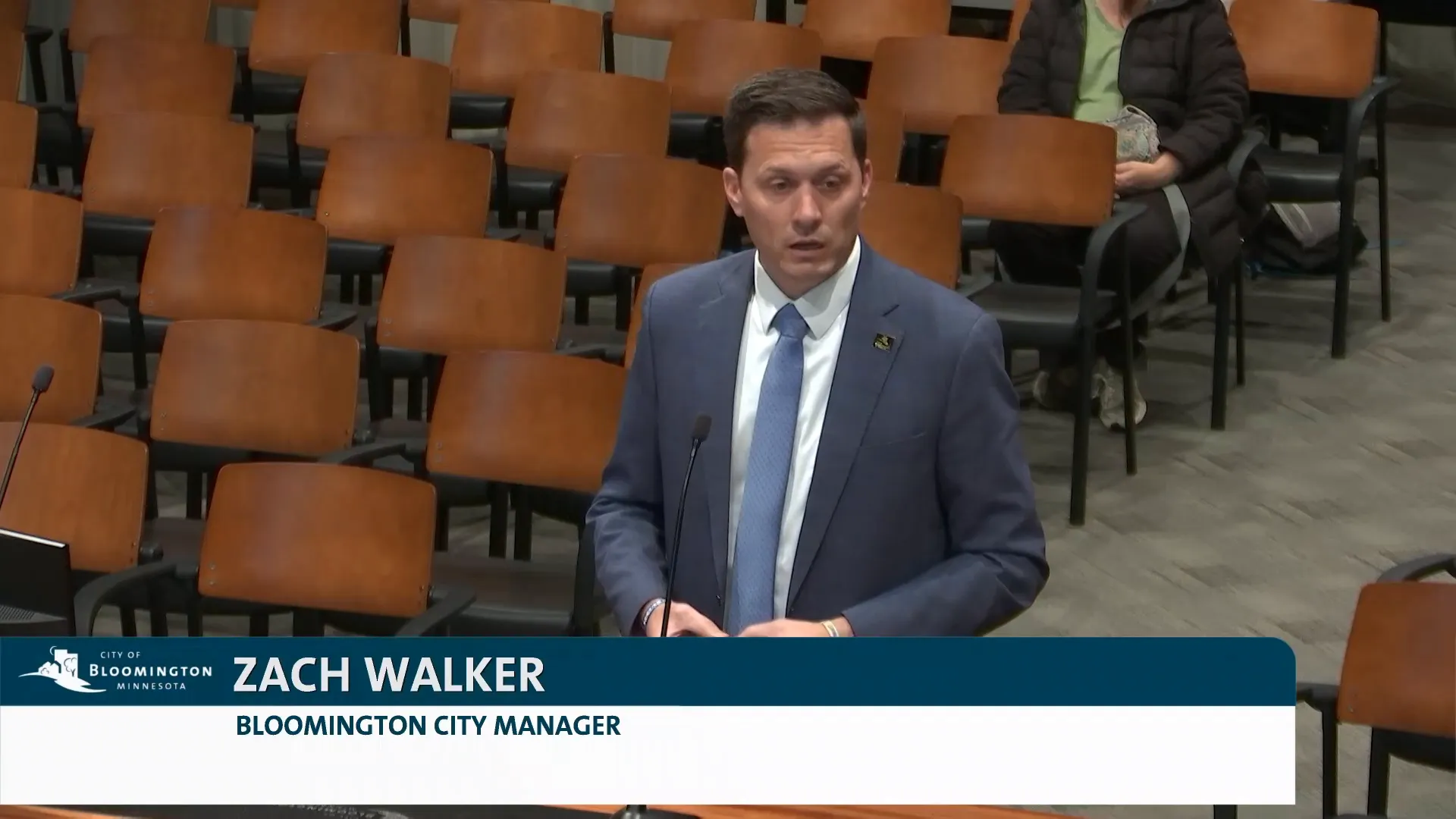
- City Manager Zach Walker summarized the February 2, 2026, listening session on Operation Metro Surge, which drew 22 speakers. Key themes included fear, anger, and requests for mental health resources, translation services, know-your-rights information, and policy actions.
- Staff actions taken: Added a resource page to the city website (12 mental health services, translation in six languages, know-your-rights materials). An internal FAQ for city employees was developed. For reporting human rights violations, the city directed residents to the Minnesota Attorney General's online form.
- Staff recommendations against several suggested actions: implementing an eviction moratorium (due to legal and practical concerns), suspending liquor licenses for hotels hosting federal agents (not legally supported), canceling contracts selectively, and prohibiting parking for federal enforcement on city property (difficult to enforce). Instead, staff proposed exploring a 30-day pre-eviction notice requirement and continuing to compile utility assistance resources.
- Councilmember Carter and others noted unintended consequences of past eviction moratoriums and supported exploring alternative tenant protections. Councilmember Nelson asked about zoning restrictions for federal detention facilities; staff agreed to review the city code.
Key Outcomes
- Animal shelter: Council directed staff to pursue a new facility (Option 2) with regional partners, explore volunteer and charitable gambling opportunities, and bring back a more detailed plan.
- Railroad quiet zones: Council deferred action pending review of other cities' studies and community input via Let's Talk Bloomington. No funding commitment made.
- Immigration enforcement: Council received the chief's and city manager's reports and expressed continued support for BPD's policy of non-cooperation with ICE. Staff will continue monitoring fiscal impacts and coordinating with other cities.
- Next steps: City staff will compile requested information and return to council at a future meeting.
Meeting Transcript
Good evening, everyone, and welcome. I will call this Ploomington City Council meeting to order. Tonight is Monday, February 9th, 2026. This is officially a study session, so no official votes or or decisions on anything. It's basically staff presentations and giving them policy direction on a couple of items. We do have uh an agenda in front of us, and to approve the agenda, we have uh three items under organizational business, actually four items, excuse me. Item 5.1 is a presentation regarding uh the animal shelter and what's some possible uh moves forward on that. Uh item five point two, uh study uh information on railroad quiet zones. That is what we have for our our agenda, and if unless there are any changes, I will move approval of that agenda. Motion and a second by Councilmember Dalessandro to approve tonight's agenda as stated. No further council discussion on this. All those in favor, please signify by saying aye. Aye opposed. Motion carries 7-0. We will go on. Item 5.1, our presentation regarding the animal shelter. Our deputy chief Damon Bitney is gonna give us uh the rundown on the animal shelter. No, we don't during study meetings, we don't do the pledge of allegiance. Yep. I'm not is it on the agenda? Okay. We we typically don't do a uh uh Pledge of Allegiance during the uh the study sessions, but if we've got it on the agenda, I don't see it on mine, but if you would all rise and join me in the Pledge of Allegiance. I pledge allegiance to the flag of the United States of America and to the Republic for which it stands. One nation under God, indivisible with liberty and justice for all the questions. Thank you for that clarification. I'm glad we got that straight and we we did it correctly. We will move on then. Item 5.1, our animal shelter presentation. Deputy Chief Damon Bitney's joining us this evening. Welcome. Thank you. Uh I appreciate the opportunity to uh uh speak tonight. Uh mayor, city manager, city council. Uh for some of you, some of the stuff is going to be repeat. I know we've been uh talking about this on and off for uh some time. Uh it's just the first time in my current role that I'm bringing this forward to kind of get some direction to say, hey, where are we gonna where should we be going with that? And one of the main driving forces of that is is right now the building is uh scheduled to be demolitioned in 2028. So we need to have some decisions on uh the shelter facility that is. It's in the CIP plan and all that kind of stuff. So as we move forward to get some direction for where this council would like this program to go. Uh so I'm gonna provide a little bit of context. I know like I said, some of you have already heard this, but uh councilmember Robertson's maybe fairly new to you. Uh so I just want to get you up to speed, and maybe there's some things that weren't covered in the previous uh presentations that I can hopefully cover today. Um so currently the the main issue that we're dealing with is the facility. Uh it's long outlived its uh life cycle. Um, and thanks to uh Superintendent Tim Barrett and his staff, they've kept it up and running uh for us. They continue to do things for us to make sure that it's operational. Um, but it is truly just past its life, and it doesn't suit the needs that we have uh currently. Um some things that I just want to uh kind of let people know that you may not have heard in the past. Um our current program is kind of in two separate things, right?
openpublica.com