Browse by city
Date range
Search help

Search titles, summaries, topics and stored transcripts together. Keywords may match separately; put the whole query in double quotes for a phrase. Matching follows word analysis, so punctuation is not exact. Both dates are included. Documents are not searched.

SHOWING 1–10 ENTRIES
01
OCT 26, 2026 · BLOOMINGTON, MINNESOTA · CITY COUNCIL
Bloomington City Council Meeting - October 26, 2026: Proclamation, County Update, Sports-Use Zoning Review

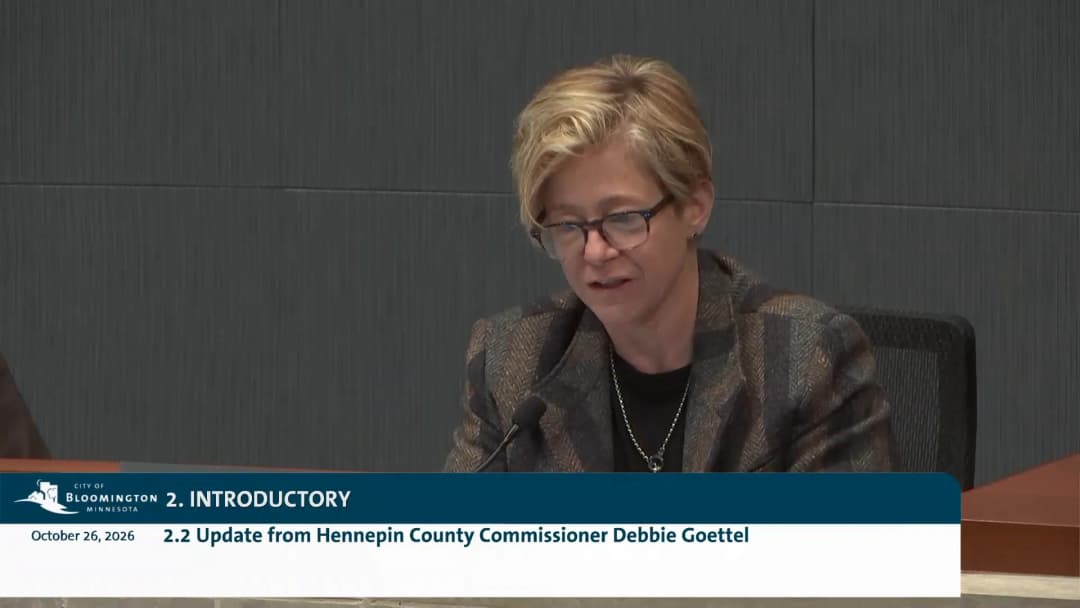
On Monday, October 26, 2026, the Bloomington City Council met in Council Chambers with an online audience. The agenda and minutes were not separately available, so this summary is based entirely on the meeting transcript. The council adopted the agenda 7-0, approved a Native American Heritage Month proclamation, welcomed new employees, heard a Hennepin County update, acted on consent business, discussed a sports and recreation zoning study item, and adjourned 7-0. Consent Calendar - The agenda was approved 7-0 on a motion by Councilmember Rivas, seconded by Councilmember Robertson. - Consent business items 3.1 through 3.10 were approved 7-0 on a motion by Councilmember Loman, seconded by Councilmember Dalessandro. - Councilmember Loman pulled item 3.11, a resolution amending the city of Bloomington employment rules, and said he would vote against it. Councilmember Dalessandro moved approval, Councilmember Carter seconded, and the resolution carried 6-1 with Councilmember Loman opposed. Proclamations, Presentations, and Introductions - Mayor Tim Bussi proclaimed November 2026 as Native American Heritage Month. Nat Kirk, Equity and Inclusion Project Manager, accepted the proclamation and spoke about her mixed Native ancestry, the history of survivance, and the meaning of the month. She invited the community to a screening of The People's Protectors on November 13 at 6:30 p.m. at Schneider Theater. - Community Development staff introduced two new employees: long-range planner Elena Franzen, who started September 21 and previously worked in Plymouth and Arden Hills, and environmental health specialist Alma Guerrero Sanchez, who rejoined on August 31 after a 2025 internship. - Hennepin County Commissioner Debbie Goettel gave an annual update. She described Hennepin County as Minnesota's second-largest government and largest local government unit, with a budget of nearly $3.2 billion. She reported that the county absorbed $10.8 million in federal cuts during the 2026 budget year and faces roughly $27 million to $28 million in cuts for 2027, including $59 million in combined HUD, SNAP, and Medicaid pressures, and $52 million the following year. She discussed an 8.15 percent property tax levy increase, the county board's assumption of the HCMC hospital board role to prevent closure, affordable housing investments of $19.4 million creating or preserving 1,339 affordable rental units and 69 affordable homeowner options, Elevate Hennepin assistance to more than 4,500 entrepreneurs, a youth crisis stabilization center with 13 beds, tree canopy programs, and the county board's September 15 affirmation of free and fair elections. She also answered council questions about Hennepin Health work requirements, HCMC funding options, possible service cuts, and the levy increase. Public Comments & Testimony - The mayor reported the evening's community listening session included six speakers, then named five: Matthew Hallett made four suggestions about climate resiliency; John Crampton, representing Third Act, urged the city to adopt SolarAPP+ to speed residential solar permitting; Deb Harper raised code enforcement concerns affecting her neighbors; John Hutmaker discussed budget forecasts, tariffs, and household costs; and Kathy Jones, a neighbor to the James Avenue townhomes approved at the previous meeting, shared reactions to that project. Council members indicated staff would follow up on several of these items. Discussion Items - Item 5.1 was a study item on a sports, health, and recreation use review, presented by planning staff Emily Hesbeck; no decision was required. Staff proposed combining the current health club and sports training facility uses into a new category called fitness and sports facility, with indoor recreation and entertainment remaining separate. The proposal would allow the new use in all commercial districts except B1 and, in industrial districts, would permit facilities under 10,000 square feet and larger facilities only when adjacent to an arterial or collector road. Staff noted current health club rules require adjacency to an arterial or collector and limit use to 50 percent of a building's floor area. - Existing examples cited included Vertical Endeavors, Northern Elite All Stars, and M1 Volleyball. Planning Commission feedback on October 1 included adding hockey facilities and ice rinks and requesting additional data on industrial vacancies and traffic. - Council discussion raised definitional questions about fitness businesses, food and beverage service, saunas and cold plunge facilities, and membership-only versus public access. Councilmembers expressed concerns about safety for children near heavy industrial uses, preserving industrial land and tax base, the usefulness of the 10,000-square-foot threshold, tournament parking demand, and the need for performance standards on lighting, pedestrian routes, building entrances, and parking. Some councilmembers suggested phasing the allowance into lighter industrial districts and letting the market guide which buildings are reused. Staff clarified the review was not tied to a specific development project and that the fire code restricts some hazardous uses from sharing buildings. - No formal action was taken. Staff said public hearings will likely be held in December or January. Council Policy & Issue Updates - Mayor Bussi summarized the listening session comments and reminded residents that Election Day is November 3, with early voting available at City Hall. - The City Manager thanked Fire Chief Yuli Seal for 50 years and five months of service, noting he is the city's first and only fire chief; remarks mentioned a November 6 retirement date before correcting to a November 9 celebration. Key Outcomes - Agenda and consent items approved; item 3.11 approved 6-1. - November 2026 proclaimed Native American Heritage Month; new employees introduced; county update received. - Sports-use study item discussed with no vote; staff will refine the proposed ordinance and return for public hearings in December or January. - Listening-session items, including SolarAPP+ and climate resiliency, were referred for staff follow-up. - The meeting adjourned 7-0.
ZONING REGULATIONS 32% · COMMUNITY ENGAGEMENT 10% · ECONOMIC DEVELOPMENT 10% · PUBLIC HEALTH AWARENESS 8%
02
OCT 19, 2026 · BLOOMINGTON, MINNESOTA · CITY COUNCIL
Bloomington City Council Study Session on 2027–2036 CIP and External Services Budgets – October 19, 2026

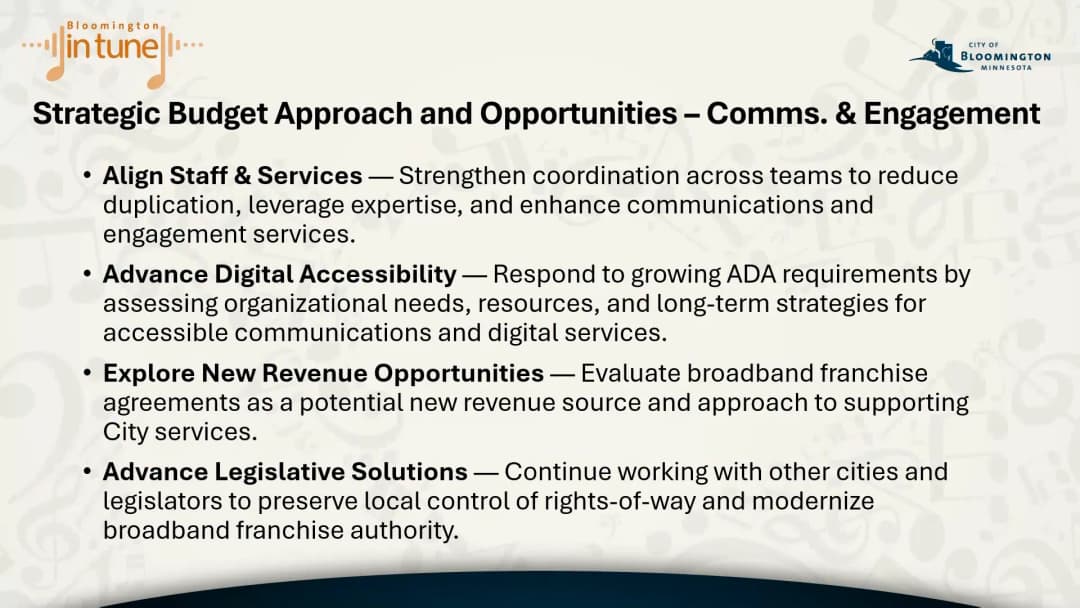
On Monday, October 19, 2026, the Bloomington City Council held a study session to review the draft 2027–2036 Capital Improvement Plan (CIP) and 2027–2028 budget requests for external services departments. The council approved the agenda 7-0 and heard staff presentations; no substantive decisions were made. Capital Improvement Plan Review - CIP staff presented the annual 10-year CIP, a planning tool covering capital projects over $50,000 expected to begin during the plan period. It is aligned with strategic priorities for a connected and welcoming community, a healthy community, and equitable economic growth. - Category totals included surface transportation at $275 million, sewer/water/storm at $177 million, South Loop at just under $100 million, park development at about $70 million, and housing and redevelopment authority at just under $4 million. - The 2027–2028 portion contains 90 projects totaling about $260 million, including $75 million for the water park parking ramp and $45 million in bonding; a large portion is in the South Loop. - Staff noted debt-related future projects including Fire Station 2 rebuild, Dwan Clubhouse, animal shelter, pavement management, and water park financing/parking ramp. There are 35 new projects listed for 2027. - A councilmember asked whether projects had changed since last year; staff said bonding projects remained the same except for inflation and pricing. The animal shelter estimate moved from about $5 million to $7 million due to inflation, and its feasibility study is underway. Another councilmember asked for follow-up on Bri Park and on the Bloomington Center for the Arts business plan; staff committed to follow up. - The mayor emphasized the CIP is a planning document, not a funding commitment; projects require future council approval and funding. Final CIP consideration is scheduled for December 7. External Services Team Budgets - Deputy City Manager Kathy Hadeen introduced the external services team, which accounts for about 90% of the city’s general fund budget. External services 2027 expenditures are projected at $116.3 million (+7.26%), with a net general fund impact of $91.4 million (+8%). For 2028, expenditures are projected at $120.9 million (+3.97%), with a net general fund impact of $97.8 million (+7% over 2027); 2028 revenues are expected to decline by about 1.8%, partly due to the SAFER grant ending. Personnel is 71% of the external services budget. Public Works - Public Works has 164 employees. General fund expenditures increase 4.5% in 2027 and 2.8% in 2028, with over $200,000 in reductions. New investments include $150,000 annually for climate action plan implementation. - Utility funds show combined expenditure increases of 5.5% in 2027 and 9.3% in 2028, driven by capital, materials, and debt service. Proposed utility rate increases are 3% for water, 9% for wastewater, 4% for stormwater, and 4% for solid waste. The wastewater increase is tied to the North Central Sanitary Sewer Project; no curbside cleanup in 2027 helps offset costs. - A councilmember asked about the projected decline in public works general fund revenue; staff attributed it largely to the fiber buildout reducing expected revenue. - Accomplishments highlighted included $4 million in state bonding for the North Central Sanitary Sewer Project, construction of a fleet garage and salt storage facility, $600,000 in federal funding for the Normandale Boulevard Sidewalk and Trail Project, and delisting Highland Lake from the impaired waters list. Police Department - Police Chief Booker Hodges said the department’s net general fund impact rises about 3.92%, with salary and benefits up 3.73% and materials, supplies, and internal services up 3.55%. Reductions of $34,000 offset a $545,000 increase, leaving a $510,000 total increase, about $500,000 of which is the Axon contract. - He compared staffing with Rochester (161 officers, about 123,000 residents) and Duluth (156 officers, 88,000 residents) versus Bloomington’s 133 officers for about 92,000 residents. - Strategies and accomplishments included the in-house therapist program, executive protection unit, Axon and AI efficiencies, expanded drone capability, about $2 million in grant applications, hybrid fleet savings, 100% retention, and growth in staff therapist use from 1 in 20 to 1 in 4. Fire Department - Deputy Fire Chief Forrester presented. The 2027 budget adds 9 full-time firefighters, including 3 battalion chiefs and 3 captains, plus equipment, supplies, and a fire cadet program, for about $1.1 million in new investments; 2028 would add 10 part-time firefighters. Reductions of about $64,000 lower the 2027 increase to about $392,000. - Revenue declines in 2028 are tied to the end of the SAFER grant, with the fire pension fund used to help offset levy impacts. - The 90th percentile response time has improved from about 12 minutes to 9 minutes, still above the 7:30 benchmark. Call volume is up 4–5%, nearing 13,000 runs, with overlapping calls 42% of the time and up to seven simultaneous calls. The goal remains six stations staffed with four personnel per truck. Parks and Recreation - Parks and Recreation has 66 full-time, 53 part-time, and about 300 seasonal employees. The 2027 general fund net impact increases about $1.1 million (8.7%), partly because the forestry fund moved into the general fund. Tax support decreases by almost $400,000 due to earned revenue growth; reductions total $175,000. - Enterprise facilities are presented together: property tax revenue supporting the golf course, Ice Garden, Center for the Arts, aquatic center, and future community health and wellness center drops almost 20%. The Ice Garden no longer needs an operating or debt-service subsidy, and Dwan closure affects 2028 revenue. - Staff discussed pricing policy, cost recovery, naming and sponsorships, consolidated food and beverage operations, new recreation software, and a target of 100% cost recovery for the community health and wellness center by 2030. Councilmembers asked about cross-subsidization and park maintenance service tiers; staff said cost recovery decisions will come back to council and service-level tier work may affect the 2028 budget. Public Health - Dr. Nick Kelly presented. Public Health serves Bloomington and Richfield with 39 full-time and 15 part-time employees, expects about $6.4 million in revenue in 2027, and receives 67% of its budget from contracts and grants. The department identified $130,000 in reductions. - The budget increase includes investments in vaccines; Dr. Kelly cited vaccine resources declining from 16,000 to about 9,000 to about 4,000 over three years and framed the spending as prevention against a vaccine-preventable outbreak. - He projected uninsured rates could double over five to ten years and said the department is exploring expanded billing, legislative changes, and partnerships to manage funding pressures. Community Development - Kim Bergren presented. Community Development has six divisions and about 90 staff, and the budget excludes HRA and Port Authority. Total spending increases 5% in 2027, with a similar revenue increase; net increases are $313,000 in 2027 and $317,000 in 2028. - A full line-item review reduced spending by $36,000, offset by $73,000 in increases, for a net $36,000 operating cost increase. Most costs are staffing, and no staffing changes are proposed. Focus areas include customer service, housing creation and preservation, technology, code updates, and process improvements. Public Comments and Visitors - No public testimony was offered. Four Hill-Murray High School students attended as part of a government and economics project and introduced themselves during the meeting. Key Outcomes - The council approved the agenda 7-0. No votes were taken on the CIP or budget requests. - The CIP is scheduled to return for final approval on December 7, with a public hearing in December. - Budget discussions will continue ahead of the city’s truth-in-taxation hearing in mid-December.

CAPITAL IMPROVEMENT PLANNING 15% · PARKS AND RECREATION 15% · PUBLIC SAFETY 13% · PUBLIC ENGAGEMENT 12%
03
OCT 12, 2026 · BLOOMINGTON, MINNESOTA · CITY COUNCIL
Bloomington City Council Meeting – October 12, 2026

Mayor Tim Bussey convened the regular Bloomington, Minnesota, City Council meeting on Monday, October 12, 2026, in the Council Chambers with online viewing. The council approved the agenda 7-0 and then moved through ceremonial items, a 12-item consent agenda, public hearings on assessments and parking requirements, a continued rezoning and townhome proposal, and an informational budget discussion for the city's internal enterprise service departments. Ceremonial and Recognition Items - Mayor Bussey proclaimed October 2026 as National Chiropractic Health Month in Bloomington, recognizing Northwestern Health Sciences University and musculoskeletal health care. Student Elise and Dr. Bo Foshi of the Minnesota Chiropractic Association accepted the proclamation and thanked the city. - Communications staff introduced Trisha O'Brien, the city's new part-time communication specialist. O'Brien has more than 10 years of communications experience and a master's degree in journalism from the University of Southern California. - The city presented its 2026 communications awards. Bloomington won five Minnesota Association of Government Communicators Northern Lights awards: first place for the Annual Report and for the Public Works/Police Open House promotional video; second place for Bloomington Today and the We Mean Business series; and third place for The Briefing. Nationally, the Bloomington Police Department's Instagram reel, 'Valentine's Day Special,' won a first-place 3CMA Savvy Award and was nominated for a Diamond Award. The reel generated more than 6.3 million Instagram views, reaching 4.7 million accounts, 98% of them non-followers. Consent Calendar - Councilmember Robertson presented the consent agenda. Items 3.1 through 3.3 and 3.5 through 3.11 were approved 7-0. - Item 3.4 was approved 6-0, with Councilmember Loman abstaining. - Item 3.12, the Axon Enterprise agreement expansion, was discussed in detail. Police Chief Hodges said it would add drone-as-first-responder capability, translation tools, and dispatch technology. He said the program is not spyware, that Axon data is audited and tracked, and that misuse is subject to discipline up to termination. Councilmember Carter moved to approve the agreement through the State of Minnesota NASPO cooperative procurement contract No. 247327. City Manager Zach Walker said the new spending had been programmed into the budget. The motion carried 7-0. Public Comments & Testimony - At the council listening session held in connection with the meeting, seven community members addressed the council. Lee and Sue Lang Sheridan voiced concerns about tobacco industry efforts to weaken local regulations as federal oversight declines, and urged Bloomington to remain a public health leader. Matthew Hallett spoke about the budget, climate resiliency, and recent city issues. Paul Coate discussed gun violence. Greg Kyle raised concerns about neighbor code compliance and said the city was not doing enough. Ali Jarvis urged consideration of preemptive animal protection ordinances, including limits on the sale of animals and animal shows such as circuses. Kathy Jones spoke about R1-to-R3 zoning changes and townhomes. Jamie Anthony asked questions about Axon technology, which City Manager Walker answered. - The public hearings on the 2026 pavement assessment roll and the off-street parking ordinance drew no speakers in chambers or online. Discussion Items and Public Hearings 2026 Pavement Management Program Assessment Roll (Item 4.1) - Staff presented the assessment roll for the 2026 P.M.P. street reconstruction project. The total project cost was just over $8.6 million across 13 street segments, with 170 parcels assessed. Single-, two-, and three-family properties are assessed at a 25% rate; other property types are assessed at 50%. Final assessment notices were mailed in September. Property owners may prepay without interest until November 24, 2026, with a $100 minimum. Remaining balances will be rolled onto property taxes, beginning with May 2027 statements, at 5.5% interest over 10 years. Hardship deferral and appeal options were also described. - Councilmember Robertson moved to adopt Assessment Roll 2026-1. The motion carried 7-0. James Avenue City Homes (Item 4.2) - This item was a continuation of a public hearing closed at the September 14, 2026 council meeting. The requests were to rezone 9025 and 9033 James Avenue South from R1 to R3, approve final site and building plans for nine detached townhomes, and approve a Type III preliminary/final plat creating nine townhome lots and one outlot. Staff and the Planning Commission recommended approval. A construction management plan condition was added after earlier neighborhood concerns. Following prior discussion, a 40-foot maximum building height condition was proposed; the applicant agreed on the record to the 40-foot limit. The applicant also did not object to adding approximately 12 trees. - Councilmembers expressed a range of views. Supporters noted that the area had been guided toward medium-density housing since 1981 and that the project would expand homeownership opportunities, including smaller single-family homes. Councilmembers Dalessandro and Carter opposed, citing uncertainty about whether the two extra lots compared to R1 development would actually result in homes being built, and Carter also objected to what she called piecemeal R3 zoning in the middle of an R1 neighborhood. - Votes: the rezoning ordinance was adopted 5-2, with Councilmembers Dalessandro and Carter opposed; summary publication was approved 7-0; the final site and building plans were approved 5-2; and the preliminary/final plat was approved 5-2, with the same two councilmembers opposed. Off-Street Parking Requirements Ordinance (Item 4.3) - Staff presented amendments to Chapters 12 and 21 of the City Code to right-size off-street parking requirements. The proposal included reductions of about 10-30% for many uses, 50% reductions for some uses, a 10% by-right reduction in designated development districts, a cap of two parking flexibility requests per site, an increase in the number of vehicles allowed to park outside garages at single- and two-family residences, and several clarifications. - The Sustainability Commission submitted a letter of support, and the Planning Commission recommended approval 4-1. Council discussion focused on enforcement, commercial vehicles, the 24-hour street parking rule, consistency with alternative transportation goals, and Councilmember Rivas's concern that some commercial areas already have difficult parking conditions. Staff noted that larger reductions target industrial uses and that general retail reductions are more modest. - The council adopted the ordinance 7-0 and authorized summary publication 7-0. Internal Enterprise Services Budget (Item 5.1) - The council extended the meeting to no later than 9:30 p.m. and received the budget presentations as an informational item only; no vote was taken. - Deputy City Manager Elizabeth Tolsman presented an overview of the Internal Enterprise Service Team. The proposed 2027 net budget was reduced by nearly $197,000 while maintaining services. She also highlighted state and federal advocacy results, including $4 million in state funding for the North Sanitary Sewer Project and $1.69 million in federal infrastructure funding. - City Clerk Jamie Hanson reported that the 2027 clerk's office budget decreases by about $307,000, or 20.42%, primarily due to lower election judge costs in a non-statewide-election year. The 2027 request has a negative net impact of $36,319. The 2028 conceptual budget rises due to the 2028 election, but remains below the 2026 level. Accomplishments included a record-setting 33% primary voter turnout. Plans include consolidating election precincts from 30 to 20 and moving to flat-rate cemetery pricing. - Communications Director Janine Hill said the newly aligned Communications and Engagement Department's 2027 net budget decreases by $66,441, or 4.15%. Operating reductions totaled about $156,590 after offsets. The department reported 4.9 million media impressions in 2026, worth $368,000 in publicity, and the Hatch program has generated $11.7 million in earned media since its launch. A website redesign is being delayed until 2029 to reduce costs. - Finance staff reported a 2027 net budget impact of approximately $1.7 million, an increase of 7.7%, with a 2028 conceptual increase of 6.2%. Line-by-line cuts totaled $36,000, but unavoidable cost increases left a net reduction of about $2,500. Finance also assisted in bringing the preliminary 2026 levy to 6.64% in September and is planning to replace the utility billing system before its platform reaches end of life in 2029. - City Attorney Melissa Vanderscheid reported a 2027 legal budget request of about $3 million, up 5.24%. The city attorney salary allocation changed from 50% city/50% Port Authority-HRA to 70% city/30% Port Authority-HRA. Legal reduced operating costs by about $43,333 after offsets. Accomplishments included trying three criminal jury trials to verdict, a 150% increase over 2025, prosecuting about 5,000 cases annually, generating more than $400,000 in fine revenue, and recovering unpaid wages on city-funded projects. - IT Director Cheney said the IT budget for 2027 increases expenditures by 3.4% and revenues by 3.7%, lowering the net budget impact by $19,000. The 2028 conceptual budget includes a planned use of about $1 million in fund balance. IT implemented a new firewall, migrated to a cloud-based phone system, and is managing a 30% increase in data requests. - Councilmember Loman asked whether expenditure growth is being driven by prior compensation policy decisions; no immediate answer was required. City Manager Walker said external services departments would present the following Monday. Key Outcomes - Agenda approved 7-0. - Consent agenda items approved, including the Axon Enterprise agreement expansion, which passed 7-0. - The 2026 P.M.P. Assessment Roll 2026-1 was adopted 7-0. - The James Avenue City Homes rezoning, final site and building plans, and preliminary/final plat were approved 5-2 on each land-use action; summary publication was approved 7-0. - The off-street parking requirements ordinance was adopted 7-0, and summary publication was approved 7-0. - The budget discussion was informational only; no budget vote was taken. - Council directed staff to look into potential humane pet store and wild animal-free circus ordinances, agreed to a future study session on parking sign policy, and noted the Comprehensive Plan update as the appropriate forum for broader R3 zoning policy discussion. - The meeting adjourned 7-0.

PROCEDURAL 18% · PUBLIC ENGAGEMENT 10% · ZONING REGULATIONS 8% · PARKING REGULATIONS 8%
04
SEP 28, 2026 · BLOOMINGTON, MINNESOTA · CITY COUNCIL
Bloomington City Council Meeting: September 28, 2026

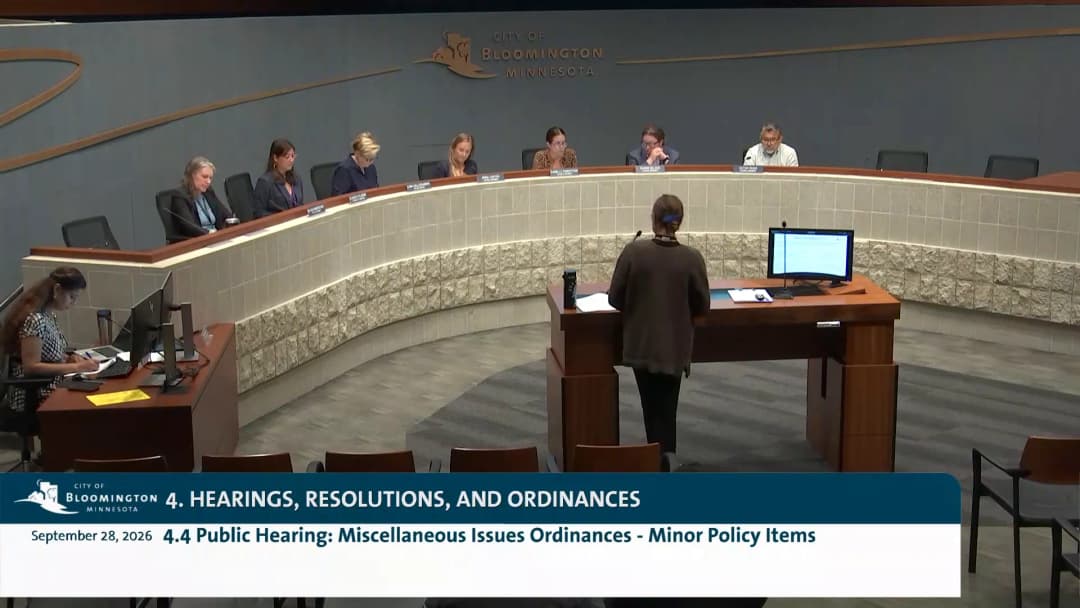
The Bloomington City Council met on September 28, 2026 at 6:30 PM, with Acting Mayor Lona Dalessandro presiding due to the absence of Councilmember Loman and Mayor Tim Bussey. The meeting covered proclamations, new employee introductions, consent business, four public hearings, an informational presentation on a geothermal pilot, and council policy updates. All votes were unanimous (5-0) unless noted. Consent Calendar - Agenda approval: Motion by Councilmember Carter, second by Councilmember Robertson. Approved 5-0. - Consent business (items 3.2–3.13): Approved 5-0 without discussion. - Donations (item 3.1): Councilmember Carter held this item to acknowledge community partners. Donations included: American Legion Post 550 (five dog tags for memorial), anonymous donations to BPD (office supplies, snacks, youth leadership lunch, wellness program), Bloomington Community Foundation ($10,000 for wellness summit), and additional donations for public health (Narcan, baby blankets, newborn bundles). Councilmember Carter thanked donors and moved to approve; second by Councilmember Robertson. Approved 5-0. Public Comments & Testimony - Latino and Hispanic Heritage Month Proclamation: Martha Mendiola Rios and Juan Cerezo Cortez (30-year Bloomington residents) accepted the proclamation, expressing gratitude for the city’s recognition of Hispanic/Latino culture and for making Bloomington a safe, welcoming home. - Listening Session (recap): Acting Mayor Dalessandro summarized four speakers from the evening’s listening session: - Brian Emerson and Elizabeth Carbone: Expressed concerns about construction of the Community Health and Wellness Center. - Sally Ness: Spoke again about the Smith Park Shared Agreement. - Matthew Hallett: Advocated for policies to support food growing, reducing sod, and sustainable residential practices. - Deb Harper: Raised concerns about the notice of corrections process for residential code violations. Discussion Items - Proclamation – Hispanic/Latino Heritage Month: The council observed September 15 – October 15, 2026 as Hispanic/Latino Heritage Month. Acting Mayor Dalessandro read the proclamation highlighting that 11.2% of Bloomington residents identify as Hispanic/Latino, and the contributions of the community and the city’s employee resource group OLA. - New Employee Introductions: - Scott Frost – Civil Engineer, Utilities Division (public works). Grew up in Bloomington, graduate of Jefferson High School, brings experience from Met Council, White Bear Township, and St. Paul Regional Water. - Dr. Jen Fuller – Sustainability Coordinator. Holds a PhD in environmental social science from Arizona State University, 20 years’ experience in environmental education and policy, will lead the city’s climate action plan implementation. - Public Hearing 4.1 – Street Name Change: City Engineer Julie Long presented renaming a portion of Hopkins Road (northwesterly of 10526 Hopkins Road and 600 Mission Road) to Mission Road to resolve confusion at a Y intersection. Two parcels would be re-addressed from Hopkins to Mission; the city proposed a $1,000 stipend per home to offset costs. After public hearing (no speakers), council discussed an effective date after the November 3, 2026 election. Councilmember Nelson asked about voter registration implications – staff to notify affected residents. Adopted 5-0, effective November 4, 2026. - Public Hearing 4.2 – Zoning Amendment for Sports Training Facilities: Kareem Sherrard (staff) presented a privately initiated code amendment to allow sports training facilities (e.g., dance studio) in the FD2 freeway development district. The applicant (Just for Kicks, represented by Perry Platicia) would occupy 8,790 sq ft at 1321 American Boulevard, operating off-peak with 60 kids peak times. No public opposition. Amended Chapter 21 of city code. Adopted 5-0, summary publication 5-0. - Public Hearing 4.3 – Miscellaneous Issues Cleanup Items: Emily Hestbeck presented 16 cleanup items correcting errors and improving consistency (e.g., corner lot definitions, missing middle housing occupancy standards, hotel airport parking). Planning commission unanimously recommended approval. Councilmember Carter asked about goat/sheep grazing (Ordinance B) – clarified that the permit requires a minimum one-acre parcel. Adopted 5-0, summary publication 5-0. - Public Hearing 4.4 – Miscellaneous Issues Minor Policy Updates: Hestbeck presented five minor policy updates: - Odor mitigation for cannabis businesses within 150 ft of residential properties. - Separate use for car detailing (permitted in B2, I1, I2, I3 districts) distinct from car washes. - Clarifying tree preservation standards for missing middle housing. - Restoring trailer parking standards to allow trailers on grass in rear yards with 5-ft setback. - Clarifying rezoning application requirements. No public testimony. Adopted 5-0, summary publication 5-0. - Informational Presentation – CenterPoint Energy Networked Geothermal Pilot: CenterPoint (Kat Knutson, Emma Ingebretsen) presented a pilot under the Natural Gas Innovation Act. Bloomington is one of three finalist sites. Potential buildings: Civic Plaza, Public Works, single-family homes (opt-in). Construction timeline: final site selection early 2027, construction late 2027/early 2028. Community open house Saturday, September 28? (October 3?) from 10-12 at the Center for the Arts. Council asked about construction impact (coordination with Community Health Center construction) and possible developer programs. No action taken. Key Outcomes - Street name change adopted (Ordinance): 5-0, effective November 4, 2026. - Zoning amendment (sports training facilities in FD2) adopted: 5-0; summary publication approved 5-0. - Cleanup items (ordinances A–J, L–Q) adopted: 5-0; summary publication 5-0. - Minor policy updates (ordinances R–V) adopted: 5-0; summary publication 5-0. - Meeting adjourned at 7:42 PM.

PROCEDURAL 24% · ZONING REGULATIONS 18% · ENERGY MANAGEMENT 14% · ZONING CODE ENFORCEMENT 12%
05
SEP 14, 2026 · BLOOMINGTON, MINNESOTA · CITY COUNCIL
Bloomington City Council Meeting Summary: September 14, 2026

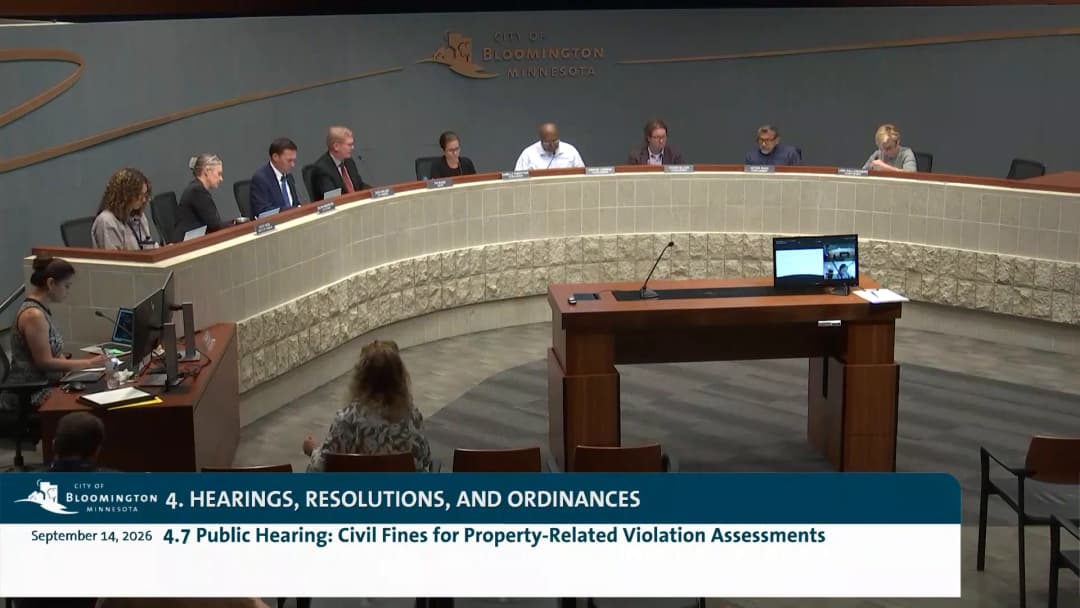
The Bloomington City Council met on Monday, September 14, 2026, at 5:00 PM (CT) in council chambers and via remote participation. The meeting covered proclamations, consent agenda, adoption of the preliminary 2027 tax levy and budget, annual assessment hearings, and a rezoning request for James Avenue City Homes. The council extended the meeting twice, first to 9:30 PM and then to 10:00 PM, to address the full agenda. Consent Calendar - Approved items 3.1–3.11 and 3.13–3.24 (24 items total) by a 7-0 roll call vote. - Item 3.12 (Advisory Board of Health bylaws and rules of procedure) was held by Councilmember Lowman, who voted no; the item passed 6-1 with Lowman in opposition. Public Comments & Testimony - Tax Levy (4.1): Two speakers addressed the preliminary 2027 levy. Matt Hallett argued the levy was not high enough given climate and federal policy challenges, and expressed concerns about Axon technology (related to police drones) and its ties to ICE. Dan Bell urged the council to consider the cumulative burden of rising taxes on seniors and fixed-income residents, and called for more efficient spending. - Assessment Hearings (4.3–4.7): - Marlis Johansson (phone) questioned why unpaid assessments don't appear on title searches when properties sell, specifically regarding civil fines. - Matt Hallett suggested debt forgiveness programs for stormwater drainage and encouraged native landscaping to reduce water use. - Mohammed Abdel Hafiz (on 4.6) appealed a $155 charge for removal of nine leaf bags that had been placed to block drafts while he was out of the country. The council later exempted his property from the assessment. - Rezoning – James Avenue City Homes (4.8): Several residents opposed the project: - Kathy Jones (neighbor) asked why R1 zoning could not be used and opposed changing to R3, citing increased traffic and incompatibility with the neighborhood. - Luann Mikhail questioned the traffic analysis, predicting higher daily trips than estimated. - Jan Miller and Scott Deers expressed concerns about height, parking, construction impacts, and the loss of a maintained home at 9033 James. - Dan Bell argued the project would not provide truly affordable housing. - Matt Hallett suggested the city explore eco-village concepts and better stormwater management. Discussion Items - Proclamations & Honors: - International Day of Peace (September 21) – proclaimed by Mayor Busse. The youth commissioner was absent but the proclamation was read. - National Suicide Prevention Month and Week – proclaimed; Jen Owens from SAVE praised Bloomington’s postvention LOSS Team. - Hatch Bloomington 2026 winners honored – five existing local businesses received a total of $124,000 (Port Authority added $24,000 to the original $100,000). Winners: Auto's Auto Body (collision repair), Afghan Darvand (restaurant), Nine Mile Brewing (taproom), Bloomington Garden Center, and Zeke's Place (diner). - New public works employees introduced: Amy Hiam (fleet support), Everly Goleman (equipment operator), Jacob Stone (service technician). - Paige Roman appointed to the Merit Board (7-0 vote) to fill a vacancy. - Preliminary 2027 Tax Levy & Budget (4.1/4.2): Finance Director Kari Carlson presented a proposed 6.64% increase in the city levy ($100.2 million). Key drivers: public safety staffing (fire department transition), new technology (drone-first responder, Axon platform), and the new Community Health & Wellness Center opening in 2027. A $1.9 million debt levy reduction from the Capital and Debt Management Fund helped offset the increase. The median-value home would see a $128.49 annual increase ($2.47/week). The council discussed inflationary pressures, staffing, and reserve policies. Councilmembers expressed support, citing thorough community engagement and transparent breakdowns. The 2027 preliminary levy and budget passed 7-0. The conceptual 2028 budget also passed 7-0. - Assessment Hearings (4.3–4.7): Staff presented the annual process for delinquent utilities, tree removal, weed/brush removal, public nuisance abatement, and civil fines. After public testimony, the council closed each hearing and adopted the assessment rolls with one exception: on 4.6 (nuisance abatement), the council voted to exempt 8724 Crest Road ($155 charge) due to extenuating circumstances (property owner was out of country caring for ill mother). All other assessments were approved unanimously. - Rezoning – James Avenue City Homes (4.8): Applicant Steve Furlong seeks to rezone two parcels (9025 and 9033 James Avenue) from R1 to R3, approve a final site and building plan for nine detached townhomes, and plat the lots. The property is guided Medium Density Residential in the Comp Plan. Planning Commission recommended approval with a construction management plan condition. During council discussion, concerns were raised about: - Lack of guarantee on final building design (conceptual plans show 20-ft height, but R3 allows up to 50 ft). - Traffic generation (staff estimated 66 new daily trips; residents argued it could be higher). - Construction impacts and duration. - Whether the project truly provides affordable housing (lot prices $120k, homes expected $400k–$600k). - The need for more information on the construction management plan, potential height restrictions, and compatibility with the neighborhood. Councilmember Lowman expressed reluctance to approve the R3 rezoning without clearer certainty about final development. Councilmember Nelson noted that if rezoned to R3, any code-compliant structure could be built, subject to setback and other standards. After extensive discussion, the council voted 7-0 to table the item to the October 12, 2026 meeting, directing staff to provide additional information and clarification. Key Outcomes - 2027 Preliminary Tax Levy & Budget: Adopted (7-0). Levy set at $100.2 million (6.64% increase). Public comment heard; no changes made at this step. - Conceptual 2028 Budget: Approved (7-0) as a planning target. - Consent Agenda: Approved (7-0) except item 3.12 passed 6-1 (Lowman opposed). - Merit Board Appointment: Paige Roman appointed (7-0). - Assessment Rolls (4.3–4.7): All adopted (7-0) with the exception of the assessment at 8724 Crest Road (nuisance abatement) which was specifically exempted from the roll in a 7-0 vote. - Rezoning – James Avenue City Homes: Tabled to October 12, 2026 (7-0). Staff to prepare further analysis, particularly on use of a construction management plan and options for ensuring compatibility with the surrounding neighborhood. - Meeting adjourned at approximately 10:00 PM.

ZONING REGULATIONS 15% · PROCEDURAL 11% · COMMUNITY ENGAGEMENT 10% · FISCAL SUSTAINABILITY 9%
06
AUG 31, 2026 · BLOOMINGTON, MINNESOTA · CITY COUNCIL
Bloomington City Council Meeting – August 31, 2026

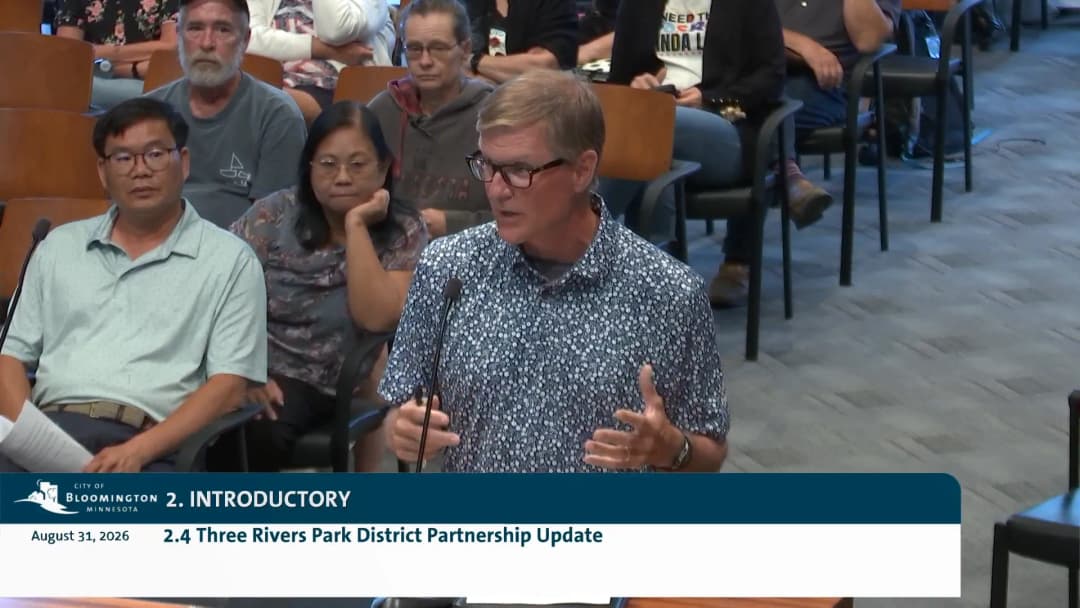
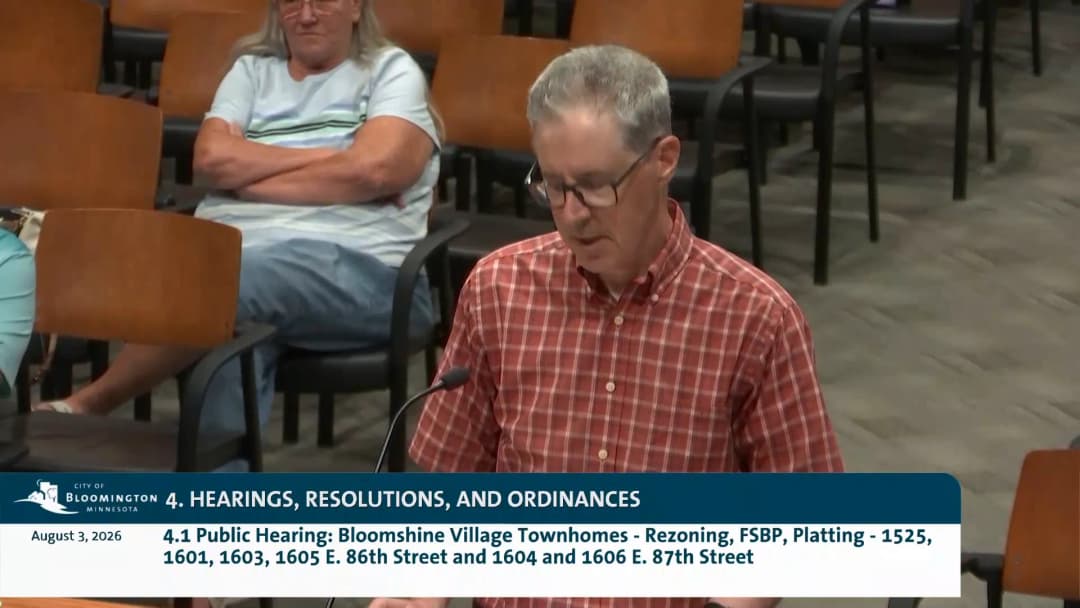
The Bloomington City Council met on Monday, August 31, 2026, beginning with the Pledge of Allegiance and presentations before moving through a consent agenda, public hearings, general business, and a closed session. Key actions included approvals of new officer swearing-in, a Three Rivers Park District partnership update, a controversial townhome rezoning, and ordinances for surplus property donation and unclaimed money. Consent Calendar - Items 3.1–3.15 and 3.17–3.20 were approved unanimously (7-0) with one item (3.4) held for separate comment and vote (also approved 7-0). Item 3.16 (surplus equipment donation policy) was moved to the business portion. Public Comments & Testimony - Listening session recap (Mayor): Seven residents addressed the council prior to the meeting: - Matthew Hallett: Requested bike lanes on Humboldt Avenue. - Sally Ness: Discussed a Smith Park shared use agreement. - Chris Scanlan: Raised code enforcement concerns affecting her neighbor; council directed her to staff. - John Minx: Asked about long-range planning and the Gateway District. - Brian Emerson: Expressed concerns about the community health and wellness center construction. - Pam Palmer: Suggested improvements to the neighborhood watch program, including mass email notifications. - Andy Thule: Raised parking issues on Park Avenue. - Public hearing (Item 4.2): No one testified in person or online. Discussion Items - Introductory Items: - Public Safety Cadet Ambassadors Program: Officer Sam Davern introduced the program (formerly the Explorer program) for ages 14–20, noting 25 participants and recent competition awards. Three ambassadors (Thomas Atuma, Selma Joffrey, Yuri Vasquez Rubio) shared their backgrounds. - Swearing-in of New Police Officers: Chief Booker Hodges administered the oath to seven officers (Jeremy Morrison, Justin Schwagert, Jack Fallen, Kevin McCabe, Nick Mulligan, John Tamborino, and one not named in transcript). The chief emphasized all officers had completed field training. - New Employee Introduction: Ryan Solberg, housing development specialist, was introduced by Community Development Director Kim Bergen. - Three Rivers Park District Partnership Update: Park Board Chair John Gibbs and Superintendent Bo Carlson reported: - 16.5 million visits system-wide in 2026; 1.7 million at Hyland Bush Anderson Lakes Park Reserve. - 39.7% increase in Bloomington regional facility visits from 2024 to 2025. - Hyland Greens Golf Course: 24,000 rounds in 2025, targeting 25,000 in 2026; $800,000 revenue; new par hole, bunker renovation, and fence replacement along Normandale Drive planned. - Beach improvements: shower towers, shade structures, paddle share program, ADA kayak launch, fishing docks. - Bush Lake Beach Building remodel planned for 2027 (design underway). - Natural resource management: 100 hazard trees removed; buckthorn removal with partners; aerial deer survey planned. - New wayfinding signage system launching first at Hyland Bush Anderson. - Councilmember Nelson asked about food/beverage options at the beach building, which Carlson confirmed would be a hybrid concession. - Councilmember D'Alessandro requested deer survey results be shared and suggested aligning the beach building design with city standards; Carlson agreed to include city staff on the project team. - Bloomsbern Village Townhomes (Item 4.1): This was a continuation from August 3, 2026, after council asked for revisions. Planner Liz O'Day presented modifications: - Rezone 6 lots from R1 to R3; reduce density from 33 to 30 units (10.9 units/acre); increase side yard setbacks from 10 to 19 and 15 feet; increase open space by 14.4%; reduce building height to 39'4". - Councilmember Rivas expressed concerns about neighborhood notification, traffic (bus stop on 86th Street), and construction phasing. Developer Dean Devolas stated they would coordinate with Metro Transit to maintain bus service. - Councilmember Robertson supported the project; Councilmember D'Alessandro praised the compromises but urged better city communication to residents about density planning. - Mayor discussed lessons learned: residents should have earlier notice of zoning potential when buying homes. - Councilmember Carter suggested the three affordable units (OHO) be designated for ownership; applicant clarified they intended ownership for those units. - Surplus Equipment Donation Policy (Item 3.16) and Ordinance (Item 4.2): Law Clerk Jackson Snyder presented amendments to Chapter 5 of the city code to allow donation of surplus equipment to nonprofits and set a process for unclaimed money (90-day hold, then deposit into general fund; six-month reimbursement window). The policy was required before the ordinance could take effect. - Councilmember D'Alessandro queried seized money handling; Snyder confirmed it applies after forfeiture procedures. - The policy (3.16) was approved 7-0; the ordinance (4.2) was approved 7-0 after a public hearing with no testimony. Key Outcomes - Consent Agenda (3.1–3.15, 3.17–3.20): Approved 7-0. - Item 3.4: Approved 7-0 (Councilmember D'Alessandro's separate comment). - Item 4.1 – Bloomsbern Village Townhomes: - Rezone from R1 to R3: Approved 6-1 (Councilmember Rivas opposed). - Summary publication: Approved 6-1 (Rivas opposed). - Final site and building plans: Approved 6-1 (Rivas opposed). - Preliminary and final plat: Approved 6-1 (Rivas opposed). - Item 3.16 – Surplus Equipment Donation Policy: Approved 7-0. - Item 4.2 – Code Amendment Ordinance: Approved 7-0; summary publication approved 7-0. - Closed Session: Council met in closed session (attorney-client privilege) to discuss litigation strategies related to federal rulemaking. Upon reopening, they authorized the mayor, city manager, and city attorney to take actions consistent with the discussion (motion approved 7-0). - Adjournment: Motion carried 7-0 at 9:21 PM.

HOUSING AND ZONING 23% · PROCEDURAL 20% · PARKS AND RECREATION 20% · PUBLIC SAFETY 13%
07
AUG 17, 2026 · BLOOMINGTON, MINNESOTA · CITY COUNCIL
Bloomington City Council Meeting - August 17, 2026: Budget, BCA Plan, and Multifamily Standards

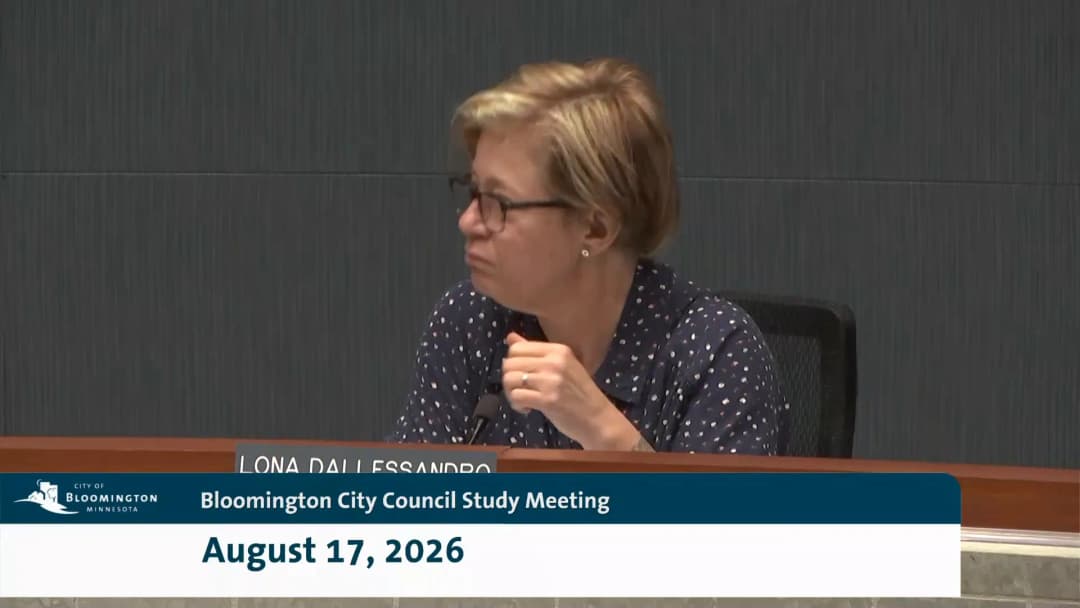
The Bloomington City Council met on Monday, August 17, 2026, to discuss the preliminary 2027 tax levy and budget, the Bloomington Center for the Arts strategic plan and operations analysis, and proposed amendments to multifamily performance standards. The meeting included a public comment period and council deliberation on all three items, with no formal votes taken on the discussion items. The agenda was approved unanimously at the start of the meeting. Consent Calendar - Approved the meeting agenda (voice vote, unanimous). Public Comments & Testimony - Dulce Emerson requested that the budget include funds to make residents of the Newton neighborhood whole for structural damage caused by the community health and wellness center construction, citing up to $50,000 in personal losses. - David Freeman urged caution on city investments in AI and automatic license plate readers, citing privacy and ecological risks, and opposed using levy funds for such technology. - Jamie Anthony (District 4) expressed strong opposition to spending on ALPRs (flock cameras), shock gloves, and drones for surveillance; she asked for more precise language in the budget and for public engagement on new technologies. - Billy Wald questioned why the levy increase could not be zero, challenged the need for fire department expansion (noting many calls are medical), stated the police chief had said staffing is sufficient, and asked for an update on local option sales tax collections. - Mr. Sebek noted historical city spending has been at least twice the CPI and asked why recent increases were so high; he characterized the capital and debt management fund as a "slush fund" and called for better long-term forecasting. - John Hoopmacher reported that his city property taxes rose 57% from 2020 to 2026 (compared to 21% inflation) and argued the city is overspending; he criticized duplication of services (e.g., earned sick and safe time enforcement, smoking regulations, community engagement staff) and called for cuts; he also complained that the city turns off comments on its Facebook page, reducing transparency. Discussion Items 1. Preliminary Tax Levy and Budget (Item 3.1) Finance Director Ms. Carlson presented the current working model for the 2027 preliminary tax levy. The city portion is projected between $100.6 million and $101.5 million (a 6.6-7.5% increase), and including HRA and port levies the total is 6.98-7.93%. Key drivers include the fire department transition to full-time staffing, police technology, the community health and wellness center, park master plan, and climate action plan. The city is moving toward a two-year budget cycle. A capital and debt management fund (starting with $11.2 million) will be used to reduce levy pressure. Community engagement included four in-person events and a mail-in questionnaire; residents expressed pride but concern about affordability. Council questions included: Dalessandro asked about bond calls for the Ice Garden and the ongoing operating cost of 78 firefighters; Rivas requested the tax impact on a median-value home; Carter asked for a breakdown of the levy increase by department, median impact, and more detail on public safety technology; Loman raised concerns about inflation, the animal shelter, and staffing costs; Dellessandro urged clearer separation of base operating costs vs. strategic investments and requested costs for items like the quiet rail study; the mayor noted that 85% of the budget goes to core services (police, fire, public works, community development, parks). o council member made a motion to set the levy; the preliminary levy will be set on September 14. .2. BCA Strategic Plan and Operations Analysis (Item 3.2) Ian Brecke and consultant Duncan Webb presented a pro forma operating budget for the Bloomington Center for the Arts (BCA). They tested three levels of cost recovery: Level (optimize utilization, minimal impact on resident arts organizations (RAOs)), Level 2 (increase RAO fees and rental rates), and Level 3 (reduce RAO access and increase external rentals). The baseline 2027 cost recovery is 39%; Level 1 reaches 48% by 2032, Level 2 goes to 53%, and Level 3 to 57%. Key findings: Level 1 yields significant improvement with little pain to ROs; Level 3 has greater negative impact on RAOs but only modest added benefit. Staff recommend pursuing Level 1 changes and further refining the RAO agreement structure. Council feedback: Carter asked about use of net revenue and whether a grant writer would be full- or part-time; Nellessandro asked about RAO sentiment (nervous but engaged) and space optimization specifics; Loman noted staffing levels are similar across scenarios, so the real choice is how much cost to pass to RAOs; Rivas asked about benchmarks (cost recovery slightly below peer buildings); Nelson questioned margins on education programs and the cost-benefit of adding a box office position; Robertson supported exploring broader rental opportunities (not just arts events); the mayor suggested exploring business and event rentals. .3. Multifamily Performance Standards (Item3.3) Thomas Ramler Olson presented proposed amendments to multifamily development standards. The first standard is street side setbacks: staff recommend reducing the required setback from 40 feet to 20 feet in RM24 and RM50 districts (RM100 already at 10 feet). Some council members (Nelson, Loman, Rivas) questioned going to 10 or 20 feet; the mayor preferred 20 feet for a buffer. The second standard is storage units: staff recommend eliminating the requirement for one storage unit per dwelling unit (as a burden on developers and often unused), after also considering a reduction to half. Council feedback: Loman supported elimination but with a provision for affordable housing tenants who may rely on storage; Dalessandro asked about tenant demand (anecdotal evidence of empty units); Rivas opposed elimination, favoring a 0.5-per-unit reduction; Nelson favored elimination to let the market decide. The third standard is usable open space: staff recommend lowering the baseline minimum open space per unit and eliminating the bonus structure for private balconies and patios to address equity; they also proposed investigating a proximity credit for developments near existing parks or trails. Council discussion: Carter supported both changes; Dalessandro raised equity concerns about balconies and emphasized safe access to parks; Robertson echoed access concerns; Loman felt the open space issue needs more work; Rivas questioned the lack of analysis on concentration of reduced open space and sustainability; the mayor argued that open space fosters community and should not be reduced, especially near highways. Key Outcomes - Agenda approved unanimously. - Budget and Levy: Council provided extensive feedback; staff will refine the preliminary levy for the September 14 meeting where the maximum 2027 levy will be set. Council requested additional information on median home impact, cost breakdown by department, and fire and police staffing costs. - BCA Strategic Plan: Council generally supported Level 1 improvements and directed staff to continue refining cost recovery strategies and RAO agreements. Staff will bring a final proposal later in the fall. - Multifamily Performance Standards: Council gave direction on all three standards: - Street side setbacks: Support for reduction to 20 feet; some council members open to 10 feet; staff to consider further analysis. - Storage units: Mixed feedback; majority seemed to favor elimination or significant reduction; staff will bring a draft ordinance for further discussion. - Usable open space: Council requested more analysis on the proximity-based credit and equity issues; staff will continue work and bring a proposed ordinance later this year. No formal votes were taken on any of the discussion items. Next meetings: Preliminary levy set on September14; further budget discussions on November16 and December7 and14. BCA and multifamily standards will return later in the fall for ordinance adoption.

BUDGET EQUITY ANALYSIS 29% · PUBLIC SAFETY 11% · ARTS AND CULTURE 11% · ZONING REGULATIONS 10%
08
AUG 3, 2026 · BLOOMINGTON, MINNESOTA · CITY COUNCIL
Bloomington City Council Meeting - August 3, 2026: Nine Mile Creek Contracts Approved, Bloomshire Village Townhomes Continued

The Bloomington City Council met on Monday, August 3, 2026, to address a proclamation for National Night Out, a resolution denying a petition for an environmental assessment worksheet (EAW) for the Nine Mile Creek Corridor Renewal Project, a public comment period on the project, and a public hearing on the Bloomshire Village Townhomes rezoning and development. The meeting featured extensive public participation and debate on ecological restoration and housing density. The council voted to award two major contracts for the Nine Mile Creek project and continued the townhome proposal to allow exploration of alternative designs. Consent Calendar - Items 3.1–3.8, 3.10, 3.12–3.21 were approved unanimously (5-0, with Councilmember Carter absent). - Items 3.9 and 3.11 were held over to the August 31, 2026 meeting on a motion by Councilmember Dalessandro (5-0), as they contain schedule updates requiring further review. Public Comments & Testimony - National Night Out Proclamation (Item 2.1): Mayor Bussey read a proclamation declaring August 4, 2026 as National Night Out. Police Chief Hodges urged community participation. - Resolution Denying EAW Petition (Item 2.2): Derek from SEH explained that the original EAW process was sufficient and the petition raised no new material issues. Councilmember Dalessandro confirmed that outstanding permits (historic preservation, endangered species) had been addressed. Councilmember Revaz asked about communicating design changes to the public. - Nine Mile Creek Corridor Renewal Project (Item 2.3): The council heard 30 speakers during the public comment period. Positions included: - Supporters (approx. 16): Emphasized the ecological benefits of oak savanna restoration, the necessity of removing invasive species, and the long-term legacy. Speakers included Dr. Gretchen Buchanan, Ben Bullard, Paul Coate, Matthew Hallett, Dan Jolik, Jamie Anthony, Sonia Walters, Natalie Rooney, Alex Brose, Suzanne Zatiskow, Trevor Jackson, David Owen, Cody Sweet, Megan Lundquist, Jill Crafton, and Ted Kramer. - Opponents (approx. 12): Raised concerns about the scale of tree removal (citing “60 acres of clear-cutting,” later clarified to 5–6 acres for infrastructure), loss of shade and canopy, insufficient public transparency regarding the oak savanna conversion, and potential negative impacts on wildlife and climate. Speakers included Mark Mercer, Jonathan Minx, Connie Anderson, Robert Frischman, Eloise Jaskin, Tom Walter, Jane Freeman, Brian Hoffman, Susan Baker, Vicky Hewson, Brian Savig, and Leslie Swenson. Many urged delaying the contract to allow more community dialogue. - Bloomshire Village Townhomes (Item 4.1): Six residents spoke in opposition, arguing the 33-unit, three-story townhomes are incompatible with the surrounding single-story, single-family neighborhood. Concerns included loss of affordable housing (six homes replaced by three affordable units), increased traffic, stormwater runoff, lack of play space for children, and inadequate notification. Speakers were Connie Rivard, Lana Fredin, Roger Rivard, Brian Savig, Benita Welch, and one additional resident. Discussion Items - Item 2.2 – EAW Petition Denial: Councilmember Rivas expressed concern that changes during project development were not adequately communicated to the public. Staff acknowledged some refinement but maintained that all required topics were addressed. The council approved the resolution 5-1 (Rivas opposed). - Item 2.3 – Contract Awards for Nine Mile Creek: Following public comment, staff presented: - Corridor Renewal Project (contract to Veit & Company, $11.6M): Includes trail paving, bridge replacements, creek remeander, and bank stabilization. - Lower Valley Management Plan (contract to Resource Environmental Solutions, $4.1M): Five-year plan for invasive species removal, oak savanna restoration, and prairie enhancement. - Derek from SEH clarified that

ENVIRONMENTAL PROTECTION 23% · PARKS AND RECREATION 19% · COMMUNITY ENGAGEMENT 14% · PROCEDURAL 12%
09
JUL 20, 2026 · BLOOMINGTON, MINNESOTA · CITY COUNCIL
Bloomington City Council Meeting – July 20, 2026: Awards, Development Incentives, and Wetland Mitigation

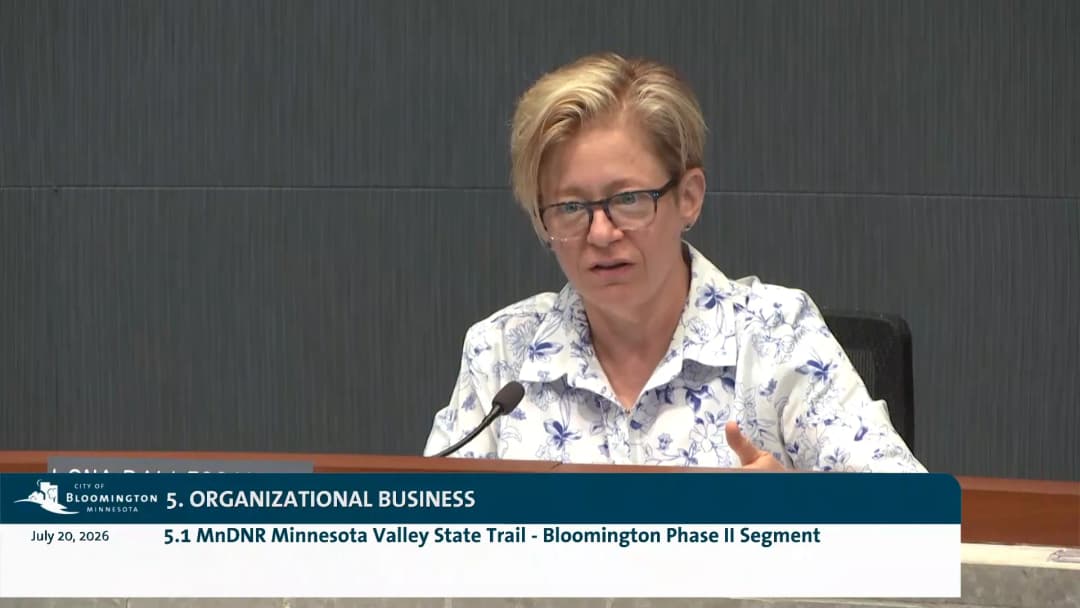
The Bloomington City Council met on Monday, July 20, 2026, at 5:00 PM (CDT) to conduct regular business. The agenda included a presentation of four MRPA Awards of Excellence, a public hearing on a Minnesota Investment Fund application for Seagate Technology, approval of a plat for Southtown Shopping Center, a discussion on wetland mitigation for the Minnesota Valley State Trail Phase 2, and an amendment to the 2016 master redevelopment contract for Mall of America land. The council also heard public comments on several community issues and received updates from the city manager. Consent Calendar - Unanimous approvals: The council approved the consent agenda (items 3.1–3.11 and 3.13–3.19) by a 7-0 roll call vote. - Item 3.12 – Olive Isle Edition preliminary and final plat: Councilmember Nelson held this item for two meetings to review code compliance. After discussion, the council approved the plat (7-0) with conditions attached to the staff report. Councilmember Nelson stated the proposal meets city code and obligations, though some provisions are quirky. Councilmember Dalessandro encouraged staff to revisit code if patterns emerge. Public Comments & Testimony - Nine Mile Creek restoration process (prior to council policy update): Connie Roth, Mark Mercer, and Erica McMullen spoke in opposition to the restoration plan. Matthew Hallett spoke in favor of it. The mayor noted that a public comment opportunity may be offered at the August 3 meeting. - Olive Isle addition: Mark Hansen and Keith (Kevin) Johnson spoke regarding the item that was later approved. - Smith Park Shared Use Agreement: Sally Ness spoke on this topic. Discussion Items - Item 2.1 – MRPA Awards of Excellence Presentation: Mitchell Cheek (City of Shorewood, MRPA Awards Committee) presented four awards to Bloomington’s Parks and Recreation Department: 1) Administrative/Management category for data-driven park maintenance and operations plan; 2) Park/Facility category for Logan Lodge Interim Senior Activity Center (temporary senior programming after Creekside closure); 3) Programming/Events category for the Bloomington Indigenous Art Fair (featuring over 40 indigenous artists); 4) Volunteer Initiatives category for Dred Scott Field Improvement Kickoff (with Toro Company support). Council members praised the breadth of achievements. The awards are peer-nominated or self-nominated. - Item 4.1 – Public Hearing on Minnesota Investment Fund (MIF) Application for Seagate Technology: Alan Thorpe (Port Authority) presented. Seagate, a mass capacity data storage company, is evaluating Bloomington and two other sites. The city would act as fiduciary for a state MIF loan (0% interest) to support expansion. Councilmember Carter clarified Seagate manufactures storage technology, not a data center. Councilmember Dalessandro questioned why Seagate needs free money given its stock price and profit margins, and expressed skepticism about job creation value. Mayor Busse explained the MIF evolved from the Minnesota Forward Fund (matching CHIPS Act) to retain tech companies. Councilmember Rivas asked about Seagate’s competitiveness moving overseas; the mayor noted Seagate’s headquarters are in Northern Ireland and the loan is leverage. Councilmember Lowman supported job retention. The resolution passed 6-0 (Councilmember Dalessandro abstained). - Item 4.2 – Southtown Shopping Center Fifth Edition Plat (Reconsidered): Julie Long (City Engineer) explained the plat was previously approved in September 2024 but expired; the applicant (Kraus-Anderson) resubmitted. The first vote passed 7-0, but Councilmember Vandershah (city attorney) noted a public hearing was required but not listed. The council voted 7-0 to reconsider, held a brief public hearing (no speakers), then re-approved the plat 7-0. - Item 5.1 – Minnesota Valley State Trail Phase 2 Wetland Discussion: Jack Distel (city staff) and Alex Yellick (DNR consultant) presented the Wetland Conservation Act (WCA) replacement plan. The DNR proposes a 2.23-mile trail segment with a bridge over Nine Mile Creek, impacting 0.2 acres of floodplain forest permanently plus 128 sq ft temporary impact. The city will seek council action on August 3, pending DNR take permits for protected species (northern long-eared bat, cricket frog). Mitigation would be through purchase of 0.4 acres of wetland credits in the same watershed (2:1 ratio). Council question topics: boardwalk alternative (rejected due to floodplain and maintenance vehicle requirements), use of native seed mixes, and concern about cricket frog take. Councilmember Nelson also questioned the need for vehicular capacity on the bridge and asked about trail access through private property. The item will return for a decision on August 3 or later. - Item 5.2 – Second Amendment to 2016 Master Redevelopment Contract for MOA Land: Kevin Knuth (Port Authority) presented a two-year extension due to COVID-19 delays. The contract governs financial assistance for redevelopment north of Mall of America. The extension adjusts performance periods from 10/20 years to 12/22 years, reduces the required valuation at the first milestone from $500M to $400M, increases the second milestone from $500M to $800M (total $1.2B remains). The council approved the resolution 7-0. Key Outcomes - Votes: 7-0 on consent agenda (except 3.12), Olive Isle plat, Southtown plat (after reconsideration), and MOA contract amendment. - Abstention: Councilmember Dalessandro abstained on Seagate MIF resolution, which passed 6-0. - Directives: The Minnesota Valley State Trail wetland replacement plan will be brought back for council decision on August 3 (or later) after receipt of state take permits. A public comment opportunity may be scheduled for Nine Mile Creek restoration. - City manager updates: The Port Authority’s small business loan program (Operation Metro Surge) supported 25 businesses with $180,000 total. The Bloomington Remembers Veterans dog tag sale closes August 1. The Communications department won five Northern Lights Awards. The July 27 council meeting is canceled; next meeting is August 3.

ENVIRONMENTAL PROTECTION 28% · ENGINEERING AND INFRASTRUCTURE 24% · ECONOMIC DEVELOPMENT 16% · PARKS AND RECREATION 12%
10
JUN 29, 2026 · BLOOMINGTON, MINNESOTA · CITY COUNCIL
Bloomington City Council Meeting – June 29, 2026

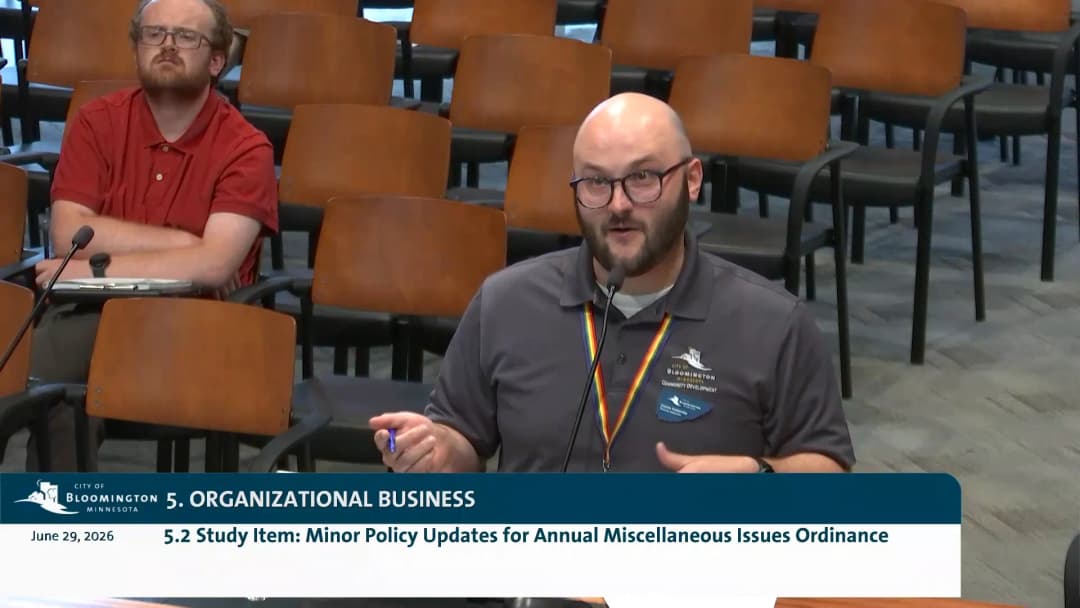
The Bloomington City Council met on Monday, June 29, 2026. Key actions included approving the Seagate Technology expansion, supporting TIF for the Adora Affordable Housing Project, adopting the Urban Forest Master Plan, and tabling the Amsden Ridge Drive item. The council also heard updates on the I-494 Quarter Commission and reviewed minor zoning policy changes.

ENGINEERING AND INFRASTRUCTURE 18% · PARKS AND RECREATION 13% · PROCEDURAL 12% · TRANSPORTATION SAFETY 11%
0102
NEXT →
OPENPUBLICA · PUBLIC MEETING INDEXUPDATED DAILY · openpublica.com