Brookings City Council Study Session – November 19, 2024
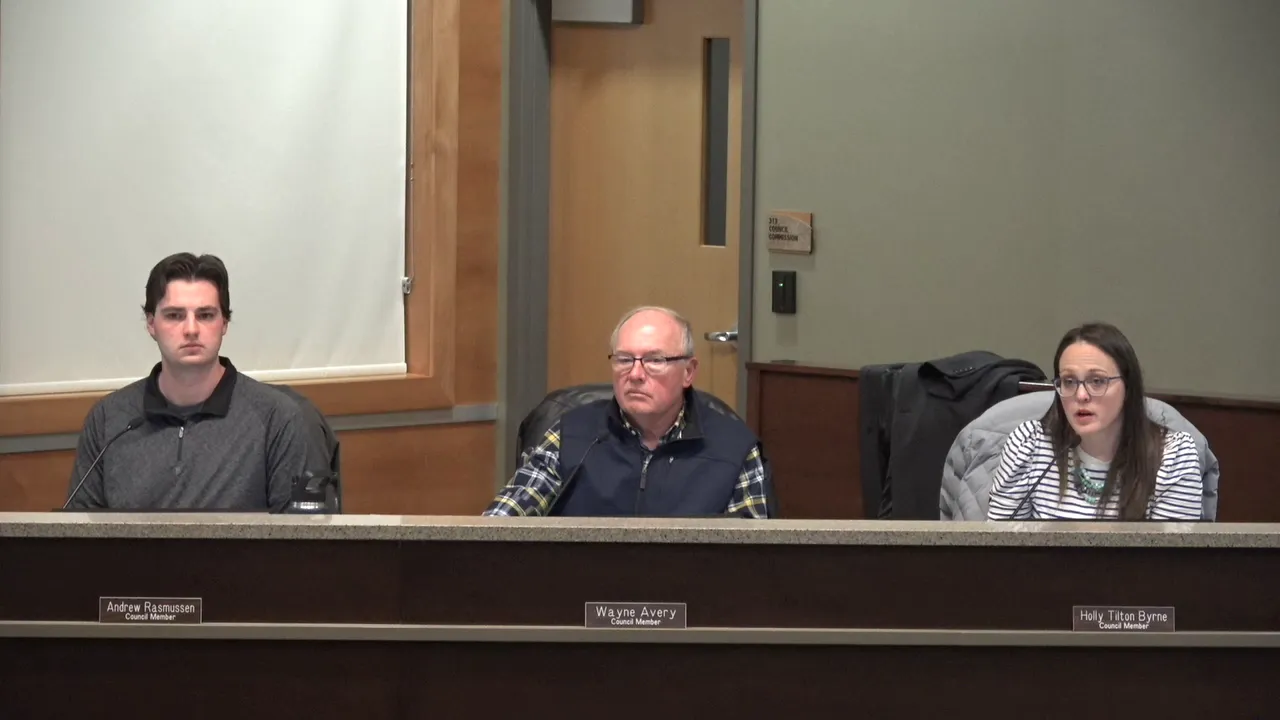
STREAMING COPY IN PREPARATION — RECORDING AVAILABLE FROM THE ORIGINAL SOURCE
Brookings City Council Study Session – November 19, 2024
This study session of the Brookings City Council, held on November 19, 2024, at 6:00 PM in the Council Chambers, featured presentations on proposed charter amendments, downtown incentive programs, Edgebrook Golf Course water sourcing, and the Public Works Streets Division winter operations. Council members discussed each item, and the public provided testimony. No formal votes were taken; the session was informational and will inform future council actions.
Public Comments & Testimony
- Open Forum: A resident (speaker not fully identified) expressed strong support for a community recreation center, stating that many children cannot afford the Miller Wellness Center and that the city should retain its own space for programming and affordable memberships. He referenced the old Fifth Street Gym and the park and recreation master plan.
- Stephanie Mason (Brookings Economic Development Corporation – BEDC) expressed full support for the proposed downtown incentive programs, noting that feedback from business surveys, a small business meetup, and over 80 downtown business walk visits identified needs for more site-ready locations, repairs, and improvements. She said BEDC will collaborate with the city, Downtown Brookings, local lenders, and contractors to foster economic growth.
- Angie Borisma (local business owner and architect) asked for clarification on whether professional services (e.g., architectural fees) would be eligible costs under the facade grant program. She noted that the interior program (DRIP) allows such costs to count toward owner equity, but the facade program does not explicitly state this.
- Dr. Bob Burns (member of the Charter Commission) spoke in support of the proposed charter language for the city attorney and city clerk positions, explaining that the commission recognized these positions serve primarily the council and that the new language formalizes the council's role in hiring and evaluation.
- Diane Nagy (resident and Charter Commission member) encouraged the council to consider whether the proposed charter revisions truly reflect the values of the Brookings community.
Discussion Items
Charter Commission Proposed Changes
Commission Chair David Gilbertson and Derek Akubo (National Civic League) presented the proposed charter amendments. The commission reviewed the charter sentence by sentence, focusing on fine-tuning and updating language after 20 years. Key changes include:
- Removing transitional language from the 2002 home rule adoption.
- Updating the city attorney title (from “municipal attorney” to “city attorney”) and requiring the city attorney to be a licensed member of the South Dakota State Bar.
- Clarifying the supervisory relationship between the city manager and the city attorney/city clerk, with the manager recommending candidates and supervising, while the council retains a role in appointment and evaluation.
- Replacing “newspaper” with “news media” for publication of election notices to allow for future media changes.
- Adding a requirement to review the charter every 10 years.
Councilmember Wendell asked about the intent behind the supervisory language; Gilbertson and Akubo explained it was to clarify the partnership between the council and manager. Councilmember Tilton Byrne expressed concern that the written language might not fully reflect the council’s continued role in hiring and oversight. Burns confirmed the commission’s intent was to maintain council involvement. Councilmember Doran asked about when the city attorney must be licensed; Gilbertson confirmed at the time of appointment. Outreach to the public will occur in December through April, with a ballot vote scheduled for April 8, 2025. The commission will consider council input before finalizing the document.
Proposed Downtown Incentives
Samantha Beckman (Assistant to the City Manager) presented three incentive programs aligned with the Downtown Brookings Master Plan (adopted October 2024). All are limited to the B-1 Central Business District (Main Avenue area).
- Downtown Brookings Façade Grant: 50% matching grant up to $25,000 per project; minimum project cost $35,000. Focuses on historic preservation and facade improvements. Budget: $100,000 for 2025.
- Downtown Revitalization Incentive Program (DRIP): One-third grant, one-third loan, one-third owner equity. City matching grant up to $25,000; minimum project cost $75,000. Eligible improvements include ADA upgrades, electrical, and plumbing. Budget: $200,000 for 2025.
- Lights Camera Action Grant: 50% matching grant up to $2,000 for lighting, security cameras, and placemaking features. Administered by Downtown Brookings. Budget: $20,000 for 2025.
Funds come from the city’s economic development reserves (replenished by land sales). Applications will be due March 1, 2025, with a review committee composed of city staff, Downtown Brookings, and possibly Historic Preservation or BEDC. Councilmember Specker questioned whether professional services could be included in project costs; staff will evaluate and clarify. Councilmember Wendell noted the program could encourage collaboration between business operators and property owners. The programs aim to spur private investment in downtown while preserving historic character.
Edgebrook Golf Course Water Sourcing
Kristen Zimmerman (Parks, Recreation and Forestry Director) updated the council on efforts to secure a long-term, sustainable water source for the golf course. The current irrigation system is inefficient (single alleyway), and a planned upgrade to dual-row heads will increase water demand. Previous options explored (runoff capture, connection to LG Everest site, treated water from BMU, test wells on golf course property) were found insufficient or not feasible. Three current options are under evaluation:
- City-owned well south of the golf course: Test well found viable at 300–350 gallons per minute; property acquisition needed.
- Connection to the South Brook softball fields well: Currently using only 1/8 of its capacity; further analysis required.
- Connection to BMU’s raw water line near the railroad crossing: Requires crossing the interstate.
Cost estimates will be finalized in early 2025, and the Parks Department will provide a final recommendation. A long-term option includes transitioning to more drought-tolerant turfgrass. Councilmember Avery urged pursuing the BMU raw water line as a dependable source. Councilmember Wendell congratulated Zimmerman on becoming the first certified Parks and Recreation Executive in South Dakota.
Public Works Streets Division Winter Operations
Jeremy Lindstedt (Street Division Manager) and John Thompson (Public Works Director) presented the winter operations plan. The plan uses a four-classification system based on snowfall intensity and timing (Class 1: light snow <2 inches; Class 2: 2–6 inches; Class 3: >6 inches; Ice storm). Parking bans are issued for Class 3 events; the city has issued two bans per year recently. The city maintains 330 lane miles of roadway (including 15 miles gravel). Average 30-year snowfall is 38.5 inches; last year received 41 inches. Equipment includes 5 motor graders, 5 loaders, 5 trucks, 4 haul trucks, 2 skid steers, plus park department equipment. Contractors are used for snow removal in designated zones. The department uses 14 staff plus 2–3 from parks during events. Annual budget for contractor snow removal is $100,000; materials cost $88,000. New technologies include BAM weather app, road temperature sensors, automated vehicle location (AVL) GPS, and dash cams. Pre-wetting of materials (brine) is not yet implemented but is under consideration for future trucks to reduce material waste and environmental impact. The department conducts after-action reviews after each storm. Challenges include single-shift crew, on-street parking, and timing of events. Future opportunities include creating a one-page maintenance report, updating snow storage sites, improving anti-icing methods, and exploring contractor licensing. Councilmembers asked about boulevard damage repair (city covers repairs for both staff and contractors), resident education, and sidewalk snow removal rules (ordinance requires removal within 48 hours; non-compliance is forwarded to code enforcement). Councilmember Duran encouraged ride-alongs to see operations firsthand.
Key Outcomes
- Charter Commission: The council took no formal action but provided feedback. The commission will incorporate council input and conduct public outreach through December 2024–April 2025, with a final ballot proposal on April 8, 2025.
- Downtown Incentives: No formal vote. The programs will be launched in January 2025 with an application deadline of March 1, 2025. Staff will clarify eligibility of professional services costs before launch.
- Golf Course Water: No decision made. Final cost estimates and a department recommendation will be presented in early 2025.
- Winter Operations: The plan was presented for informational purposes. No action required. Council members expressed appreciation and noted ongoing improvements.
Council Member Introductions for Future Discussion
No new topics were introduced for future discussion. The next regular council meeting is scheduled for November 26, 2024, with items including the third quarter finance report, a pinning ceremony for two officers, a Small Business Saturday proclamation, a bid award for hay land lease, and a possible license renewal hearing.
Meeting Transcript
Afford to go to the Miller Wellness Center. There's a lot of kids in this town that their parents can't afford to put them there. So I want a place for those kids. I want a place that kids can go and shoot baskets on the weekends and the holidays. They don't get into the schools those times. And once something happens to a school gymnasium, they're gonna shut them off from the from us anyway. So I just I just think we need our own space that we program, we decide what goes on, we set the price for the memberships, whatever, you know, because I know that there has to be a cost. Years ago, back when we had the uh special assessment and kind of failed, uh it was kind of that was the number two item on the overall park and recreation uh master plan is recreational center. But they the Fifth Street or the the old armory, my wife used to go there and walk. People used to use that go, you know, no more. Now the Fifth Street Gym, they're gonna we're gonna lose that. I just think it's necessary that we retain that. So that's all I thank you for your comments. Yep, thank you. And before you guys start talking, I would like to recognize people that uh were on this, that uh also were part of the whole process. We have some of them present this evening. Mr. Tom Weisseth, Mr. Gail Robertson, Mr. Roger Solemn, Jeannie Manger, Dr. Bob Burns. Uh thank you very much for putting in the time. And then Diane Nagy, way in the back. I'm sorry, Diane, didn't see you back there. And so then uh some of the other people that were also on this were Lisa Hager, uh Dr. Lisa Hager, Keith Corbett, uh Van Fischback, and uh Ashley Ragsdale. And please proceed. Okay. Thank you, Mr. Mayor. Uh as the mayor said, my name is David Gilbertson, and it's been my privilege to chair this uh commission. With me tonight, also is Derek Akubo from the National Civic League who has assisted us in the review of the existing uh document and uh also assisting us with uh what proposed changes and uh the one thing that I thought was particularly helpful was they have access to virtually every city in the country. What have they done? Uh the theory that that it can assist us, and it also says a lot if nobody has done something we're talking about, thinking about if there must be a reason if they didn't. So that's been very helpful, and we will jointly make a presentation. We will try to keep it as brief as possible uh so that there is time for questions from uh you folks. So home rule very briefly is a uh way to uh govern a city that uh is fairly new to South Dakota. It's new to the city of Brookings. We became a home rule town in 2002, and very briefly what it says is under the old system and its existing system for most cities in the state still, a city can only do what the law specifically says you can do. If you the law doesn't say you can do it, you can't do it. But in home rule, the city can do anything that the state law says you can't do. In other words, you're you get much more latitude uh in uh your changing your policy and everything else and your rules and your ordinances. The only thing you can't do is simply something that's prohibited by the state code. So uh apparently it's been effective since uh it's been ongoing since 2002. Um besides the charter, of course, incorporated is every state statute and every federal uh statute too, because they are for better they trump uh a city uh ordinance or uh that so um with that uh I'll turn the presentation. Uh we're gonna kind of work back and forth on this, but Derek, you're up. Okay. So I'm going to uh um Mayor Neemier and City Council. Uh thank you for having us tonight. Uh and I really appreciate the opportunity to have been able to uh facilitate this process and work with these incredible community members and also the incredible staff of the city of Brookings.
openpublica.com