Broward Next Land Use Plan Update Kickoff and Affordable Housing Workshop - August 15, 2024
STREAMING COPY IN PREPARATION — RECORDING AVAILABLE FROM THE ORIGINAL SOURCE
Broward Next Land Use Plan Update Kickoff and Affordable Housing Workshop - August 15, 2024
The Broward County Planning Council hosted a kickoff meeting on August 15, 2024, for the 2024 comprehensive update of the Broward County Land Use Plan (Broward Next). The meeting also included presentations on affordable housing and population growth. Over 100 attendees participated both in-person and virtually. The event featured opening remarks by Executive Director Barbara Blake-Boy, an affordable housing overview by Ralph Stone, and a population forecasting model presentation by Joe Silger.
Consent Calendar
- No consent calendar items were presented.
Public Comments & Testimony
- Roger Newkark (community outreach worker) expressed concerns about in-lieu fees ($10,000 per unit opt-out) discouraging actual affordable housing production, and that new affordable units often go to people outside the community rather than long-term residents. He urged better outreach to inner-city residents and questioned how the county ensures local residents benefit.
- Julian Bobilev (Green Spoon Larder) asked about strengthening accessory dwelling unit policies and allowing more density by right in single-family neighborhoods to encourage incremental development.
- Karen Friedman (Broward MPO) noted the MPO is developing a housing coordination plan and suggested considering separated shared-use paths for park/open space credit, and density bonuses near bus rapid transit corridors in addition to rail stations.
- Jay Spock (affordable housing property manager) asked about funding for conversions of underutilized hotels, motels, and office buildings into affordable housing. Ralph Stone confirmed that gap financing can be used for acquisition/rehab projects.
- Marcia Barry Smith (Broward Housing Council) urged inclusion of the employed homeless population in housing plans, noting that moving from shelters to permanent housing remains difficult.
- Sherry Brown Grover (Community Foundation of Broward) questioned whether redevelopment can keep pace with population growth and asked how philanthropy can engage. Ralph Stone acknowledged the challenge and mentioned that the United Way had provided a $10 million grant.
Discussion Items
- Historical Context & 2017 Broward Next Update: Barbara Blake-Boy reviewed the evolution of county land use planning since the first plan in 1977. The 2014–2017 comprehensive update modernized policies on climate resilience, redevelopment, affordable housing, multimodal transportation, and intergovernmental coordination. Key tools created included: bonus density formulas (6–19 bonus units per affordable unit), residential by right on qualifying arterials (Policy 2.16.4), residential by right near passenger rail stations, unified flex zones, redevelopment unit tool, and exemptions from platting.
- Current Challenges & Opportunities: Two-thirds of Broward County is conservation land; the urban area is largely built out with only 12 square miles of vacant land. Future growth (650,000 new residents by 2050) must occur through redevelopment of commercial corridors, transit station areas, and brownfield sites. Affordable housing is the top regional issue, with 74,000 units of rental deficiency and 50% of workers earning 60% or less of area median income.
- Proposed Policy Changes for 2024 Update: Staff presented the framework for the new update, including:
- Revisiting affordable housing in-lieu fees (currently $1/sq.ft.) to align with Policy 2.16.4.
- Examining maximum density of 50 dwelling units per acre, especially near transit.
- Expanding residential by right to more land use designations (e.g., medium/high residential within 0.5 miles of passenger rail).
- Adding affordable housing opportunities on recreation/open space lands (up to 5 acres, similar to community facilities).
- Updating park and open space counting rules (e.g., counting public beaches, lowering private recreational space threshold to 0.25 acre).
- Strengthening climate resiliency policies using new vulnerability studies.
- Addressing multimodal level of service challenges.
- Refining definitions, permitted uses, and map series for natural resources.
- Affordable Housing Master Plan Implementation: Ralph Stone highlighted the board’s commitment of $20–25 million annually for gap financing, which can be leveraged with $100 million in HFA bond allocation. He urged cities to contribute their own funds, noting that Fort Lauderdale’s $5 million contribution earned 25 points in the scoring process. The plan recommends densification along commercial corridors and rail lines.
- Population Forecasting Allocation Model (PFAM): Joe Silger presented the model projecting 218,000 new housing units needed by 2050 to accommodate population growth. Vacant land can only supply about 30,000 units, so redevelopment must fill the gap. The model allocates growth to activity centers and commerce zones, consistent with existing land use plan. The final publication will be released next month with dashboards for each city.
Key Outcomes
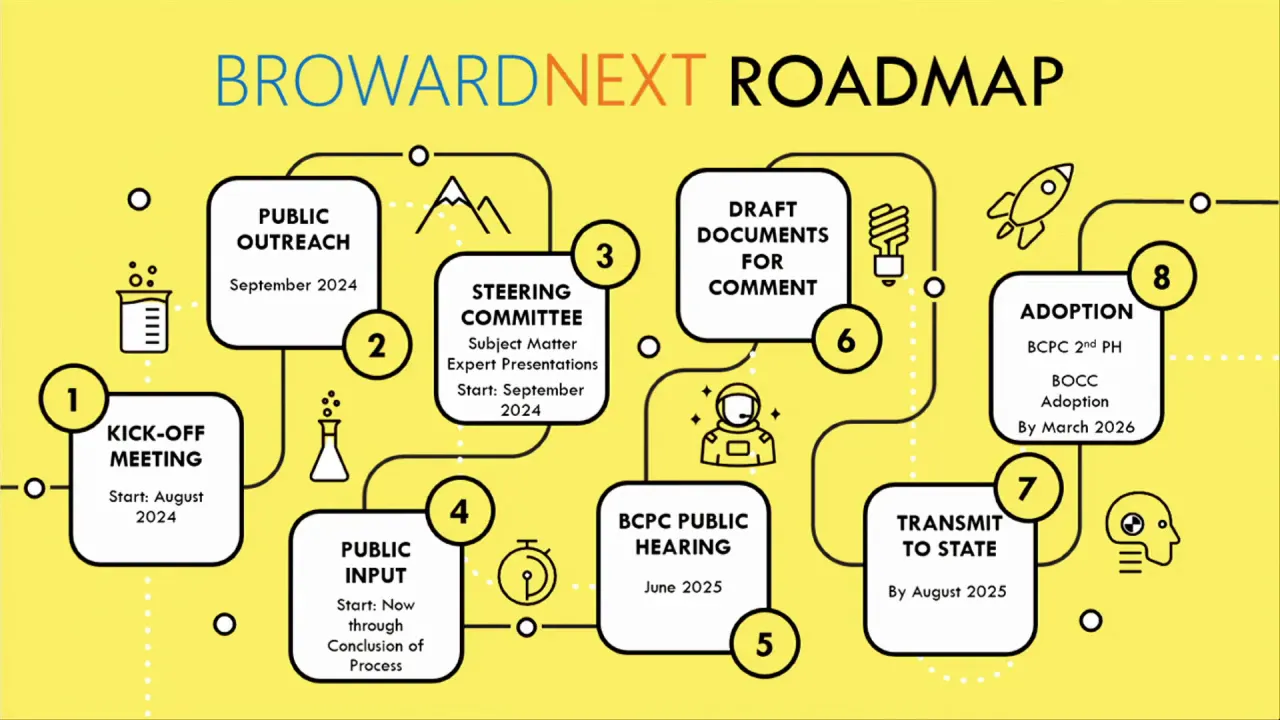
- The Planning Council will conduct extensive public outreach through September 2024, including educational sessions on affordable housing, transportation, and redevelopment.
- A steering committee (the Planning Council’s executive committee) will hold policy discussions and direct staff on drafting amendments.
- First Planning Council public hearing on draft amendments expected by summer 2025; adoption anticipated by March 2026.
- Affordable housing gap financing RFP to be released in November 2024, with $20–25 million available.
- The board reaffirmed its commitment to funding affordable housing and encouraged cities to adopt similar policies and dedicate local funding.
- The population allocation model data will be published publicly in September 2024.
Meeting Transcript
Hi, good morning. If everyone can find a seat, we're gonna get started. Thank you. Thank you everyone for being here today. My name's Barbara Blake Boy. I'm the executive director of the Broward County Planning Council. And it's a pleasure to kind of be in the space again for talking about updating the Broward County land use plan and Broward Next in the in the process. A couple of housekeeping items. If I can just ask you to silence your cell phones. You will need your cell phones if you have them available. We will be doing some mentee questions in the during the presentation. We'll get to that in just one second. For participation, all participants, if you haven't signed in, please take an opportunity to sign in. It is just an ArcGIS survey, so just putting your name in your whatever agency or whoever you are representing. Please feel free to ensure that you sign in. Also, any questions that we received today that may not be addressed if if we do run out of time, I don't think we will, but in case we do run out of time, we will take the opportunity to kind of create a response document and publish that on the Broward Next website. Please do try to hold your questions and comments to the end because perhaps it's going to be addressed as we make our way through the presentation. And virtual participants, please enter your questions or comments in the chat on the Vimeo webcast. Only on the Vimeo webcast. If you're on YouTube, we won't be able to, we're not monitoring that. So Vimeo only, which is the webcast link that was sent out in all of the constant contact emails and my emails. So thanks again for joining us today. We're the planning council staff. We're all over the room except for our attorney who's joining us virtually, Annie Morotis. I'm Barbara Boyd, Deanne Von Satina is our assistant director. Don Tietzel, our director of planning, they're up here managing the chat. We have Kim Rudaminer in the back of the room. She was kind of helping welcome you. She's our GIS project manager. Huda Ashwa is a planner. She's in the back of the room. She'll have a microphone for questions. Alicia Joseph, also a planner in the back of the room, she'll have a microphone for questions also for the side of the room. And then Leslie Nelson, also on the back of the room. So that's just our staff. So we try to all wear planning council clothes. So if you see us, if you're looking for us, that's an easy way to find us. The mentee instructions. I'm sure most of you have used have had the opportunity to use this platform before. If you use this QR code or the access code, 78458968. That's 78458968, or use the QR code. I'll give you a second, and that will take you through where we have about five questions, an icebreaker, and then four kind of planning related questions that we'll do during the presentation. So it's Menti.com and then the access code is 7845 8968 or scan the QR code. The agenda for today. Welcome and opening remarks. I think we've pretty much covered that so far. I'm going to take you through a historical perspective of planning in Broward County and really the genesis of that, the update of the Broward County land use plan that took place from 2014 to adoption in 2017. Take you through that process, what those updates were, what the policy directives and kind of the evolution of that, and I think why that's so important. So I think one of the really great things about county land use planning is we are constantly evolving. So we just we never let it stay static.
openpublica.com