OPENPUBLICA · PUBLIC MEETING RECORD
Record of Proceedings
State of Housing Affordability in Broward County - November 3, 2026
Upcoming and Archived Meetings — Tuesday, November 3, 2026
BodyBroward County, Florida
SessionUpcoming and Archived Meetings
DateTuesday, November 3, 2026
StatusNEW · FILED
Video Record
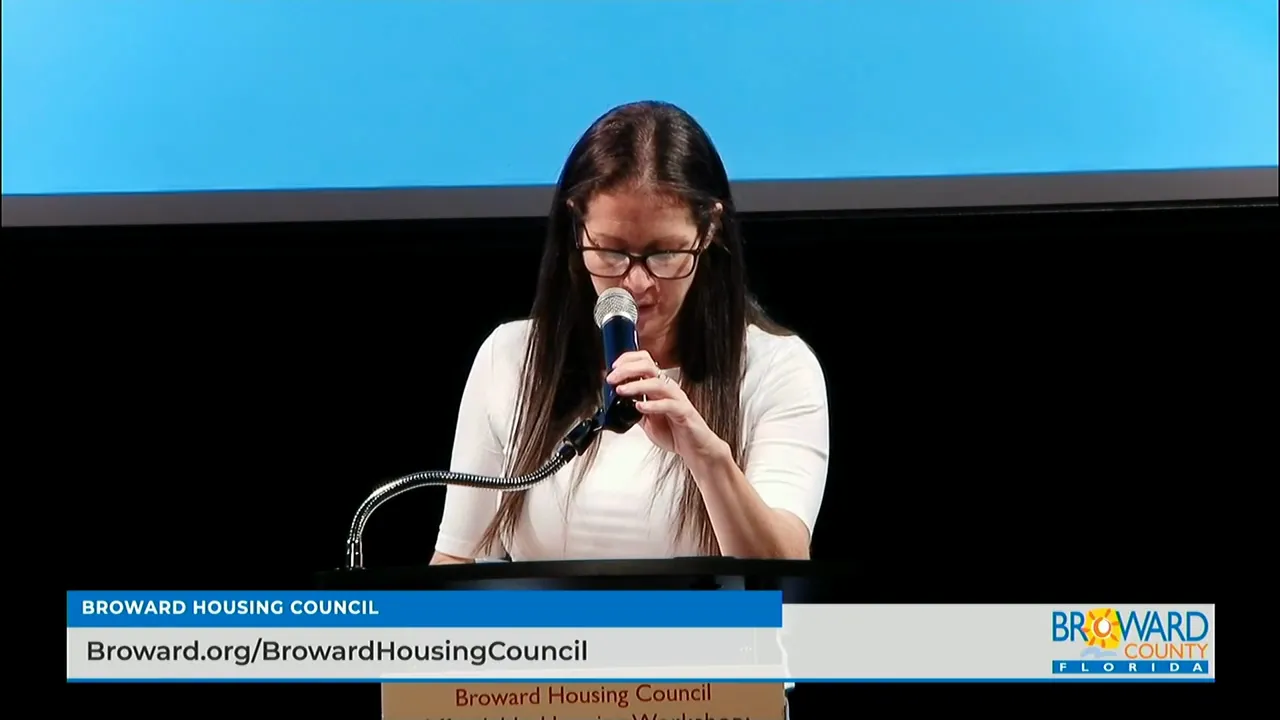
STREAMING COPY IN PREPARATION — RECORDING AVAILABLE FROM THE ORIGINAL SOURCE
Transcript — Verbatim
Speaker numbers apply only to this recording.
Discussion Breakdown — Share of Meeting
Affordable Housing56%
Housing And Urban Planning11%
Procedural9%
Public-Private Partnerships6%
Economic Development6%
Mixed Income Communities3%
Public Engagement3%
Public Comment1%
Technology and Innovation1%
Summary of Proceedings
State of Housing Affordability in Broward County - November 3, 2026
On November 3, 2026, the Broward Housing Council, in partnership with Broward County and Wells Fargo, hosted a workshop at the Broward Performing Arts Center to address the housing affordability crisis. The event featured presentations, panel discussions, and a call to action. Key statistics revealed that over 340,000 households are cost-burdened, the county ranks last in Florida for affordable rentals, and the region has lost 96,000 residents since 2020.
Presentations
-
Broward County Affordable Housing Needs Assessment (Dr. Ned Murray, FIU Metropolitan Center): Dr. Murray presented updated data showing that 340,000+ households spend more than 30% of income on housing, with 175,000 severely cost-burdened (over 50%). The median home price is $620,000, unaffordable for over 95% of households. Average rent for a two-bedroom is $2,675/month. Since 2020, the county lost 96,000 residents to out-migration, and 15,000 jobs have been lost. Broward ranks 67th of 67 Florida counties in availability of affordable rentals at 60% AMI (fewer than 25 units per 100 households). 70% of housing was built before 1990 (median age 1981); only 7% since 2010. Current AMI is $102,450.
-
Municipal Scorecard (Ralph Stone, Broward County Housing Finance Authority): Stone introduced an analog scorecard to track affordable housing production. Since 2018, the GAAP program has awarded $180 million, constructing 5,000 units, with local governments contributing $67 million and the HFA providing $845 million in bond allocation. Average subsidy per unit is about $36,000 (lowest in state). Affordability periods now incentivize 99-year terms. Pipeline: 23 projects, 4,600+ homes.
Panel 1: Public-Private Partnerships
Moderated by Sandra Vassi Einhorn, panelists Mitch Rosenstein (Green Mills Group), Al Milo Jr. (Related Urban Development), Ralph Stone, Barbara Blake Boy (Planning Council), and Walter Duke III (former mayor) discussed the transformation since 2018. Key points: dedicated GAAP funding changed the landscape; municipal contributions have grown; predictability and speed are critical. Live Local Act was seen as a powerful but imperfect tool. Examples included redevelopment of a former motel into 400 units and partnerships with the Pantry of Broward.
Panel 2: Looking Ahead
Panelists Chris Cooper (Fort Lauderdale), Suzanne Cabrera (Palm Beach County Housing Leadership Council), Mayor Michelle Gomez (Tamarac), Tim Wheat (Pinnacle), and Chakira (Enterprise) focused on regional collaboration, Live Local adjustments, faith-based development (YIGBY), mixed-income communities, and workforce housing. Mayor Gomez expressed concerns about loss of local control; Cooper noted some projects causing friction. All agreed on the need for integrated housing and infrastructure coordination.
Community Scholars Program
Chelsea LaFrance (University of Miami) described the six-month program that trains emerging leaders in affordable housing. 117 alumni have completed capstones leading to policy changes, such as increased set-asides for very low-income households and extended eviction notice periods.
Closing Remarks – Senator Nan Rich
Senator Rich celebrated progress but warned that Amendment 3 could reduce county revenue by $195 million (first year) and $334 million (second year), threatening dedicated housing funds. She urged protecting the GAAP program, faster approvals, and changes to Live Local. She emphasized that every home built makes a difference for families and the economy.
Key Outcomes
No formal votes were taken. Strong consensus emerged on:
- Protecting dedicated housing funding from Amendment 3.
- Increasing municipal participation and streamlining approvals.
- Adjusting Live Local Act to balance state and local needs.
- Expanding public-private partnerships and faith-based development.
- Strengthening regional collaboration across South Florida.
- Continuing data-driven planning via needs assessment and scorecard.
Meeting Transcript
Good morning, everyone. We are about to get started. If everyone can please take their seats. Group of adults can get quieter quicker than two kids. Good to know. All right. Good morning, everyone. My name is Sandra Vassi Einhorn, and I am welcoming you to our morning, the state of housing affordability in Broward County. I'd like to thank our partners, Broward County, Sue Carano, Keith Darby, Ralph Stone, the entire team. Thank you for everything. I'm going, I'm really honored to be able to turn it over to our first speaker for some welcoming remarks. Please join me in welcoming Commissioner Hazel Rogers from the Board of County Commissioners District 9 and member of the Broward Housing Council. Good morning, everyone. Well, I can tell you it's a good morning. It feels good. Got an opportunity to put on something comfortable to enjoy this cool weather that we're experiencing, right? Oh, when we get it, we take it. But it's good to see everyone here. I'm scripted by staff. And usually when they script me, they know I'm not going to read it that way because I am me. And I'm here to just talk about housing and thank you first for all that you do every day when we are not there and we can't see or hear it. But some of us do live it. Maybe my staff have a hard copy. Makes it a lot easier for me. Thank you, sir. All right. I'm more comfortable. I'm a paper girl. Thank you for being here today at the Broward Performing Arts Center as we tackle one of the most critical issues facing our community. Right now, as you talk about elections, you hear housing. I should ask you that question. One of the top topics of discussion is housing, right? Did you get that from everyone? That they're ready to truly deal with the housing issues that we're facing across this nation. But Broward County in particular, because this is the place that have the sunshine, it has the beaches, it has that airport, seaport. We are ready for everything. Resource, every economy, everything. We are prepared for it. But most of all, we must prepare the housing. You can't work here and not afford to live here. Do you agree? Thank you very much. I know I'm talking to the right audience. I want to extend a special thank you to our sponsors and partners who have made today possible. The Broward Housing Council, the coordinating council of Broward, the Broward County Housing Finance Authority, and Wells Fargo. I'm also sharing the stage this morning with Leo Toca from Wells Fargo, Philanthropy and Community Impact, and I want to thank him and his team for their incredible support. Today is about moving from data to direct action.
SUMMARIZED BY OPENPUBLICA AI
TRANSCRIPT VIA PUBLIC VIDEO
openpublica.com
openpublica.com