Chesapeake City Council Meeting - December 12, 2023
STREAMING COPY IN PREPARATION — RECORDING AVAILABLE FROM THE ORIGINAL SOURCE
Chesapeake City Council Meeting - December 12, 2023
This meeting of the Chesapeake City Council included a work session beginning at 4:45 PM and a regular session starting at 6:30 PM. The work session covered the Industrial Waterfront Study, the Annual Comprehensive Financial Report, and an update on the Comprehensive Plan. The regular session addressed agenda approval, a presentation of the Virginia Municipal League Innovation Award, a public hearing, public comments on agenda and non-agenda items, a consent agenda, several regular agenda items, new business items, and a closed meeting.
Work Session Topics
- Industrial Waterfront Study: Consultants from Wagner & Ball presented findings on the economic development potential and climate resilience of the waterfront along the Elizabeth River. Key strategies included resilience and adaptation, industry opportunity, connected ecologies, and community connectivity. The plan is expected to go to the Planning Commission in February 2024 and to City Council in March 2024.
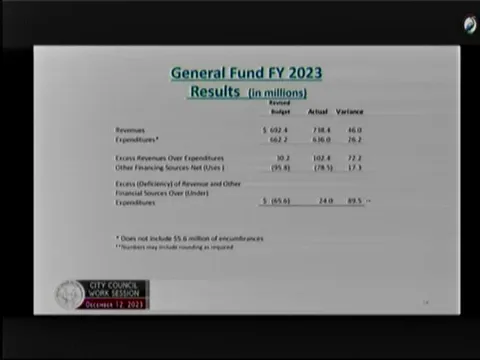
- Annual Comprehensive Financial Report: The city received an unmodified (clean) audit opinion for FY 2023. Highlights included a $24 million increase in general fund balance to $420 million, a $9.6 million increase in unassigned fund balance, and strong revenue performance from sales tax, business license tax, and restaurant tax. The city's fund balance policy was updated to a minimum of 12%.
- Comprehensive Plan Update: Director of Planning James McNamara reported on the Chesapeake 2045 plan update. Seven focus areas were identified. Over 300 residents were engaged at 13 events, and additional outreach is planned through stakeholder groups and community meetings. The goal is to present the plan for adoption in spring 2025.
Consent Calendar
- Approved (unanimous): Consent agenda items except City Clerk Item 1(A). This included:
- Acknowledgements for rezoning applications (PLN-REZ-2022-008 Dominion and Scenic Mixed Use and PLN-REZ-2023-014 Copart Auto Sales) – these were acknowledged and tentatively scheduled for Planning Commission on January 10, 2024.
- Resignations from Baxter Ennis (Chesapeake Hospital Authority), Veronica Hill (Citizens Advisory Committee), Kevin Finn (Board of Historic and Architectural Review), and Cynthia Jackson (Animal Services Advisory Board).
- Resolution rescinding a lease with Glenn Weatherly Farms, LLC for 36 acres of farmland at Deep Creek Park.
- Acceptance of $500,000 in state opioid response funds.
- Acceptance of $8,177 in additional litter prevention and recycling grant funds.
- Resolutions for new leases at Great Bridge Locks Park (11.7 acres) and Deep Creek Locks Park (19.0 acres), each with $8,970 payment to the Army Corps.
- Ordinance amending Chapter 38 (Health and Sanitation) to align with state and federal laws.
- Item Removed: City Clerk Item 1(A) (Dominion and Scenic Mixed Use) was removed by Council Member Whitaker due to a conflict of interest.
Public Comments & Testimony
- Public Hearing on Elbow Road Bridge Replacement: No public speakers; resolution authorizing property acquisition (fee simple, leasehold, easements) by agreement or condemnation was approved unanimously.
- Comments on Agenda Items: Five speakers supported amending the 2024 Legislative Program to address hunting on Indian River:
- Vic Nicholls (self) commented on agenda item 9 and new business items A and B.
- Rogard Ross, Gary Ball, James Haluska, and Michelle Tarrant (all representing Friends of Indian River) urged the city to seek state legislation allowing enforcement of existing firearms discharge ordinances on state waters (Indian River) or to prohibit hunting there due to proximity to residential neighborhoods.
- Non-Agenda Comments: Six speakers addressed various topics:
- Vic Nicholls (self) criticized council actions and budget transparency.
- Jennifer Economy (self) requested preservation of rural southern Chesapeake and addressing by-right development loopholes.
- Linda Tindell (self) described drainage issues and flooding from development on West Road.
- Jennifer Knight (self) supported rural relief and asked for immediate closure of zoning loopholes.
- Rogard Ross (Friends of Indian River) reported on progress of the Indian River Small Area Plan, noting some successes (Blue Heron Landing, McDonald Manor funding) but slow action on pedestrian safety, stormwater, and economic development.
- Antonio Taylor (Chesapeake Rural Preservation) advocated for farmer safety (traffic signs, tree overhang) and protection of farmland.
Discussion Items
- 2024 Legislative Program (Item 9): City Manager Price presented the program, which was amended at the start of the meeting to include amendments to Virginia Code Sections 46.2-881.2, 46.2-844, and 15.2-968.1. Following public comments, Vice Mayor de Triquet directed the City Manager and City Attorney to research all possible methods to address the Indian River hunting issue and potentially add it to the legislative package. Council Member Newins raised the issue of first responders being unable to provide emergency care to working K9s not solely owned by the city, asking to add an exception to the veterinary medicine practice act. The City Manager agreed to research both topics and report back. The legislative program as amended was approved unanimously.
- Consideration of Concealed Weapon Permit Fee Reduction (Item 10): Removed from the agenda per the approved motion; Council Member Whitaker asked that it be considered in the next budget process. Council Member Newins voted against the agenda removal, stating the fee reduction should take effect now.
- New Business A – Fence Setback and Height Requirements: Initiating resolution requesting Planning Commission to consider amending Article 14 of the Zoning Ordinance for corner lot fence regulations. Approved unanimously.
- New Business B – Subdivision and Zoning Definitions: Initiating resolution to amend definitions of subdivision, add definitions for conservation, open space, and agricultural divisions, and update development standards in conservation and agricultural districts. Council Member Ritter credited Mayor West for initiating the process and encouraged public input. Approved unanimously.
- Additional New Business: Council Member Bunn moved to grant city employees a full holiday on December 22, 2023 (expanding from a half-day). Approved unanimously.
Key Outcomes
- Agenda Approval: Approved as amended (removing Item 10, amending Item 9) by a vote of 8-1 (Council Member Newins dissenting on removal of Item 10).
- Elbow Road Bridge Replacement: Resolution authorizing property acquisition approved unanimously (9-0).
- Dominion and Scenic Mixed Use Rezoning (Item 1A): Acknowledged as a future item; Council Member Whitaker recused himself; approved 8-0.
- CRHA Legal Entities Resolution: Approved unanimously (9-0) to facilitate revitalization of Peaceful Village and MacDonald Manor.
- CRHA Multifamily Housing Revenue Bonds: Up to $12,500,000 for Peaceful Preservation LLC approved unanimously (9-0).
- PILOT Agreement for Affordable Rental Housing: Approved unanimously (9-0).
- 2024 Legislative Program: Approved as amended (unanimous, 9-0), with direction to research Indian River hunting and K9 emergency care issues.
- Closed Meeting: Held from 7:44 PM to 8:08 PM to discuss pending litigation and a prospective business opportunity. Council Member Ritter abstained due to potential conflicts. Closed meeting certification approved unanimously (8-0).
Meeting Transcript
Our December 12, 2023 Council work session. Mr. Manager, we really do appreciate you bringing just like a uh we've got a lot of stuff here tonight. Yeah. So do things. And I appreciate the uh our early start, three important and timely items, and we'll get right into it. I'll turn it over to planning director McNamara. Good evening, everyone, and I'm gonna defer right to our consultant. This is Rami Diaz with uh Wagner and Ball, and they are completing, we're rounding the bend here on our industrial waterfront study, and we'd like to touch base with you as we move forward with this. So we'll turn it over to Ramirez. Thank you, good evening. Um happy to be back. Um so we've been working on this for over a little over a year now. Um looking at the waterfront along the Elizabeth, the southern branch of the Elizabeth River, as well as the creeks and tributaries that feed it. Um you can see some of the images of what the character is of the river. Um, the study area here is mostly the the watershed of the the river itself, um, the industrial properties, as well as the adjacent neighborhoods uh along the river. Um the goals of the study were to look at the economic development potential for the waterfront as well as uh thinking about climate impacts and future challenges to um to this part of the city, um, which is uh most of it is relatively high, um, but there are some areas that are quite low and at risk to future flooding from storm events. Um so it's a working waterfront, as you know. There's a lot of interest in the land that you have and the potential for it, um, as well as the new new industries that are coming in, um especially the offshore wind, um which is looking for parcels around this area. Um so you have a great waterfront, lots of individual parcels. You don't have one big port like uh Portsmouth or Norfolk. Um you have a lot of individual users of the waterfront, you've got really great connections to rail and uh the road network, um, as well as draft issues. So we were looking at all of these together, thinking about the forces of water, groundwater, tidal flooding, sea level rise, all of these together to come up with recommendations, as well as some of the other climate stresses that you're seeing sunny day flooding, standing water, uh, extreme heat, urban heat island effects. So we're making recommendations about all of these things with the interest of advancing economic development along the water. Thinking about different types of flooding. You've got your chronic flooding, which will be areas that will be underwater in the future regularly. Um, and you have it today in certain places that flood regularly when there's a nor'easter or just a high tide. Um this impacts many roads in the area, as I'm sure you've heard and know from your residents, um, but we've been mapping that and looking at them specifically and trying to find uh ideas for improving that. Um we've met with many stakeholders, including uh several of the industries themselves. We toured sites, um, we met with the community and have had several design charrets and and meetings with the last one at the Portlock uh gallery there to come up with a plan that incorporates uh these these six sort of strategies and it's organized around the reports organized around resilience and adaptation, opportunities and connectivity, corridors and hubs, connected ecologies, community access and amenities, and then highest and best use, and I'll explain quickly what these all are. So the resilience and adaptation is looking at that uh current flood risk and future flood risk and what can be done to address that. Some areas along the waterfront can be defended potentially with projects, and some areas we're gonna be have to have to think in the future about how to adapt uh to rising waters. Um and so we have some strategies and projects uh within the report, like raising certain roads to protect behind the neighborhood, as well as getting dry feet and dry cars uh access. Um we organized different strategies around um you know different tactics around these strategies of of buffering, so trying to keep cut down the wave action from the water side, um, reserving space for ecology and for um also buffering those storms and then raising and protecting at the edge where possible. Um and then once you're inside that protection, how do we think about adapting houses? How do we think about um storing water when it rains uh and and slowing down water as it rains? Um so this is an example of one of those uh projects that's in the report, which is looking at Bainbridge specifically, and there are segments of it that if you raise them and created some tidal control, you could protect the neighborhoods behind as well as providing better access to the industrial properties at the waterfront. Um and so these are some diagrams about what that looks like and different elevations over time. So these challenges will get uh more difficult in the future. So thinking ahead um how to do this incrementally. Um the industry and opportunity, we as I said we spoke to many of the businesses to understand what their challenges were. We also were looking at specific sites that are underutilized or have potential for redevelopment. And so those are talked about in more in depth in the report and what connection challenges they have to have access back to your infrastructure connectivity points like the interstate or the rail. Um there at Dominion and investing in those areas in the future. This other big idea is about connected ecologies. This is about trying to create corridors throughout the city. This builds on some of the work that the Hampton Roads PDC did in the past about green infrastructure corridors, but looking at making connected conservation areas that are both there to buffer from storms, also to create areas to store stormwater, but to also buffer the neighborhoods from the industry. So in instead of just planting one or two trees because you're required to by code, maybe it'd be better to create more of a larger buffer between the neighborhoods. And you've got some great examples already in the in the area of what this could look like. Paradise Creek Park is one of the ones that uh we were very inspired by that is a mitigation project.
openpublica.com