Chesapeake City Council Meeting - June 18, 2024: Public Hearings, Zoning, and Navy Update
STREAMING COPY IN PREPARATION — RECORDING AVAILABLE FROM THE ORIGINAL SOURCE
Chesapeake City Council Meeting - June 18, 2024
The Chesapeake City Council held a work session at 4:45 p.m. and a regular meeting at 6:30 p.m. on June 18, 2024. The work session covered agricultural text amendments, the city's investment policy, and an update from Naval Air Station Oceana. The regular meeting included a special recognition, numerous public hearings on zoning and conditional use permits, and votes on several development proposals. Key decisions included approval of the Thornton North Battlefield rezoning (6-3), denial of The Commons accelerated proffer modification (6-3), and adoption of the agricultural text amendment (6-3).
Special Recognition
- AAA School Safety Patrol Lifesaving Medal: Gabriella Caraballo, a fifth grader at Deep Creek Central Elementary, was recognized for rescuing a student from traffic on March 25, 2024. She is one of only two students in the country and the first in Hampton Roads since 1977 to receive this medal.
Public Comments & Testimony
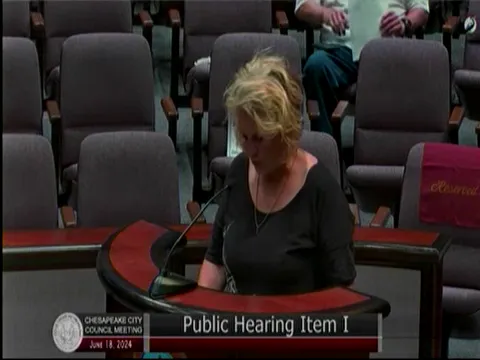
- Christina Teeuwen (self) – Opposed items H (Agricultural Text Amendment) and I (Scenic Heights Accelerated Proffer Modification). Requested amendments per suggestions of the Agricultural Advisory Committee and Farm Bureau.
- Jennifer Knight (self) – Spoke in opposition to item H before item C was presented. Urged council to value agriculture and close loopholes, citing unsafe conditions in rural Chesapeake.
- Grady Palmer (Thornton Development LLC) – Supported item A (Thornton North Battlefield rezoning) and item B (height exception). Described the project as a live-work opportunity with a medical office building and 215 apartments.
- Randy Royal (Kimley-Horn) – Supported item A, detailing traffic improvements, a 50-foot vegetated buffer, and removal of a billboard.
- Bill Hall (Thornton Development) – Supported item A, emphasizing amenities and workforce housing.
- Eric Gordon (property owner) – Supported item A, calling it a win-win for the city.
- Jim Steil (self) – Supported item A, urging council to approve for future needs.
- Vic Nicholls (self) – Opposed items A, B, I, and J. Raised concerns about traffic, building heights, and lack of major road expansions.
- James A. Leftwich Jr. (512 Battlefield LLC) – Supported item D (Battlefield Carwash), opposed continuance, arguing the project improves ingress/egress.
- Kortney Ryder (self) – Supported item E (Ryder Hair Salon), no further comments.
- Grady Palmer (604 Snowden LLC) – Supported item G (Office Container Stacking), described as low-impact with limited truck traffic.
- Mark Beck (United Rentals) – Supported item G, clarified they rent mobile storage/offices, not shipping containers.
- Byron Stonecypher (Chesapeake Farm Bureau) – Opposed item H (Ag Text Amendment), called perpetual easements an abuse of property rights, proposed a 5-year use restriction instead.
- Jenny McPherson (self) – Opposed item H, concerned about perpetual easements without compensation, requested deferral for more stakeholder input.
- Pete Burkhimer (NVR Inc.) – Supported item I (Scenic Heights), noted unit count reduction from 885 to 845, replacement of apartments with condos.
- Linda Tindell (self) – Opposed items I and J, citing drainage issues, sinkhole repairs at Grassfield High School, and school capacity concerns.
- Jeff Staples (self) – Opposed item J (The Commons), called it bait and switch, criticized reduction of commercial space.
- Vic Nicholls (self) – Opposed item J, argued residential uses burden city services more than businesses.
Discussion Items
- Investment Policy (Work Session): Finance Director Kristen Bailey and Assistant Director Nikki Griffith presented a proposed investment policy to enhance safety, liquidity, and transparency. The policy establishes an investment committee, limits investments to authorized securities, and requires quarterly reporting. Council had questions on bond proceeds and diversification parameters. The policy will be brought for adoption on June 25.
- Naval Air Station Oceana Update (Work Session): Capt. Steve Djunaedi provided an overview of operations at NAS Oceana and Fentress Auxiliary Landing Field. Reported over 136,000 flight operations in 2023, a regional economic impact of $2.15 billion, and 39,000 personnel and families. Highlighted ongoing PFAS remediation (9 homes receiving bottled water), planned city water line extension to affected homes near Fentress, and the upcoming Oceana Air Show (Sept. 20-22, 2024) which will include Chesapeake fifth graders for the first time. Also discussed Dominion Energy’s Coastal Virginia Offshore Wind project and its easement agreements with the Navy.
- Agricultural Text Amendment (Item H): Planning Director James McNamara presented the proposed ordinance to amend subdivision and zoning ordinances, replacing the agricultural and conservation divisions with a “preservation division” requiring a perpetual easement for agricultural/horticultural uses. Major changes: elimination of the agricultural division (15-acre lots) and conservation division, replacement with preservation division (10-acre lots with easement). Minor subdivisions (up to 5 lots) remain unchanged. Council debate centered on the perpetual easement requirement. Councilmember Ritter proposed removing “perpetual” but staff recommended adoption as-is, citing future tools like the increased OSAP funding ($3 million) and transfer of development rights. Councilmember Newins moved to continue for 60 days to address landowner concerns; Councilmember Ritter offered a substitute motion to approve Version A. After discussion, the substitute motion passed 6-3.
- Thornton North Battlefield Rezoning (Item A): Staff and Planning Commission recommended approval with 11 proffers, including 215 multi-family apartments, 20,000 sq ft medical office, 50-ft buffer, turn lane extension, 10 workforce housing units, etc. Council discussed traffic access (right-in/right-out with U-turn), shared parking, and compatibility with nearby homes. Motion to approve passed 6-3.
- Thornton North Battlefield Height Exception (Item B): Conditional use permit for building height up to 57 feet. Approved 8-1.
- Premier Healthcare Assisted Living (Item C): Conditional use permit for assisted living facility. Approved 9-0.
- 512 Battlefield Carwash (Item D): Staff recommended continuance due to proffer conflicts; Planning Commission recommended approval. Council voted to approve with stipulations 9-0.
- Ryder Hair Salon (Item E): Level II home occupation. Approved 8-1.
- Woodley Motorcycle Sales (Item F): Sale and repair of motorcycles. Approved 9-0.
- Office Container Stacking (Item G): Storage of non-shipping containers. Approved 9-0.
- Scenic Heights Accelerated Proffer Modification (Item I): Modified development criteria and master plan to reduce units from 885 to 845, replace apartments with condos, and enhance open space. Approved 6-3.
- The Commons Accelerated Proffer Modification (Item J): Proposed elimination of 88,000 sq ft of ground-floor retail, replacing with suburban-style mixed-use. Staff recommended denial citing inconsistency with comprehensive plan. Councilmember Ike moved approval, Councilmember Carey made a substitute motion to deny. After debate, substitute motion passed 6-3, denying the modification.
- FY 2024/2025 CDBG/HOME Action Plan (Regular Agenda Item 1): Request to approve the final Statement of Objective/Action Plan and authorize submittal to HUD. Approved 9-0.
Key Outcomes
- Approved: Thornton North Battlefield rezoning (6-3), height exception (8-1), assisted living facility (9-0), carwash (9-0), hair salon (8-1), motorcycle sales (9-0), office container stacking (9-0), Scenic Heights proffer modification (6-3), CDBG/HOME plan (9-0).
- Denied: The Commons accelerated proffer modification (6-3 to deny).
- Adopted: Agricultural text amendment (Version A) by a 6-3 vote, closing the agricultural subdivision loophole and introducing preservation divisions with perpetual easements.
- Next Steps: City Manager Price committed to accelerating other preservation tools, including the enhanced OSAP program (funds available July 1), transfer of development rights, and farming villages. Council requested a meeting between staff and the Farm Bureau to address ongoing concerns. Investment policy will be formally considered on June 25.
- Closed Meeting: Council certified a closed meeting held earlier at 2:30 p.m. and authorized a second closed meeting to discuss litigation and real property acquisition.
Meeting Transcript
We have a number of items. I'll turn it over to Mr. Manager to present. Thank you, Mr. Mayor. Three items for you tonight. First is on rural preservation tools and its germane to an agenda item this evening on agricultural preservation subdivisions and how the subdivision ordinance interacts with the zoning ordinance. Second is our investment policy, and we have the team from finance and treasurer's office and the our consultants here. And then last uh we have uh a visit and an update from our friends at Oceana. Really appreciate uh them coming out that we have great partnerships with Ocean, and you'll hear about some of the great stuff that they're doing there. Um so getting started with rural preservation before we jump into the ordinance that's on the agenda tonight. Um I do want to recap a little bit from council's retreat um from last week uh for um the members of the public that may have not been able to see that retreat. Um as we talked about with council, we have a lot of agricultural preservation tools. The the code of Virginia authorizes um localities um to do different things. We we've taken advantage of the the enabling authority to to enact several um tools and tactics for rural preservation. Um, but it's pretty clear from council direction over the past year that um council and the community want to make sure that we can clearly articulate what's the overall strategy that that we're pursuing and what are the desired outcomes that we're trying to achieve with regards to rural preservation. And so they've uh council's asked staff to develop a much more comprehensive and coordinated rural preservation um strategy and overall program. Um at the end of the day, we want to make sure we align all of our plans, our policies of all of our tools to achieve um those desired outcomes of rural preservation. Um lots of tools uh won't go into uh a lot of these in detail, but it starts with uh having a clear strategy and objectives. Um council recently um in this budget year has significantly expanded um resources available for our conservation um uh programs. Council's added three million dollars um to the budget to be able to go out and augment our existing um open space acquisition programs. Um council's asked us to take a look at more opportunities for uh what we call value-added agriculture. This is agribusiness agro tourism. Um a year, a little more than a year ago, council approved uh approved some changes to the zoning ordinance to make some agribusiness and agritourism opportunities more available than they were in the past. We've learned some lessons and and are recommending some additional modifications and resources to continue to improve agribusiness and agro tourism opportunities. Um council asked us to explore farming villages. This is a way to um for for landowners to be able to better plan and utilize um utilize their land but also achieve some of the desired desired outcomes of rural preservation, um making sure that housing that's built uh pays its own way from an infrastructure perspective and is really value-added to the community, uh doesn't detract from the character of the rural area. Um council asked us, we're really excited about this one to pursue a transfer of development rights program. This is a a voluntary program that's enabled in Dakota, Virginia that would allow the private sector, the free market to transfer development rights um from the rural area into the development area, and without again going into a lot of detail because you'll see you'll see these tools coming forward to council in the in the relatively near future. This would allow a developer to go into Southern Chesapeake if council so chooses and um and um purchase what would have been development rights on a property um so that the landowner can keep the property, they can keep it available for farming, they don't have to develop it, they don't have to sell um to a developer, but they could sell the development rights, which a developer would then take and transfer those rights into an area that has existing or planned infrastructure. Um so again, matching matching development with where infrastructure is or is one of our principles of smart growth. Um obviously we continue to update ordinances and policies, including the agenda item on this evening, and at the end of the day, as I mentioned, we want to coordinate all of our programs to achieve council and the community's goals. So this is a brief graphic that we showed you at the retreat where each of the individual tools and tactics can be used to complement one another so we can start creating um true large areas of uh preserved open space. So if you combine a farming village tool with uh our open space acquisition program, we'll still have some minor subdivision aggregative activity, some value added ag in terms of agritourism, um, so lots of different tools uh put together to achieve really, really dramatic open space preservation in ways that we're not doing now that that would really benefit the community. Um lot of benefits that ensures clarity of our goals and objectives, maintains the rural character much more than than we're doing today. Um it provides multiple new opportunities uh and additional flexibility for landowners. I I know with the agenda item this evening, there's some perception from some of the landowners that we're taking rights away. Um these are really really significant new opportunities, including um potential sources of revenue, not not even tax funding, private private sector funding that that don't exist anywhere else in the city. So it's it's a pretty significant um uh opportunities for for landowners that don't exist today. It makes sure that lands actually preserved and available for farm or or rural use, some of our preservation tools today, um they they're not working as intended, so land's not actually being preserved. Um, so this makes sure that that is happening, and then finally improves the viability of the rural economy. So overall, each of these individual tactics uh when put together are pretty powerful in terms of achieving the desired count outcomes and councils assets to achieve ultimately improving um uh preserving land, um, improving agribusiness and and agritourism opportunities, maintaining the rural character, and providing additional flexibility and resources to um to landowners in southern Chesapeake. So I think we've done a pretty good job. It all starts, as I said, this evening with um addressing the agricultural text amendment that that's before you, um, and then we'll continue to bring these forward. So as far as next steps, um making sure all of those plans, policies, and ordinances are aligned. Uh, you'll take that first step uh at least it's on your agenda this evening. Um we will begin implementing the new three million dollar uh purchase of development rights program that council enacted in the budget, those funds will become available in July 1, and then we'll continue the tools that I just briefly mentioned. We'll to continue to advance those tools, have conversations with landowners, conversations with the community to make sure we're bringing you the best tool that makes sense for both Southern Chesapeake and the development area. At the end of the day, some of these tools are really powerful. I know Councilmember Ritter has said this many, many times, but I think we do some really great small area planning, but we we don't want to lose sight of the whole.
openpublica.com