Chesapeake City Council Meeting – August 20, 2024: Rezonings, Text Amendments, and New Business
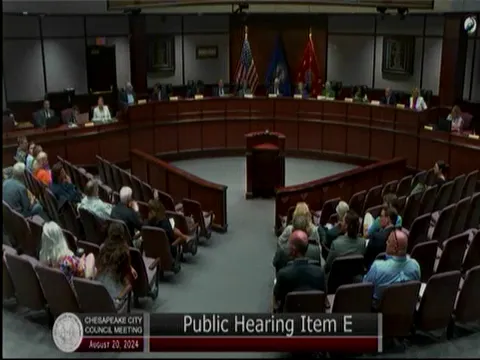
STREAMING COPY IN PREPARATION — RECORDING AVAILABLE FROM THE ORIGINAL SOURCE
Chesapeake City Council Meeting – August 20, 2024
The Chesapeake City Council convened for a work session at 5:15 p.m. and a regular meeting at 6:30 p.m. on August 20, 2024, in City Hall Council Chamber. The council considered a lengthy agenda including multiple conditional rezoning requests, conditional use permits, text amendments to the zoning ordinance, an accelerated proffer modification, and new business items involving former city attorney email review and allegations of misuse of city funds. All council members were present.
Public Comments & Testimony
- Heron Point (Item A): Gary Szymanski (self) spoke in opposition, arguing that the multifamily development is incompatible with surrounding neighborhoods, would harm school performance (citing Jolliff Middle School at 67% capacity and schools below 40% proficiency), and that the city is over‑saturated with low‑income housing. He also expressed concern about losing the ability to provide safe access to Hampton Roads Executive Airport.
- St. Joseph Church (Item E): Lisa Murphy (attorney for applicant) explained the modest nature of the church (20–30 members) and the prohibitive cost ($350,000–$500,000) of installing a left‑turn lane in Phase I. Vic Nicholls (self) spoke in support, urging trust in the congregation.
- Children of Valour Christian Academy (Item G): Vic Nicholls (self) spoke in support, noting the daycare is desperately needed in Greenbrier.
- Text Amendment H (home occupations): Vic Nicholls (self) spoke in support, stating it was needed years ago.
- Text Amendment J (reasonable deviations): Vic Nicholls (self) questioned who would define “reasonable” and ensure consistency.
- Transamerica Accelerated Proffer Modification (Item L): Valerie Wilkinson (Tri‑City Properties) and team spoke in support, highlighting the reduction from 1,904 by‑right units to 500 new units, conservation of 600+ acres, relocation of a fire station site, and a $500/unit cash proffer for parks. Vic Nicholls (self) also spoke in support.
Discussion Items
- 2045 Comprehensive Plan Update (Work Session, 5:15 p.m.): Planning Director McNamara presented a midpoint update, recapping stakeholder input, seven focus areas (connectivity, economy, environment, growth management, housing, placemaking, quality of life), and “big ideas” such as walkability, complete communities, and resilient development. Council members discussed level‑of‑service policies, the Dominion Corridor Plan’s implementation, renewable energy, and transfer of development rights.
- Heron Point (Item A): The council asked about price points (attached units starting ~$400,000, detached ~$500,000) and school capacities (E.W. Chatham Elementary 91.9%, Jolliff Middle 69.5%, Western Branch High 97% at projected buildout). A council member noted a preference for single‑family homes.
- St. Joseph Church (Item E): Debate centered on the timing of a left‑turn lane on Battlefield Boulevard. A substitute motion (requiring the turn lane in Phase I) failed 3‑6; the primary motion (Option #4, requiring a traffic study and improvements in Phase II) passed 9‑0.
- Transamerica (Item L): Council members questioned the absence of architectural elevations (explained as a legacy from the 1990s zoning), the amenity package (pools, playground, open space, ~$2 million), and the right‑sizing of proffers. Councilmember Ritter voted no, citing discomfort with using the accelerated modification vehicle for such extensive changes.
- New Business – Former City Attorney Email Review: Councilmember Newins moved to direct the City Attorney to review emails of former City Attorney Jay Stroman for any forwarding to personal accounts or deletions, and to report on ethical or integrity concerns. The motion passed 6‑3 (Carey, Ike, Ward opposed).
- New Business – Mayor West Misuse of Funds: Councilmember Ike read a statement alleging Mayor West used City Attorney staff for personal legal services for his stepbrother, calling it a theft of city services, and asked the Commonwealth’s Attorney to appoint a special prosecutor. He also requested an accounting of hours expended. Councilmember Newins asked the City Attorney to poll all council members on whether they had used the office for personal business.
- Councilmember Ritter’s Observation: She questioned the pattern of encouraging single‑family developments to become multifamily, noting a lack of single‑family projects in recent approvals. City Manager Price said staff does not direct applicants but responds to what would achieve a recommendation of approval given council’s policy direction.
Key Outcomes
- Heron Point (Item A): Approved 9‑0 with proffers.
- Forbes Organization (Item B): Approved 9‑0 with proffers.
- Forbes Overflow Parking (Item C): Approved 9‑0 with stipulations.
- Cardinal Meadows Proffer Modification (Item D): Remanded to the Planning Commission for further review (9‑0).
- St. Joseph Church (Item E): Approved 9‑0 with stipulations including revised stipulation #1 and Option #4 (traffic study required at Phase II).
- Nurtured In Nature (Item F): Approved 9‑0 with stipulations and alternative parking surface.
- Children of Valour Christian Academy (Item G): Approved 9‑0 with stipulations.
- Text Amendment H (home occupations): Approved 9‑0 (version dated May 31, 2024).
- Text Amendment I (R‑6 in Urban Overlay): Approved 9‑0 (version dated May 30, 2024).
- Text Amendment J (reasonable deviations): Approved 9‑0 (version dated June 11, 2024).
- Text Amendment K (regular periodic assemblies): Approved 9‑0 (version dated June 4, 2024).
- Transamerica Accelerated Proffer Modification (Item L): Approved 8‑1 (Ritter opposed) with revised proffers dated July 18, 2024, and 2024 Master Development Plan.
- Virginia Land Conservation Grant Request: Approved 9‑0 to apply for funding to preserve 96 acres.
- Hotel Parking Garage Resolution: Approved 9‑0 reserving 156 spaces on top level for hotel guests 8:00 p.m.–7:30 a.m.
- Closed Meeting (Real Property): Approved 7‑2 (Newins, Ritter opposed); held from 8:05 p.m. to 8:14 p.m.; certification approved 8‑0 (de Triquet absent).
Meeting Transcript
I want to welcome everyone to our August 20th City Council work session and like to call on our city manager to present the items. Thank you, Mr. Mayor. As you know, the comprehensive plan process is well underway, and uh our our staff wanted to give council an update. There's been a lot of community conversations so far and a lot of work done. And so before we get too much further, just wanted to give a situation report to council, and I'll turn it over to Director McNamara. So good evening, everyone, and very excited to be here this evening and sharing our midpoint update for the comprehensive plan. We want to first start off by saying thank you to all the stakeholders who have taken part in this process to date. We'll be sharing a lot of the work uh that has been uh has been done so far. So as an agenda for this evening, uh we'll be focusing on a recap of work completed in 2023 and then turning our focus to what we've been doing this year. Uh we've had a lot of great input from uh citizens, stakeholder groups so far, and we'll be sharing the work uh through the induct introduction of some of the focus area big ideas uh that are going to be summarized later on this in the presentation. We'll then talk about next steps and expectations moving forward. First, the recap. So in 2023, we began by laying the foundation for the plan. We conducted our demographics, housing, and market reports. Uh we worked to develop our branding and engagement plan, and we also looked at best practices from around the country and looked at what gaps may exist within our existing policies. In June, we took our show uh to the public and hosted a series of five open houses where we asked people's thoughts on the focus areas for the plan. We didn't stop there, we popped up at various city events like the Holiday Craft Show, Oktoberfest, Black Inc., the Wine Festival, Monster Fest, and more. We then set forth uh to develop stakeholder committees that represented a diverse range of participants on thoughts, age, jet geographic location, et cetera. Those seven groups met somewhere between seven to eight times a piece to discuss the topics. As 2024 began, those stakeholder groups continued to meet and be started to form big ideas, of which we'll be sharing with you in a little bit. Knowing Chesapeake is a diverse city uh and it's made up of many communities. We knew that these big ideas and policies would affect different areas of the city in different ways. So with that, we formed geographic focus groups uh from each of the ten planning areas and met with uh each of those groups to discuss the ideas of each of the focus areas and their perspective on how they would affect their communities. All along the way, we've done a series of quick surveys uh that focused on green spaces, development patterns, unique neighborhood places, and ongoing housing preferences. Taking in all this input, uh we have developed new displays and hit the road again for our next series of five summer open houses where we shared both focus area and geographic area perspectives with the public and sought their input on our work to date. So that's where we're at tonight. Uh we'd like to share the input that we've received and some of the big ideas that came from that input. So, as a reminder, uh these policies are not the entirety of what will be in the plan. Uh they were generated based on consultant feedback, stakeholder community work committee work, and uh the initial public interest. Prior to bringing the them to the community open houses, we shared these with community leaders from each of the planning areas to get their perspective and to add it to the conversation. Some of these may be familiar to you, and you may note that they are already in the comprehensive plan. The fact that you're seeing them here means that we've heard a swell of support and a desire to truly push these initiatives forward above others. As a reminder, the seven focus areas are listed on the screen, and we'll be going through each one of those in detail. In connectivity and infrastructure, movement was broken down to two things moving people and moving things. Moving people, not cars. Sometimes moving people does require cars, and that's okay. But the focus is actually on moving the people and how we're going to move them. So you'll see a lot of key policy overlap uh across many focus areas. Infrastructure uh comes up in growth management and housing as well. So walkability continues to be an important repeated point that also shows up in place making and design, and as well as environment resilience and quality of life. So our next focus area, three big points rise to the top here. First is business retention and recruitment. The next focuses on the connection between housing and jobs and the need to keep things in balance by providing adequate affordable housing near employment centers. You'll hear more about this when we get to the housing focus area. The next is the need to protect economic development sites. Sometimes this takes the form of purposeful redevelopment of abandoned and obsolete sites, while other times it's through protecting prime inventory of environment of economic development sites. Turning our focus to environment and resilience, we heard over and over again about flooding and sea level rise and the need to adapt to these forces through resilient development strategies. Renewable energy was another topic that came up quite a bit, and the fact that we need to adopt standardized practices for this and the need to lead the way in city spaces. Another topic that comes up all the time is the need for an urban forest and accomplishing this by protecting existing mature trees and supplementing through reforestation efforts.
openpublica.com