Chesapeake City Council Meeting - September 17, 2024
STREAMING COPY IN PREPARATION — RECORDING AVAILABLE FROM THE ORIGINAL SOURCE
Chesapeake City Council Meeting - September 17, 2024
The Chesapeake City Council held a Work Session at 5:00 PM followed by the Regular Meeting at 6:30 PM on September 17, 2024, in the City Hall Council Chamber. The Work Session featured briefings on the Fire Department Pharmacy Program and the Trails and Connectivity Plan. The Regular Meeting included a special recognition, five public hearing items (four approved unanimously, one approved 7-2), and discussion of new business items.
Public Comments & Testimony
- Public Hearing A (Sewell Massage Therapy): Vic Nicholls (self) asked whether the permitted hours (8 AM to 6 PM, Monday–Saturday) could be extended to accommodate working clients.
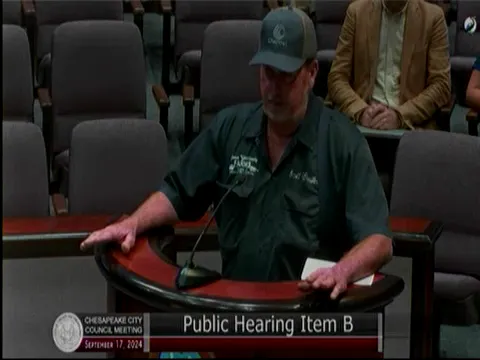
- Public Hearing B (Long Ridge Road Solar): Seven speakers expressed support:
- Cara Romaine (ESA Solar) supported the project and requested a modification to reduce minimum evergreen tree heights due to local sourcing and survivability concerns.
- Wes Shaffer (ESA Solar) echoed the request for reduced tree heights.
- Glenn Scott Weatherly (co-owner) supported the project, noting it would provide financial security and allow him to continue farming and keeping beehives.
- Chris Weatherly (co-owner) supported the project, addressing environmental and drainage concerns, and argued that 4–6 ft trees have better survival rates than 8 ft trees.
- Todd DeWees (self) supported the project, citing multi-use land benefits.
- Rogard Ross (self) supported the project, highlighting renewable energy, wildlife habitat, and OSAP funding.
- James Dana Todd (self) supported the project as a way to keep farmland viable.
- Additionally, Vic Nicholls offered comments noting the lack of mention of animal grazing in the stipulations, the absence of panel replacement provisions, and lower OSAP contributions compared to past projects.
Discussion Items
- Work Session – Fire Department Pharmacy Program: Chief Gulisano briefed Council on a new pharmacy program required by federal regulatory changes (Drug Supply Chain and Security Act, DEA rules, etc.) that eliminate the current hospital-exchange system for controlled medications. The program will cost approximately $780,000 to implement (including security upgrades, software, and two new positions: a full-time lieutenant as program manager and a part-time paramedic), plus recurring operational costs. The city must be compliant by November 27, 2024. A formal appropriation request will be brought to Council next week. Council members discussed cost recovery (EMS billing), storage logistics (medications will be kept on apparatus, not at stations), and the role of the medical director (Dr. Siegel).
- Work Session – Trails and Connectivity Plan: Planning Director McNamara and staff presented an update to the 2050 Trails Plan. The draft plan includes over 300 miles of trails, shared-use paths, bike lanes, and blueways. A core network (roughly one-third of total) was identified for near-term implementation. Community engagement included open houses, surveys, and pop-up events. The plan includes sample projects, design guidelines, and an access benefit analysis showing improved access to parks, schools, and jobs. Planning Commission continued the item to seek additional stakeholder outreach. Council members discussed safety for existing infrastructure, prioritization mechanisms, tourism potential, and challenges on rural roads.
- Public Hearing B – Modification of Stipulation #10: The applicant requested reducing the minimum height of evergreen trees in the landscape buffer from 8 ft to 6 ft (north/west) and 6 ft to 4 ft (south/east) at planting. City Attorney Lindley confirmed the modification. Planning Director McNamara supported the change. Council member Newins asked whether local sourcing could be required; the City Attorney advised against including that language.
- New Business – Temporary Sign Permits: Councilmember Whitaker requested an initiating resolution to remove the permit requirement for all temporary signs, citing citizen concerns.
- New Business – Solar Farm Policy Review: Councilmember Bunn (seconded by Councilmember Ritter) requested a work session to review the city's solar farm policy. Councilmember Ritter noted repeated complaints about road conditions and landscaping and stated that solar facilities are industrial, not agricultural.
- New Business – Virginia Municipal League Membership: Councilmember Ritter requested a future discussion about the city's membership in the Virginia Municipal League, expressing disappointment with what she perceives as anti-law enforcement stances.
- New Business – Library Satellite Locations: Councilmember Carey asked for a memo on the performance of satellite library locations.
- New Business – Marijuana Use in Parks: Councilmember Newins asked that signage be updated to remind the public that marijuana use is prohibited in city parks.
Key Outcomes
- PLN-USE-2024-019 (Sewell Massage Therapy): Approved 9-0 with stipulated conditions.
- PLN-USE-2024-020 (Long Ridge Road Solar): Approved 7-2 (Council Members Bunn and Ritter voting no) with stipulations and a modified Stipulation #10 reducing evergreen tree minimum heights at planting to 6 ft (north/west) and 4 ft (south/east).
- PLN-TXT-2024-006 (Site Plan Deadlines): Approved 9-0, retroactive to July 1, 2024.
- PLN-TXT-2024-007 (Fentress Airfield Overlay Disclosure): Approved 9-0, retroactive to July 1, 2024.
- PLN-TXT-2024-008 (Lawful Nonconformity): Approved 9-0, retroactive to July 1, 2024.
- Directives from Council:
- City Manager to draft an initiating resolution to remove permit requirements for temporary signs.
- Schedule a work session to review the solar farm policy.
- Schedule a work session to discuss Virginia Municipal League membership.
- Provide a memo on satellite library locations.
- Update park signage regarding marijuana prohibition.
Meeting Transcript
Want to welcome everyone to our September 17th uh work session. Have a couple of items. Mr. Manager, please. Thank you, Mr. Mayor. Two items uh for your information today. First up, I'll turn it over to Chief Gulisano to talk about our new pharmacy uh program implementation. All right, uh good afternoon, Mr. Mayor, uh Vice Mayor, members of the city council, and uh Mr. Manager, thank you for the opportunity to uh present an initiative that we're moving forward on in regards to a pharmacy program uh for the fire department, and this is uh be specifically so we can continue to provide medications to our patients in the field. Uh so this afternoon we're gonna brief you on that, kind of give you a little bit of history of how we handle medications in the field currently, uh, some of the changes that we have to make to be compliant with uh uh several regulatory agencies, and then uh the steps that we're taking as we move forward. All right, so uh how we currently operate our system is we carry uh we carry basically two boxes that we'll focus in on this this afternoon that have one box has our medications, we call that our drug box, and then we have another box that has our IV equipment that helps us administer those those medications. So we get the that drug and IV box and everything that's in them from the local hospitals. Uh they provide that to us, we put that uh equipment on our medic units or and or our engine companies, and then we re when we have those on the units, then we get a uh an emergency call, we respond to that call, we provide patient care while we're there. If uh that patient needs medication of any sort that we carry, then we administer that medication on the scene. We transport the patient to the hospital. Uh when we get to the hospital, we then uh there's a whole process of how we transfer care from our folks to the hospital staff. Uh once that's done, we then take the that drug and IV box that we utilize for that patient, and we bring that to the hospital pharmacy. Now at the pharmacy, we then do an exchange. We give them the old box with uh the opened box with the medications that we used. We give that to the pharmacist. There's a process for how they check that in, and then they give us a brand new sealed boxes with uh a new set of drugs and a new set of IV uh equipment and supplies. So that system has worked for many, many years. Uh and actually uh for our department, we've been doing that for over 50 years now. Uh it's a very common system uh throughout the United States, but specifically in the commonwealth of Virginia. That's uh that's the primary way that EMS agencies obtain and um how they get their their drug and IV supplies and equipment. supplies so that system has worked for many many years and actually uh for our department we've been doing that for over 50 years now it's a very common system uh throughout the United States but specifically in the Commonwealth of Virginia that's a that's the primary way that EMS agencies obtain and how they get their their drug and IV supplies and equipment so when we're talking about the medications that we utilize uh they are split into different schedules um schedule two through five medications are are heavily regulated uh they're they're very regulated by a bunch of different organizations uh these five uh medications that we carry the the morphine fentanyl versed ketamine and how dahl uh they are very effective in treating patients for a wide variety of of uh medical ailments that they're having but you've you may recognize that these five medications are also they're they're ripe for abuse uh so there's there's been a lot of um a lot of research on it a lot of discussion about it uh that these these schedule two through five medications are uh very effective in treating medical issues but they are also very susceptible to abuse uh so that's why there are a lot of regulations that that have to be adhered to when you're uh storing or utilizing these these types of medications so these these uh five medications aren't the only ones that we carry we also carry 18 other medications uh that are that classified as schedule six uh they're not as heavily regulated as two through five however there are a lot of um processes and regulations that we do have to follow when we're uh storing and administering these medications as well so that's a little bit of the history of kind of where we're at um how we do our our med how we obtain the medications how we work with the hospitals to do that there's change though so uh I won't get into too much of the details of the legislation what I will point out is on this slide in the top five boxes it does list out some of and I apologize it's a little sm small print but it does address some of the legislative changes that have occurred specifically to address the opioid epidemic these top five boxes that's it's legislations or it's regulations that have changed to address the abuse specifically of those those top five or those schedule two through five medications. So the Drug Supply Chain and Securities Act the DEA protecting patient access ambulance restocking safe harbor under the anti-kickback statutes uh the Board of Pharmacy regulations and FDA regulations all these over a period of time have changed to increase the accountability that's required for those types of medications that we carry so essentially when a when somebody obtains a medication these regulations now require them to maintain an accountability of that medication from the time they purchase it or the time they own it until the time it's administered to the patient so if you think about our current process of the hospital owns that medication they own that that IV supplies they own those boxes and when they hand them over to us we can account for them but the hospital as the owner of the medication can no longer do that. They've they've essentially they've lost control of it. So based on the legislation that have that has been passed that is no longer an acceptable practice to be able to do so the the the intent of the legislation is to again put tighter controls on those specifically those schedule two through five medications to make sure that they don't fall into the wrong hands I mentioned a little bit earlier that this has a it impacts well it impacts the entire country I mean these are federal laws that that we're not that we're under we have to be compliant with those specifically in the commonwealth of Virginia this pharmacy exchange program with the hospitals has been in existence for many many many years and just about every jurisdiction in the commonwealth of Virginia follows that that process of getting their drug and IV supplies from the area hospitals so every fire chief right now is having the same conversation that that we're having this afternoon this again it it really impacted Virginia probably more significantly than other states because some states had moved away from this this process but in the Commonwealth of Virginia again just about every every city council every city manager is having this conversation with their fire chief right now in the region there's been a lot of partnership and really working together as a region to make sure that all of our systems are as we move forward they're they're they're pretty they're very similar they're very similar for all the fire departments as they transition and away from a hospital based medical exchange program to a an EMS agency based medical program so some timelines we got guidance on this in May of 2024 so just a few short months ago since then staff has been working exceedingly hard to make sure that we're getting everything in place to make sure we're compliant with the regulations that next bullet slide the bullet point is is probably the one that we've uh myself and Chief Reynolds and I apologize for not introducing him I So some timelines. Um we got guidance on this in May of 2024, so just a few short months ago. Uh since then, uh staff has been working exceedingly hard to make sure that we're getting everything in place to make sure we're compliant with the regulations. Uh that next bullet slide, the bullet point is is probably the one that we've uh myself and Chief Reynolds, and I apologize for not introducing him. I know most of you know him. Uh Division Chief J.R. Reynolds, he's our uh he he he leads our EMS division in the department. He's really been taking point on making sure that we're uh compliant with our uh the federal regulations and we're ready to go uh before this November 27th, 2024 deadline. Uh so credit to him and and the team that we put together to really pull this thing together. And I'll talk a little bit about more about that in in just a few minutes. So issued at 5 07 p.m. The National Weather Service in Wakefield has issued a flash flood warning for current. The county in northeastern North Carolina until 8 15 p.m. At 5 07 p.m. Broadcast media reported extensive street flooding in coastal curve county. Between four and six point five inches of rain have fallen. The expected rainfall rate is one to one point five inches in one hour through 6 30 p.m. Flash flooding is already occurring. Hazard, life-threatening flash flooding, heavy rain producing flash flooding, source, public reported impact, life-threatening flash flooding of creeks and streams, urban areas, highways, streets, and underpasses.
openpublica.com