Chesapeake City Council Work Session and Regular Meeting – February 11, 2025
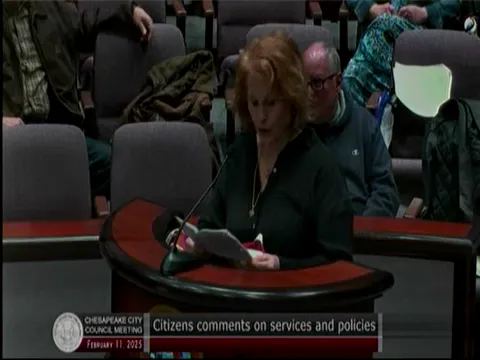
STREAMING COPY IN PREPARATION — RECORDING AVAILABLE FROM THE ORIGINAL SOURCE
Chesapeake City Council Work Session and Regular Meeting – February 11, 2025
The Chesapeake City Council convened for a work session at 5:00 p.m. on February 11, 2025, to conduct annual Freedom of Information Act (FOIA) training and discuss the South Norfolk Design Guidelines. The regular meeting began at 6:30 p.m., covering consent and regular agenda items, public comments, appointments, and new business. All council members were present. The meeting included a closed session from 7:39 p.m. to 8:43 p.m.
Consent Calendar
- Acknowledgements for Rezoning Applications: Two rezoning requests were acknowledged for future hearings: Ballahack Lot Rezoning (PLN-REZ-2024-003) to reclassify 1.0 acre from B-1 to R-15s, and Knicks Reserve (PLN-REZ-2024-016) to reclassify 31.93 acres from A-1 to R-MF-1 and C-2. These will be heard by the Planning Commission on March 12, 2025, and later by City Council.
- Resignations: Accepted resignations of Brad Moore (South Norfolk Revitalization Commission) and James Lang (Stormwater Committee).
- Grant Acceptance and Appropriation: Accepted $3,265 from the Virginia Department of Environmental Quality for litter prevention and recycling; accepted and appropriated $20,000 from the Virginia Department of Forestry for urban forestry software; and authorized a resolution for a grant agreement for TreePlotter software.
- Ordinance on Abandoned Vessels: Amended Chapter 14 to change the enforcing official for abandoned or hazardous vessels from the Director of Development and Permits to the City Manager or designee, and clarified notice requirements. Adopted unanimously.
- Deed of Gift from American Battlefield Trust: Authorized acceptance of a 0.664-acre property at 113 North Battlefield Boulevard, adjacent to the Great Bridge Waterways History Museum, conveyed as a gift. Adopted unanimously.
- South Norfolk Façade Improvement Grant: Approved a $6,206 grant to Vinayaka LLC for façade improvements, distributing funds to the Economic Development Authority. Adopted unanimously.
- Renaming of Southwestern Park: Designated Southwestern Park at 4016 Airline Boulevard as Clementine Elliott Southwestern Park, honoring longtime community advocate Clementine Elliott. Adopted unanimously.
Public Comments & Testimony
- On Agenda Items:
- Vic Nicholls spoke in opposition to City Manager Item (3) (microtransit program), questioning the $260,400 city match and urging that funds be used for routes with proven demand.
- Lamar Elliott, representing the Elliott family, spoke in support of renaming the park after his mother, Clementine Elliott, highlighting her decades of advocacy for recreation in the Airline Boulevard corridor.
- Non-Agenda Speakers (Citizens’ Comments on City Affairs):
- Vic Nicholls criticized the city’s cost structure and development patterns, urging a focus on maintenance over growth and citing a “growth Ponzi scheme.”
- Joseph Davis (President, Eva Garden Civic League) expressed concerns about a proposed Virginia Natural Gas compressor pump station near the community, citing potential harm to health and safety, and asked the Planning Commission and council to prioritize people in decision-making.
- Leigh and Kimberly Goodwin (Northwest Pines Farm Animal Sanctuary) described conflicts with a new neighbor who complained about farm activities despite the property’s agricultural zoning. They reported lost use of land due to setback requirements and uneven enforcement of zoning rules.
- Linda Tindell supported the Goodwins and cited broader impacts of rural rezoning, including drainage changes, privacy loss, and safety hazards from nearby development. She also requested water trucks for the fire department to protect farms.
- Sharon Stull (We Care Resource Center) advocated for a bus stop near the Steppingstone Square resource center, noting clients walk up to a mile from the nearest stop, and recommended a stop at Smith Drive and Stepping Stone Square.
- Debra Campbell (Heritage Point resident) described being ordered to remove a deck and shed due to a Dominion Power easement she was unaware of, noting the utility could not locate the easement line and had not surveyed.
- Sydney Diaz (volunteer at Chesapeake Animal Services) voiced support for additional staff positions in the shelter budget, praising current staff dedication.
- Frank Walter expressed concerns about federal funding cuts under the new administration, noting that federal funds make up 5.4% of the city’s revenue but $65 million supports Chesapeake Public Schools, including special education and COVID-19 learning gap grants. He urged the city to use its influence to demand congressional oversight.
- Jeff Staples (Brentwood resident) described ongoing vandalism and safety hazards at the Chesapeake Fire Training Center on Sherbrook Road, including broken glass, nails, and stagnant water in training tires. He requested proper maintenance until demolition.
Discussion Items
- FOIA Training (Work Session): City Attorney Catherine Lindley provided the annual FOIA training, covering definitions of public meetings and records, closed session requirements, penalties, and best practices. Council members asked questions about including non-members in closed session, text message communications, and attorney-client privilege.
- South Norfolk Design Guidelines Update (Work Session): Planning staff and consultant Katie Paulson presented the fifth update to the design guidelines, incorporating extensive community engagement. Key changes included shifting some items (paint color, replacement-in-kind, removal of modern additions, site work) to administrative review to ease the burden on the Historic Architectural Review Board (HARB), adding an alternative materials flow chart, and enhancing guidance for infill construction. A six-month COA extension option and updated hardship determination process were recommended. Council Member Ritter asked for details on grant usage and requested the grant guidelines be provided. Council members praised the update.
- Microtransit Zone (Regular Agenda): Council Member Ritter requested removal of City Manager Item (3) from the consent agenda for discussion. She noted a request from the Chesapeake Area Shelter Team (CAST) and the ABBA List to establish a bus connection between a Military Highway stop and the new Steppingstone Square resource center. City Manager Price acknowledged the request and committed to evaluating whether the microtransit program could address it.
- Request to Name Oak Grove Park Lake: Council Member Newins proposed naming the Oak Grove Park Lake after Officer Timothy B. Schock, who died in the line of duty in 2011. Mayor West deferred the request, asking to first review the city’s process for naming facilities. Council Member Newins agreed provided a date certain was set. The manager will bring a recommendation on the timeline to the next meeting.
- Sign Ordinance Amendments: Council Member Ritter requested two initiating resolutions to amend sign regulations in the Fentress Airfield Overlay District and the Great Bridge Village Overlay District, asking staff to bring them back in two weeks.
- Demolition of Old Nike Site and Fire Training Center: Council Member Ritter inquired about demolition timelines. City Manager Price stated the Nike site is planned for demolition soon; staff will look into the Fire Training Center site. Council Member King asked about the decision process; Price explained it is within his operational purview unless the structure is historic, as with Sunray School.
- Agricultural Policies Update: Council Member Ritter asked for an update. City Manager Price reported that closing the agricultural loophole and adding funds to the Open Space Preservation Fund are accomplished. Staff are working on a Transfer of Development Rights program and comprehensive plan updates, with a consultant developing a Chesapeake-specific plan to be presented later this year.
Key Outcomes
- Consent Agenda: Approved 9-0 with the exception of City Manager Item (3), which was moved to the regular agenda.
- Microtransit Program Participation: Approved 9-0. Staff will evaluate connecting CAST and the resource center to the microtransit zone.
- Ordinance on Abandoned Vessels: Adopted 9-0.
- Deed of Gift from American Battlefield Trust: Adopted 9-0.
- South Norfolk Façade Improvement Grant: Approved 9-0.
- Renaming of Southwestern Park: Approved 9-0.
- Initiating Resolution for Indian River Design Guidelines: Approved 9-0, referring to the Planning Commission for recommendations.
- Initiating Resolution for Alcohol and Substance Abuse Facilities as Conditional Uses: Approved 9-0, referring to the Planning Commission to amend Article 9 of the Zoning Ordinance.
- Appointment to Chesapeake Board of Historic and Architectural Review: Kaydee Moore appointed as the Historic District Resident by unanimous consent, correcting a prior over-appointment.
- Direction to Staff: City Manager will research the Virginia Natural Gas compressor station near Eva Gardens and report back; staff will meet with the Chesapeake Police Foundation and others regarding naming Oak Grove Park Lake, with a timeline recommendation in two weeks; staff will bring initiating resolutions for sign ordinance amendments in two weeks; staff will look into demolition of the Fire Training Center.
- Closed Meeting: Council voted 9-0 to enter closed session to consult with the city attorney on litigation (William Kuhn v. City of Chesapeake) and discuss economic development opportunities in Pleasant Grove and Washington boroughs. The closed session was certified upon reconvening at 8:43 p.m. A second closed meeting was scheduled for February 18, 2025, at 5:00 p.m. to discuss facility security and cybersecurity threats.
Meeting Transcript
Everyone to our February the 11th, 2025 council work session. We have a couple of items which manager will introduce to this time. Thank you, Mr. Mayor. And I'll first turn it over to City Attorney Linley to go through your annual Virginia Freedom of Information Act training. Good evening. I am here to discuss the Freedom of Information Act. And if you will indulge me one acronym, I will probably refer to it as FOIA throughout the presentation, but I will try to not use any other acronyms. So if I do, give me the look. Alright, so to begin, what is FOIA? FOIA is basically Virginia Code statutes that collectively combine to make what is called the Virginia Freedom of Information Act. And the purpose of all of these statutes is to ensure that Virginia citizens have ready access to open public meetings and access to public records. The standard for construction and application of FOIA is that it should be liberally construed to promote awareness and the opportunity for citizens to witness the operation and activities of its government. So why do you need to have training? The Virginia FOIA does require that as a member of a public body, which is city council, you are required to have this training within two months of assuming office and every two years thereafter. And for your knowledge, the city clerk is gracious enough to always keep records of these trainings, which is another law or legal requirement. As we did learn in the FOIA case from last year, the failure to provide this training doesn't constitute a penalty that's punishable by the courts, but obviously it's a legal requirement that we still respectfully oblig and are obligated to follow. So to begin with the basics, FOIA is basically comprised of two components meetings and records. And so this slide just lays out the basic rules that we're going to go over throughout this presentation. In the case of meetings, all meetings should be open and available to the public unless a specific legal exemption is met that justifies the city council entering closed session and discussing the topic in private. Any open meeting or any meeting at all actually must receive adequate notice to the public, which should include the date, time and location of the meeting. Any material should be made available to the public at the same time that the city council is provided the materials. Minutes must be taken at all public meetings as regarding records. All public records of the city are supposed to be provided upon the written request or verbal request, any type of request from any Virginia citizen or vent Virginia media entity. And if we receive a request of that nature, with the typical response is that we must provide a response within five days. But I'll go into the details of that a little bit more in the presentation. And much like the exemptions for closed meeting, if we are going to withhold a record or redact portions of a record, we must cite an exemption that is provided in the law allowing us to take that action. So to begin with public meetings, um, first I just want to say this is a definition of a public meeting. And a meeting is basically happening when three or more council members are assembled and they are transacting or discussing public business. Now, you note that I put an asterisk up by one. At least three members are assembled. That's only just to point out the fact that if two members of a council are delegated to form a committee and they perform functions on behalf of the body, then that can also constitute a meeting under FOIA. So just to be clear about that, for purposes of the presentation, though I'm only going to continue talking about three or more members. So if three or four more members are present, is the first requirement for a public meeting to occur. The next requirement is public business is transacted or discussed. Now, public business previously was not defined in the Freedom of Information Act, but we had a Virginia Supreme Court case in 2023, Glossy Wheeler, that then put out a definition for public business that was pretty ambiguous. It basically said public business means anything that is pending or reasonably likely to come before a body in the foreseeable future. As you can imagine, that type of ambiguous nature is not favorable, and so a lot of lawyers were concerned about it. The General Assembly responded, and in 2024, they did put out a new definition of public business that is more narrow. And so now the definition of public business is anything that a governing body would undertake or propose to undertake. So it's much more reasonable in in terms of its scope, but there is still some vague nature to the term public business. Obviously, communications can happen over Zoom, through text, you can have phone calls with people. So while the Virginia code has not kept up with technology, the case law has. So that means if you have a Zoom meeting with three council meeting members and you discuss public business, then that was a meeting and it should have been properly noticed. If you have text messages, if they happen in real time or there's some simultaneous component, which one case identified as responses within two to three minutes, that could possibly be construed as a meeting too. So I would just exercise caution in all respects whenever you have three or more council meeting members assembled in some capacity, whether physically or electronically, and you're discussing or transacting public business. The final point I just wanted to make is there are some exemptions from the definition of meeting in FOIA, and that includes campaign events, informational gatherings, meetings of other public bodies, and debates or similar events. So now to discuss why that matters. It matters in how you define a meeting because an open meeting has specific rules that apply to it. So as we kind of briefly touched on at the beginning, if you have a meeting, three or more members discussing transacting public business, then these statutes come into play.
openpublica.com