OPENPUBLICA · PUBLIC MEETING RECORD
Record of Proceedings
Clarksville City Council Executive Session – April 30, 2026
City Council — Thursday, April 30, 2026
BodyClarksville, Tennessee
SessionCity Council
DateThursday, April 30, 2026
StatusFILED
Video Record
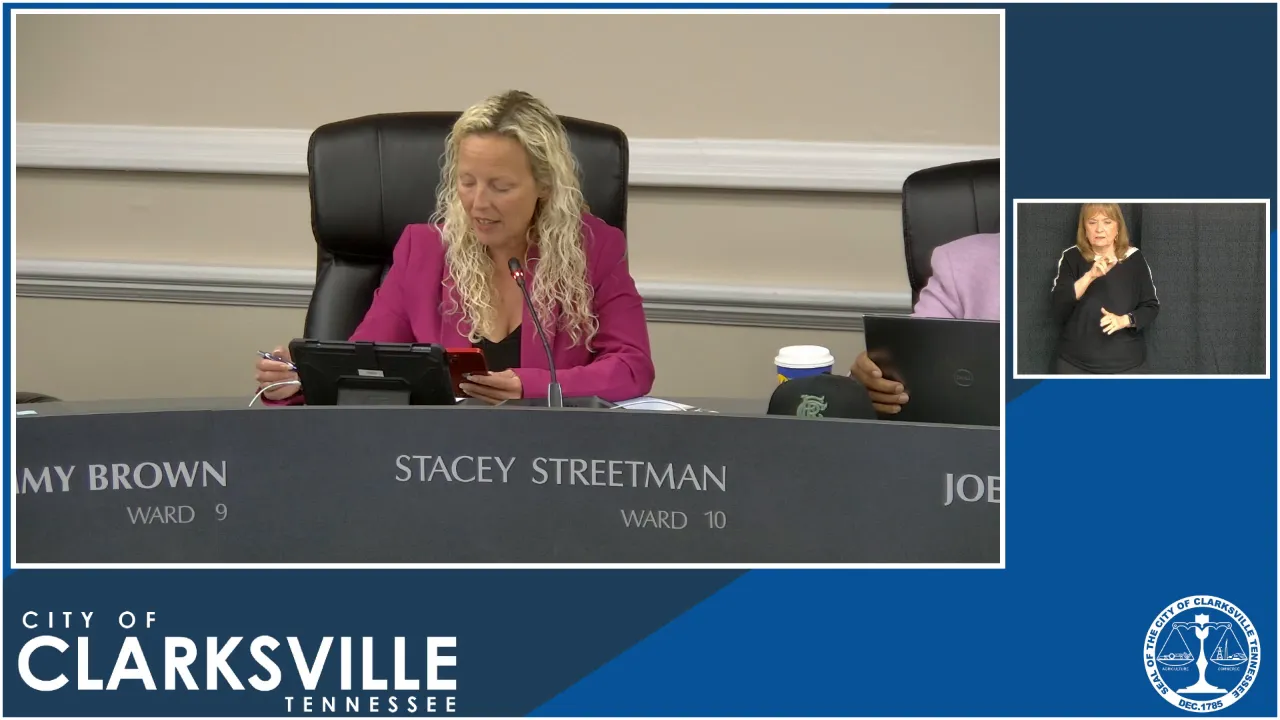
STREAMING COPY IN PREPARATION — RECORDING AVAILABLE FROM THE ORIGINAL SOURCE
Transcript — Verbatim
Speaker numbers apply only to this recording. Names come from transcript evidence. “Possibly” marks uncertain attribution.
Discussion Breakdown — Share of Meeting
Zoning And Land Use44%
Fiscal Sustainability14%
Procedural13%
Engineering And Infrastructure6%
Parking Management4%
Public Engagement4%
Community Engagement4%
Public Safety3%
Transportation Safety2%
Summary of Proceedings
Clarksville City Council Executive Session – April 30, 2026
The Clarksville City Council held an executive session on April 30, 2026, at 4:30 PM in the City Council Chambers. The meeting featured a presentation by Financial Advisor Lauren Lowe of PFM on proposed property tax cap legislation, followed by numerous zoning case discussions from the Regional Planning Commission, routine consent agenda items, and financial matters including eminent domain authorization and bond issuances. Public comment centered on the Ajax Turner Senior Center’s lease termination. Council members also reported on committee activities and legislative successes.
Consent Calendar
- Second reading approvals for two zone changes: Ordinance 65 (Batson-East Land Company, AG to C-5) and Ordinance 70 (City of Clarksville, M-2 to PUD Residential).
- Resolutions approving wine sale certificates for Wawa #7015 and RaceTrac #2550.
- Resolution 59 approving appointments to various boards.
- Adoption of minutes from April 2 and April 6, 2026. All items were approved without objection.
Public Comments & Testimony
- Kyle Shannon (representing Ajax Turner Senior Center) stated the Center is aware of the city's lease termination and hopes to maintain communication as it seeks a new location.
- Lois Grider and another speaker criticized Mayor Pitts’ decision to terminate the lease and move the Senior Center under Parks and Recreation, citing decades of community service, recent turnover in board and director positions, and lack of prior discussion. They urged renewal of the lease and funding.
Discussion Items
- Presentation: Property Tax Cap Legislation (Lauren Lowe, PFM) Lowe reviewed proposed legislation (now withdrawn) that would cap property tax revenue growth at 2% plus inflation (inflation undefined), requiring voter referendum (60% approval) to exceed. She discussed potential impacts on the city’s credit rating (Moody’s AA2, Fitch A+) and institutional framework scores. Analysis of the city’s FY2020-FY2026 revenue showed that under such a cap, with assumed 4% organic growth and 2% cap, the city would have faced revenue shortfalls of $1.5M (FY2026) and $6.4M (FY2025) unless voters approved. She noted the legislation is not currently in effect but may return.
- Planning Commission Zoning Cases (First Reading)
- A. Ordinance 51-2025-26 (Z-57-2025): 0.55 acres at 1182 Rossview Rd from R-1 to C-1 (Neighborhood Commercial). RPC recommended approval. Council questioned residential allowance (none allowed, per Mr. Tyndall).
- B. Ordinance 58-2025-26 (Z-2-2026): 20.16 acres on Seven Mile Ferry Rd from R-1 to R-3 (Three-Family Residential). RPC recommended disapproval due to steep slopes, floodplain, substandard road (16 ft wide), and poor traffic level of service. Several council members expressed opposition citing traffic and infrastructure concerns.
- C. Ordinance 72-2025-26 (Z-12-2026): 1.45 acres at Trenton Rd & Hayes St from R-1 to O-1 (Office). RPC recommended disapproval due to documented flooding/drainage issues. Discussion centered on potential future increased impervious cover and lack of resolution for drainage.
- D. Ordinance 73-2025-26 (Z-13-2026): 0.35 acres on Center Rd from RM-1 to R-4 (Multiple Family). RPC recommended approval for replacing aging housing stock. No significant council discussion.
- E. Ordinance 74-2025-26 (Z-14-2026): 0.14 acres on Marion St from R-3 to R-6 (Single Family). RPC recommended approval to allow two small single-family houses. Councilman Smith opposed, citing incompatibility with area and parking issues; Councilman Shakeenab noted parking problems from nearby Austin Peay students.
- F. Ordinance 75-2025-26 (Z-15-2026): 1.08 acres on Fantasy Ln from R-1 to R-1A (Single Family). RPC recommended approval as an extension of adjacent R-1A. Minor discussion.
- Finance Committee
Chairman Streetman presented:
- Ordinance 67: Authorizing eminent domain for utility easements for Hampton Station Road and Madison Street gas main projects.
- Ordinance 68: Conveying city property (behind old Coca-Cola building) to Clarksville Montgomery County Museum for artifact storage.
- Resolution 55: Interlocal agreement with Montgomery County for utility relocation at Rossview Rd & Rollow Ln.
- Resolution 56: MOU with Clarksville Arts & Heritage Development Council to install an IRIS sculpture near the Iris Garden at the L&N train station.
- Resolutions 60 & 61: Authorizing up to $42.5 million in general obligation bonds and bond anticipation notes for flexible financing over 2-6 years, protecting credit rating.
- New Business – Resolution 57-2025-26 Councilman Chandler sponsored a resolution requesting the Regional Planning Commission study Title 11, Chapter 11, Section 11.11 (Amendments Affecting the Same Parcel of Land) and return an ordinance for consideration. He argued that once the council denies a rezoning, it should not be easily resurrected without strict limits, citing potential for misuse. The resolution was discussed but no vote was taken.
- Committee Reports
- Legislative Agenda: Chairman Streetman reported two legislative wins: HB 1667/SB 1668 allowing tiered fines for repeated ordinance violations, and HB 2328 enabling a land bank for Clarksville (sponsored by Rep. Lankford).
- Parks & Recreation: Chairman Zacharias announced upcoming events (Greenway 8K May 2, Downtown Market opening May 9, March to the Past, 50+ Games May 11-15).
- Public Safety & Transportation: Chairmen Lovato and Smith deferred full reports to next week.
Key Outcomes
- No formal votes were taken on first-reading ordinances or resolutions; these will return for second reading or subsequent action.
- Council members expressed general support for the consent agenda and finance items, which were approved collectively.
- The public comment period highlighted strong community sentiment regarding the Ajax Turner Senior Center; no immediate council action was taken.
- Councilman Chandler’s resolution (57) was referred for study, with no final decision.
- Mayor Pitts acknowledged the discussions and adjourned the meeting.
Meeting Transcript
Good afternoon, everyone, and welcome to the April 30th, 2026 executive session of the Clarksville City Council. Before we get into our planning commission report, uh Kristen Wilcox, our chief financial officer will introduce our guest who will make a presentation that is very timely and very important. So Ms. Wilcox, you're recognized. Thank you, Mayor. Tonight we have our financial advisor from PFM. Her name is Lauren Lowe. She's gonna be giving you an update on uh the property tax cap legislation that has been coming up for the past few years. It did fail in this session, but we expect it to come again. So Lauren's just gonna give you an update on that. Thank you. Thank you. As we used to say in the legislature, nothing dies in Nashville. It just kind of sleeps for a year. That's right. Um, good afternoon. As Kristen said, I'm Lauren Lowe with PFM Financial Advisors. We serve as independent advisor to the city. Um I believe you all have the presentations visible. I will try to keep clicking through as well as turning my own pages as we go through the materials. So um uh as Kristen mentioned, we have been tracking the legislation as it relates to sort of the practical implication of this legislation. And so when it did fail, it we start already teed this up to talk about it, so we just kept it on the agenda. So moving forward, and some of you may be aware of this, so I'll try to keep it a pretty quick clip, but still be informative. So, from our records, this concept of a property tax cap in Tennessee was first introduced in late 2023 for the 24th legislative session. Obviously, it has not been in place into effect, but since then each year we've sort of seen a various versions of that bill come and before the legislature. Most recently with the 2026 session, which is now adjourned. Um, so I'm gonna talk about the legislation that was proposed during this last session. It has been removed by its sponsor. Um while we don't know if it's going to come back. I just felt like the reoccurrence of it felt like it was timely to revisit. Our information here talks about two kind of key elements in thinking about a property tax cap in Tennessee is the potential for it impacting a local government's credit rating, as well as just the practical implications of what it would mean. Obviously, we don't want it looks like now, but we can only look back and see what was being proposed. All right, there we go. All right, so this is what was the bill that was being proposed. It has now been removed. It capped the property tax revenue growth at 2% over the previous fiscal years plus inflation. I will note that there was no definition of how inflation would be measured, when it would be measured, and by how, and we recognize that that would be timely and part of the concept. So I don't have any directions. We're gonna actually exclude it from the conversation without further direction from a potential bill. The cap would have applied to total property tax receipts, not your assessed values or the tax base of the community.
SUMMARIZED BY OPENPUBLICA AI
TRANSCRIPT VIA PUBLIC VIDEO
openpublica.com
openpublica.com