OPENPUBLICA · PUBLIC MEETING RECORD
Record of Proceedings
2026-10-27 Cook County Board Committee Meeting: Assessor's Office 2027 Budget and Property Tax Reform Presentation
Board of Commissioners — Tuesday, October 27, 2026
BodyCook County, Illinois
SessionBoard of Commissioners
DateTuesday, October 27, 2026
StatusNEW · FILED
Video Record
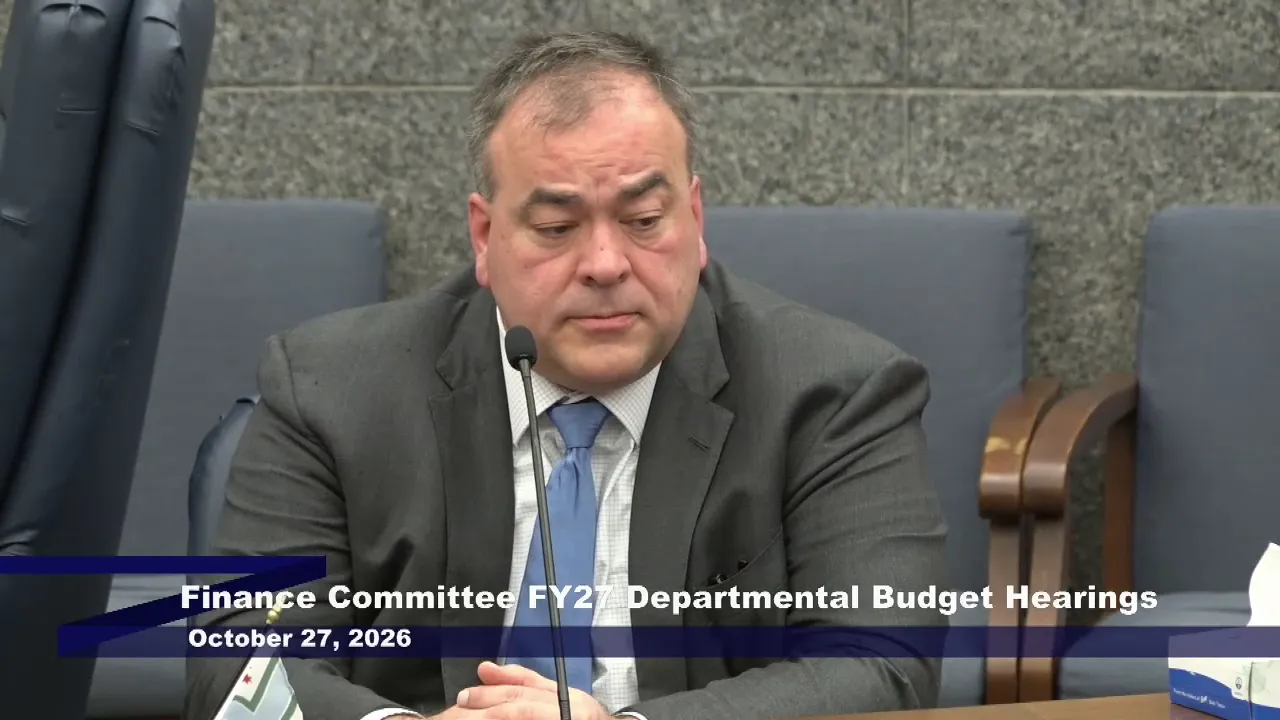
STREAMING COPY IN PREPARATION — RECORDING AVAILABLE FROM THE ORIGINAL SOURCE
Transcript — Verbatim
Speaker numbers apply only to this recording.
Discussion Breakdown — Share of Meeting
Property Management68%
Technology and Innovation10%
Tax Policy8%
Community Engagement4%
Fiscal Sustainability3%
Housing2%
Public Engagement2%
Budget Equity Analysis1%
Economic Development1%
Summary of Proceedings
Cook County Board Committee Meeting: Assessor's Office 2027 Budget and Property Tax Reform Presentation
Meeting Overview
On October 27, 2026, the Cook County Board Committee heard a presentation from Assessor Fritz Kagey and Chief of Staff Scott Smith on the office's 2027 budget and ongoing property tax reform efforts, including closing the commercial valuation gap and improving taxpayer services.
Discussion Items
- Commercial Valuation Gap: Assessor Kagey reported that his office took three key steps: sending data packets to the Board of Review for commercial appeals, defending assessments at Board of Review hearings, and agreeing on a shared methodology for calculating tax rates and capitalization rates. These steps have reduced the shift of tax burden to homeowners.
- Impact Examples: In Elk Grove Township, the median residential tax bill increased only 7% in 2025 (down from 24% in 2022), and homeowners' share of the property tax base remained at 41% in 2025 rather than jumping as it did in 2022. In the North Suburbs overall, the median residential bill increase dropped from 16% in 2022 to 7% in 2025.
- Outreach and Exemptions: The office held 226 outreach events (87 in Spanish), issued over 1 million homeowner exemptions, 380,000 senior exemptions, more than 100,000 senior freeze exemptions, and 15,000 exemptions for veterans with disabilities. The Affordable Housing Special Assessment Program preserved more than 16,500 affordable housing units across 1,600 projects.
- 2027 Budget: The proposed budget increases 11% overall, but the general fund allocation only rises 3%. Full-time staff remains flat, and 20 FTEs were shifted from general fund to special purpose funds. The office projects fewer than 10 vacancies by year-end. Key costs include postage, graphics, and advertising for state-mandated newspaper publication of assessment notices.
- Questions and Discussion:
- Commissioner Lowry asked about commercial vacancy downtown. Kagey noted office vacancy is high (pushing into the high 20s, with about 50 million sq ft vacant downtown), but assessments have been accurate per IDOR sales ratio studies. Vacancy shifts burden to remaining tenants.
- Commissioner Britton praised the tax methodology agreement with the Board of Review and discussed the need for PTAB reform, annual reassessments, and automatic renewal of the senior freeze. Kagey supported these, highlighting that 40% of workshop attendees in Chicago were entitled to exemptions but hadn't received them.
- Commissioner Morrison asked about analyst positions moved to special purpose funds. Scott Smith confirmed no job losses; positions were shifted to ease general fund burden.
- Commissioner Trevor asked about feasibility of annual reassessments. Kagey said it requires better commercial data, reduced appeals, and improved taxpayer services, possibly more outreach staff.
- Commissioner Aguilar asked about senior freeze vs. appeals. Kagey explained automatic renewal would dramatically reduce senior appeals and certificates of error.
- Commissioner Vasquez asked about certificates of error backlog. Kagey and Smith reported a significant backlog (about half a year), but the office is working overtime and expects to complete assessment appeals for the South Suburbs by December 2026. Tyler Technologies implementation caused a six-month pause, but processing has resumed.
Key Outcomes
- The committee received the Assessor's 2027 budget presentation and will consider it further.
- Several commissioners expressed support for pursuing state legislation on automatic renewal of the senior freeze (Senate Bill sponsored by Senator Cervantes) and on commercial data modernization.
- The Assessor emphasized that ongoing collaboration with the Board of Review and continued oversight (e.g., annual sales ratio studies) are critical to reducing homeowners' tax burden.
- No formal votes were taken during this committee hearing.
Meeting Transcript
The Office of the Cook County Assessor, the Anborough Fritz Keggy. Fritz, welcome. Good afternoon, Chairman Daly. Good afternoon, Chairman Daly and Commissioners. And before I begin discussion of our 2027 budget, I want to update you on my administration's strategic focus for the past few years. And that is closing the gap in valuations of commercial property in our property tax system. This gap has historically been the biggest inequity in the system. We shifted our focus to commercial assessments after our successful work to make residential assessments fairer. As you can see from the following slide, between 2018 and 2024, our assessment saved the owners of more affordable homes nearly $2 billion in property taxes, according to a major study by the University of Chicago. But we still saw homeowners' tax bills spiking in part because of the commercial valuations gap between us and the board review. In 2024, my office unveiled a strategic plan to guide the operations of the assessor's office. The main priority of that plan was to narrow the gap between the assessor's office and board review final assessments. Significant reductions in the value of large commercial properties at the board review level had led to increases in the share of tax burden carried by homeowners. These reductions were due in part to different valuation practices in both of our offices. At the end of 2024, the county property tax reform group released an analysis of the commercial valuation practices of each office and made a series of recommendations. And the team of researchers behind this report, along with staff from the Civic Consulting Alliance, created a framework for real change. Two years later, the work of the members of the group have led to tangible benefits for the owners for homeowners' tax bills. And let's talk about the how and the why. The assessor's office has taken three key steps in closing the commercial valuation gap. We send data packets to the board review for each commercial property that appeals to them. We defend the assessment decisions of some of the largest commercial properties at board review appeals hearings. And we've come to a shared agreement on the calculation of tax rates and capitalization rates. All of this work has led to a reduced shift in tax burden for homeowners. Without getting further into the weeds, the data packets we send to the board review are effective for a couple of reasons. First, uh they contain every valuation input that guides the assessment of commercial properties in Cook County. You can see this on the slide here, you know, what we're providing for a concrete example of that. Second, uh, these packets contain our initial assessments along with any changes we make on appeal. So that gives them further information when they have their own decisions to make. This part of assessment work is a cooperative act and improves the Cook County property tax system. It is one of the strongest recommendations in the county's commercial valuation report. And as mentioned, is an industry best practice. It also has the most potential for reducing the property tax burden for homeowners. It's the best dollar we spend in our office on behalf of homeowners. The evidence we provide gives support to the board review's decisions, which are more then more defensible at the state's property tax appeals board, where large reductions can lead to costly refunds paid out by schools and taxing bodies, and where the board review defends the assessments of Cook County. So what does all this mean for homeowners who've taken on more of the property tax burden in recent years? Let's look at the numbers in Elk Grove, where the three data centers are located. I know this might be a particular interest to Kevin and Sean Morrison, our two commissioners who represent the area. In the 2022 reassessment of Elk Grove Township, homeowners share of the property tax burden jolted upwards by four percentage points from 38% to 42%. That's what happened in 2022. By contrast, in the 2025 reassessment of Elk Grove Township, when we defended our data center assessments, homeowners maintained their previous year's share of the property tax base at 41%, even after appeals concluded at the board review. So what difference does this make for their bills? It means we slowed the increases in homeowners' tax bills. In 2022, the median residential tax bill in Elk Grove Village shot up by 24%. In 2025, the median residential bill increased by only 7%. In the North Surbs overall, we saw similar results. In 2022, the median homeowners bill went up 16%, but in 2025, it only went up 7%.
SUMMARIZED BY OPENPUBLICA AI
TRANSCRIPT VIA PUBLIC VIDEO
openpublica.com
openpublica.com