Browse by city
Date range
Search help

Search titles, summaries, topics and stored transcripts together. Keywords may match separately; put the whole query in double quotes for a phrase. Matching follows word analysis, so punctuation is not exact. Both dates are included. Documents are not searched.

SHOWING 1–10 ENTRIES
01
NEWNOV 2, 2026 · COOK COUNTY, ILLINOIS · BOARD OF COMMISSIONERS
Cook County Independent Revenue Forecasting Commission Meeting - November 2, 2026

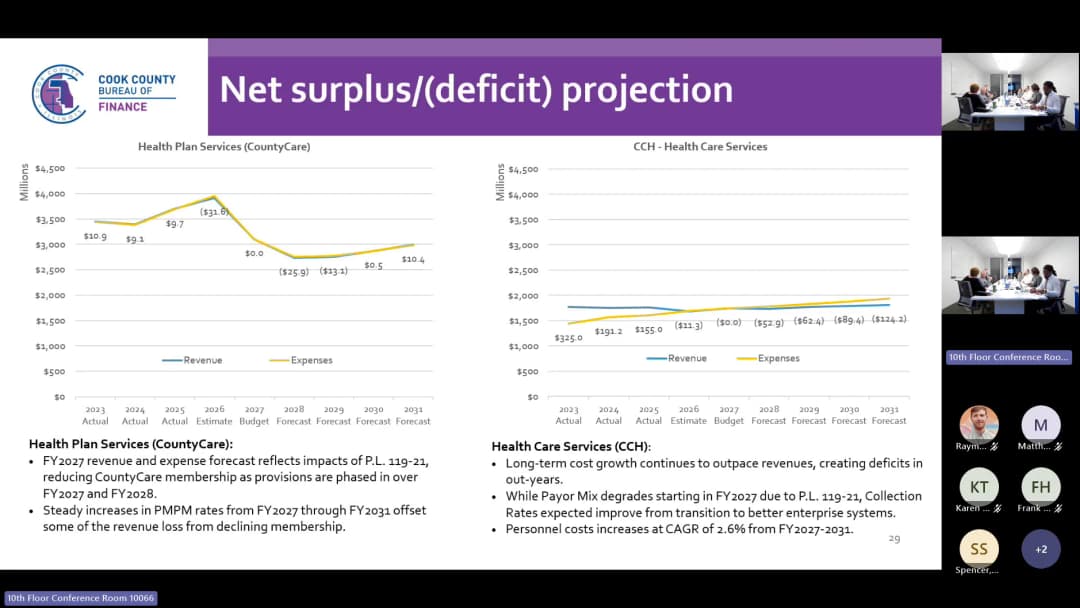
On November 2, 2026, the Cook County Independent Revenue Forecasting Commission (IRFC) reviewed the proposed $9.69 billion FY2027 executive budget and updated long-term financial forecasts. Commissioners discussed budget pressures from the road builders' litigation, federal Medicaid changes, and rising personnel costs, and examined one-time measures used to achieve a balanced FY2027 budget. Consent Calendar - Approval of Minutes: The minutes from the August 27, 2026 meeting were approved on a motion by Commissioner Merriman, seconded by Commissioner De Vila. - Approval of 2027 Meeting Schedule: The schedule for 2027 (January 28, April 29, June 29, July 29, August 31, October 26, all at 5:30 PM) was approved on a motion by Commissioner Baylain, seconded by Commissioner Merriman. Discussion Items - Executive Budget Recommendation: The FY2027 executive budget totals $9.69 billion. Health care programs account for approximately $4.7 billion (about 50% of the budget), while public safety and health care together comprise just under 70%. The budget reflects a 1% decrease in full-time equivalents (FTEs) compared to the FY2026 adopted budget. - Major Budget Pressures: Presenters identified three key pressures: (1) federal changes to Medicaid coverage (referred to as OBA) expected to increase uncompensated care; (2) the road builders' litigation, which restricts the county from appropriating about $258 million in transportation-related tax revenues; (3) growing payroll, pension, and benefit liabilities that outpace revenue growth. - Road Builders' Litigation Details: The $258 million figure represents the annualized estimated revenues from motor fuel tax (excluding sales tax on gasoline), parking lot, and garage operations collected since January 2026. Commissioners noted that these revenues had been partially sequestered in prior years, but the current restriction affects all such revenues. The county is exploring an appeal; no clarity exists on permissible uses of the funds. The potential for retroactive liability remains uncertain. - One-Time Balancing Measures for FY2027: To offset the revenue constraints, the budget employs several one-time strategies: drawing $53.9 million from debt service reserves (from $228.7 million in reserve accounts); redirecting $12.4 million in Build America Bond subsidies; recognizing ARPA interest income; allocating $61.2 million from the ARPA sustainability reserve to general fund operations (in addition to $52.6 million for originally planned ARPA programs); and using $18 million from the pension stabilization fund (leaving a balance of $180 million). - General Fund Revenue Update: FY2027 general fund revenue is forecast at $2.749 billion, a $260 million (10.5%) increase from the June forecast. Major changes include a $167.1 million increase in other financing sources (primarily one-time measures), a $35 million increase in county sales tax projections (2.3% above prior forecast), and a net $20 million increase in property taxes after accounting for a $40 million allocation to the health fund. - General Fund Expenditures: Personnel expenses comprise 66% of general fund spending. Public safety and court system agencies (sheriff, chief judge, state's attorney, public defender) account for about 60% of the total. Personnel costs increased 5.6% ($96 million) due to salary progressions, benefit increases, and cost-of-living adjustments (COLAs). - Health Fund Revenue and Membership: County care per-member per-month (PMPM) revenue is projected to decline by about 1% to $793 in FY2027 (from $800 in FY2026), due in part to the loss of the higher-reimbursement MLTSS population. Overall health fund revenue is expected to drop by nearly $400 million, driven by membership reductions from OBA. The county is allocating an additional $40 million from the property tax levy to CCH in FY2027 ($207 million total). - County Care Membership Projections: Membership is projected to decline through FY2028, particularly among the ACA adult population, due to more frequent redeterminations (every six months) and work requirements. Membership is expected to stabilize from FY2029 onward. The state's decision to allow self-attestation for work requirements in FY2027 was noted as a potential mitigating factor. - Long-Term General Fund Outlook: The baseline forecast shows deficits beginning in FY2028 if no structural changes are made. The unassigned ending fund balance is projected to fall below the floor in FY2028 and become negative by FY2029. Commissioners requested a separate view of sustainable revenues excluding one-time sources. - Health Enterprise Fund Projections: The health fund is projected to have a small deficit in FY2026 ($40–43 million), a balanced budget in FY2027, but growing deficits from FY2028 onward. Health care services expenses are growing at 2.7% annually while revenues grow at about 1%. The payer mix shift toward self-pay and uncertainty around federal DSH (disproportionate share hospital) cuts are major drivers. - Collection Rates and Payer Mix: Medicaid collection rates have been suppressed by state clawbacks in 2023–2024, with rates expected to stabilize near 25%. Private payer rates are declining due to a rising share of self-pay patients. Collection rate improvements from the new Epic system are forecast conservatively, with potential net revenue gains of 2–10% noted by CCH's CFO. - Epic System Implementation: The Epic electronic health record system is expected to cost less than the current dual system (Cerner/Divnision), generating estimated annual savings of $35 million. Capital costs for Epic are handled through the county's separate capital budget process; only operating savings are reflected in the forecasts. - DSH Revenue Risk: CCH receives about three-quarters of the state's DSH allocation, estimated at $228 million for FY2027. The baseline and optimistic scenarios assume a scheduled federal DSH cut is delayed; the conservative scenario projects a $120 million reduction in FY2028. - PPRT (Personal Property Replacement Tax) Discussion: Commissioners questioned the projected decline in PPRT revenues in out years, given recent strong corporate income tax receipts. Staff acknowledged timing issues with state true-up data and agreed to review the assumptions. Key Outcomes - Minutes and Meeting Schedule Approved: Both items passed unanimously. - No Public Comment: No speakers registered. - Adjournment: The meeting adjourned; the next meeting is scheduled for January 28, 2027 at 5:30 PM.
BUDGET EQUITY ANALYSIS 34% · MEDICAID/INSURANCE 16% · FISCAL SUSTAINABILITY 13% · ECONOMIC DEVELOPMENT 10%
02
NEWOCT 30, 2026 · COOK COUNTY, ILLINOIS · BOARD OF COMMISSIONERS
Cook County Circuit Court Clerk FY27 Budget Hearing - October 30, 2026

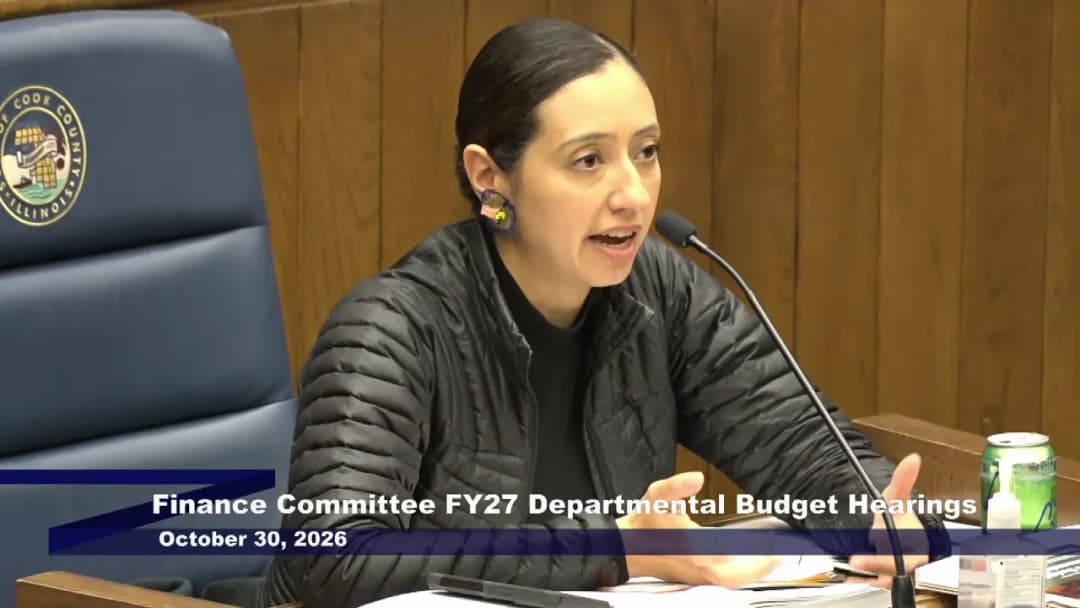
On October 30, 2026, the Cook County Board of Commissioners held a budget hearing for the Clerk of the Circuit Court's Office. Clerk Sparopolis presented the fiscal year 2027 budget request and highlighted modernization efforts, including digital data exchange, an upgraded self-represented litigant center (serving approximately 10,000 people since 2026), a second annual Second Chance Summit, and the expansion of online services. The hearing focused on the office's financial needs, staffing challenges, and statutory obligations. Discussion Items - Budget Overview: The Clerk requested a corporate fund budget of $129.7 million for FY27, a $7.6 million (6.2%) increase over the FY26 approved $122 million. This increase absorbs approximately $11.1 million in cost increases, including $4 million in salary step and COLA increases ($4 million for step increases and cost-of-living adjustments), increased employee benefits, and the loss of a $3.18 million transportation-related home rule tax credit. Non-personnel expenditure increases were only about $874,000. Total staffing decreases from 1,405 to 1,387 full-time positions (a reduction of 18 FTEs). Special purpose fund requests included: Court Administrative Fund ($1.14 million, +73% mainly for Tyler contract, step increases, COLA, and indirect costs), Electronic Citation Fund ($1.13 million, slight decrease), Court Document Storage Fund ($10 million, +$1.6 million due to Tyler contract, step increases, COLA, and $87,000 in increased indirect costs), and another unnamed fund (+$2.38 million attributable to Tyler contract, step increases, COLA, and $1.5 million in increased indirect costs). Salary and wages increase by $6.7 million (1.8%) despite workforce reduction. Contractual services decrease by $177,000 (6.2%), supplies and materials by $205,000 (35.7%), operation and maintenance increase by $678,000 (8.6%), and rental and leasing decrease by $233,000 (62.9%). The Clerk emphasized the office is absorbing increased costs while reducing staff and discretionary spending. - Data Requests and Staffing Needs: The Clerk noted over 700 data requests last year, requiring additional MIS staff (requested 3 positions at mid-year). The office is overextended with court clerks and needs at least 4 more positions for courtroom expansion (new domestic violence and stalking no-contact courtrooms). Additionally, a Clean Slate Act mandate requires expunging cases dating back to 1970, requiring staff to retrieve paper files from a warehouse; the Clerk estimated needing 10 additional staff for this effort. Commissioners expressed support for additional funding to upgrade the data system to better run reports and manage tech. - Second Chance Summit: Commissioner Degden asked for data on the most recent summit. David Moses reported 784 cases were handled, close to 200 participants attended, 110 pre-registered with necessary documents (petitions prepared by legal team), 35 showed with rap sheets (received direction), and about 60 walk-ins received packets with next steps. The Commissioner requested packets be distributed to all commissioners. The Clerk agreed to develop a one-pager. - EMET System: Commissioner asked about the new EMET system integration with the clerk's office. Ramesh (MIS CIO) stated coordination with the sheriff's office and IT is ongoing, with no open items on the clerk's side. - Inspector General: Commissioner noted the budget includes an Inspector General line for the clerk's office (Kate McKay present). The office has its own IG who issues public reports on its website. - Rental Equipment Decrease: Commissioner asked about the large drop in rental of office/data processing equipment. CFO Honey Hill explained it is due to a capital refresh program; the office received $2 million previously and still has $1 million leftover, so additional refreshing is not needed. - Orders of Protection Warrants: Commissioner Britton asked about the process for electronic service of warrants. David Moses explained the judge orders the warrant, the clerk prepares, scans, and emails it to the arresting agency (Chicago police, suburban districts, etc.). Key Outcomes - No formal votes were taken during the hearing. The hearing served as a review of the budget request and an opportunity for commissioners to ask questions. - The board announced that final approval and adoption of the FY27 budget is scheduled for November 19, 2026. The budget amendment system is open; all proposed amendments must be submitted by 12:00 PM on November 5, 2026, and must be budget-neutral. Only germane amendments will be considered on November 19. Submission deadline will be strictly enforced.

DATA SHARING 21% · PUBLIC ADMINISTRATION 19% · PERSONNEL MATTERS 13% · COURT REPORTING 11%
03
NEWOCT 30, 2026 · COOK COUNTY, ILLINOIS · BOARD OF COMMISSIONERS
Cook County Board Budget Hearing on Veterans Assistance Commission FY27 Request (October 30, 2026)

On October 30, 2026, the Cook County Board held a budget hearing where the Veterans Assistance Commission (VAC) presented its Fiscal Year 2027 budget request, detailing its current operational impact and urgent staffing needs against a backdrop of severe countywide fiscal constraints. The central debate concerned whether to honor a previously negotiated compromise of $4.5 million or accept a county recommendation of $4.0 million. Discussion Items - Superintendent Elizabeth Soto and Deputy Superintendent Grant Jacobson presented the budget progression: an original request of $5.6 million was reduced to a compromise of $4.5 million with the county budget team, which is now under threat of a further reduction to $4.0 million. Soto stated that this additional cut would harm existing capacity, not just proposed growth. - Outreach Manager Connor Interest reported that a team of two completed 304 outreach events in the first three quarters (on track for 400), providing direct assistance to 1,173 veterans and interacting with 4,661. He explained the team can currently only reach an estimated 25% of Cook County Commissioner districts. - VSO Manager Derek Giffin stated that two veteran service officers submitted 3,601 total claim actions, securing $1.77 million in retroactive benefits and $16.42 million in recurring annual benefits for Cook County veterans. - Deputy Superintendent Jacobson highlighted that the VAC's entire $4.5 million budget represents roughly 46 cents for every $1,000 of the county's $9.69 billion budget. He warned that without the agreed funding, the commission risks staff burnout, turnover, and reduced service quality for the county's 141,000 veterans. - Commissioner Open delivered an extensive and impassioned plea, arguing that veterans are being "hit twice" by federal cuts and local budget constraints. He stated the VAC is a state mandate and the only county agency funded by tax dollars exclusively for veterans. He urged the board to honor the $4.5 million compromise, asserting that the funding difference is minimal relative to the county budget. - Commissioner Kevin Morse noted that the budget still represents a base increase from $3.24 million to $4.0 million and inquired about current staffing. Soto reported that the VAC is filling its remaining vacancies and expects to be near full capacity by year's end. - Commissioner Vasquez praised the outreach team, specifically highlighting Connor Interest and Julian for their work in the 8th district and expressed strong support for the VAC's mission. - Commissioner Degnan thanked the VAC for its work, asked about the Rolling Meadows office timeline, and acknowledged the tight budget situation. Soto responded that the office is expected to be fully operational by the end of the calendar year. - Commissioner Dickner clarified the board's limited role in drafting the budget, noting it originates from the President's office, but committed to advocating for the VAC. - Commissioner Lowry thanked the VAC for its sacrifices which helped the county close a $516 million budget gap without directly burdening residents. - Commissioner Trevor explained the broader context of county-wide hiring freezes and FTE reductions, asking for patience from the VAC as the board develops a long-term fiscal strategy. Key Outcomes - No formal vote was taken during the hearing. The VAC's FY27 budget remains under deliberation by the Cook County Board. - The VAC formally requested the board honor the $4.5 million compromise figure against the county's $4.0 million recommendation. - Commissioners unanimously acknowledged the VAC's strong performance and critical mission, committing to advocating for its funding during the remaining budget process and noting the potential for internal fund transfers after passage.

VETERANS AFFAIRS 72% · BUDGET EQUITY ANALYSIS 26% · HOMELESSNESS 2%
04
NEWOCT 30, 2026 · COOK COUNTY, ILLINOIS · BOARD OF COMMISSIONERS
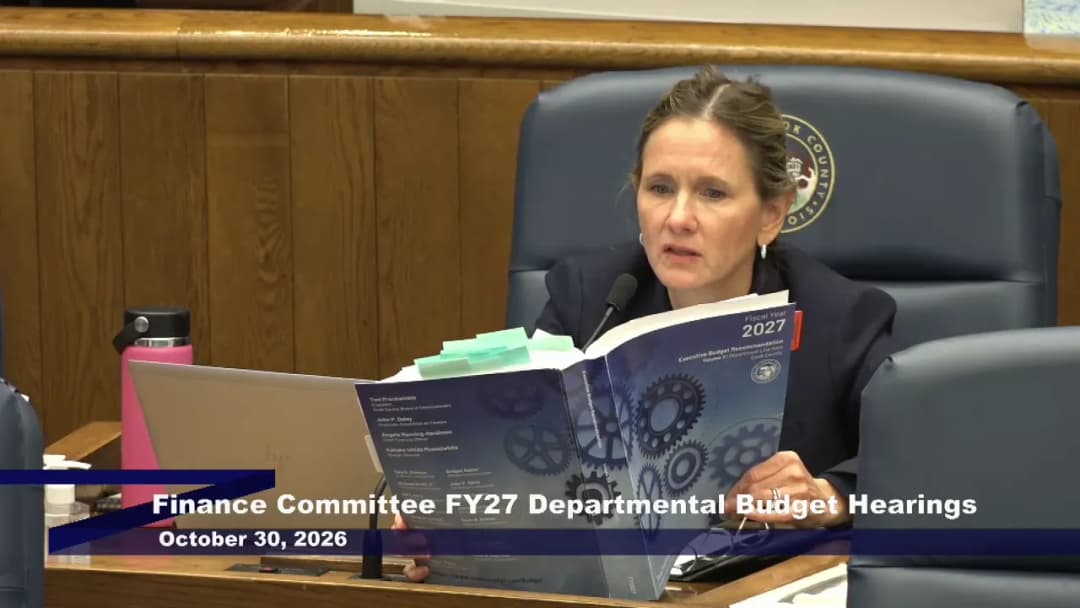
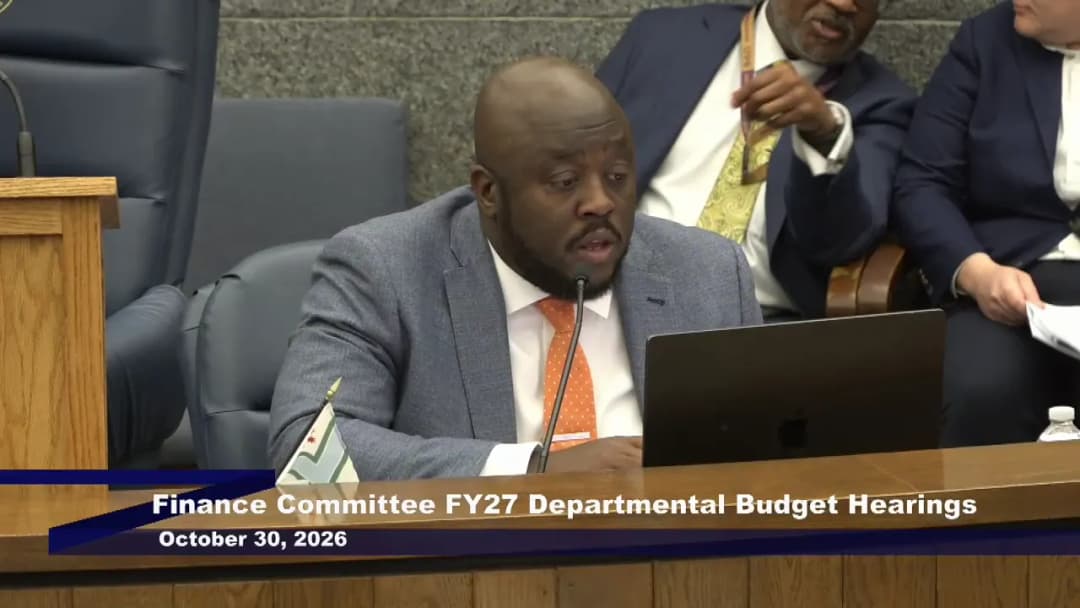
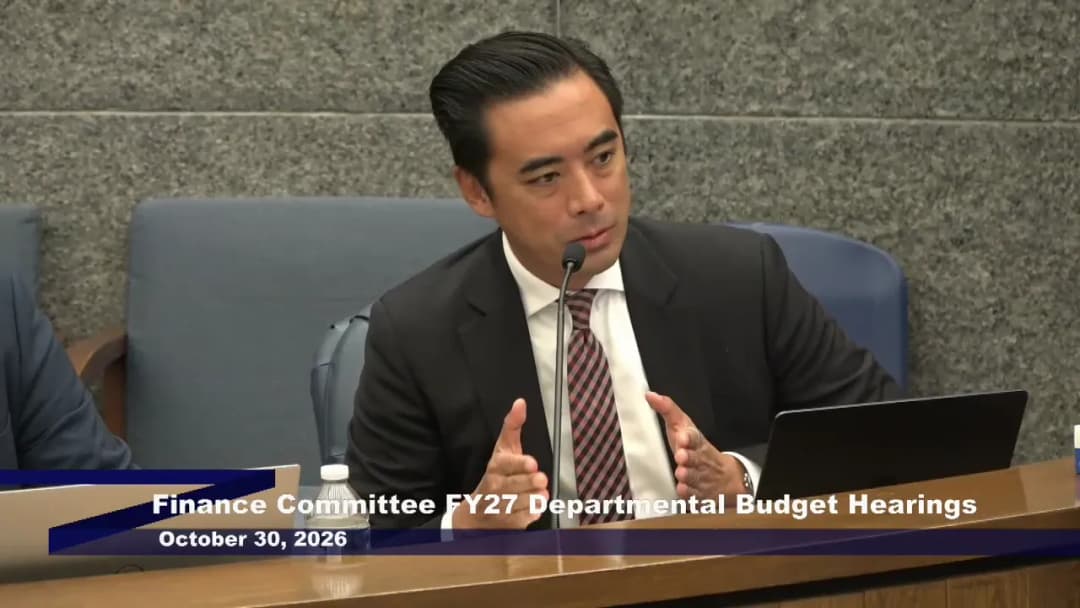
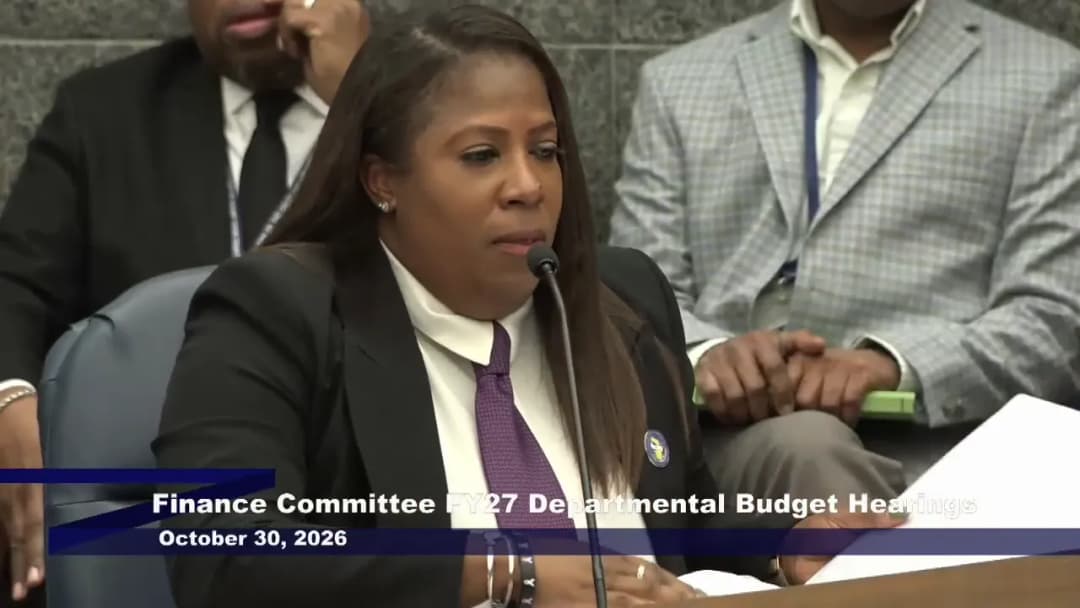
Finance Committee Meeting: Inspector General Budget Presentation – October 30, 2026

On October 30, 2026, the Cook County Finance Committee heard a presentation from Inspector General Tourell Pakistan on the Office of the Independent Inspector General's proposed budget for fiscal year 2027. The presentation detailed the office's accomplishments, ongoing investigations, and resource needs. Discussion Items - Budget Presentation: Inspector General requested $4,159,541 for FY2027, an increase of $621,835 from the FY2026 budget of $3,537,706, primarily for salaries and benefits. The office also requested five new positions (two for SHACMAN/sexual harassment and discrimination compliance, three for general investigations), at an additional cost of $390,000. - Accomplishments: The office completed investigations into the county tax system, identifying fraudulent exemptions and improper evaluations. A review of the property tax system contract found widespread failures causing delays. A follow-up report indicated potential cost savings of up to $500 million from sustained reduction in claim denials. - Investigations of County Officials: The IG reported four investigations involving county officials, finding issues from inconsistent administrative practices to violations of ethics rules. One board of review official refused to cooperate and made false statements; one elected official engaged in prohibited political activity; a high-ranking official under the president attempted to intimidate staff and refused to cooperate. - Sheriff's Office Review: The IG reviewed complaints referred to the Sheriff's Office Office of Professional Review and identified significant deficiencies in handling misconduct investigations. The Sheriff's Office disputed the IG's authority and rejected all recommendations, prompting the IG to request a public hearing. - Public Safety Oversight: A dedicated public safety oversight unit has been established within the IG office to strengthen community confidence in law enforcement. Key Outcomes - Commissioner Degnan expressed support for the IG's work and transparency, noting the office's agreement to undergo peer review by the National Association of OIGs. - Commissioner Degnan inquired about the professional services line item ($7,500 for relocation and AIG auditing fees) and the case management system subscription (increase from $43,000 to $63,000). - Commissioner Degnan asked about investigation volume: 57 investigations completed in prior years (2024–2025), compared to 90 already completed in the current year (2026), with the same staffing level of 25 FTEs. - Commissioner Degnan acknowledged budget constraints but stated that if the requested positions cannot be added in FY2027, it should be a high priority for the next year. - The Inspector General responded that without additional resources, the office faces reputational and litigation risks, potentially costing more than the $390,000 requested. - The committee chair concluded that the budget request may not be fully addressed in FY2027, but future budgets could address concerns, and copies of reports would be made available to board members. - No formal vote was taken; the presentation served as informational input for budget deliberations.

MISCELLANEOUS 100%
05
NEWOCT 30, 2026 · COOK COUNTY, ILLINOIS · BOARD OF COMMISSIONERS
Cook County Board FY27 Public Defender Budget Hearing – October 30, 2026

On October 30, 2026, the Cook County Board heard a budget presentation from Cook County Public Defender Sharon Mitchell Jr. on the office's FY27 budget. Mitchell described the budget as a pause in progress caused by county fiscal pressures, while emphasizing persistent understaffing, growing caseloads, and the need for a long-term plan to meet national workload standards. No formal votes were recorded in the transcript. Budget Presentation - Mitchell, presenting her sixth budget, said the office represents the vast majority of people in the Cook County criminal legal system, plus clients in family defense and immigration matters. - She said the outcome of a case should depend on the facts, not on whether a defendant was assigned a public defender with enough time and resources. - Mitchell said the office contracted with the RAND Corporation for an office-wide workload study. Preliminary findings applying national standards show attorney shortages on the adult criminal side in the triple digits; a time study and Delphi study will help build local standards. - She compared the office to the State's Attorney's Office: in 2024, the public defender's office had 610 fewer full-time positions than the state's attorney's office; over the last three budget cycles that gap grew by more than 80 additional positions. New county investments in the state's attorney's office have been more than twice the investments in public defense. - Mitchell said the public defender's office operates with roughly 550 full-time positions and about $109 million less in funding, excluding the state's attorney's civil practice. - She noted that prosecutors have investigative support from law enforcement agencies with combined annual spending of about $2 billion per year. - Mitchell said dismissals and not-guilty outcomes in felony cases fought by the office between 2023 and 2026 spared defendants approximately 25,761 years of incarceration. - She said Cook County has the largest funding and staffing gap between defense and prosecution among the seven largest county-run public defender's offices, citing Maricopa County, where the public defender's budget is roughly $30 million higher than the prosecutor's budget. - Mitchell said an average assistant public defender 3 carries a caseload 2.7 times higher than minimum national standards, requiring 5,590 hours of work per year compared with 2,080 standard working hours. - She reported that digital discovery grew from 267 terabytes between 2020 and 2023 to more than one petabyte in under two years, describing that as equal to 1,000 terabytes or about 18 million USB flash drives of data. - Mitchell said new prosecution policies increased defense workload: changes to retail theft policy have produced roughly 400 additional felony cases every year, and a slide showed 1,666 more felony retail theft cases in the first four quarters of the new administration compared with 2024. - She also cited changes in drug possession and sex work enforcement, more pretrial detention requests, increased weekend and holiday court staffing, and a growing jail population that has swallowed initial reductions after the Pretrial Fairness Act. - Mitchell said the FY27 budget is approximately $131 million, mostly staffing, with positions staying relatively flat. Two positions are being transferred to compliance to support human resources strategy changes, and several professional contracts were reduced. - She did not request a budget amendment this year but asked for a multi-year commitment to close the gap and for defense workload to be accounted for whenever prosecution policy creates more cases or hearings. Discussion Items - Commissioner Laura asked what the plan is to close the gap. Mitchell said the office is not asking for a budget amendment this year but wants a multi-year commitment and cited the RAND study as the basis for a specific plan. Commissioner Laura offered a standing monthly check-in; Mitchell accepted. - Commissioner Degan asked about the $74,542 difference between the department request and the president's recommendation. Mitchell said the initial request focused on attorney positions. Degan also questioned whether the forensic science division was losing four full-time employees; Mitchell said her understanding was that the forensic team was staying flat and offered to review the budget book. Degan emphasized constitutional balance between prosecution and defense resources and asked for more attention to immigration and forensic staffing. - Commissioner Degan asked about the new Collaborative Defense Unit. Mitchell explained it consolidates attorneys working in restorative justice, veterans, women's treatment, and other problem-solving courts into one division, partnered with ASME, to improve expertise and efficiency. - Commissioner Anaya asked for an immigration unit update. Mitchell said the unit has moved more work into federal courts because federal immigration courts are no longer a viable relief option for many clients. Staffing includes eight attorneys, one supervisor, three to possibly five paralegals, and one social worker. At mid-year, the unit had about 576 hotline calls and walk-ins, over 400 pro se advisals and intakes, about 248 removal cases, over 400 Padilla assessments, and 54 community presentations. - Mitchell said detained clients with Cook County ties are being held in other states, with cases in Chicago, Memphis, Detroit, Kansas City, El Paso, Minneapolis, and Indianapolis immigration courts. She acknowledged that some people are turned away because of capacity and agreed to provide data on unmet need. - Commissioner Anaya questioned why two public defender positions were transferred to BHR instead of being reclassified within the public defender's office. The budget director explained that the compliance work resides in county human resources and that the two-position reduction is a true FTE transfer. The budget director also clarified that the State's Attorney's Office FTE increase comes from grant-funded positions being shifted into the general fund after federal victim-services grants ended, not from new positions. - Commissioner Anaya asked about interpreter services. Mitchell said the office currently has one interpreter, is interviewing for three more, purchased about 200 handheld interpretation devices through a state grant, and maintains a language line and bilingual pay bonus. - On the Community Defense Center, Mitchell said seven grant-funded positions were impacted by federal cuts and the office is absorbing those positions into its corporate budget to keep the centers operational. - Commissioner Trevor praised Mitchell for making realistic, incremental requests and said this year's budget pauses that progress. He connected the budget situation to federal funding cuts such as Medicaid and their ripple effects on justice. - Commissioner Aguilar asked about differences in felony charging numbers between the public defender and state's attorney. Mitchell said her numbers come from the Cook County dashboard and show more felony retail theft cases under the new administration; she said the prosecutor decides charges, while judges and juries decide guilt, and higher charges affect defense time, attrition, and collateral consequences. - Commissioner Aguilar also asked about ICE presence; Mitchell confirmed increased immigration enforcement and ICE activity near courthouses, despite county policy and state law. She said ICE presence affects not only clients but also domestic violence victims, witnesses, and people trying to use the courts. - Commissioner Vasquez described ICE incidents near county courthouses, including four instances the previous day, detentions in Bridgeview and Maywood, and families separated after appearing for court summons related to retail theft. She argued the State's Attorney's Office should reallocate its existing historical staffing instead of seeking new funds for civil work, and she strongly supported additional investment in public defense. - Mitchell said crime rates do not necessarily correlate with defense workload because policy changes can create more work even with the same number of cases. She also pushed back on the idea that a lab would solve wrongful convictions, arguing wrongful convictions stem from people willing to lie or cheat for convictions, lack of defense resources, weakened police accountability, and perverse incentives if one office both prosecutes and controls forensic evidence. - Mitchell said incarceration costs about $143 per day, and she was reluctant to put a dollar value on someone's freedom. She noted that in many retail theft cases the property is recovered and the response can create greater community harm. - Commissioner Aguilar raised the impact of retail theft on small businesses and pharmacy access, citing a closed Walgreens in his district. He said he does not believe low-level thefts should lead to jail, but acknowledged there are no easy solutions. Public Comments & Testimony - Advocates from the Defenders for All Coalition were present in the room and were thanked by Mitchell and multiple commissioners. No separate oral public comment period is reflected in the transcript. Video Testimony from Public Defenders - The hearing included a video featuring line public defenders. One defender said they currently carry 178 cases in misdemeanor branch court while state's attorneys often appear two, three, or four deep, and that prosecutors have law enforcement agencies as investigators. - A defender said State's Attorney policy changes have removed courtroom prosecutors' autonomy and their ability to make offers, causing clients to return to court more often or stay in custody longer, and forcing cases to trial even when directed verdicts show the state had little or no case. - Another defender said the office is criminalizing homelessness, with unhoused people prosecuted for taking hygiene products or medical supplies and low-level retail thefts charged as felonies, along with low-level drug and marijuana possession cases. - A defender described a felony jury trial for about $32 worth of two Yankee candles and a client over 60 facing one to three years for $75 sneakers that were returned; the state's offer was two years in prison. - Another defender described a client held in custody for over a year on a case the courtroom prosecutor believed should be a misdemeanor; a misdemeanor offer came only the week before trial. - Defenders also said an arrest is enough to affect immigration proceedings, that public defenders need proper staffing to prevent burnout, and that the Constitution is under attack. Key Outcomes - No formal votes or budget amendments were recorded during the hearing. - Mitchell did not request an FY27 budget amendment; she requested a multi-year commitment to close staffing gaps and a plan informed by the RAND workload study. - Commissioner Laura and Mitchell agreed to a standing monthly working meeting to track progress. - Mitchell agreed to provide the board with data on immigration cases the office cannot take because of capacity. - The chair said the public defenders' video would be shared with all commissioners. - The transcript confirms two public defender positions are moving to BHR/compliance, and seven grant-funded Community Defense Center positions are being absorbed into the public defender's corporate budget. - The FY27 recommended position count is 861, compared with 863 adopted positions in FY26, reflecting the two-position transfer.

CRIMINAL JUSTICE 42% · BUDGET EQUITY ANALYSIS 11% · LEGAL ACCESS 10% · IMMIGRATION AND NATURALIZATION 10%
06
NEWOCT 30, 2026 · COOK COUNTY, ILLINOIS · BOARD OF COMMISSIONERS
Cook County Board FY2027 Budget Hearings: Treasurer and Public Defender, October 30, 2026

A Cook County Board committee held a FY2027 budget hearing on October 30, 2026, taking presentations from the Treasurer's Office and the Cook County Public Defender. No agenda or minutes were available, and the transcript does not provide a meeting time range; it ends mid-way through the Public Defender's presentation. No votes or final budget actions are recorded. Treasurer's Office FY2027 Budget - Treasurer's Office representative David presented a $20.1 million FY2027 budget, with 97% from commercial fees and about 61 employees at the start of the fiscal year; he said a 250-employee office would cost about $68 million. The office expects to exceed its FY2026 revenue estimate by $14 million. - David described a difficult property-tax year with three installment due dates. He said roughly 285 tax bills from 2024 remain unresolved and another 1,700 from 2025 need Tyler fixes; the office distributed more than $7 billion for the 2025 second installment to taxing districts, including $2.7 billion then hitting bank accounts, and issued more than 110,000 refund checks totaling about $313 million from mid-March to October 1. - He disputed claims that the office was not fully cooperative on the Tyler project and said it would keep pushing implementation until defects are resolved. He cited website use of 13.6 million hits this fiscal year and 130 million since 2004, $105 million in duplicate and overpayment refunds, about $19 million in missing exemptions mainly for seniors, and about 25,000 seniors affected by freeze or exemption changes. - He highlighted Public Act 104-0553, signed July 10 this year, which phases out private tax buying after six more tax sales; the next sale for tax year 2023 delinquencies begins December 15, and the 2024 sale is set for August. The 2025 tax bill analysis showed $19.9 billion billed, an increase of $743.8 million. - Outreach included Black and Latino Houses Matter radio programs; more than $429 million distributed to Black communities since March 2020 and $280 million to Latino communities; a February Telemundo phone bank found over $188,000 in exemptions and refunds. The office is pursuing data science and AI, an AI phone system within three years, and a future two-coupon tax bill. Commissioner Questions on Treasurer's Budget - Commissioner Lowry thanked the office for interdepartmental synergy, self-funding, and Black and Latino outreach. Commissioner Vasquez thanked staff for handling Tyler-related constituent workload and said blame for the technology problems has been disproportionate. - On metrics, Vasquez noted printing, folding, and inserting took 9 days in FY24 and FY25 and a likely lower FY26 figure of about 6 to 7 days, while the FY27 target is 14; David attributed the higher target to Tyler file issues and the outsourced print and mail vendor. Online payments were 1.1 million in FY24, 0.6 million in FY25, and targeted at 0.8 million for FY26 and FY27; David attributed the dip to the late December 2025 due date and said about 25% of on-time payments are online, with just under 1.8 million bills sent and about 780,000 paid by mortgage companies. - FTE shifts from operations to IT and legal were described as both Tyler-related and process-improvement related, including two data analysts starting in November for finance and legal and another later for refunds. CFO Andrew Jadico said a $558,000 capital decrease reflected prior-year replacement pushed forward, reduced 2026 spending, and delayed equipment expected in 2027; he referenced a $500,000 line-item decrease. - On certificate-of-error refunds, David said approved refunds are delayed by multiple Tyler defects and complex scenarios such as late payments, transit TIFs, abatements, and PTAB decisions. The office handles them case by case, waits for assessor certification, and sometimes finds the Tyler-generated refund amount is not what is expected. He said the office does not know the total universe of certificate-of-error refunds; the assessor certifies them and sends correspondence, and the Treasurer runs the TX600 calculation. - David said stale-dated checks can be canceled and reissued and deceased-payee refunds can be reissued through a financial transaction rather than Tyler. On staffing, he said security and community-outreach positions were converted from full-time to part-time and a call-center analyst went from two to one, with cross-training and non-union staff shifted by need. - On the scavenger sale, David said it has been phased out; about 38,000 certificates that would have gone to scavenger sale are held by the county and Bureau of Economic Development, and the Treasurer has no statutory role after the county takes the certificate but can advise. - On timing, David said the next first installment, due the first business day of March, is not expected to be delayed because it is 55% of the prior year's total. He said it is too early to predict the second installment, though the assessor has pledged to finish by the end of December and the office monitors Tyler daily. He said disbursements to taxing districts are going out without delay, though data reporting to about 300 agencies remains incomplete. Public Defender FY2027 Budget - Cook County Public Defender Sharon Mitchell Jr. presented her sixth budget and said the FY2027 budget represents a pause in incremental progress due to the tough fiscal year. She said the office represents the vast majority of people in the criminal legal system and also handles family defense and immigration matters. - Mitchell said the office contracted with the RAN Corporation for an office-wide workload study. Applying national standards to current caseloads produced a preliminary finding of a triple-digit shortage of attorneys on the adult criminal side; the office will conduct time and Delphi studies to build local standards and issue a final report. - She compared public defense with the State's Attorney's Office: the public defender began 2024 with 610 fewer full-time positions, the gap grew by more than 80 positions over three budget cycles, and new county investments in the State's Attorney were more than twice those in public defense. Excluding civil practice, she said the office has about 550 FTEs and about $109 million less in funding for criminal, family defense, and juvenile justice staffing. - Mitchell said pay disparities, collective-bargaining and employment-plan constraints, and limited lateral hiring make recruitment harder, while prosecutors have the investigative support of law enforcement agencies with combined annual spending of about $2 billion. She said dismissals and not-guilty outcomes in felony cases from 2023 through 2026 spared approximately 25,007 years of incarceration. - She cited Cook County's largest funding and staffing gap between defense and prosecution among the seven largest county-run public defender offices and mentioned Maricopa County, Arizona, where the public defender budget is roughly $30 million higher than the prosecutor's in a smaller system. The transcript ends mid-presentation. Key Outcomes - No votes or final budget actions were recorded; the meeting was a presentation and question-and-answer session. - The Treasurer's Office presented a $20.1 million FY2027 budget and reported ongoing Tyler-related refund and data-reporting problems; it expected the next first-installment tax bills to go out on time but could not yet rule out second-installment delays. - The Public Defender presented an FY2027 request centered on a pending workload study whose preliminary results showed a triple-digit attorney shortage; no funding decision was made before the transcript ended.

FISCAL SUSTAINABILITY 23% · PUBLIC ENGAGEMENT 18% · TAX POLICY 12% · TECHNOLOGY AND INNOVATION 10%
07
NEWOCT 29, 2026 · COOK COUNTY, ILLINOIS · BOARD OF COMMISSIONERS
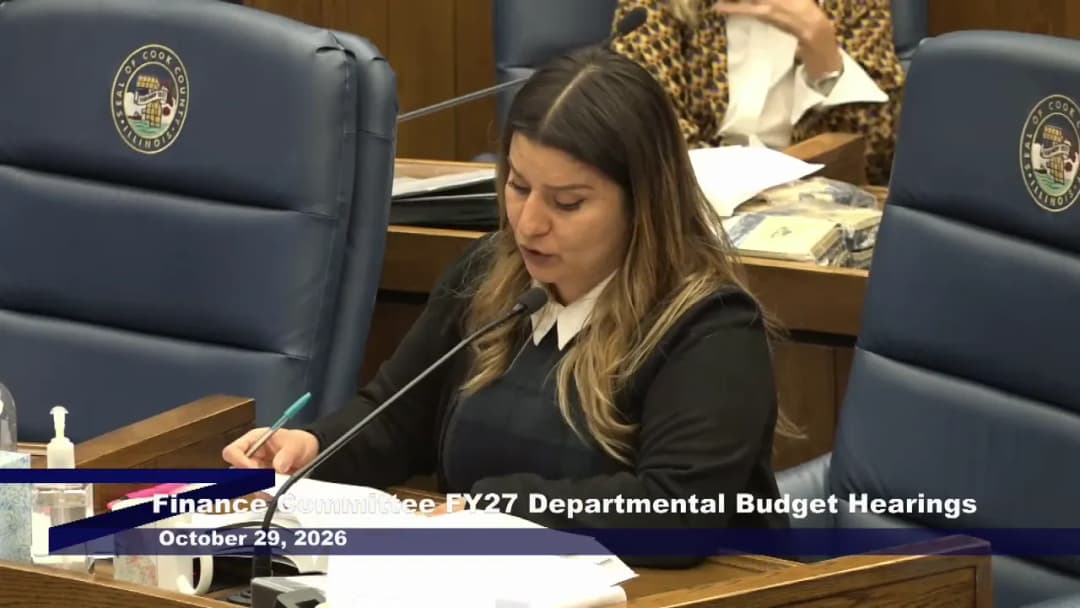
Cook County Finance Committee Hears FY2027 Budget from Board of Review on October 29, 2026

The Cook County Board of Commissioners Finance Committee convened on October 29, 2026, to hear the FY2027 budget presentation from the Cook County Board of Review. The session was immediately marked by Chairman Daly's sharp rebuke of the three elected Commissioners of the Board of Review (Samantha Steele, Larry Rogers Jr., and George Cardinals) for their absence, noting they were given a second date after a scheduling conflict yet failed to attend or provide notice. Their staff, led by Chief Deputy Commissioner William O'Shields and Secretary Liliana Scarpita, presented the executive budget recommendation of $26.1 million, a $2.3 million increase from FY2026 driven primarily by the annualization of the first collective bargaining agreement. Discussion Items - Commissioner Absence and Leadership Concern: Chairman Daly stated it was the first time in his tenure elected officials failed to attend without notice. Commissioners Lower, Dagner, and Anaya echoed the disappointment, citing a lack of respect and collaboration. Commissioner Anaya asked whether the $9,000 salary increase for commissioners would guarantee their attendance at the next hearing. - Budget Overview and Personnel Costs: The FY2027 request of $26.1 million is driven almost entirely by personnel costs, which constitute 95% of the budget. The FTE count remains flat at 177, with 11 vacancies identified. Staff highlighted a 10.7% reduction in contractual services, a roughly 50% cut in supplies and materials, and a 30% reduction in rental and leasing expenses. - Operational Scale and Technology Modernization: O'Shields reported the office processed 290,533 appeals covering 527,937 parcels in the 2025 tax year, conducted 11,120 hearings, and held 201 outreach events. The office is prioritizing technology modernization, including data analytics for workflow efficiency and user dashboards. - Property Tax Appeal Board (PTAB) Defense: Commissioner Dagner questioned the office's capacity to defend assessments at PTAB. O'Shields explained that because Illinois is a market state, PTAB weighs appraisal evidence heavily, but the Board of Review lacks resources to commission appraisals for most commercial cases. Dagner requested a cost-benefit analysis weighing appraisal costs against potential tax revenue loss from unsuccessful appeals. - Equity in Outreach and Operations: Commissioner Anaya extensively questioned the geographic disparity in appeal volumes, highlighting the 14th district's 41,629 appeals versus the 6th district's 6,687 appeals. She requested a formal plan to ensure equitable outreach in under-resourced areas. Anaya also pressed for transitioning from a joint budget to separate district budgets for greater transparency. Staff noted each district has 41 employees and cited new language access programs as steps toward equity. - Data and Logistical Support: Commissioner Scott requested operational data cut by the percentage of parcels appealed, broken down by property type, to better understand outreach effectiveness. He also raised the difficulty of scheduling events due to the lack of advanced notice for appeal windows. - Overtime Analysis: In response to Commissioner Dagner, O'Shields stated that while the office attempted to cap overtime at $800,000, the consistent burn rate suggests a $1 million allocation is appropriate given seasonal peaks and the workforce structure. Key Outcomes - The committee received the Board of Review's FY2027 budget presentation; no formal recommendation or vote was taken before the committee recessed. - Staff committed to providing follow-up items: a geographic equity analysis for outreach, data cuts showing appeal percentages by parcel type, and a cost-benefit analysis for PTAB defense appraisals. - The committee formally registered its displeasure over the absence of the elected Board of Review commissioners.

BUDGET EQUITY ANALYSIS 38% · TAX POLICY 32% · PUBLIC ENGAGEMENT 26% · TECHNOLOGY AND INNOVATION 2%
08
NEWOCT 29, 2026 · COOK COUNTY, ILLINOIS · BOARD OF COMMISSIONERS
Cook County State's Attorney Budget Hearing - October 29, 2026

The Cook County State's Attorney, Eileen Burke, presented a revised budget request for fiscal year 2027 to the Cook County Board of Commissioners. The hearing focused on a request for 70 new positions, which the State's Attorney argued would be largely budget-neutral through savings from reduced outside counsel, overtime restructuring, and turnover adjustments. Commissioners questioned the request's sustainability, funding sources, and impact on the county's budget, as well as the office's policies on prosecuting retail theft, ICE-related referrals, and restorative justice programs. Presentation of Budget Request - State's Attorney Burke introduced her leadership team, including First Assistant Craig Engebretson, Chief of Staff Don Black, Chief Assistant for Policy and External Affairs Loisen, and Chief Financial Officer John Horahan. - She emphasized that the budget request is part of a strategic multi-year plan to strengthen the workforce, professionalize operations, and improve services to victims and witnesses. - The original request for 154 new positions was narrowed to 70 mission-critical positions after identifying funding mechanisms. Discussion Items - Budget Neutrality and Funding Sources: The State's Attorney argued that 50 of the 70 positions are permanently budget-neutral, funded by expanding in-house civil legal capacity (saving an estimated $5 million annually in outside counsel expenses) and eliminating overtime for weekend first appearance court (saving an estimated $750,000 to $1 million annually). The remaining 20 positions are budget-neutral this year through adjustments to turnover rates. - Outside Counsel Savings: The office previously collected $173 million from class-action settlements. By adding 10 experienced civil attorneys, the office projects annual savings of approximately $5 million, based on the reduction in outside counsel spending which averaged $359,000 per month over the past two years (over $8 million total). The workers' compensation unit was cited as a proof of concept, where adding three attorneys nearly eliminated outside counsel, saving $2.2 million in 2024 and 2025. - Digital Forensics Lab: The office is opening its first digital forensics lab at 525 West Van Buren, approved by the board last month, planned to open in January. It will be staffed by seven certified digital forensic examiners and four digital forensic analysts. The volume of digital evidence has surged: 308 requests for cell phone data analysis in the prior full year, now at 1,483 requests (an average of five per day), projected to grow 382%. The State's Attorney argued this investment helps prevent wrongful convictions. - Workforce and Recruitment: The office is swearing in its largest-ever class of bar takers (80 recently graduated law students), almost double the size of the previous class. This follows a period of critical understaffing that led to attorney burnout and low morale. - Mental Health and Victim Services: The request includes mental health specialists and additional victim specialists to reduce caseloads (which peaked at over 400 cases per specialist in 2025, down to mid-300s in 2026, with a goal of returning to 270-280 as in 2023). - Paralegals: Additional paralegal positions are requested to support attorneys with research, discovery review, and case preparation, improving workflow efficiency. - Retail Theft Prosecution: In response to Commissioner Broad's question, First Assistant Craig Engebretson stated that felony retail theft cases increased from 594 under the previous administration to 701 this year (a difference of about 100), and that this change does not impact staffing needs. Commissioner Broad noted that the public defender's office expressed concerns about increased resources needed due to more retail theft prosecutions. - ICE Referrals: State's Attorney Burke confirmed that no referrals have been received from any law enforcement agency requesting charges related to ICE. She also stated that two secret requests for federal agents were received, but she could not divulge further details. A protocol for federal immigration enforcement actions was created in February and adopted by all prosecutors in the state, with no updates. - Restorative Justice Programs: The office is using restorative justice community courts for the Gun Accountability Program (GAP), which allows people charged with a Class 4 felony for lacking a FOID card to have charges dismissed upon completing gun education and obtaining a FOID card. Over 90 people are in the program. The Misdemeanor Deferral Program (MDAP) offers treatment for mentally ill, drug-addicted, and veteran defendants. - Community Justice Centers: The 13 FTEs from the Community Justice Center unit have been redeployed to other vacancies. - Sexual Assault and Domestic Violence Division: The division has been moved from Special Prosecutions to a new Special Victims Bureau, consolidating sexual assault, domestic violence, and crimes against children. - Vacancies: The office has filled all allotted positions for the first time in 10 years, but operationally there are 32 positions posted or being interviewed for. The office can fill vacancies within 8-10 weeks. - Vine Contract: The contract for victim notification services has not yet been executed; the last issue was a background check in the procurement workflow. Key Outcomes - No votes were taken during the hearing. The State's Attorney concluded her presentation and answered Commissioner questions. - Commissioner Broad requested that the office provide documentation showing how the $7 million in new positions would be offset by savings from outside counsel, overtime reductions, and turnover adjustments. He specifically asked for a justification to reallocate funds from the current balanced budget. - Commissioner Vasquez requested a formal opinion from Risk Management on the estimated $5 million in savings from bringing civil cases in-house. Risk Management head Deana Zellas agreed to work with the budget office to produce a written review by the amendment deadline (the following Thursday). - Commissioner Nye stressed the importance of finalizing the Vine contract, noting an ordinance amendment passed at the last board meeting. - Commissioner Trebor expressed concern that adding 70 FTEs would lock the county into higher expenditures in future budget years, despite the structural savings identified. - Commissioner Grieg asked about revenue generation from civil settlements; State's Attorney Burke confirmed the office frequently brings civil actions against corporations for violations. - The hearing recessed for 10 minutes for the Board of Review to present.

BUDGET EQUITY ANALYSIS 39% · CRIMINAL JUSTICE 29% · PROCUREMENT 9% · PUBLIC SAFETY 7%
09
NEWOCT 29, 2026 · COOK COUNTY, ILLINOIS · BOARD OF COMMISSIONERS
Cook County Finance Committee Reviews Clerk's FY2027 Budget and Election Preparations on Oct 29, 2026

The Cook County Board Finance Committee, chaired by Chairman Daly, convened on October 29, 2026, to review the Fiscal Year 2027 budget request for the Cook County Clerk's Office. Clerk Monica Gordon presented the budget, highlighting the upcoming November 3rd election, technological improvements, and significant challenges with the Tyler property tax system. Commissioners engaged in detailed questioning on election integrity, budget line items, and vendor accountability. Discussion Items - Clerk's FY2027 Budget Presentation & Election Update: Clerk Gordon presented the budget, emphasizing investments in in-house technology, such as the clerk recording system. She reported that as of that morning, more than 157,000 residents had cast early ballots and nearly 84,000 mail ballots had been returned. The clerk's office serves 1.7 million registered voters in suburban Cook County. She described the Tyler project as the office's most significant operational challenge, noting critical defects remain unresolved as the December 15th tax sale approaches. - Election Security and Misinformation: Commissioners Degman, Naya, and Morrison raised concerns about election equipment reliability, potential federal presence at polls, and the spread of misinformation. Clerk Gordon and Deputy Clerk Ed Michaelowski detailed safeguards, including the election lens real-time analytics platform, paper ballot backups, and a clear chain of command requiring election judges to report incidents to an election center. Commissioner Degman directly questioned a claim about voting machines flipping votes, which Deputy Clerk Michaelowski stated is impossible with the county's equipment. Clerk Gordon declared misinformation the biggest threat to democracy. - Tyler Technologies System Failures: Significant discussion focused on the Tyler property tax system. Deputy Clerk Carolyn Ellaby outlined that Tyler must fix 17 specific defects by a November 13th checkpoint meeting to meet the December 1st go-live deadline. Of the 60 total defects, 43 need resolution. If these benchmarks are not met, the office will build workarounds for the December 15th tax sale. The Clerk's office has assumed project management to hold Tyler accountable. Commissioner Britton requested that Tyler Technologies attend a future committee meeting, which Chairman Daly confirmed. - Budget Line Item Questions: - Staffing: Deputy Clerk Christina Saldana clarified that an apparent reduction of seven customer service positions was a realignment to a special purpose fund. The net loss of four positions were all previously vacant, and the office is actively hiring for one customer service position in real estate. - Moving Expenses: A $740,000 increase on line J3 was attributed to the upcoming municipal elections and rising contractor costs. - Overtime: The overtime budget decreased because Tyler system testing costs were not expected to continue into FY2027. - Maintenance Subscriptions: A $1.4 million increase on page J2 was explained by the Bureau of Technology distributing the operating costs of the Tyler system across county agencies, charging the Clerk's office that portion. - Community Outreach and Youth Engagement: Commissioners Britton, Scott, McCask, and Naya praised the Clerk's outreach initiatives. The 'Defenders of Democracy' program, which trains high school students as election judges, has expanded to 27 schools and won national awards. A new early voting site in Wheeling was highlighted as highly successful. Commissioner Naya acknowledged the 'Love Purse' initiative for domestic violence survivors, which collected 432 purses. Key Outcomes - Directive for Vendor Accountability: Chairman Daly and Commissioner Britton directed that representatives from Tyler Technologies must attend an upcoming committee meeting to answer questions regarding the contract and persistent system defects. - Firm Benchmarks Established: The Clerk's office set a strict November 13th deadline for Tyler to resolve 17 critical defects, with a final decision point on November 24th. Failure to meet these benchmarks removes the possibility of going live on the system by December 1st. - Contractual Protections: The Clerk's office confirmed that the upcoming contract amendment with Tyler includes provisions to withhold payment for modules until they are fully functional. - Budget Amendment Planned: The Clerk's office will bring a budget amendment reflecting updated revenue projections to absorb higher turnover costs while maintaining direct customer service capacity.

ELECTION INTEGRITY 40% · TECHNOLOGY AND INNOVATION 21% · PUBLIC ADMINISTRATION 11% · PUBLIC SAFETY 6%
10
NEWOCT 29, 2026 · COOK COUNTY, ILLINOIS · BOARD OF COMMISSIONERS
Finance Committee Reconvenes on FY2027 Budget with Sheriff Dart on October 29, 2026

The Cook County Board Finance Committee reconvened for its FY2027 budget hearings on October 29, 2026, featuring Sheriff Tom Dart. The Sheriff presented a $799 million budget request and responded to commissioner questions on a wide range of topics including electronic monitoring, mental health services, overtime costs, and public safety technology. Budget Overview - Sheriff Dart presented an FY2027 budget of $799 million, a $24 million increase from the $774 million FY2026 budget. The increase is primarily driven by salary and benefit increases totaling $34 million. The department made $10 million in cuts, largely in IT, to offset the increase. Electronic Monitoring (EM) - Sheriff Dart reported the department is currently monitoring 109 individuals under the EM program. He expressed frustration that the transfer to the statewide EM program and Chief Judge's office has been delayed on their end. Commissioner McCaskill noted the program costs approximately $2.5 million annually and involves around 45 staff. Public Safety & Technology - Commissioner Degnan raised concerns about the use of Flock license plate readers, citing ethical issues with the company and stating she "regrets" her previous vote on the contract. Sheriff Dart shared concerns about over-surveillance, noting access is restricted to fewer than 30 employees within his office. He stated that 177 out of 230 external agencies chose not to participate with the Sheriff's office due to strict data usage rules, and expressed openness to other vendors. Overtime & Staffing - The budget projects a $4.1 million reduction in overtime, bringing the total to $69 million. Commissioner Vasquez highlighted that overtime per employee has risen sharply from $3,500 in 2022 to $19,000. Sheriff Dart attributed high overtime to an average of 440 daily sick calls out of 1,300 needed staff, as well as labor-intensive hospital runs. The department is 233 officers below its full staffing target, with 55 currently in training. Targeted home checks following high call-in days (e.g., after sporting events) have reduced call-ins by 13%. Treatment Response Team (TRT) & Mental Health - The TRT is expanding, with funding for an additional two FTEs in FY2027, bringing the total growth to 18 from 7 in 2024. Sheriff Dart highlighted the program's expansion to over 60 external agencies and its role on the CTA. He noted a new Medicaid funding formula in June or July will allow provider reimbursement for in-jail services, which he hopes will improve the "warm handoff" to community care and reduce recidivism. Retail Theft & ICE Investigations - Commissioner Britton asked about an increase in detained individuals on felony retail theft charges. Sheriff Dart stated most of these have underlying failure-to-appear issues and their stays are short. The Sheriff's office opened a portal for law enforcement misconduct tips, which received 950 submissions, though none related to ICE. Commissioner Vasquez pushed for the Sheriff's office to accept direct police reports for ICE misconduct, which Sheriff Dart agreed to do, provided his office coordinates with potentially involved municipal agencies first to avoid interfering with existing investigations. Court Services & Domestic Violence - Sheriff Dart provided an update on Order of Protection service. The first-attempt success rate is in the 80% range. Over three attempts, the service rate hovers around 50%, largely because law enforcement cannot enter a residence to serve the order. The office is pushing for electronic service legislation. Key Outcomes - The Sheriff agreed to provide Commissioner Vasquez with data on overtime patterns and repeat call-ins. - The Sheriff agreed to coordinate with Commissioner Vasquez's office to directly take police reports from individuals alleging ICE misconduct if local police lack resources. - Commissioner Degnan noted that the collaborative issues on the EM system between the Sheriff, Clerk, and Chief Judge have been resolved, pending a "go live" date.

PUBLIC SAFETY 51% · PUBLIC HEALTH 12% · DOMESTIC VIOLENCE 10% · TECHNOLOGY AND INNOVATION 5%
0102
NEXT →
OPENPUBLICA · PUBLIC MEETING INDEXUPDATED DAILY · openpublica.com