OPENPUBLICA · PUBLIC MEETING RECORD
Record of Proceedings
Cook County Land Bank Fiscal Year 2027 Budget Hearing - October 28, 2026
Board of Commissioners — Wednesday, October 28, 2026
BodyCook County, Illinois
SessionBoard of Commissioners
DateWednesday, October 28, 2026
StatusNEW · FILED
Video Record
STREAMING COPY IN PREPARATION — RECORDING AVAILABLE FROM THE ORIGINAL SOURCE
Transcript — Verbatim
Speaker numbers apply only to this recording.
Discussion Breakdown — Share of Meeting
Property Management34%
Zoning And Land Use30%
Affordable Housing18%
Public Administration11%
Budget Equity Analysis5%
Economic Development2%
Summary of Proceedings
Cook County Land Bank Fiscal Year 2027 Budget Hearing - October 28, 2026
Executive Director Jessica Caffrey presented the Cook County Land Bank's proposed FY2027 budget of $14.5 million, a $652,000 reduction from the previous year. The hearing covered the land bank's achievements, revenue trends, and plans to address over 38,000 long-term tax-delinquent properties. Commissioners asked questions about inventory, partnerships, affordable housing, and new reactivation initiatives.
Discussion Items
- Budget Overview: The FY2027 total appropriation is $14.5 million (down from $15.2 million in FY2026). Cook County's appropriation adjustment decreased from $3.5 million to $2.6 million, based on a three-year rolling average of penalties and fines. Equity funds from FY2026 are carried over and will be spent down in FY2027. The IDA (Illinois Housing Development Authority) strong communities grant of $750,000 is pending, so it is budgeted at $0. The property maintenance line (landscaping, snow removal, board-ups) remains consistent year-over-year at about $6.5 million for 1,800+ properties.
- Operational Impact (2013–present): Since 2013, the land bank has acquired over 5,000 parcels, sold over 3,500, and rehabbed over 2,600 across 76 municipalities and 61 Chicago neighborhoods. This generated $38.5 million in property tax revenue, $330 million in community wealth, and $38 million in delinquent taxes redeemed through notice actions. A 10-year economic impact report estimated $1.8 billion in total economic impact, with a 77-cent benefit per $1 of public-private spending.
- Revenue & Sales: Primary revenue sources are traditional property sales, municipal sales, land banking agreements, and tax reimbursements. As of October 27, 2026, revenue stood at $7.32 million, in line with FY2024 ($7.29 million). FY2025 was the strongest year since 2018 at $9.64 million. FY2027 revenue is budgeted conservatively at $7 million, slightly below the three-year average of $8.08 million. Sales depend on market conditions and closing timings; inventory consists of very low-valued properties.
- Developer Network & Vendors: The land bank works with over 1,400 unique developers (small, local contractors often working in their own neighborhoods) and 19 vendors for property preservation. Each sale includes a rehab requirement, deed restriction, and soft second mortgage. Annual developer recognition events cover the west side, south side, south suburbs, and west suburbs.
- Inventory & Acquisition Strategy: Current active inventory is about 1,800 properties. The annual acquisition volume is constrained by budget (the largest expense is property preservation). The land bank acquires properties for market viability, community strategy, municipal requests, long-term tax delinquency, and to align with public investments (e.g., City of Chicago's Missing Middle program). The goal is to keep inventory stable around 2,000 properties.
- FY2027 Commitments: Minimum targets: 300 acquisitions, 500 dispositions (which reduces inventory and holding costs), $30 million in community wealth, 80% of homes going to homeownership, 90% of acquisitions in priority/low-to-moderate-income areas, 30 purchase assistance grants, a 15% reduction in age inventory (properties held over two years), and four community outreach events. In FY2026, the land bank sold 302 age-inventory properties (18.82% of that category), exceeding the 15% goal.
- Opportunity – Over 38,000 Long-Term Tax-Delinquent Properties: There are more than 38,000 properties left unsold from 2021/2022 tax sales. Recent state laws (2023 and 2026) ended mandatory scavenger sales and addressed the Tyler v. Hennepin Supreme Court decision. The county, under President Preckwinkle, is developing a new reactivation mechanism with the Civic Consulting Alliance (CCA). The land bank will not hold 38,000 properties; most will pass through an auction process. For FY2027, the implementation phase is within the budget request. Requirements: auction system with clear rules, technology to track tens of thousands of parcels, legal capacity for deeds, and agreements with municipalities, the city, the clerk, the treasurer, and the president's office. A pilot program is planned before full-scale operations. The added costs at full scale (auction, legal, technology, holding costs) will be brought back to the board later.
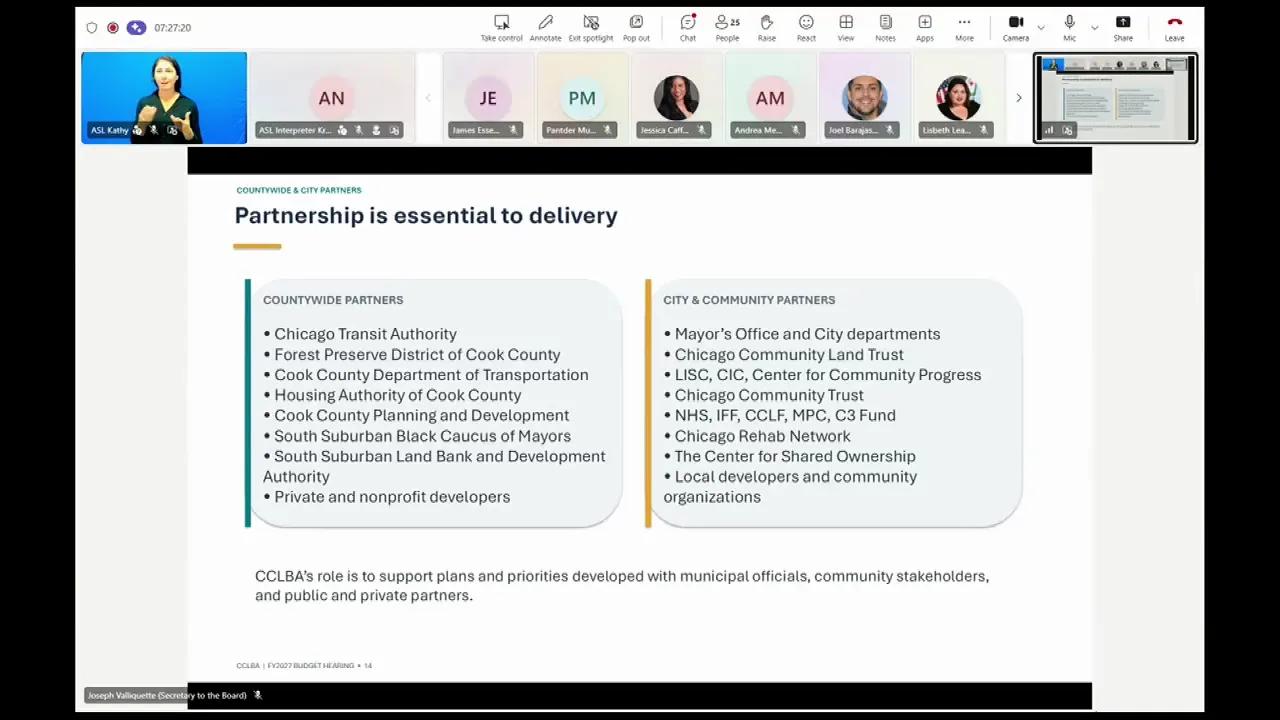
- Partnership Examples: (1) Rebuild 2.0 with Chicago Department of Housing: transferred 33 vacant homes in Englewood and Roseland; community lenders (Chicago Community Loan Fund, Greenwood Archer Capital) financed local developers; homes sold to owner-occupants with a $20 million IDA grant. (2) Austin Hope Center: vacant lots became a 25,000 sq ft facility with pediatric care, mental health services, youth programs, and community space, developed by Stone Community Development Group and Chicago Neighborhood Initiatives. The land bank is also closing on homes in Roseland with the Hope Center Foundation.
- Commissioner Questions:
- Commissioner (unidentified): Asked about the ratio of land bank to city-owned lots and whether the land bank can get a share of the 38,000 properties. Caffrey explained that the land bank only takes inventory it can afford to maintain (around 2,000 active properties). The 38,000 are not yet in inventory; the new process will assemble them. Collaboration with the city through joint RFPs is being explored.
- Commissioner Dagner: Praised the land bank's charrettes and asked about a $1.25 million reduction in professional services on page E6. Daniel Taylor clarified that the reduction includes carryover equity funds from FY2026; the professional services line actually decreased from $450,000 to $404,000.
- Commissioner (another): Asked for clarification on the 38,765 properties – not all are vacant. Caffrey stated that 60% of the 38,000 are vacant land (no structures). The land bank does not take occupied residential properties; a separate pilot program (with Bureau of Economic Development) aims to keep 100 families in their homes. Discussed the new auction process: after the auction, if no bid meets the total taxes/debt, the property can go into land bank inventory and be sold without surplus equity concerns. Surplus equity would be returned to former owners when required. Legal details are still being worked out with judges and CCA.
- Commissioner (same): Asked about FY2027 goals – they appear to be new goals. Caffrey confirmed they are new; previous goals were met except acquisition targets (due to a 75-step deed process). Also noted that the IDA grant of $562,000 (state) has been fully expended; the pending $750,000 for FY2027 is not yet announced.
- Commissioner (8th District): Commented on the website's improved user-friendliness and asked for more suburban/south suburban community partners. Caffrey noted existing partnership with South Suburban Land Bank and willingness to do more. The commissioner also requested that the 8th district be considered for future acquisitions, especially in its lower-income south end. Caffrey agreed to meet and discuss tax-delinquent areas.
- Other commissioners: Expressed appreciation for the land bank's work and staff responsiveness. Commissioner noted enforcement follow-through by land bank staff on developer maintenance.
Key Outcomes
- The board did not take a vote on the FY2027 budget request ($14.5 million) during the hearing. The meeting was recessed until 9:30 AM the following day (October 29, 2026) for a finance committee with the Cook County Sheriff and a board meeting at 9:30 AM.
- Several commissioners requested follow-up meetings with the land bank to discuss district-specific properties, affordable housing strategies, and partnerships.
- The land bank will continue working with CCA and judges to finalize the auction and reactivation program, with a pilot expected to inform full-scale operations.
Meeting Transcript
Good afternoon, Chairman Daly, and good afternoon, Cook County Board of Commissioners. Thank you. Good afternoon. Thank you, Chairman Daly, for chairing today's hearing, and I thank each of you, Commissioners, for your time and your continued support for the Cook County Land Bank. My name is Jessica Caffrey, and I'm the executive director of the Cook County Land Bank, and I'm pleased to share our achievements and highlights for our proposed fiscal year 2027 budget. With me today, I have Daniel Taylor, our manager of finance and business operations, and our SEO planning analyst Alex Simmons. Next slide, please. So the land bank was an initiative of Commissioner Gaynor. She proposed it in 2012, sponsored the ordinance with President Tony Preckwinkle, and the board passed it unanimously in January of 2013. Commissioner Gaynor has also served as our first board chair, and we are so proud to carry that vision forward. Thank you for your dedication and commitment to Commissioner Gaynor in her absence today. Now, with that, I want to talk a little bit about our impact and what we do. We acquire and hold property and then we sell it to certified developers, home buyers, nonprofits, and municipalities who must complete this rehab within 12 to 18 months. And our impact includes that since 2013, we have acquired over 5,000 parcels. We've sold over 3,500, we've rehabbed over 2,600, and that's across 76 municipalities and 61 Chicago neighborhoods. This has generated $38.5 million in property tax revenue, and $330 million in community wealth, and $38 million in delinquent taxes that were redeemed. Our 10-year economic impact report showed that there was an estimate of $1.8 billion in economic impact, which was both direct and indirect in our first 10 years of operations, and that just continues to grow.77 cent economic benefit for every $1 of public-private spending. Next page, please. So here is our budget investment at a glance. Our fiscal year 27 budget investment is $14.5 million. This is a $652,000 reduction from our previous fiscal year of $15.2. Our appropriation adjustment from Cook County went from $3.5 million in 2026 to $2.6 million in 2027. This is using a calculation, a three-year rolling average of the penalties and fines that are collected by the Treasurer's Office to support the land bank operations. You'll notice our equity funds amounts have been rolled over to from fiscal year 26, and this will be spent down in 2027. Our Ida award shows a zero balance as it has not been announced yet if we will receive those funds. Next slide, please. Good afternoon, Daniel Taylor, manager of finance and business operations. This slide is presenting our at the top. This is driven by four FTEs. We're currently interviewing, and those vacant positions will be filled by the end of FY27. Our contractual service line, which includes many expense lines, uh, with our largest being professional service and legal expense. Um, and that will be spent down in FY27. The exact amounts can be found on E8 AGEA. Excluding equity fund, our professional service line is reduced from 450,000 to 404, 404,000, and special and co-op programs from 100,000 to 80,000. And our property maintenance line, which is our largest expenditure line, is reserved for property preservation, landscaping, and snow removal, which remains the same year over year. Lastly, our grants contingencies and special purpose line increases due to the reduction of appropriation adjustments, as Jessica just mentioned. And this is an increased shown as an increased expense to the land bank in the amount of 882,907. The strong communities grants listed shown is not budgeted until Idaho announces the award. We expect this award to be awarded by the end of this year. And lastly, department staffing is currently at 25 budgeted FTEs. Next slide, please. So the land bank is driven by transactions. Our traditional property sales are our primary source of revenue. It's followed by our municipal sales, our land banking agreements, our tax reimbursements, and other special program sales. As of October 27th of this year, our revenue is about $7.32 million. That is in line with fiscal year 24 at $7.29 million. However, as you can see, fiscal year 25 was our strongest year since 2018 at about 9.64 million. Now, for fiscal year 2027, we are planning conservatively with revenue budgeted at about $7 million.
SUMMARIZED BY OPENPUBLICA AI
TRANSCRIPT VIA PUBLIC VIDEO
openpublica.com
openpublica.com