OPENPUBLICA · PUBLIC MEETING RECORD
Record of Proceedings
Cook County Finance Committee Holds FY2027 Capital Budget Hearing on October 28, 2026
Board of Commissioners — Wednesday, October 28, 2026
BodyCook County, Illinois
SessionBoard of Commissioners
DateWednesday, October 28, 2026
StatusNEW · FILED
Video Record
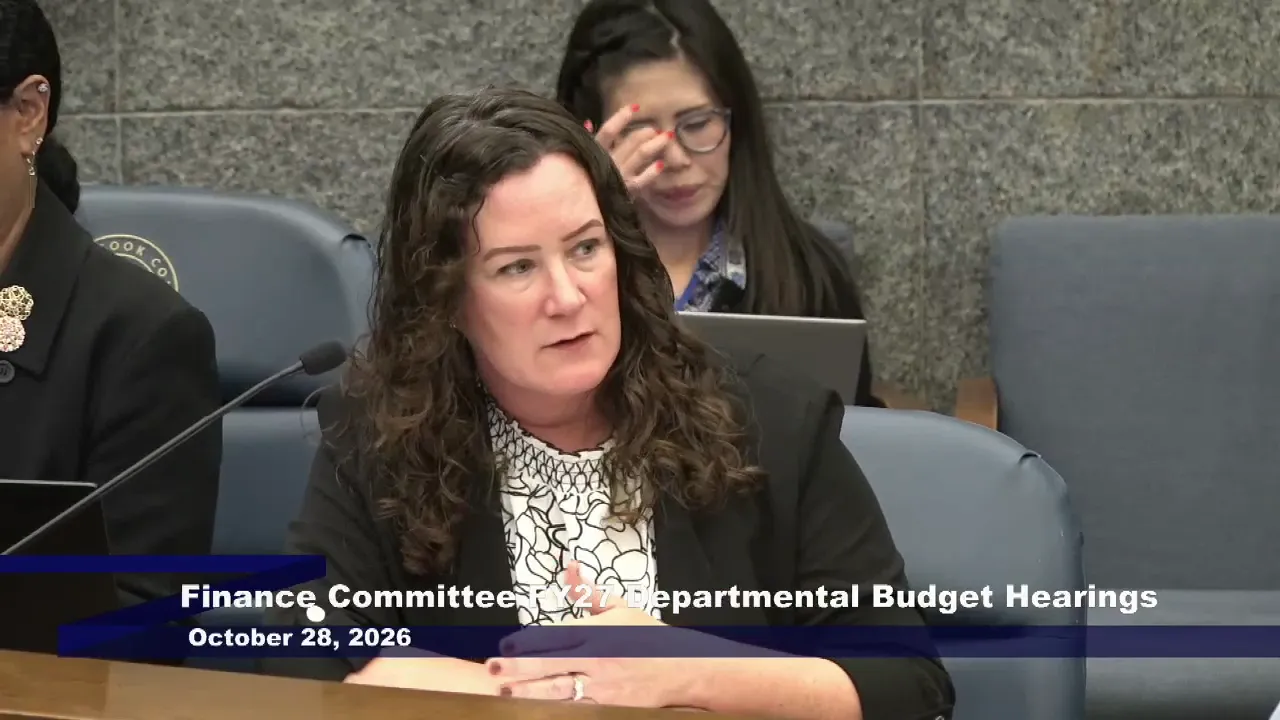
STREAMING COPY IN PREPARATION — RECORDING AVAILABLE FROM THE ORIGINAL SOURCE
Transcript — Verbatim
Speaker numbers apply only to this recording.
Discussion Breakdown — Share of Meeting
Technology and Innovation19%
Capital Planning14%
Public Safety12%
Data Sharing9%
Public Transit8%
Environmental Protection7%
Transportation Safety6%
Public Administration6%
Fiscal Sustainability5%
Summary of Proceedings
Cook County Finance Committee Holds FY2027 Capital Budget Hearing on October 28, 2026
On October 28, 2026, the Cook County Finance Committee, chaired by Chairman Daly, held a hearing to review the proposed FY2027 Capital Budget. Chief Financial Officer Angela Manning Hardeman presented the budget alongside Chief Jamie Myers (Bureau of Asset Management), Acting Superintendent Tara Orban (Department of Transportation and Highways), and Chief Information Officer Tom Lynch (Bureau of Technology). The combined capital plan includes a $240.1 million Capital Improvement Program (CIP), $180 million for transportation and highways, and capital equipment projects funded largely by debt (57.3%). Commissioners explored the budget's alignment with the county's six policy roadmap pillars.
Discussion Items
-
Capital Budget Overview: CFO Hardeman stated the county received Fitch credit upgrades (A to A+ for GO and sales tax bonds). The debt strategy targets 2% annual growth, capped at $400 million. Commissioner Lauber questioned refinancing opportunities; Hardeman confirmed two refinancings in FY26 saved $12 million, recommending an annual review due to market volatility. Hardeman also confirmed escrowed resources from the road builders case are kept segregated.
-
Capital Improvement Program and Facilities (BAM): Chief Jamie Myers reported the FY27 CIP request is $240.1 million. The county achieved a 57% carbon emissions reduction (end of 2024), exceeding the 45% target, and is adopting a new goal of 50% reduction by 2034. Key projects include the DOC Enhanced Visitation Center (opening end of FY27), the new Medical Examiner's Office design, Boardroom completion (substantial completion expected the following week), and 18 solar installations by end of 2027. Commissioner Nayer questioned the low energy-specific allocation (2.3%) in the corporate portfolio. Myers explained energy projects compete with life safety and accessibility, with progress tracked by an annual benchmark report. Director of Capital Planning Earl Manning stated ADA work is embedded in most projects and agreed to adjust the budget presentation. Commissioner Nayer also flagged spending jumps between FY27 and FY28 (e.g., Public Safety from $81M to $278M). Manning explained this reflects a shift from design to construction phases. Commissioner Degnan inquired about solar deployment, the warehouse study (draft finalizing), and bird-friendly windows (already part of green standards). Commissioner Marita raised concerns about courthouse security camera quality; Myers committed to a follow-up discussion on upgrades.
-
Transportation and Highways (DOTH): Acting Superintendent Tara Orban presented the $285.5 million program, including 20 miles of road rehab. The Invest in Cook program awarded $8.3M to 36 projects in the previous cycle, leveraging $3 for every $1 county investment. The FY27 budget includes $8.5M for the 11th round. $68.8M in pass-through grants supports the program. Commissioner Lauber requested a breakdown of the 43 high-need communities receiving awards. Commissioner Degnan asked about the impact of the federal administration on funding; Orban stated the landscape remains stable. Commissioner Reid requested a status update on PACE dial-a-ride funding; Orban committed to following up.
-
Technology and Capital Equipment (BOT): CIO Tom Lynch presented the capital equipment plan. Key projects include an electronic warrant management system, a new Public Defender case management system, a Grants Management System RFP, ADA digital accessibility compliance (April 2027 deadline), and $2.8 million for a Gen AI platform. Lynch reported the retirement of hundreds of legacy mainframes across elected offices, enabling real-time data sharing. The County Clerk's system is expected to go live by end of calendar year 2026. On the Tyler Technologies system, renewal options are being exercised in November 2026 to maintain stability while the county explores alternatives. Lynch stated the Gen AI platform will be a county-controlled AWS platform to protect data. Commissioner Degnan emphasized the importance of carefully evaluating AI vendors' ethics. Commissioner Vasquez stated the county should set aside budget dollars to build an alternative to Tyler. Commissioners discussed implementing domestic violence task force recommendations on courtroom technology; Lynch noted a complex RFP for courtroom tech enhancements is underway.
Key Outcomes
- The hearing served as a budget review; no formal vote was taken.
- BAM will adjust budget documentation to better capture ADA spending. (Commissioner Nayer)
- DOTH will provide the list of 43 high-need communities and follow up on PACE funding. (Commissioners Lauber, Reid)
- BAM will discuss upgrading courthouse security camera systems and resume ICE/US Marshal presence notices to commissioners. (Commissioner Marita)
- The Boardroom renovation is scheduled for substantial completion within days of the hearing.
- The county will explore alternatives to the Tyler Technologies system via an RFP while exercising renewal options for continuity.
Meeting Transcript
Capital planning hearing. Angel, Jamie. Time and that's a question. Where did Tara results? Oh, she's on SI. We'll begin the hearing. Okay. Good afternoon, Chairman Daly, and members of the Finance Committee. I am Angela Manning Hardeman, Cook County Chief Financial Officer, and I'm here today to present the FY27 capital budget. As you may already know, the county reviews its capital programming needs each year as part of the budget process. This reevaluation includes capital improvements for facilities, capital equipment purchases, and transportation and highway planning. As part of this, the county considers its ability to issue new debt for capital expenditures for or fund smaller projects to our operating budget. This process allows for the identification, review, planning, and budgeting of some exciting and important capital investments. The goal here today is to provide a complete look at Cook County's capital needs and ongoing efforts. This is an important part of our long-term fiscal planning, including projecting future debt service requirements. This also helps us better plan our work on public facilities, strategic renovations, and upgrades of county assets. Today I'm joined by Chief Jamie Myers from our Bureau of Asset Management, Acting Superintendent Tara Orban from Highways and Transportation, and Chief Information Officer Tom Lynch from the Bureau of Technology, as well as our budget director, Kanako Ishida Musselwhite. I will walk you through the capital budget overview before handing it off to them to provide a more detailed look at the exciting work we're doing in Cook County. So quick agenda. As I mentioned, I'll do the capital overview. Capital improvement projects will be done by Jamie. Transportation and Highway Projects will be presented by Tara, and capital equipment projects will be presented by Tom Lynch. Next slide, please. Similar to last year, the six policy pillars of Cook County's policy roadmap are the foundation of the FY27 capital budget. Using the policy framework improves outcomes for residents and requires close coordination and collaboration with separately elected officials and other partners. Next slide. Next slide, please.7 in capital equipment projects, and $180 million in transportation and highway projects. The pie chart represents funding sources of the county's capital projects. 57.3% of the projects are funded by debt proceeds. Our second largest source of funding are highway improvement funds, which represents 30.8% of our funding for capital projects. In July, the county received two credit upgrades from FITCH, raising our GO and sales tax revenue bond ratings from A to A plus. The county's debt management strategy has resulted in high investment grade bond ratings and lower borrowing costs for the county. Next slide. This chart depicts the county's current debt service profile and future funded capital program. The black line represents the county's annual debt service growth financial policy that is aligned with the Federal Reserve's long-term inflation target of 2% and capped at $400 million in debt service. The rat line represents the county long-term debt amortization strategy that ensures we are facilitating a future state where we can issue bonds using a level debt service structure. To further this objective, the county seeks to fund capital equipment through pay as you go means. So that's grants, that's the infrastructure and equipment fund and other special purpose funds to reduce reliance on budgeted funds. And with that, I will turn the slides over to Jamie to talk about the capital improvement program. Thank you, Angela. Jamie Myers, Bureau Chief, Bureau of Asset Management. Good afternoon. So not a lot has changed within the Bureau. We're primarily responsible for the capital improvement program as it runs through the Department of Capital Planning and Policy. We use the Cook County Policy Roadmap as the foundation for making our decisions as we make different investments in improving our facilities.
SUMMARIZED BY OPENPUBLICA AI
TRANSCRIPT VIA PUBLIC VIDEO
openpublica.com
openpublica.com