OPENPUBLICA · PUBLIC MEETING RECORD
Record of Proceedings
Cook County Board FY27 Public Defender Budget Hearing – October 30, 2026
Board of Commissioners — Friday, October 30, 2026
BodyCook County, Illinois
SessionBoard of Commissioners
DateFriday, October 30, 2026
StatusNEW · FILED
Video Record
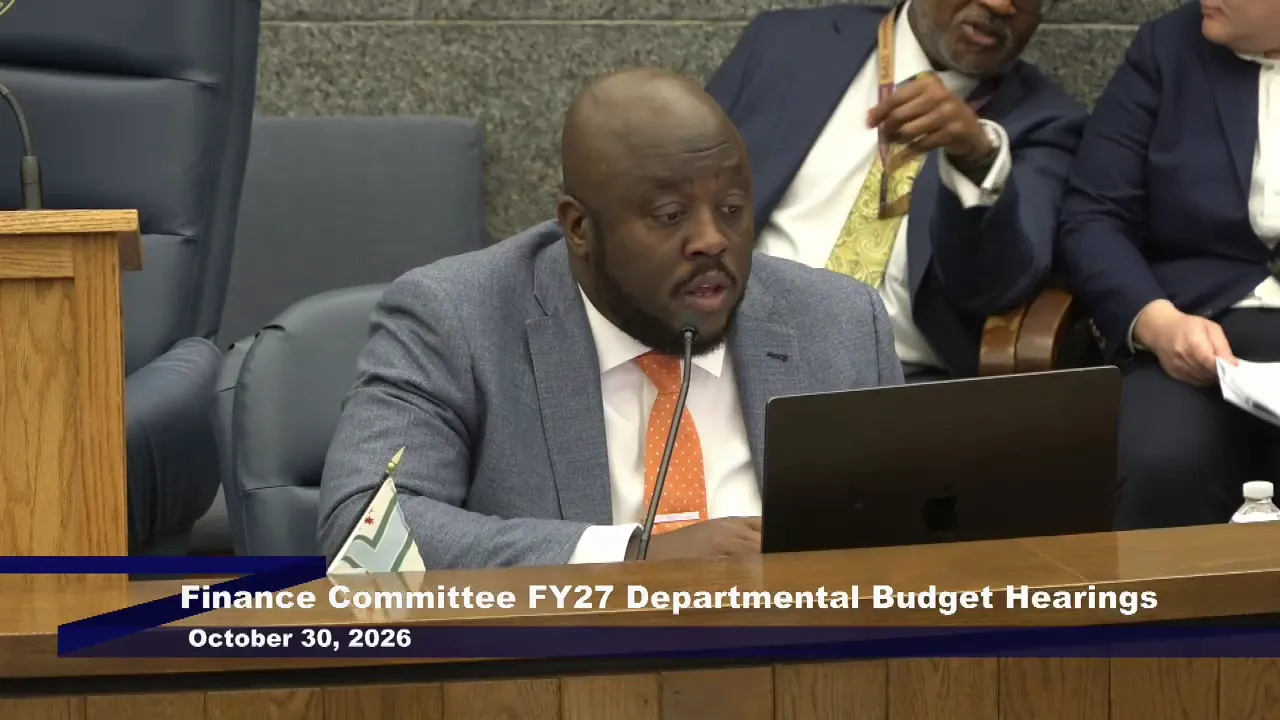
STREAMING COPY IN PREPARATION — RECORDING AVAILABLE FROM THE ORIGINAL SOURCE
Transcript — Verbatim
Speaker numbers apply only to this recording.
Discussion Breakdown — Share of Meeting
Criminal Justice42%
Budget Equity Analysis11%
Legal Access10%
Immigration and Naturalization10%
Interpreter Services8%
Procurement7%
Public Safety6%
Personnel Matters5%
Cannabis Regulation1%
Summary of Proceedings
Cook County Board FY27 Public Defender Budget Hearing – October 30, 2026
On October 30, 2026, the Cook County Board heard a budget presentation from Cook County Public Defender Sharon Mitchell Jr. on the office's FY27 budget. Mitchell described the budget as a pause in progress caused by county fiscal pressures, while emphasizing persistent understaffing, growing caseloads, and the need for a long-term plan to meet national workload standards. No formal votes were recorded in the transcript.
Budget Presentation
- Mitchell, presenting her sixth budget, said the office represents the vast majority of people in the Cook County criminal legal system, plus clients in family defense and immigration matters.
- She said the outcome of a case should depend on the facts, not on whether a defendant was assigned a public defender with enough time and resources.
- Mitchell said the office contracted with the RAND Corporation for an office-wide workload study. Preliminary findings applying national standards show attorney shortages on the adult criminal side in the triple digits; a time study and Delphi study will help build local standards.
- She compared the office to the State's Attorney's Office: in 2024, the public defender's office had 610 fewer full-time positions than the state's attorney's office; over the last three budget cycles that gap grew by more than 80 additional positions. New county investments in the state's attorney's office have been more than twice the investments in public defense.
- Mitchell said the public defender's office operates with roughly 550 full-time positions and about $109 million less in funding, excluding the state's attorney's civil practice.
- She noted that prosecutors have investigative support from law enforcement agencies with combined annual spending of about $2 billion per year.
- Mitchell said dismissals and not-guilty outcomes in felony cases fought by the office between 2023 and 2026 spared defendants approximately 25,761 years of incarceration.
- She said Cook County has the largest funding and staffing gap between defense and prosecution among the seven largest county-run public defender's offices, citing Maricopa County, where the public defender's budget is roughly $30 million higher than the prosecutor's budget.
- Mitchell said an average assistant public defender 3 carries a caseload 2.7 times higher than minimum national standards, requiring 5,590 hours of work per year compared with 2,080 standard working hours.
- She reported that digital discovery grew from 267 terabytes between 2020 and 2023 to more than one petabyte in under two years, describing that as equal to 1,000 terabytes or about 18 million USB flash drives of data.
- Mitchell said new prosecution policies increased defense workload: changes to retail theft policy have produced roughly 400 additional felony cases every year, and a slide showed 1,666 more felony retail theft cases in the first four quarters of the new administration compared with 2024.
- She also cited changes in drug possession and sex work enforcement, more pretrial detention requests, increased weekend and holiday court staffing, and a growing jail population that has swallowed initial reductions after the Pretrial Fairness Act.
- Mitchell said the FY27 budget is approximately $131 million, mostly staffing, with positions staying relatively flat. Two positions are being transferred to compliance to support human resources strategy changes, and several professional contracts were reduced.
- She did not request a budget amendment this year but asked for a multi-year commitment to close the gap and for defense workload to be accounted for whenever prosecution policy creates more cases or hearings.
Discussion Items
- Commissioner Laura asked what the plan is to close the gap. Mitchell said the office is not asking for a budget amendment this year but wants a multi-year commitment and cited the RAND study as the basis for a specific plan. Commissioner Laura offered a standing monthly check-in; Mitchell accepted.
- Commissioner Degan asked about the $74,542 difference between the department request and the president's recommendation. Mitchell said the initial request focused on attorney positions. Degan also questioned whether the forensic science division was losing four full-time employees; Mitchell said her understanding was that the forensic team was staying flat and offered to review the budget book. Degan emphasized constitutional balance between prosecution and defense resources and asked for more attention to immigration and forensic staffing.
- Commissioner Degan asked about the new Collaborative Defense Unit. Mitchell explained it consolidates attorneys working in restorative justice, veterans, women's treatment, and other problem-solving courts into one division, partnered with ASME, to improve expertise and efficiency.
- Commissioner Anaya asked for an immigration unit update. Mitchell said the unit has moved more work into federal courts because federal immigration courts are no longer a viable relief option for many clients. Staffing includes eight attorneys, one supervisor, three to possibly five paralegals, and one social worker. At mid-year, the unit had about 576 hotline calls and walk-ins, over 400 pro se advisals and intakes, about 248 removal cases, over 400 Padilla assessments, and 54 community presentations.
- Mitchell said detained clients with Cook County ties are being held in other states, with cases in Chicago, Memphis, Detroit, Kansas City, El Paso, Minneapolis, and Indianapolis immigration courts. She acknowledged that some people are turned away because of capacity and agreed to provide data on unmet need.
- Commissioner Anaya questioned why two public defender positions were transferred to BHR instead of being reclassified within the public defender's office. The budget director explained that the compliance work resides in county human resources and that the two-position reduction is a true FTE transfer. The budget director also clarified that the State's Attorney's Office FTE increase comes from grant-funded positions being shifted into the general fund after federal victim-services grants ended, not from new positions.
- Commissioner Anaya asked about interpreter services. Mitchell said the office currently has one interpreter, is interviewing for three more, purchased about 200 handheld interpretation devices through a state grant, and maintains a language line and bilingual pay bonus.
- On the Community Defense Center, Mitchell said seven grant-funded positions were impacted by federal cuts and the office is absorbing those positions into its corporate budget to keep the centers operational.
- Commissioner Trevor praised Mitchell for making realistic, incremental requests and said this year's budget pauses that progress. He connected the budget situation to federal funding cuts such as Medicaid and their ripple effects on justice.
- Commissioner Aguilar asked about differences in felony charging numbers between the public defender and state's attorney. Mitchell said her numbers come from the Cook County dashboard and show more felony retail theft cases under the new administration; she said the prosecutor decides charges, while judges and juries decide guilt, and higher charges affect defense time, attrition, and collateral consequences.
- Commissioner Aguilar also asked about ICE presence; Mitchell confirmed increased immigration enforcement and ICE activity near courthouses, despite county policy and state law. She said ICE presence affects not only clients but also domestic violence victims, witnesses, and people trying to use the courts.
- Commissioner Vasquez described ICE incidents near county courthouses, including four instances the previous day, detentions in Bridgeview and Maywood, and families separated after appearing for court summons related to retail theft. She argued the State's Attorney's Office should reallocate its existing historical staffing instead of seeking new funds for civil work, and she strongly supported additional investment in public defense.
- Mitchell said crime rates do not necessarily correlate with defense workload because policy changes can create more work even with the same number of cases. She also pushed back on the idea that a lab would solve wrongful convictions, arguing wrongful convictions stem from people willing to lie or cheat for convictions, lack of defense resources, weakened police accountability, and perverse incentives if one office both prosecutes and controls forensic evidence.
- Mitchell said incarceration costs about $143 per day, and she was reluctant to put a dollar value on someone's freedom. She noted that in many retail theft cases the property is recovered and the response can create greater community harm.
- Commissioner Aguilar raised the impact of retail theft on small businesses and pharmacy access, citing a closed Walgreens in his district. He said he does not believe low-level thefts should lead to jail, but acknowledged there are no easy solutions.
Public Comments & Testimony
- Advocates from the Defenders for All Coalition were present in the room and were thanked by Mitchell and multiple commissioners. No separate oral public comment period is reflected in the transcript.
Video Testimony from Public Defenders
- The hearing included a video featuring line public defenders. One defender said they currently carry 178 cases in misdemeanor branch court while state's attorneys often appear two, three, or four deep, and that prosecutors have law enforcement agencies as investigators.
- A defender said State's Attorney policy changes have removed courtroom prosecutors' autonomy and their ability to make offers, causing clients to return to court more often or stay in custody longer, and forcing cases to trial even when directed verdicts show the state had little or no case.
- Another defender said the office is criminalizing homelessness, with unhoused people prosecuted for taking hygiene products or medical supplies and low-level retail thefts charged as felonies, along with low-level drug and marijuana possession cases.
- A defender described a felony jury trial for about $32 worth of two Yankee candles and a client over 60 facing one to three years for $75 sneakers that were returned; the state's offer was two years in prison.
- Another defender described a client held in custody for over a year on a case the courtroom prosecutor believed should be a misdemeanor; a misdemeanor offer came only the week before trial.
- Defenders also said an arrest is enough to affect immigration proceedings, that public defenders need proper staffing to prevent burnout, and that the Constitution is under attack.
Key Outcomes
- No formal votes or budget amendments were recorded during the hearing.
- Mitchell did not request an FY27 budget amendment; she requested a multi-year commitment to close staffing gaps and a plan informed by the RAND workload study.
- Commissioner Laura and Mitchell agreed to a standing monthly working meeting to track progress.
- Mitchell agreed to provide the board with data on immigration cases the office cannot take because of capacity.
- The chair said the public defenders' video would be shared with all commissioners.
- The transcript confirms two public defender positions are moving to BHR/compliance, and seven grant-funded Community Defense Center positions are being absorbed into the public defender's corporate budget.
- The FY27 recommended position count is 861, compared with 863 adopted positions in FY26, reflecting the two-position transfer.
Meeting Transcript
Please uh we did close. Okay. The Kirk County Public Defender, Sharon Mitchell. Sure. Welcome, Sharon. Good morning, good morning, everybody. Good morning. Shout out to the Defenders for All Coalition. Good morning. My name is Sharon Mitchell Jr. and I serve as the Cook County Public Defender. Joining me today in person are our first assistant Rodney Carr, Chief Financial Officer Peter Caserka, Deputy Chief of Staff, Sad Felix, Deputy Public Defender Charlotte Grace, Operations Directors Jennifer Green, and Joel Simberg, our associate director of trial technology. We're here today to present our FY27 budget. This is my sixth budget presentation. If it turns out to be my last, I want to thank this board for the support you've given our office over the past six years onto the work. Our office carries a serious responsibility, representing the vast majority of people in the criminal legal system. Our attorneys, our investigators, our support staff, and our specialists are incredibly proud to take on that responsibility, along with our work in the family defense and immigration systems. Unfortunately, not everybody values at work, but I do want to proceed with something that I think everybody could agree on. The outcome of a person's case should depend on the facts. It should never come down to whether a person was lucky enough to be assigned to a public defender that happened to have the time and the capacity and the resources to give their case the attention that it deserves and the Constitution requires. I wish I could tell you that that's a reality in every case, that everyone has access to a well-resourced PD with the capacity to do right, but unfortunately, I can't. That's why over the past six years, our message has been consistent. We have to continue to keep addressing the overwhelming caseloads and workloads that have burdened this office for decades. This board did not create this problem, and neither did this administration. But you have helped us make progress year after year, one budget at a time. This year's budget does represent a pause in that progress. We understand, as everyone does, that this is a tough fiscal year. However, over the past six years, our focus has been asked, our focus has been on ask asking for gradual incremental increases because we truly understand the county's many fiscal responsibilities. More that gap between what we have and what we need has always been too great to responsibly close in any single budget year. So our ass has always been for progress. To put us on the correct path, we've contracted with the RAN Corporation through the procurement process to conduct an office-wide workload study to apply clear numbers and clear details to that need. And with that study, we can build a comprehensive plan to address it. We're in the middle of that process. It starts with taking national standards and applying them to our current caseloads. The numbers you see on the screen are applying those national standards to our caseloads, giving us a preliminary number. But then we'll be conducting a time study and a Delphi study to build local standards. Local standards also include applying some of the non-legal resources we have available to us. We'll end with the final report. The preliminary finding that I talked about shows that our shortages among attorneys on the adult criminal side is in the triple digits. It's a big number. And we understand what it means to bring a big number before this board, especially in a year like this. But even in better financial times, we've shaped our requests around what the county could realistically afford.
SUMMARIZED BY OPENPUBLICA AI
TRANSCRIPT VIA PUBLIC VIDEO
openpublica.com
openpublica.com