OPENPUBLICA · PUBLIC MEETING RECORD
Record of Proceedings
Cook County Independent Revenue Forecasting Commission Meeting - November 2, 2026
Board of Commissioners — Monday, November 2, 2026
BodyCook County, Illinois
SessionBoard of Commissioners
DateMonday, November 2, 2026
StatusNEW · FILED
Video Record
STREAMING COPY IN PREPARATION — RECORDING AVAILABLE FROM THE ORIGINAL SOURCE
Transcript — Verbatim
Speaker numbers apply only to this recording.
Discussion Breakdown — Share of Meeting
Budget Equity Analysis34%
Medicaid/Insurance16%
Fiscal Sustainability13%
Economic Development10%
Public Health9%
Capital Planning5%
Public Safety4%
Pending Litigation4%
Procedural3%
Summary of Proceedings
Cook County IRFC Meeting: Executive Budget Review and Long-Term Forecast
On November 2, 2026, the Cook County Independent Revenue Forecasting Commission (IRFC) reviewed the proposed $9.69 billion FY2027 executive budget and updated long-term financial forecasts. Commissioners discussed budget pressures from the road builders' litigation, federal Medicaid changes, and rising personnel costs, and examined one-time measures used to achieve a balanced FY2027 budget.
Consent Calendar
- Approval of Minutes: The minutes from the August 27, 2026 meeting were approved on a motion by Commissioner Merriman, seconded by Commissioner De Vila.
- Approval of 2027 Meeting Schedule: The schedule for 2027 (January 28, April 29, June 29, July 29, August 31, October 26, all at 5:30 PM) was approved on a motion by Commissioner Baylain, seconded by Commissioner Merriman.
Discussion Items
- Executive Budget Recommendation: The FY2027 executive budget totals $9.69 billion. Health care programs account for approximately $4.7 billion (about 50% of the budget), while public safety and health care together comprise just under 70%. The budget reflects a 1% decrease in full-time equivalents (FTEs) compared to the FY2026 adopted budget.
- Major Budget Pressures: Presenters identified three key pressures: (1) federal changes to Medicaid coverage (referred to as OBA) expected to increase uncompensated care; (2) the road builders' litigation, which restricts the county from appropriating about $258 million in transportation-related tax revenues; (3) growing payroll, pension, and benefit liabilities that outpace revenue growth.
- Road Builders' Litigation Details: The $258 million figure represents the annualized estimated revenues from motor fuel tax (excluding sales tax on gasoline), parking lot, and garage operations collected since January 2026. Commissioners noted that these revenues had been partially sequestered in prior years, but the current restriction affects all such revenues. The county is exploring an appeal; no clarity exists on permissible uses of the funds. The potential for retroactive liability remains uncertain.
- One-Time Balancing Measures for FY2027: To offset the revenue constraints, the budget employs several one-time strategies: drawing $53.9 million from debt service reserves (from $228.7 million in reserve accounts); redirecting $12.4 million in Build America Bond subsidies; recognizing ARPA interest income; allocating $61.2 million from the ARPA sustainability reserve to general fund operations (in addition to $52.6 million for originally planned ARPA programs); and using $18 million from the pension stabilization fund (leaving a balance of $180 million).
- General Fund Revenue Update: FY2027 general fund revenue is forecast at $2.749 billion, a $260 million (10.5%) increase from the June forecast. Major changes include a $167.1 million increase in other financing sources (primarily one-time measures), a $35 million increase in county sales tax projections (2.3% above prior forecast), and a net $20 million increase in property taxes after accounting for a $40 million allocation to the health fund.
- General Fund Expenditures: Personnel expenses comprise 66% of general fund spending. Public safety and court system agencies (sheriff, chief judge, state's attorney, public defender) account for about 60% of the total. Personnel costs increased 5.6% ($96 million) due to salary progressions, benefit increases, and cost-of-living adjustments (COLAs).
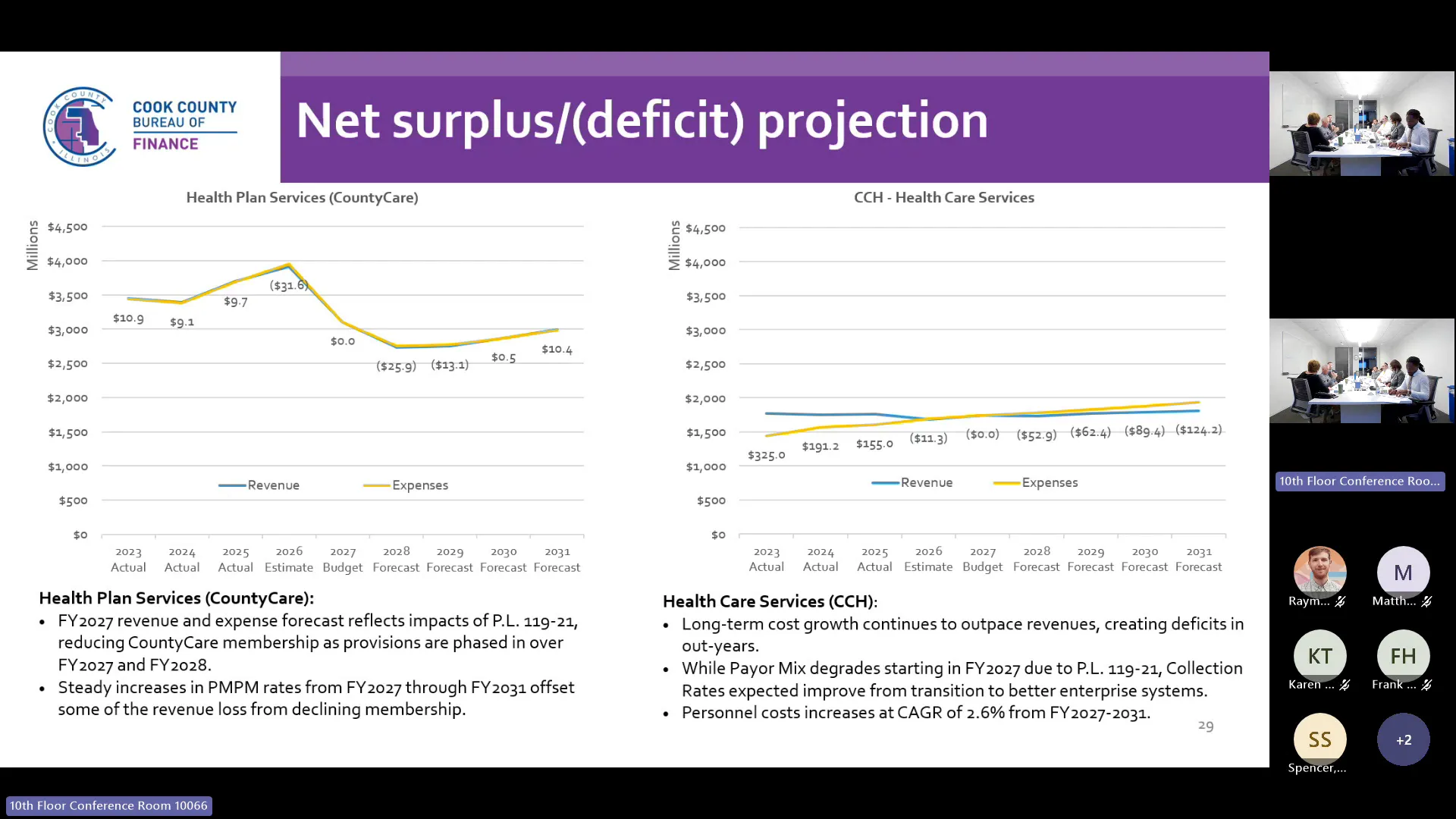
- Health Fund Revenue and Membership: County care per-member per-month (PMPM) revenue is projected to decline by about 1% to $793 in FY2027 (from $800 in FY2026), due in part to the loss of the higher-reimbursement MLTSS population. Overall health fund revenue is expected to drop by nearly $400 million, driven by membership reductions from OBA. The county is allocating an additional $40 million from the property tax levy to CCH in FY2027 ($207 million total).
- County Care Membership Projections: Membership is projected to decline through FY2028, particularly among the ACA adult population, due to more frequent redeterminations (every six months) and work requirements. Membership is expected to stabilize from FY2029 onward. The state's decision to allow self-attestation for work requirements in FY2027 was noted as a potential mitigating factor.
- Long-Term General Fund Outlook: The baseline forecast shows deficits beginning in FY2028 if no structural changes are made. The unassigned ending fund balance is projected to fall below the floor in FY2028 and become negative by FY2029. Commissioners requested a separate view of sustainable revenues excluding one-time sources.
- Health Enterprise Fund Projections: The health fund is projected to have a small deficit in FY2026 (~$40–43 million), a balanced budget in FY2027, but growing deficits from FY2028 onward. Health care services expenses are growing at 2.7% annually while revenues grow at about 1%. The payer mix shift toward self-pay and uncertainty around federal DSH (disproportionate share hospital) cuts are major drivers.
- Collection Rates and Payer Mix: Medicaid collection rates have been suppressed by state clawbacks in 2023–2024, with rates expected to stabilize near 25%. Private payer rates are declining due to a rising share of self-pay patients. Collection rate improvements from the new Epic system are forecast conservatively, with potential net revenue gains of 2–10% noted by CCH's CFO.
- Epic System Implementation: The Epic electronic health record system is expected to cost less than the current dual system (Cerner/Divnision), generating estimated annual savings of $35 million. Capital costs for Epic are handled through the county's separate capital budget process; only operating savings are reflected in the forecasts.
- DSH Revenue Risk: CCH receives about three-quarters of the state's DSH allocation, estimated at $228 million for FY2027. The baseline and optimistic scenarios assume a scheduled federal DSH cut is delayed; the conservative scenario projects a $120 million reduction in FY2028.
- PPRT (Personal Property Replacement Tax) Discussion: Commissioners questioned the projected decline in PPRT revenues in out years, given recent strong corporate income tax receipts. Staff acknowledged timing issues with state true-up data and agreed to review the assumptions.
Key Outcomes
- Minutes and Meeting Schedule Approved: Both items passed unanimously.
- No Public Comment: No speakers registered.
- Adjournment: The meeting adjourned; the next meeting is scheduled for January 28, 2027 at 5:30 PM.
Meeting Transcript
Our registered may sign up to speak by entering their name in the virtual chat box. Please note that this meeting is being recorded for public record. The meeting of the Cook County Independent Revenue Forecasting Commission will now come to order. I will now call the role. Chair Manning Hardeman. Here. Commissioner Davilo. Here. Commissioner Merriman. Here. Commissioner Fay. Here. Chair, you have a quote. Hello all and good evening. Thank you for joining us for this meeting of the Independent Revenue Forecasting Commission. As you might know, we recently presented the president's executive budget recommendation to our board of commissioners. It was a lot of work, but we are proud of the $9.69 billion budget we put together. What we do here in the IRFC plays a real and important role in creating our budget and the long-term financial strategy for the county. Your input and recommendations help guide our work on the budget. So thank you to the commissioners and the rest of the IRFC team for everything you have done. As far as the business for today's meeting, we will go over, we will be going over the long-term forecast and doing an overview of the executive budget recommendation. Ray and his team will get into more of the specifics in their presentation. With that said, thank you for being with us tonight. And we can now start the meeting. The first item on the agenda is the approved minutes from the meeting of August 27, 2026. Chair, we will need a motion to approve the minutes to proceed. Is there a motion to approve the minutes? Is there a second? Second. The motion to approve has been uh moved by Commissioner Merriman and second by Commissioner De Vila. Uh all in favor signify by saying any opinion of the chairs, the A's have it. The meeting minutes will be filed with the Cook County Secretary of the Board. The next item on the agenda is a presentation of the executive budget recommendation and the long-term forecast by our team. Thank you. Um slides. So um as chairman already been stated, we recently um proposed the 2027 uh executive budget. Um that is 9.69 billion dollars. Uh here on this tree map, uh, you can see some of the uh major program areas which uh encompass the proposed budget. Um makes up approximately half at one uh 4.7 billion. Uh public safety is the next largest category. Together, public safety and health care uh comprise uh just under 70 percent of the budget. Um the proposed budget has a slight decrease in FTEs, about one percent from the 2026 uh adopted budget.
SUMMARIZED BY OPENPUBLICA AI
TRANSCRIPT VIA PUBLIC VIDEO
openpublica.com
openpublica.com