OPENPUBLICA · PUBLIC MEETING RECORD
Record of Proceedings
Cornelius City Council Work Session and Regular Meeting – November 2, 2026
City Council — Monday, November 2, 2026
BodyCornelius, Oregon
SessionCity Council
DateMonday, November 2, 2026
StatusNEW · FILED
Video Record
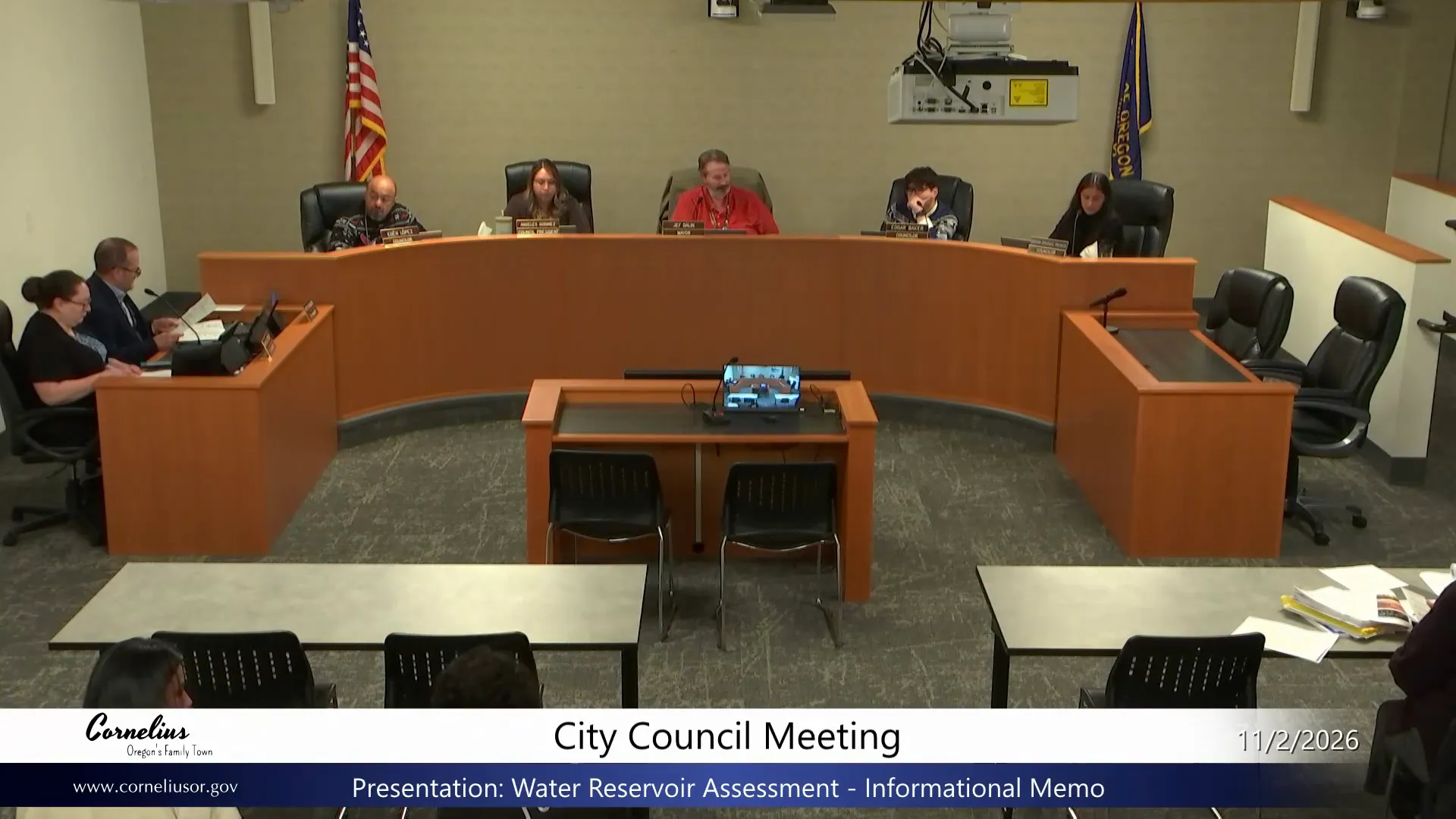
STREAMING COPY IN PREPARATION — RECORDING AVAILABLE FROM THE ORIGINAL SOURCE
Transcript — Verbatim
Speaker numbers apply only to this recording.
Discussion Breakdown — Share of Meeting
Engineering And Infrastructure32%
Transportation Safety15%
Public Records Management8%
Fiscal Sustainability6%
Public Safety6%
Water And Wastewater Management6%
Procedural5%
Public Works Recognition5%
Economic Development5%
Summary of Proceedings
Cornelius City Council Work Session and Regular Meeting – November 2, 2026
On November 2, 2026, the Cornelius City Council held a work session on pavement management followed by the regular council meeting. The meeting included recognitions, presentations on the TV Highway Transit Project and police quarterly report, a public hearing on public records policy, and council reports.
Pavement Management Update Work Session
- Terry Keys (City Engineer) and Kevin Oppenlander (Assistant City Engineer) presented the updated pavement management plan.
- The city maintains 41.5 miles of roadway, with 8.9 miles added since 2019.
- The Pavement Condition Index (PCI) dropped from 73 in 2019 to 70 in 2026. Without additional funding, it is projected to fall to 64 in five years and 59 in ten years.
- The current annual budget is $725,000. Scenarios requiring $2.6 million (maintain current PCI), $6.2 million (raise PCI to 75), and $8.7 million (eliminate backlog) were presented.
- Staff recommended focusing preservation efforts on high-volume collector roads (e.g., South 20th) and using cost-effective treatments like crack sealing and slurry seal. Major reconstruction is prioritized for roads carrying the most traffic.
- Council discussed funding challenges, including gas taxes, state transportation bills, and potential local fees. Mayor Delaney noted that raising $6.2 million annually would roughly double city property tax revenue. Council agreed to revisit the topic for further discussion.
Consent Calendar
- Resolution 2026-62 was moved to the regular agenda at Councillor Gonzalez’s request.
- The remaining consent items—city council minutes and liquor license applications—were approved unanimously (motion by Councillor Goodiness, second by Councillor Lopez, all ayes).
Public Comments & Testimony
- No public comments were made.
Recognitions
- Tim Franz (Community Development) – 20 Years of Service: Barbara Fryer recognized Tim Franz for his institutional knowledge, handling over 1,900 projects since 2015 and 370 applications per year during COVID. Franz expressed gratitude for the opportunity to work for the city.
- American Public Works Association (APWA) Oregon Chapter Award – Mariposa Causeway: City Manager Peter Brandham presented the award for the 290-foot elevated pedestrian causeway, built for $1.5 million. He noted the project’s sensitive natural area compliance, wildlife viewing opportunities, and connection of Laurel Woods to Mariposa Park. Former city manager Rob Drake was acknowledged for early efforts. The project will be submitted for APWA National Project of the Year.
Presentations and Discussion Items
TriMet TV Highway Transit and Safety Project
- Josh (TriMet) provided an update on the 16.2-mile bus rapid transit (BRT) line from Beaverton Transit Center to Forest Grove, with 42 station pairs.
- Design is at 30%; the current cost estimate is approximately $284 million. Funding includes $40 million from the state, $14 million from local partners, and federal Small Starts grants.
- Electric buses were deemed infeasible due to Merlot facility constraints; the project will use 40-foot diesel buses (renewable diesel) but is designed to accommodate 60-foot articulated vehicles in the future.
- Construction is expected to begin summer 2028, with service opening in 2030.
- Council discussed fleet choices, budget pressures, and the importance of cost-conscious station design. TriMet noted ongoing conversations about the Forest Grove layover facility and the need for a modular, low-cost solution.
Police Quarterly Report
- Chief Coley reported on past, current, and future initiatives.
- Past: A partnership with Barbara Fryer educated the community on municipal code violations (home businesses, parking, storage). An interagency team seized over a kilogram of opioids in Cornelius. Chief Coley and Deputy C. Miller will receive a critical incident award for SWAT involvement in a Sandy homicide-hostage incident.
- Current: An e-bike ordinance is in draft, being coordinated with Hillsboro and Forest Grove for consistency along Council Creek Trail.
- Future: Pedestrian safety reminders; enforcement focusing on education rather than fines for minors, with potential parental liability for serious violations.
- Mayor Delaney detailed Oregon e-bike classifications (Class 1, 2, 3) and emphasized that these vehicles are not toys and require age and safety compliance.
- Council discussed balancing safety with equitable enforcement, especially for youth.
Water Reservoir Assessment Informational Memo
- City Manager Brandham clarified language in the memo regarding lead-containing paint: TCLP analysis is not required for the reservoir building because it will not be demolished. Soil samples were not analyzed because no lead was detected in the paint. Council accepted the clarification.
Public Hearing – Resolution 2026-63: Public Records Request Policy Update
- Staff presented the updated policy, which replaces the 2008 version. Key changes include a new fee structure: $50, $75, or $100 per hour based on employee classification (first 30 minutes free). IT, legal counsel, and outside contracts remain at actual hourly rates. The policy clarifies processing goals and reinforces the use of a request form.
- No public testimony was offered. Council passed the resolution unanimously (motion by Councillor Baker, second by Councillor Gonzalez).
New Business – Resolution 2026-62: AKS Work Order No. 31
- The resolution authorizes a work order for design of South Cornelius water and sanitary sewer improvements (Turkey Scenario Engineer).
- Councillor Gonzalez asked about contract history (AKS first contracted in 2018), reimbursable expenses (mileage, administrative services – budgeted at $2,000 to ensure cost control), and the “overall disturbance” assumption (under one acre to avoid additional erosion control requirements). City Engineer Keys confirmed that cost control is maintained by not embedding these expenses in hourly rates.
- The resolution was approved unanimously (motion by Councillor Baker, second by Councillor Gonzalez).
Council Reports
- Councillor Goodiness: Expressed concern about increased ICE enforcement in the community, noting an ACLU video of tire-slashing in Hillsboro. Encouraged community members to know their rights, sign up with Equity Corps of Oregon for legal support, and contact local organizations (Adelante Mujeres, Centro Cultural) for assistance with family separation. Reminded drivers to watch for pedestrians in dark conditions after daylight saving time.
- Councillor Baker: Noted that immigration courts are under the executive branch and recommended seeking outside legal representation. Reported on a town hall with Representative Susan Family, an education roundtable, Metro’s 50-year planning effort, and the State of the County address. Highlighted potential for a new courthouse in Washington County and expressed optimism about a more diverse future House caucus.
- Mayor Delaney: Reported on JPAC and MPAC meetings, noting concerns about TriMet ridership (60–70% of pre-pandemic levels) and a proposed 30% budget cut. Stressed the need for economic growth, citing closure of a Freightliner plant, high state government costs, and the capital activities tax burden on small businesses. Praised staff for maintaining lean operations as the city grew from 9,000 to 15,000 residents with minimal staffing increases. Announced continued participation in the Metropolitan Mayors Consortium, which has growing influence with state legislators.
- City Manager Brandham: Recognized staff and Pacific North Construction for quickly repairing a homeowner’s water service line on 14th Street after a break during sewer work. Noted that the contract includes contingency for such situations. Encouraged council attendance at the community dinner on November 21 and promoted the volunteer sign-up.
Key Outcomes
- Pavement management funding will be brought back for further council discussion.
- Consent agenda items (minutes, liquor licenses) approved unanimously.
- Resolution 2026-63 (public records policy) adopted unanimously; new fee schedule effective immediately.
- Resolution 2026-62 (AKS work order) approved unanimously.
- E-bike ordinance remains in draft; staff will continue coordination with neighboring cities.
- Council acknowledged community concerns about ICE enforcement and directed residents to city resources.
- Staff and contractor commended for responsive utility repair.
Meeting Transcript
City Council. We're having our work session on pavement management update. This is for Monday, November 2nd, 2026. Staff, Terry Keys, City Engineer, and uh Kevin Oppenlander, Assistant City Engineer. We didn't just see where your time. Now you're gonna have to talk like you're selling us uh medications on the internet or something. Come on, pick it up, pick it up. Stay a half an hour, you get 20 minutes. All right, I'm thank you. Thank you, Mr. Mayor. Members of the council. I'm Turi Key, City Engineer. This is Kevin Openlander, assistant city engineer. This is really Kevin's show. Uh, every about five or six years, we do an update to our pavement management plan. The first one we, the first really real one we did is about six or seven years ago, and we just finished updating it last month, and it really kind of tells us how to spend our pavement management money as effectively as possible and get the most bang for the buck. And Kevin is our pavement expert, so I'm gonna turn it over to him. Great. Thank you, Terry. And thank you, Council and Mayor Delaney for letting me be here for a few moments to go over. Oh, yes, I need to get it closer. Can't hear your voice when you're not close enough. Yes, I hear me now. There we go. So the pavement management program and the report includes four major components a pavement inventory, pavement condition assessment, budget analysis, and a five-year plan. Pavement inventory is pretty self-explanatory. It's a database they put together of the segments of road throughout the city of Cornelius. In this instance, uh, since it's been a few years since the last report, we had to add quite a few miles of road. We've had a few new subdivisions come in, so that is included in this report. The pavement condition assessment, that is when they go out there and they assess the condition of all the asphalt. They do a visual inspection of segments, they do a sampling, 25% of the area, and they rank them, give them a rating of between zero to a hundred, hundred being the best, zero being the worst, and then they also do a budget analysis, they look at those ratings for all the segments of roadway, and then they look at our budget and they come up with budget scenarios for us to look at and to review. And then we take that information and we work on a five year plan with them. GRI is our consultant, and we've worked with them closely on how to prioritize the different roadways and different pavement management types to get the best result, as Terry mentioned. Oh, is it slow to react? Okay. Yeah, there we go. Thank you. This is a map of our current road system, and it is includes Laurel Woods, Cascaded Gardens, Greystone. Those are the few places that have been added over the since the last report. And what this shows you is a classification map, has the arterials in red, the collectors in green, and the local roads in blue.
SUMMARIZED BY OPENPUBLICA AI
TRANSCRIPT VIA PUBLIC VIDEO
openpublica.com
openpublica.com