OPENPUBLICA · PUBLIC MEETING RECORD
Record of Proceedings
Denver Community Planning and Housing Committee Advances Historic Tax Credit Amendment, Nov. 3, 2026
Council Committees — Tuesday, November 3, 2026
BodyDenver, Colorado
SessionCouncil Committees
DateTuesday, November 3, 2026
StatusNEW · FILED
Video Record
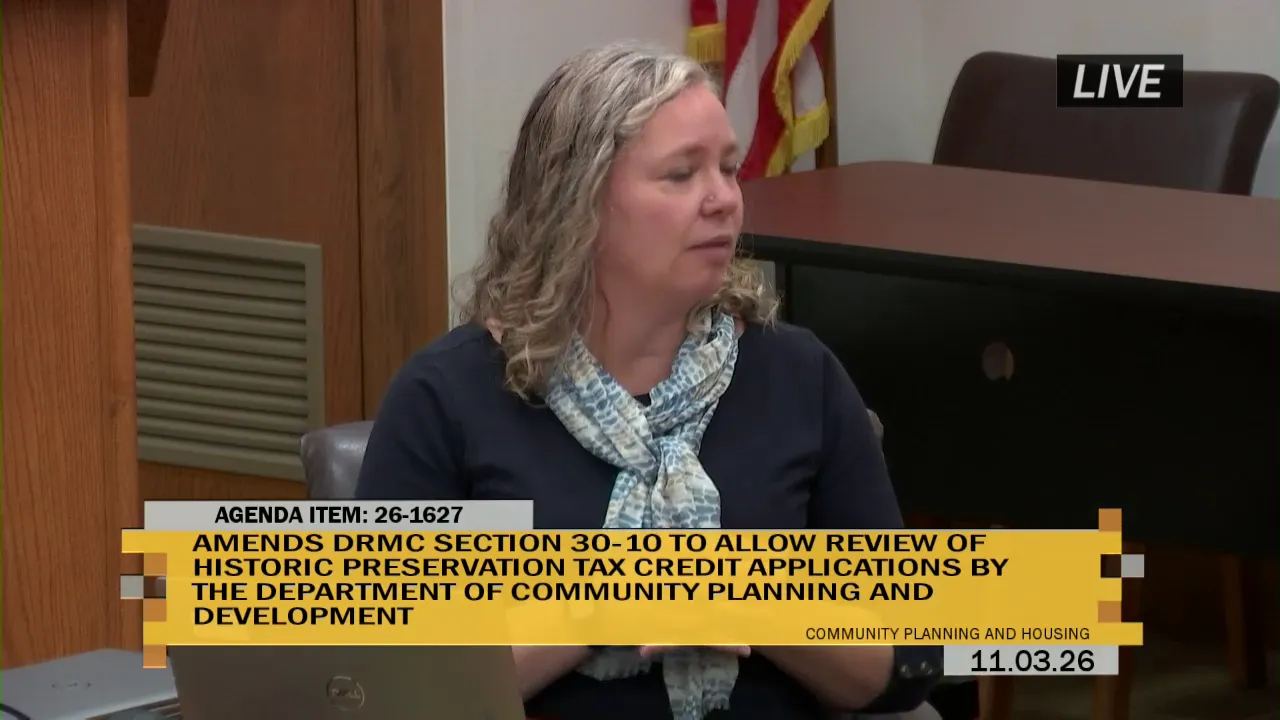
STREAMING COPY IN PREPARATION — RECORDING AVAILABLE FROM THE ORIGINAL SOURCE
Transcript — Verbatim
Speaker numbers apply only to this recording. Names come from transcript evidence. “Possibly” marks uncertain attribution.
Discussion Breakdown — Share of Meeting
Historic Preservation98%
Procedural2%
Summary of Proceedings
Denver Community Planning and Housing Committee Meeting – November 3, 2026
The Community Planning and Housing Committee of Denver City Council met on Tuesday, Nov. 3, 2026, with a single action item: a proposed amendment to Section 30-10 of the Denver Revised Municipal Code governing historic preservation tax credits. Vice Chair Amanda Sawyer (District 5) presided and opened the meeting by reminding anyone who had not voted to go to the polls. Committee members present included Jamie Torres (District 3), Paul Cashman (District 6), John Taylor (District 8), and Diana Romero Campbell (District 4). The meeting ended with the committee moving the item to the full City Council.
Public Comments & Testimony
- No members of the public signed up for the 15 minutes of public comment set aside for the ordinance change.
Discussion Items
- Jen Capetto, manager of the landmark team in Community Planning and Development, presented the proposed amendment. She explained that the landmark ordinance is nearly 60 years old and Denver is a certified local government under the National Park Service.
- The amendment would remove a reference to an expired 1990 state statute, update references to the current state tax credit program, and allow landmark preservation staff to review and certify residential, non-income-producing tax credit applications instead of requiring Landmark Preservation Commission approval. Commercial, income-producing properties would continue to be handled by the state.
- Capetto reported that last year Denver Landmark Preservation certified almost $550,000 in tax credits for non-commercial properties, from roughly 40 applicants. Qualified rehabilitation costs can earn up to 20% in tax credits, capped at $100,000 per property for 10 years or until the property is sold. Funding comes from the state general fund, not the city's general fund.
- Councilmember Torres asked how the process would change for residents. Capetto said the pre-application process remains the same but certification could be faster because staff approval replaces commission review.
- Councilmember Cashman asked where program funding comes from; Capetto confirmed it is state money. Cashman called this “fantastic news.”
- The council president asked whether the change might increase applications. Capetto said she hopes more people will apply, noted outreach efforts including postcards to recent buyers in historic districts, and directed interested residents to landmark@denvergov.org or denvergov.org/landmark.
Key Outcomes
- Councilmember Torres moved approval of the Section 30-10 amendment; Councilmember Cashman seconded. The committee approved the action item without a roll-call vote and advanced it to the full City Council.
- No consent calendar items were considered.
Meeting Transcript
Welcome back to this weekly meeting of the Community Planning and Housing Committee with Denver City Council. Your community planning and housing committee starts now. All right, good afternoon, everyone. It is Tuesday, November 3rd, election day. Everyone of you have not voted, please go out and vote. I don't care how you vote, but get out there and do it. I'm Amanda Sawyer. I have the honor of representing the residents of District 5 and also vice chairing the community planning and housing committee. Before we get started, why don't we do a round of introductions and I will start to my left. Jamie Torres, West Denver District 3. Good afternoon, Paul Cashman, South Denver District 6. John Taylor is District 8. Good afternoon, Diana Romero Campbell, Southeast Denver District 4. That is District 7. All right, we have a quick one today. Well, it might not be quick, but we only have one item to discuss today that is an action item in 1627 historic preservation tax credit application. So why don't you introduce yourself and take it away, please? Sounds great. I'm Jen Capetto. I manage the landmark team for community planning and development. So I'm here to present uh a proposed amendment to section 30-10 of the Denver Revised Municipal Code, which is the landmark ordinance. It's the section about tax credits. Just a quick reminder that uh the landmark ordinance was established by City Council almost 60 years ago. We are 59 years right now. Um, and uh looking forward to next year, which will be our 60th. Um the purpose was to designate preserve and protect properties in Denver, but also to foster civic pride, stabilize and improve aesthetic and economic vitality and promote good urban design. So the proposal here um before you is to amend Chapter 30 10 or section 30-10 of the um revised municipal code. Landmark preservation is a certified local government by the National Park Service. And as a certified local government, Denver Landmark Preservation, my team is um has been delegated to review tax credits for non-commercial properties in Denver County. So those are properties that are uh not they they could be residential, but they are non-income producing properties. Um we've been doing this for many years, um, and last year the Denver Landmark Preservation Commission certified almost $550,000 in tax credits uh for non-commercial properties in Denver. So those went back to the property owners who then use that to help with their contractor payments and their um their uh work on their um homes, their architecture payments and things like that. So um it's really great. It's a wonderful tax credit program, um, and we're excited that we're still doing this. But what we're proposing to do is to uh remove a reference to an expired state statute. This is the 1990 state statute that is no longer um in effect. There is an updated statute that is still included in our ordinance. But we also would like to allow landmark preservation staff to review tax credit applications and certify those rather than this the landmark preservation commission. That is something that the um state has said is fine. We are one of the only municipalities in the state that requires our commission to approve them, and they were actually wondering why we do this, and we thought it was there for regulation. It's not. Um so we also would like to clarify that that the landmark team's only reviewing residential, which is non-income producing tax credit applications. The state is responsible for the commercial um income producing ones. So um got a very messy ordinance with things that are taken out. Um, but here's the cleaned up version, and it's that the executive director out um and the staff uh of CPD shall act as a reviewing entity.
SUMMARIZED BY OPENPUBLICA AI
TRANSCRIPT VIA PUBLIC VIDEO
openpublica.com
openpublica.com