Mayor-Council Meeting Update on Migrant Supports and Federal Advocacy - January 23, 2024
STREAMING COPY IN PREPARATION — RECORDING AVAILABLE FROM THE ORIGINAL SOURCE
Mayor-Council Meeting Update on Migrant Supports and Federal Advocacy - January 23, 2024
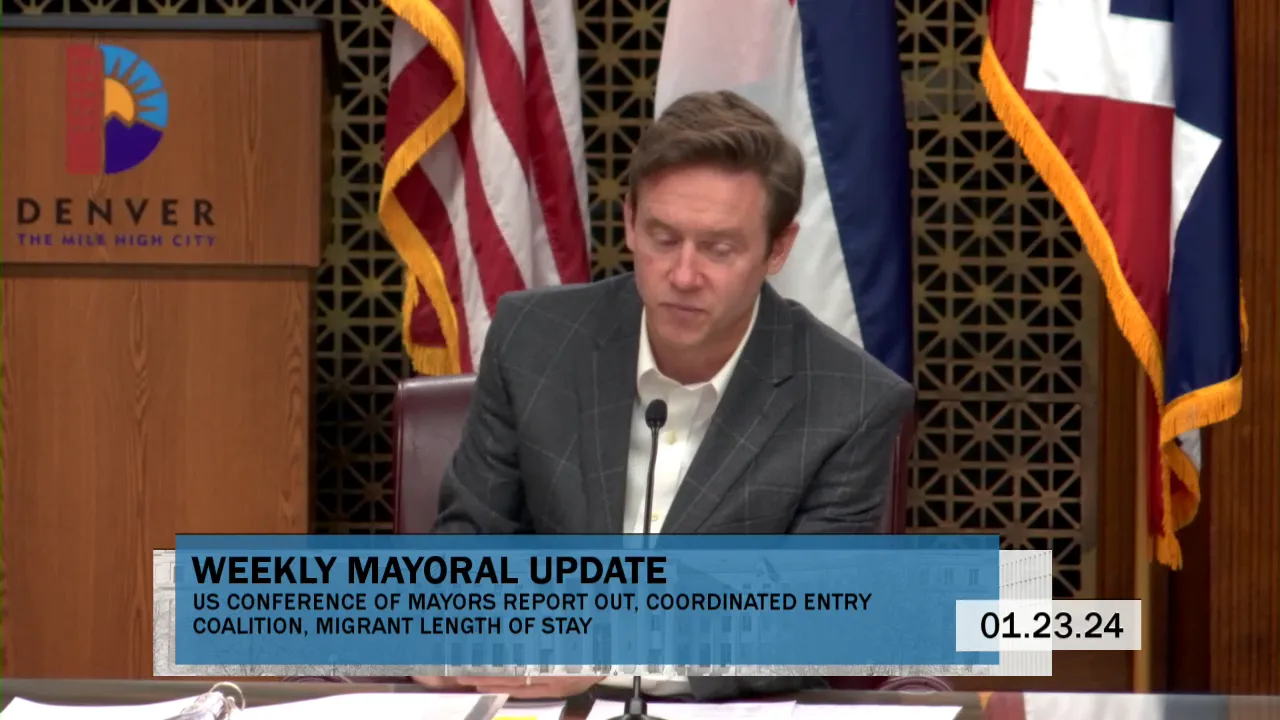
This meeting of the Mayor and Denver City Council on January 23, 2024, focused primarily on an update from Mayor regarding migrant support services, federal advocacy efforts, and legislative prospects. The meeting concluded with a motion to enter executive session to discuss collective bargaining negotiations.
Discussion Items
- Migrant Support and Federal Advocacy Update: Mayor reported on his recent trip to Washington D.C. for the U.S. Conference of Mayors, where he engaged with mayors, White House officials, and Senators on three key needs: increased federal funding, expanded and expedited work authorization, and a coordinated entry system for migrants. He noted that conversations with Senate sponsors suggest a bipartisan bill including federal dollars and accelerated work authorization may be introduced in the coming week. However, he expressed concern about passage in the House of Representatives, recalling the 2013 Gang of Eight proposal that stalled. He outlined three near-term options: passage of federal legislation, executive actions (e.g., extending TPS for Venezuelans), and reallocation of city resources or service adjustments. He emphasized that Denver is at carrying capacity with about 5,000 newcomers and that any surge (e.g., 250 arrivals per day) would overwhelm capacity.
- Council Questions and Responses:
- Councilman Gonzalez-Cutieris asked whether the proposed bill and potential executive orders would apply to all immigrants or only Venezuelans. Mayor responded that the bill likely focuses on future arrivals and may not apply to current residents, and executive orders are not yet concrete. He noted that other cities have different immigrant populations (e.g., New York and Chicago see more African and Caribbean asylum seekers).
- Councilman Sawyer asked how the Council could support the Mayor's advocacy. Mayor suggested a joint letter, mobilization of councils from other cities, and leveraging council members' personal networks to persuade federal lawmakers. He acknowledged the bill may contain provisions some may not like, but expressed his bias toward securing city relief given the severe consequences of inaction.
Key Outcomes
- The Council received the update and discussed potential support actions.
- The Council voted unanimously to move into executive session pursuant to DRMC 233 C1 and 234A6 for collective bargaining negotiations. The motion passed with two-thirds vote of members present. The meeting then adjourned into executive session.
Note: No agenda or minutes were available; summary based solely on transcript.
Meeting Transcript
Welcome to this meeting of the mayor and Denver City Council. At this weekly session, city agencies brief the mayor and council members on various proposals and projects across the city. This meeting of the mayor and city council members begins now. We still can't hear the music. Oh, yeah. Oh, I'd love to do it. And we should add some cities. Good morning. So we're about to. Council members, great to see you. We are live. Welcome to Mayor Council this Tuesday morning. We will start with some introductions. Councilman Sawyer, you want to start us off? Okay, sorry. Uh hi, I'm Anda Sawyer, District Five. Sarah Purdy representing the city at large. Serena Gonzalez, also representing the city at Gonzalez Council. Also representing the city at large. Kevin Flynn, South West Denver District Two. Good morning, Jamie Torres, District Three. Wonderful. Great to see you all this morning. Um, we'll start in with announcements if there are any announcements that people want to share for the listening public other than Councilman Gonzalez's criteria's announcement already this morning. I would. Yes, Council President. Thank you so much. And Mayor, I want to thank you for coming up last night during our our three thirty session, uh being able to share a proclamation, thanking city employees for the work that they've been doing largely on our migrant response and uh House a Thousand efforts. But um really it it it it rolls in how much work city employees have been doing since the beginning of COVID. Um and as we're coming up to two months away from uh the four-year anniversary, I think we all remember where we were on March thirteenth, twenty twenty, and um just how eerie that was and and what that kick started in so I just want to thank all my colleagues um and uh and our city employees um again for for all of their dedication to this city. So thank you so much. Uh I wanted to add to that. I thought you all did a um tremendous job with that. It was so moving. I saw there were a lot of tears in the audience as you shared the stories of how grateful you were and the impact you've had. I think the city employees really felt seen and recognized, and I thought you all did a beautiful job. So thank you so much for doing that. Um other announcements. Okay, it's a full business crowd this morning, ready to get onward. Um, we do have um I want to do an update on uh migrant supports and services today and update you a little bit on our uh work last week in DC on the conference of mayors and some on federal legislation, and so uh I wanted to do an update there and then um uh take any questions or thoughts people may have. That's the only topic I have on the agenda this morning, and then we have uh we do have an executive session with uh city attorney's office. So uh for the update, uh I was in DC last week for the U.S. conference of mayors, which gave us a chance both to visit with uh mayors from the country around this uh need, but also with leaders from the White House and also with uh senators uh who are involved in the drafting of the legislation to try to work on a uh solution, we hope on this uh need. So I want to update you on a couple of fronts. As you all know, we've been talking regularly about the three things that we think Denver needs to be successful here. One is increased number of federal dollars to help support us and welcoming people. Uh this is our most urgent need now as we look at the prospect of having to make budget cuts. The best way for us to reduce those cuts would be to actually get federal support for these services. So we're pushing very hard on that. The second was on increased work authorization, as you all know.
openpublica.com