Eagan City Council Meeting - February 17, 2026: Data Center Moratorium Approved
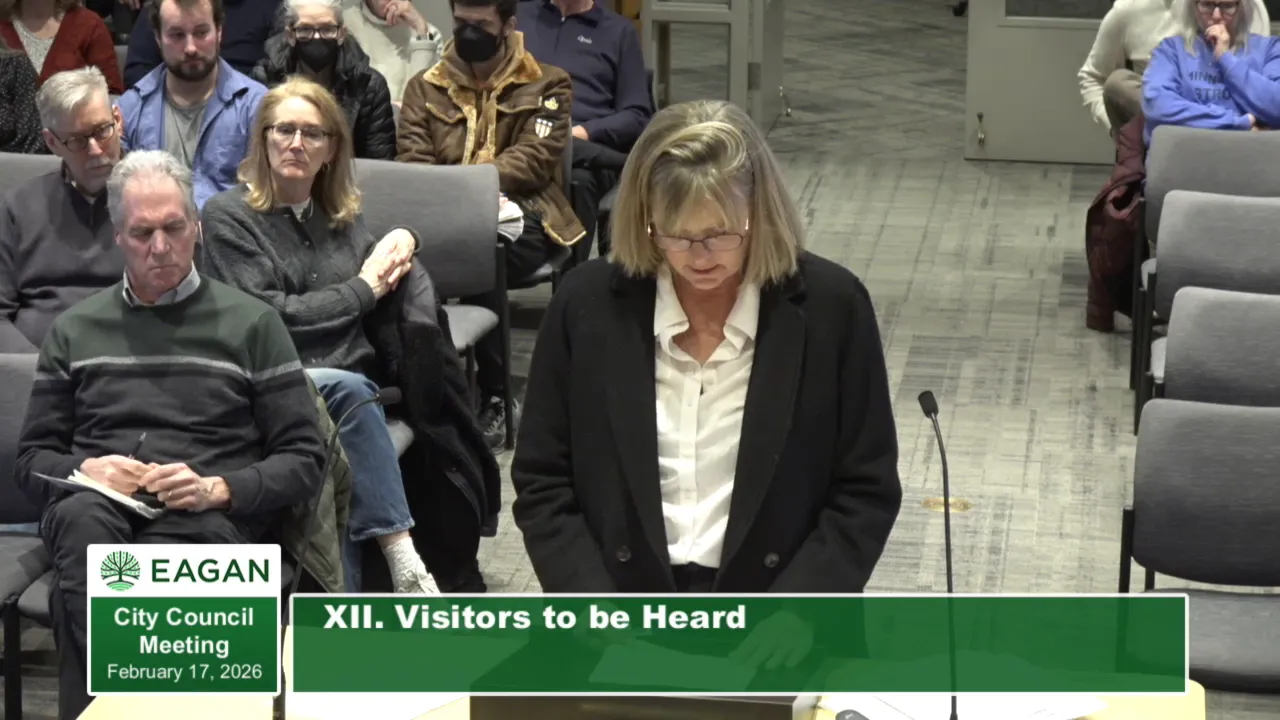
STREAMING COPY IN PREPARATION — RECORDING AVAILABLE FROM THE ORIGINAL SOURCE
Eagan City Council Meeting – February 17, 2026
The Eagan City Council met at 6:30 PM on February 17, 2026, at the Eagan Municipal Center. Mayor [Name] presided, with Councilmember Fields absent. The council adopted the agenda and consent agenda, held a public hearing on a one-year moratorium for data centers, briefly convened as the Economic Development Authority (EDA), received administrative updates, and heard public comments regarding a potential ICE detention center. The meeting adjourned without a closed session.
Consent Calendar
- Approved unanimously (3-0) the following items: approval of minutes, personnel items, check registers, contracts, a resolution to accept donations, a temporary beer and wine license (with fee waiver) for the Eagan Athletic Association, a directive to prepare an ordinance amendment for massage license appeal hearings, updates to the Pavement Management Program, final payment for Contract 25-13 (Eagandale Sanitary Sewer Replacement), plans and specifications for three street improvement contracts (26-01, 26-02) and traffic signal revisions (24-10), a resolution for State Aid Bond payment release, an amendment to the Business Assistance Policy’s table of financial assistance programs, and a directive to prepare an ordinance amendment regarding cryptocurrency ATM machines.
Public Comments & Testimony
Public Hearing – Data Center Moratorium
- Leo Caravello (Eagan resident) expressed concerns about water consumption, energy use, pollution, and lack of community benefit. He proposed lowering the moratorium threshold from 20 megawatts (MW) to 5 MW and increasing the residential setback from 500 feet to one mile.
- Jacob Steen (Larkin Hoffman, representing OpaDan, owner of an existing data center at 3621 Argenta Trail) thanked staff for the redline language but argued that regulating power usage as a proxy for zoning exceeds city authority under Minnesota law. He requested striking the language limiting approved existing data centers to 9 MW.
- Bill Jaco (Eagan resident) supported Caravello’s comments and called for a full ban on AI centers, citing noise and pollution from diesel backup generators and long-term planning risks.
- Susan Johnson (33-year Eagan resident) applauded the council for being the first Minnesota city to slow large data centers and urged continued public follow-through on the study.
Visitors to Be Heard (Non-Agenda Items)
- Nancy Lepink (Eagan resident) urged proactive measures to prevent a federal detention center in Eagan. She presented a draft resolution opposing such facilities, calling for community hearings and direct engagement with property owners.
- Matthew Shands (Eagan resident, 27 years) provided a list of 17 industrial properties for sale or lease that could be converted into a detention center. He cited other cities successfully opposing similar facilities and asked the council to act preemptively.
- Deborah Huganen (30-year Eagan resident) supported the proactive stance and noted many residents are afraid to speak but share the same concerns.
Discussion Items
Data Center Moratorium (Public Hearing and Council Deliberation)
- Staff Presentation: City Administrator Diane Miller and Community Development Director Jill Hootmacher explained the proposed interim ordinance (moratorium) to study data centers, cryptocurrency mining, and AI operations. The draft ordinance restricts new or expanded data centers using more than 20 MW or located within 500 feet of residential properties. It exempts improvements to existing approved data centers up to 9 MW. The one-year moratorium expires February 17, 2027, unless lifted earlier by the council.
- Council Discussion: Mayor [Name] expressed support for the redline language (clarifying the 9 MW exemption) and declined proposed changes to lower thresholds, stating the goal was to implement the moratorium quickly and study impacts. He emphasized that smaller existing data centers (four in Eagan, all at or below 20 MW) would not be affected and that the study would inform future regulations on water, noise, and energy use. Councilmember Backen clarified that the motion included the redline language.
- Vote: Motion to close the public hearing and adopt the ordinance (adding Section 12.09 to City Code) passed 3-0.
Administrative Agenda – City Council Comments (Detention Center Context)
- Mayor [Name] addressed community anxiety about Operation Metro Surge and rumors of a federal detention center. He stated the city has no knowledge of any proposal for a detention center in Eagan and reaffirmed the city’s commitment to public safety and constitutional rights. He outlined two scenarios: if the federal government itself acquires property (supremacy clause applies) or if a private developer seeks to build a detention center (city land-use process applies, including public hearings). The city pledged to use all lawful tools to preserve community character while respecting federal authority.
Key Outcomes
- Data Center Moratorium: Ordinance adopted (3-0) establishing a one-year moratorium on new or expanded data centers over 20 MW or within 500 feet of residential uses, with a 9 MW exemption for improvements to existing approved centers.
- Economic Development Authority (EDA) Meeting: The council, sitting as the EDA, adopted the EDA agenda and consent agenda (amendment to the Business Assistance Policy and approval of January 20, 2026 EDA minutes) and adjourned.
- Visitors to Be Heard: No immediate action taken. City Administrator received the draft resolution and property list for future consideration. The city will continue to monitor any potential detention center proposals and engage the community.
- Next Steps: Staff will conduct a study on data centers and report recommendations to council before the moratorium expires. The council may hold future discussions on the detention center issue.
Meeting Transcript
It's our second meeting of the month of February. We have a fairly uh efficient and thin agenda for the evening. Um, my understanding is we're also going to have some visitors in uh visitors to be heard, so we'll um add that to the agenda or just make note that we'll be here for a bit now talking about that as well. Um with that, um, I don't have any other changes to the agenda, Miss No, any change the agenda. No, Mr. Mayor. Changes. Councilman have to have something to adopt the agenda as presented. Second. That's moved, and second, there's any further discussion on the agenda. I should mention that Council Member Fields won't be able to join us tonight. Um, but we should be able to get through the agenda just fine without her. So uh motion is made and seconded on the agenda. Uh no more discussion. All in three I and opposed nay, that motion carries, and we have an agenda. Uh we have no recognition and presentations tonight, so we'll go right to our consent agenda. Uh there any members of the public who are here on an item that appears in the consent agenda and wanted to see that item acted on separately or had questions on it. Saying none, I'll bring it back to the council. Council same question. Council Member Backen. Second. That's moved and seconded. So any further discussion on the consent agenda. Seeing none, all in favor signifying aye. I oppose nay. That motion carries and we've adopted the consent agenda. I'll go right now to our public hearings. We have one item in public hearings tonight. That's an ordinance amendment. It's an ordinance amendment to enact a moratorium for the study of data centers. Ms. Miller. Thank you, Mr. Mayor, members of the council. As the council will recall, at the January 13th special city council meeting, the council did discuss data centers and cryptocurrency mining. Minnesota statute does permit cities to adopt an interim ordinance or more commonly known as a moratorium to allow study of a specific land use issue without time pressure generated by pending applications. Thus, on February 2nd of this year, the council directed the preparation of the interim ordinance to implement a study to evaluate whether data centers require additional local regulation and also scheduled a public hearing for this evening. The proposed interim ordinance would apply only to the expansion or new development of data centers using more than 20 megawatts of electricity or within 500 feet of residential uses. Following feedback from owners of existing and approved data centers, the draft ordinance language was revised to clarify that improvements to existing or approved data centers are allowed are allowed, provided that the improvements do not allow the data center to use more than nine megawatts of electricity. The language revisions are shown in the red line version within your packet. This proposed ordinance will terminate on February 17th, 2027 or earlier at the council's choosing. Following the study, community development, along with any consultants will make recommendations to council regarding reasonable restrictions on the operation of data centers and cryptocurrency mining businesses within Egan. So with that introduction, I'm going to turn it over to our community development director, Jill Hootmacher, for a brief presentation. Jill, welcome. Good evening, Mayor and Council. Thank you. Just a little background. Data centers are the physical facilities housing the servers, storage, and network gear that support the internet and artificial intelligence. With the growth of AI, the data center industry has been growing exponentially in recent years. And as the size of data centers has grown, so have the impacts of noise and resource usage on the surrounding community.
openpublica.com