OPENPUBLICA · PUBLIC MEETING RECORD
Record of Proceedings
Eagle Mountain City Council Meeting - September 1, 2026
City Council — Tuesday, September 1, 2026
BodyEagle Mountain, Utah
SessionCity Council
DateTuesday, September 1, 2026
StatusFILED
Video Record
STREAMING COPY IN PREPARATION — RECORDING AVAILABLE FROM THE ORIGINAL SOURCE
Transcript — Verbatim
Speaker numbers apply only to this recording. Names come from transcript evidence. “Possibly” marks uncertain attribution.
Discussion Breakdown — Share of Meeting
Land Use Planning17%
Procedural16%
Engineering And Infrastructure13%
Community Engagement12%
Public Engagement11%
Parks and Recreation10%
Public Safety8%
Fiscal Sustainability8%
Economic Development2%
Summary of Proceedings
Eagle Mountain City Council Meeting - September 1, 2026
The Eagle Mountain City Council held a work session at 4:00 PM and a policy session at 7:00 PM on September 1, 2026, in the City Council Chambers. The work session included discussions on the Utah Wellbeing Project survey results, the annual community survey, a commercial sign placement, home business standards, and a community garden proposal. The policy session addressed public comments, a consent agenda, and scheduled items including a preliminary plat, retaining wall standards, a rezoning request, and a property tax allocation ordinance. Notable outcomes included approval of a preliminary plat for Gateway Park Phase 3, adoption of updated retaining wall construction standards, denial of a rezoning request for the Pinnacles properties, and enactment of a property tax allocation ordinance. The council also added the Todd A. Black Memorial Wildlife Migration Corridor to the legislative priorities list.
Consent Calendar
- Change Order #3 for White Hills 4MG Tank (final true-up costs) – approved.
- Minutes of August 18 and August 26, 2026 meetings – approved.
- Resolution approving Second Amendment to Brylee Farms Phase B Development Agreement – approved.
- Resolution to become official member of North Utah County Aquifer Council (NUCAC) – approved.
- Ordinance amending Youth Council Member Term Limits (2.45.010) – approved.
- Ordinance amending Land Disposals code (Chapter 3.30) – approved.
- Note: Item 12.A (Gateway Park Phase 3 Preliminary Plat) was removed from the consent agenda and considered separately.
Public Comments & Testimony
- Jason Ah You (Eagle Mountain resident): Spoke in support of Gateway Park Phase 3 preliminary plat, announcing a proposed charter school (Ripple Academy) on the site. He stated that over 300 residents have expressed interest and urged council approval.
- Anthony Wood (Eagle Mountain resident): Thanked the council for listening to residents during the tax rate discussions and encouraged residents to attend meetings. He shared a story comparing city finances to a family needing a larger vehicle, emphasizing resident responsibility.
Discussion Items
- Utah Wellbeing Project Survey Results (1.D): Dr. Courtney Flint (Utah State University) presented results from an April 2026 survey (359 responses). Key findings: personal well-being average 3.92 out of 5; community connection is low but linked to participation in events; 50% of respondents have lived in Eagle Mountain 5 years or less; top concerns include traffic, water supply, and water quality; 74% of those with childcare find it difficult to afford. The council discussed using results to improve community connection and address resident concerns.
- Annual Community Survey (1.E): Ron Gailey (OnPointe Insights) discussed survey design and proposed adding questions on recreation priorities (e.g., ice skating rink vs. field house), communication preferences, and recreation programs. Council requested refining questions, including on police presence and communication methods.
- Eagle Square Commercial Sign (1.A): Planner Steven Lehmitz presented a request to place two signs in the city's right-of-way. Applicant Brett Simpson confirmed sign placement 30 feet from curb, 80 feet from Porter's Crossing, with engineering approval. Council directed staff to bring back an action item with a lease/encroachment agreement, noting the owner assumes risk for future road widening.
- Home Business Standards (1.B): Councilmember Clark initiated discussion on expanding home business licenses to include farm-related products (e.g., eggs, honey, baked goods). Staff noted current code limits greenhouse sales. Council requested a code review for home-based businesses to allow greater flexibility for agricultural sales, with an emphasis on trip counts and parking limitations.
- Community Garden Presentation (1.C): Community Services Board Chair Jessie Southworth proposed a pilot community garden at Pioneer Park West, with 5-10 raised beds, no city funding or staff time requested. Local gardener Jen Corrington expressed strong community interest. Council supported the idea but requested a policy addressing liability waivers, financial procedures (including a fee structure), signage, and maintenance agreements. The policy is to be brought back for adoption.
Key Outcomes
- Gateway Park Phase 3 Preliminary Plat (12.A): Approved 4-0 (Councilmember Wood excused) with Condition 1 (lots permitted to front onto arterial/collector streets unless internal streets can be constructed) and omitting Condition 2 (road name change to Wild Blossom Boulevard). Motion by Councilmember Whiting, second by Clark.
- Retaining Wall Construction Standards Ordinance (15.A): Approved 4-0 with amendments: removed "multi-family" from section 5.B and added "or" before "institutional" in section 5.B. Motion by Councilmember Wright, second by Whiting.
- Pinnacles Rezoning and Master Development Plan Amendment (15.B): Denied 3-1 (Councilmember Clark dissenting). Motion by Councilmember Wright, second by Whiting. The council majority cited concerns about preserving commercial land and the original development agreement; applicant Andy Flamm noted loss of green belt status and lack of commercial demand, but council preferred to maintain the commercial zoning designation.
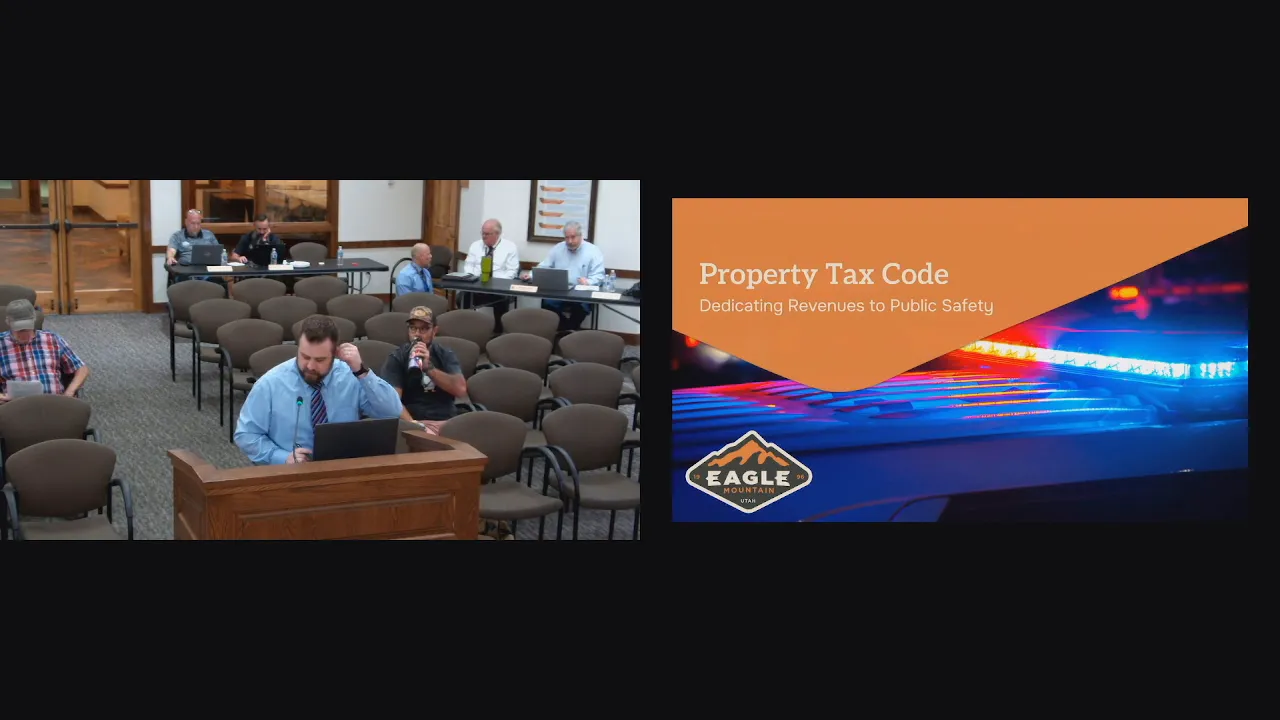
- Property Tax Allocation Ordinance (16.A): Approved 4-0 with correction changing "adoption" to "acceptance" in Section 3.50.110 B. Motion by Councilmember Huish, second by Whiting. The ordinance creates a public safety fund for property tax revenues, with annual reporting and coverage ratios.
- Legislative Priorities List (17.A): Approved 4-0 to add "Todd A. Black Memorial Wildlife Migration Corridor" to the list. Motion by Councilmember Wright, second by Clark.
- Directives: The Community Services Board will develop a policy for the community garden addressing liability waivers, financial compliance, and signage. Staff will review home business code and bring potential updates. The council will explore justice court options with neighboring cities and prioritize entering municipal code violations into the state’s master offense table. Councilmembers Clark and Whiting will work on agritourism code.
Meeting Transcript
We're gonna go ahead and get started and uh call this meeting our work session to order it's four oh one and uh Ben is gonna be here in just a minute. I think he's online for now until he gets here. Okay, and uh also just wanted to point out we do have a lot of closed session items to get through tonight for the council's awareness. So we're I want to stick as close as we can to these timelines, and we've told each of the presenters to make sure that half the times for the uh presentation and half the times for some discussion if that's the case. If there's something that requires more time, then just let us know that we needed to bring it back or something. But I want to try and make sure that we can stay on track because we got a lot to do in uh in a minute. So um with that in mind, I did move some things around uh earlier, but I don't think it changed anything. So we're gonna start off with uh one B discussion item one B, which is the uh the well-being project survey results. So uh Abby, were you gonna introduce yes? Thank you. Uh Mayor. Um I just want to introduce Dr. Courtney Flint, she's a professor at Utah State University. Um they did a well-being survey that was conducted in April twenty twenty-six of this year, and she's here to share the results, which I think are really interesting. So I'm going to turn the time over to her. Thank you for doing this. Sure. Awesome. So great to be with you. It's great to be partners again. Uh, we partnered with you on this project in 2020. A lot's changed in Eagle Mountain since then. So uh it's fun to look at the results. I'll hop right in. Um so the goals of the project, you know, I'm from Utah State. We're the land grant university. Any eggies in the house. Oh, we're far from Aggie land. Okay. Well, it's great to be here. We really provide with the Utah Well-being project um a way to help you keep your fingers on the pulse of how your residents are doing. Inform your planning processes um and and decision making. We do some research on the data related to well-being, and we support statewide and regional initiatives. We work closely with health districts, department of health, department of transportation, uh, uh office of planning and budget, things like that. Um as you can see from the map, we are all up and down the Wasatch Front and east and west and north and south uh across the state. Uh our city reports from our 2026 surveys are online. Yours is up on our website, so I encourage you to check that out if you haven't already. Um so this is an online survey. Uh it is a no-cost partnership with you. I emphasis on the word partnership. This would not happen without us working together. Because we provide the survey, we provide some materials, but you do the recruitment. We figure cities know best how to reach their residents, and we don't have the budget to do it any other way. So this is how it works.
SUMMARIZED BY OPENPUBLICA AI
TRANSCRIPT VIA PUBLIC VIDEO
openpublica.com
openpublica.com