The Eagle Mountain City Council met on November 4, 2026, beginning with a work session at 4:00 PM and a policy session at 7:00 PM. Councilmember Wood was absent due to illness; Councilmember Whiting left early for a family event. The meeting covered discussions on economic development incentives, water rights code revisions, concept plans, design exceptions, wildlife corridor naming, and public hearings on zoning and artificial turf regulations. Consent Calendar - Approved bond release for Parkway Fields Phase E, Plat 2 (into warranty). - Approved minutes of the October 20, 2026 regular meeting. - Approved site plan for UCCU Express. - Approved resolution for the Second Addendum to the Ranches Golf Course Agreement. - All consent items passed by a 4-0 roll call vote. Public Comments & Testimony - Tiffany Ulmer raised concerns about poor road conditions on Lake Mountain Road, water accumulation, and uncollected trash. She also noted increased data center traffic damaging the dirt road. Staff explained state law limits the city's ability to compel John Hancock Charter School to extend the road. Discussion Items 1.A. Strategic Industry Performance Incentive Program for Business Recruitment - Abby Ivory (Economic Development) presented a proposed framework to incentivize targeted industries (advanced manufacturing, energy, life sciences, aerospace/defense) using post-performance property tax reimbursement. The framework would require at least 100 full-time jobs at 100% of county average wage ($60,000+) and $50M capital investment. - Council members expressed reluctance to publicly disclose incentive limits, preferring to maintain negotiating leverage. They directed staff to focus on updating the general plan and creating targeted zoning (e.g., RTI overlay) to attract businesses rather than codifying a rigid incentive program. Council also emphasized supporting small and mid-sized businesses. Abby Ivory was encouraged to continue gathering site selector feedback. 1.B. Water Rights Code - Brandon presented a comprehensive code revision to clarify water dedication timing, create a Water Rights Analyst position, and require utility plans earlier in the development process. Key changes include dedicating residential water at master development plan (MDP) stage (instead of building permit) and requiring a will-serve letter at concept plan. - Developers (Scott Hazard) argued that dedicating water at MDP imposes an extraordinary capital exaction, and recommended dedication at final plat instead. Staff acknowledged the concern and proposed a water banking solution where water rights are moved to city wells but remain owned by the developer until plat. - Council directed staff to work with developers to refine the code, potentially allowing dedication at final plat or through a banking mechanism, while ensuring water rights are not rehypothecated. Discussion to continue outside the meeting. 1.C. Deer Run Concept Plan - Ivory Homes presented a revised concept plan for Deer Run (Foothill Residential zone). Changes include removing two parcels and adjusting the wildlife corridor alignment per council feedback. The wash area is not part of the wildlife corridor; staff noted code requires 75-foot setback from natural washes, but applicant disputed applicability. Council discussed selling city-owned land (approximately 3 acres) to incorporate into the development. - Council expressed support for proceeding to a draft development agreement, with conditions: water dedication to be discussed; potential equestrian overlay on large lots; and inclusion of the city parcel. Next step: formal master development plan application. 1.D. Harmony Phase A Plat MF 3 - Design/Code Exception(s) - The applicant (Flagship Homes) sought to convert a 90-unit condo plan to 68 townhomes. A prior code change requires townhouses to front on streets, not service drives. The proposed design uses Lulu Lane as a service drive, which does not comply. Options discussed: flipping units to face inward with a service drive maintained by HOA, or keeping the current layout with an overbuilt service drive. - Council favored flipping units to face the interior, with a 10-foot landscape buffer along Walden Parkway and a private service drive maintained by the HOA. Staff and applicant will meet to resolve utility conflicts and refine the design. 1.E. Proposed Renaming of the Wildlife Corridor - Council agreed to name the wildlife corridor the "Todd A. Black Wildlife Corridor" (without the word "Memorial") to honor Todd Black's contributions. A resolution will be prepared for the next meeting. Council also discussed potential future signage at bridge and access points. 14.A. Resolution Authorizing Land Disposal Application (Parcel 38:257:0108) - Applicant Mark Baum built a concrete wall on city property to mitigate water runoff into his yard. He requested to purchase the 0.04-acre parcel or donate the wall. Council approved the resolution to begin the public hearing process, with intent to sell the property to the applicant to avoid city liability for the wall. Vote: 4-0. Key Outcomes - Strategic Incentive Program: Council directed staff to focus on general plan updates and targeted zoning rather than a formal incentive framework. - Water Rights Code: Staff to revise the code to allow water dedication at final plat or through banking; continued collaboration with developers. - Deer Run Concept Plan: Council approved moving forward with a draft development agreement, including potential sale of city-owned land. - Harmony Phase A: Council directed staff and applicant to redesign with units facing inward and a private service drive. - Wildlife Corridor Naming: Name set as "Todd A. Black Wildlife Corridor"; resolution forthcoming. - Land Disposal: Approved to proceed with public hearing for sale of city parcel to Mark Baum. - Public Hearings (15.A and 15.B): Approved zoning map amendments for Oak Hollow and Parkway Crossroads (4-0). Approved artificial turf code amendments (4-0). - Consent Agenda: Approved unanimously. - Liaison Reports and Legislative Priorities: Updates provided; standard wall design discussion deferred to next meeting. - Closed Sessions: Council held two closed sessions (at 6:19 PM and 8:16 PM) for litigation, personnel, real property, and development agreement discussions. No action taken in open session thereafter.
Public Meetings - Eagle Mountain, Utah
Public Meetings - Eagle Mountain, UtahThe Eagle Mountain City Council met on October 20, 2026, for a Work Session from 4:01 PM to 5:17 PM and a Policy Session from 7:04 PM to 8:32 PM. Mayor Jared Gray presided. City Manager Ben Reeves and Deputy City Manager Steve Mumford participated remotely due to the ICMA Conference. Discussions included the Mortgage Assistance Program (MAP) funding, Alternative Energy Overlay Zone revisions, the Corrigan Farms development, a land disposal application, and a Wildland-Urban Interface (WUI) ordinance. Consent Calendar - Councilmember Brett Wright recused himself from voting on Items 10.B, 10.C, and 10.D (Firefly NPA 8 Phase A, Plats 3, 4, and 5) due to a conflict of interest from owning rental property in the area. These items were removed from the main consent agenda and voted on separately, passing with a 4-0 vote. - The remaining consent agenda was approved unanimously. This included bond releases, change orders, meeting minutes, and resolutions. - Resolution 13.A recognizing the Eagle Mountain Community Chaplain Program was adopted. Lyman Gifford, an interfaith chaplain, introduced himself and his wife and provided an overview of chaplain services. - Resolution 13.D approving the Quicksilver Solar Community Reinvestment Project Area Interlocal Agreement was adopted. Public Comments & Testimony - No members of the public spoke in person. - Two written comments were received: Jill Jones requested a community saltwater pool, and Jeff Lister submitted a comment regarding the Golden Eagle sidewalk widening project. - No public testimony was offered during the public hearing for the Wildland-Urban Interface (WUI) ordinance (Item 16.A). Discussion Items - MAP Funding Capacity and Tier Prioritization (1.A): Affordable Housing Coordinator Kiara Polee reported a 139% year-over-year increase in applications. Of the total $1.2 million allocated for FY2027, approximately $350,000 has been used, leaving roughly $840,000. The City Council discussed improving application prioritization for Tier 3 (general public) applicants. Councilmember Rich Wood proposed a weighted lottery system based on Area Median Income (AMI) to give lower-income applicants a better chance. Councilmembers largely agreed this approach was preferable to segmenting by profession. The council requested staff provide projections on future funding capacity and explore the possibility of an ADU revitalization grant program. - Alternative Energy Overlay Zone (AOZ) Revisions (1.B): Evan Berrett presented revisions including: disassociating the AOZ from the RTI overlay, defining SMR facilities without long-term waste storage, requiring air dispersion modeling for natural gas, and shifting site plan approval authority from the DRC to the City Council. Councilmember Craig Whiting advocated strongly for removing dry steam and flash steam geothermal technologies from the code due to high water consumption and visual concerns (steam clouds), preferring to limit the zone to binary and enhanced geothermal systems. A 2-gigawatt cap on natural gas was also discussed. The council directed staff to incorporate the feedback and bring the revised code back for formal consideration. - Corrigan Farms Development Agreement (1.C / 14.B): City Attorney Marcus Draper reviewed changes to the agreement based on previous council feedback. Key changes included removing the on-site natural gas power plant provision (requiring a separate future application under the AOZ), reducing the term from 20 to 10 years, and clarifying that the developer bears operational and maintenance costs for any connected lift stations. Councilmember Wood stated he remained opposed to granting entitlements without a specific end user. - Land Disposal Application (15.A): City Recorder Lacie Messerly presented an application from residents to purchase approximately 40 feet of an 80-foot-wide city-owned open space corridor behind homes in Eagle Park Phase I. The council debated the appropriate width, the lack of a city-wide plan for such spaces, and fair treatment of residents. Councilmember Craig Whiting suggested having the Community Services Board review the property. - Wildland-Urban Interface (WUI) Ordinance (16.A): Long Range Planner Elizabeth Fewkes explained the proposed code amendments necessitated by state law (HB 215). The changes allow vegetation removal for defensible space in WUI zones and require WUI designations on final plats. Key Outcomes - Corrigan Farms Rezone (14.A): The ordinance rezoning the 41-acre parcel to the RTI Overlay Zone passed unanimously. - Corrigan Farms Development Agreement (14.B): The ordinance approving the development agreement passed 4-1. Councilmember Rich Wood dissented. - Land Disposal Application (15.A): The council voted unanimously to table the resolution. They directed the Community Services Board to review all open space between houses in the area related to this application and report back with a plan and recommendations. - Wildland-Urban Interface Ordinance (16.A): The ordinance amending the municipal code passed unanimously. - Legislative Priorities (17.A): John Magness updated the council on the Todd Black Memorial Wildlife Corridor renaming. The council directed staff to bring a resolution for the name change at the next meeting. - Special Meeting Scheduled: A special meeting was scheduled for November 10, 2026 at 5:00 PM at the Public Works building to review speed study results.
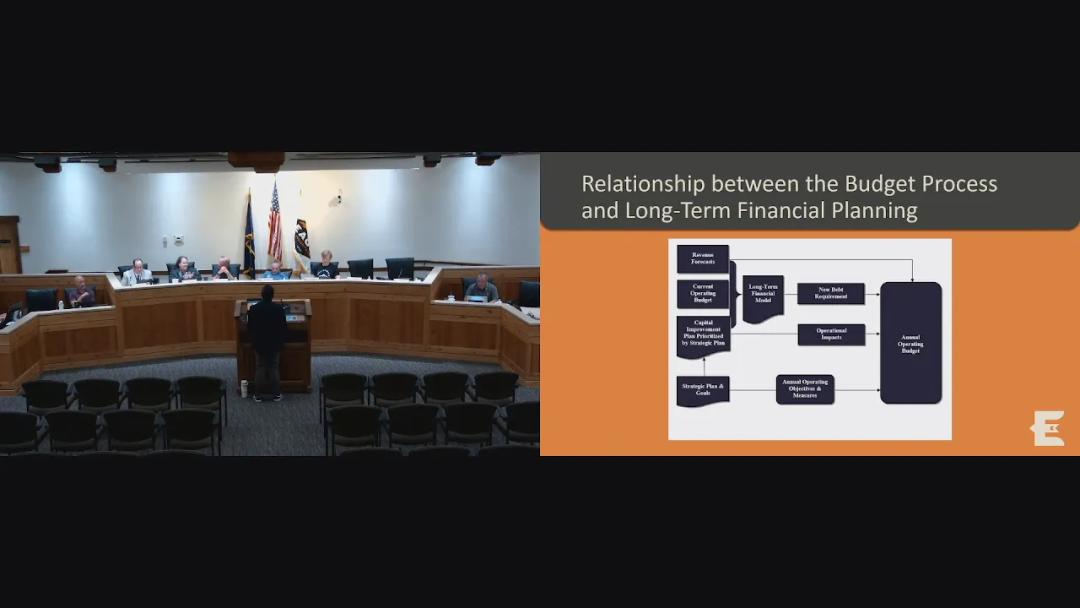
The Eagle Mountain City Council met in a budget work session on October 8, 2026, to formally kick off the Fiscal Year 2028 budget planning process. The meeting, which began at 6:02 PM and concluded at 8:42 PM after a closed session, focused on aligning the Council and staff on the budget calendar, process improvements, long-term priorities, and public engagement strategies. Mayor Jared R. Gray presided. Councilmember Rich Wood was excused, and Councilmember Zachory Huish participated electronically. Budget Process and Timeline - Budget Manager Terrence Dela Peña presented the kickoff, reviewing lessons learned from the FY 2027 process, including the need for clearer service metrics, earlier and more frequent Council touchpoints, and expanded resident engagement. - The proposed budget timeline runs from an internal staff kickoff on October 22, 2026, through the public hearing and adoption on June 15, 2027. It includes a departmental "Budget Congress" day on January 27, 2027, and a City Budget Open House. - Council discussed the timeline extensively, agreeing to utilize time around the ULCT conference in April for an extended budget session, and acknowledging the need to navigate the busy month of May carefully to avoid conflicts raised by residents in previous years. The Open House was moved from May 11 to May 13 to avoid a Planning Commission conflict. Service Levels and Long-Term Financial Planning - Dela Peña outlined the goal of establishing key performance indicators and defined service levels to better communicate the impact and value of city services. Internal department workshops in November will focus on creating five-year needs assessments. - Council strongly advocated for expanding the budget's focus beyond the single upcoming fiscal year. Councilmember Wright requested detailed five-year revenue forecasts, including projections for MET and property tax values, stating the Council lacks the information needed to make informed long-term strategic decisions on major projects. - Councilmember Huish supported a rolling five-year pro-forma to prevent the deferral of large capital projects. Councilmember Clark emphasized the need for the Council to see the full range of departmental needs to properly prioritize finite resources. - Staff confirmed they are working to mature the city's financial planning processes, moving toward five- and ten-year capital and operational forecasts. Budget Communication and Public Engagement - Council reviewed the proposed budget communication plan, which includes a dedicated webpage, email blasts, a "Budget in Brief" document, and infographics. - A significant discussion ensued on the best methods to reach residents. Councilmember Clark supported sending a city mailer or postcard to raise awareness. Councilmember Huish argued that a well-crafted Budget in Brief document, made available online, would be most effective. - Councilmember Wright supported exploring a low-cost postcard using EDDM mailing. Councilmember Whiting suggested utilizing utility bill inserts. Councilmember Clark also suggested deploying yard signs with QR codes near high-traffic areas. - Staff was directed to evaluate and bring back cost estimates for these various outreach methods. Public Education Priorities - Councilmembers shared recurring questions from residents to guide future communication. Key topics included explaining the difference between property tax, sales tax, and MET, the role of impact fees, how growth pays for itself, and the economic benefit of shopping locally to retain sales tax revenue. Key Outcomes - Motions and Votes: - The Council voted unanimously (4-0) to adjourn to a Closed Session for discussion of pending or imminent litigation, real property, personnel, a proposed development agreement, and security deployment. - The Council voted (3-0; Huish and Wood excused) to adjourn the meeting at 8:42 PM. - Directives and Next Steps: - Staff will finalize the budget calendar based on Council feedback and send out calendar invitations. - Staff will research costs for enhanced public engagement activities (mailers, utility bill inserts, etc.). - A comprehensive "Budget in Brief" document will be developed for the public. - The next budget-focused council discussion is scheduled for December 8, 2026, covering public safety and the Sheriff's contract.
The Eagle Mountain City Council convened on October 6, 2026, for a Work Session at 4:00 PM followed by a Policy Session at 7:00 PM. Key topics included an extensive review of fire service finances with UFA/UFSA, a tabled rezoning and development agreement for the Corrigan Farms data center project, adoption of updated impact fee facility plans for water and wastewater, the adoption of a community garden policy, code amendments for archery and residential standards, and a comprehensive citywide speed study presentation. Several items were tabled for further refinement. Consent Calendar - The consent agenda was approved, but Items 10.A (Firefly NPA 8 Phase A Bond Release), 10.B (Firefly NPA 8 Phase B Bond Release), and 12.D (Community Garden Policy) were removed for separate votes. - Bond Releases (10.A, 10.B): Approved (4-0, Councilmember Wright abstaining due to a conflict of interest from owning rental property in the affected area). - Community Garden Policy (12.D): Approved (4-1, Councilmember Wright dissented, expressing concerns about costs, resource requirements, water usage, and the appropriate role of government). - Remaining consent items (Minutes, Bond Releases, Resolutions for the Ranches Parkway Interlocal Agreement, Smith's Purchase Agreement, and Pioneer Addition Phase II land purchases) were approved unanimously. Public Comments & Testimony - Brett Jones: Requested the city consider installing a streetlight at the intersection of Pony Express and Shadow Drive to increase safety for pedestrians and drivers, especially with winter approaching. - Maverick Bocchicchio: Expressed strong opposition to data center and natural gas power plant development, citing concerns over air quality permits, CO2 emissions, water usage, and temperature increases. - Amy Lawson (Tooele Cares): Requested the City Council deny the Corrigan Farms rezoning application and support a statewide moratorium on new data center development. - Jay Johnson and Janielle Smith: Expressed significant safety concerns about high-speed commuter traffic on Lake Mountain Road, noting it has become a dangerous shortcut. They requested a high-visibility crosswalk, speed feedback signs, and enforcement. - Kacie Jenson: Expressed concerns about pedestrian safety at major intersections (Eagle Mountain Blvd and Pony Express) and requested the city invest in pedestrian safety infrastructure and public transportation. - Jacinto Moreno: Expressed concerns about the Corrigan Farms rezone, the power consumption of existing data centers, and requested improved lighting on bicycle paths. - Casey Vokes (Public Hearing on 14.A): Stated support for property owners' rights to rezone their land but raised concerns that data centers should be required to pay their full share of the costs they create for the community. - Brett Simpson, Pony Express Land Development (Public Hearing on 15.A): Questioned the timeline for when the city would sell water for residential developments again, given the updated Water IFFP and the city's policy of reserving water for commercial and industrial uses. The council responded that the decision to reserve water for commercial/industrial use remains in place. Discussion Items - UFA/UFSA Overview (Work Session): Fire Chief Dominic Burchette and CFO Tony Hill presented a detailed financial history of Eagle Mountain's participation in the Unified Fire Service Area since 2013. They reviewed revenue growth (from $1.6M in 2013 to $10.9M in 2026), expenditures (from $2.1M to $12M), staffing increases (from 3 full-time firefighters to 14), station upgrades, and debt service payments. The presentation highlighted a current $1.1 million shortfall and the implications for the city if it decides to separate from UFSA, including ongoing bond obligations for the fire stations. Council expressed strong appreciation for the high level of service provided. - RV Parking Code Amendment (Work Session): Discussion was deferred. Councilmembers Huish and Whiting were directed to work with staff to find a more nuanced approach to the code, balancing property rights with preventing commercial storage operations in residential areas. The item was moved to a future meeting. - Chaplain Services (Work Session): City Manager Ben Reeves proposed recognizing a volunteer chaplain program to serve as a resource for city staff and residents. Council was broadly supportive, noting no downsides, and requested it be scheduled for a future formal action. - Investment Portfolio Update (Work Session): Jace Richards (Meeder Investment Management) reported the city's portfolio is valued at $51.2 million with a 4.3% yield. Council discussed the sources of these funds (taxes, fees, bond proceeds) and the importance of maintaining adequate reserves (targeting a 35% reserve ratio). Councilmember Wright requested future presentations include benchmarking against the 2-year Treasury and the Utah Public Treasurers' Investment Fund (PTIF). - Corrigan Farms Rezone (14.A) and Development Agreement (14.B): A public hearing was held where applicant Regan Peck stated the property was intended for a data center. The Development Agreement was tabled (3-2 vote) due to unresolved issues: the energy source (natural gas), the lack of a specific end-user, the 20-year term length, and concerns over liability for a sewer lift station. The rezone was subsequently tabled unanimously, linked to the resolution of the Development Agreement. - Speed Study Results (16.A): Hales Engineering presented results from 35 citywide locations. Recommendations included speed limit changes (lowering Airport Road to 40, raising Porter's Crossing to 30) and a variety of traffic calming measures (speed tables, radar feedback signs, lateral shifts, bulb-outs, and law enforcement pull-outs). Council focused heavily on school zone safety, prioritizing speed tables over speed cushions. Council expressed strong interest in exploring pedestrian tunnels or bridges on major arterial roads. City Manager Ben Reeves suggested the council prioritize these projects in a work session and budget $1-1.5 million for implementation. - Legislative Priorities (17.A): Council voted unanimously to add a requirement for staff to provide the City Council with quarterly updates on the city's Central Utah Water Conservancy District (CUWCD) water assets. Key Outcomes - Corrigan Farms Rezone (14.A) and Development Agreement (14.B): TABLED (Dev Agreement 3-2, Rezone Unanimously). The items will return to a work session for further negotiations on energy sources, term length, and infrastructure liabilities. - Land Disposal Applications (13.A & 13.B): DENIED unanimously. Council chose to retain the properties for potential public benefit, such as trail connections, parking, or open space. - Culinary Water Impact Fee Facility Plan (15.A): APPROVED unanimously. Updated costs from $73.2 million to $109.1 million to include growth in the Spring Run/Talons Cove area. - Wastewater Master Plan and Impact Fee Facility Plan (15.B): APPROVED unanimously. Updated costs from $193.7 million to $259.4 million. - Archery Code Amendment (15.C): APPROVED unanimously, establishing standards for outdoor archery ranges. - Fencing/Screening Code Amendment (15.D): TABLED unanimously. Staff to return with a more specific scope for barbed wire fencing applications, likely limited to specific uses. - Residential Standards Table Amendment (15.E): APPROVED unanimously, legally conforming existing smaller lots and substandard setbacks in the RC zone. - Master Site Plans Code Amendment (15.F): TABLED (4-1). Staff will work with individual councilmembers to address concerns about allowing plat approvals before master site plan approvals.
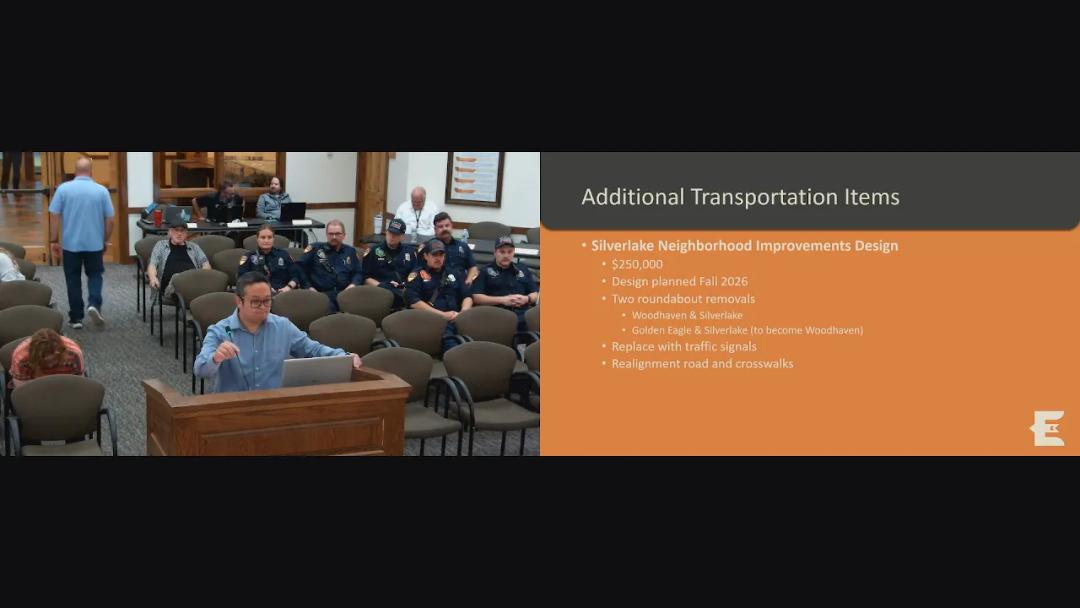
The Eagle Mountain City Council convened for a Work Session at 4:01 PM and a Policy Session at 7:03 PM on September 15, 2026. The meeting featured discussions on transmission line code requirements, project recommendations from the Community Services Board, a public hearing on the first FY 2026-2027 budget amendment, and training on the Open and Public Meetings Act (OPMA) and ethics laws. Councilmembers Zachory Huish and, for the Policy Session, Rich Wood were excused. Consent Calendar - The Consent Agenda was approved with a 3-0 vote. It included Change Orders 6 and 7 for the Midvalley Road Extension; approval of the September 1, 2026, meeting minutes; approval of site plans for Spring Run Plaza Lot 1 and Lot 2, with the added condition that the Shared Parking and Maintenance Agreement be filed with staff for Lot 2; a resolution approving a $40,000 lobbying agreement with Utah Public Solutions LLC; and a resolution approving a reimbursement agreement with Spring Run Parkway Partners II, LP. Public Comments & Testimony - Breanne Salazar expressed concern about prayers at city council meetings, requested the property tax increase not be approved, and asked that the city stop allowing additional data centers. - Joy Rasmussen voiced concerns over continued data center development, requested a city resolution to prohibit additional data centers, and requested the repeal of the property tax increase, stating the city's information pamphlet was inaccurate. - Missy Perry requested the city council listen to resident concerns and provide a detailed line-by-line budget to justify expenditures. - During the public hearing on the budget amendment, Breanne Salazar questioned the practice of employees taking city vehicles home and the cost of transportation bids and park improvements. Joy Rasmussen requested the council not pass the budget due to insufficient details. Missy Perry requested the council consider reducing expenditures before raising taxes rather than adding non-essential items. Discussion Items - Code for Transmission Lines (Work Session): Community Development Director Brandon Larsen presented on state code requirements for public utility transmission lines. He explained that while the city could impose conditions in an overlay zone, state law requires the city to pay the utility's "actual excess cost" for any such conditions. Councilmembers concluded it was not financially viable to pursue an overlay zone and decided instead to negotiate route preferences directly with the utility provider. - Community Services Board Recommendations (Work Session): Board Chair Jessie Southworth presented a prioritized project list: ADA ramp installations ($4,450/ramp), trail signage addressing 39 issues, benches at Smith Ranch Park ($1,000/bench), increased rodeo grounds maintenance, wildlife-themed utility box art ($1,000-$1,500/box), and a disc golf partnership with Firefly. The council expressed general support for the ideas and directed staff to work with the Parks Manager to assess feasibility and create a prioritized implementation plan. - First Amendment to FY 2026-2027 Budget (Policy Session): Budget Manager Terrence Dela Peña presented the amendment, noting over 90% of capital requests were project rollovers. New items included $1.8 million for Pony Express widening Phase 1 (construction), $250,000 for Phase 2 (design), and $250,000 for Silver Lake neighborhood improvements (design). Staff addressed questions regarding vehicle take-home policies for on-call personnel, the cost of professional engineering design for road projects, and the legal limitations on using specific funds (e.g., impact fees) for different purposes. - OPMA & Ethics Training (Policy Session): City Attorney Marcus Draper provided the required annual training on the Open and Public Meetings Act and the Municipal Officers' and Employees' Ethics Act. He reviewed hypothetical scenarios concerning quorums, predetermined actions via serial communication, gift prohibitions (safe harbor under $50), and disclosure/recusal requirements, and outlined the city's standards for civil discourse. Key Outcomes - Transmission Lines: The council opted not to pursue a code amendment for an overlay zone for transmission lines, choosing instead to negotiate directly with the utility provider on route preferences. - Community Services Actions: Staff was directed to assess and prioritize the Community Services Board's project recommendations in coordination with the Parks Manager. - Budget Amendment: The First Amendment to the Fiscal Year 2026-2027 Annual Budget was approved with a 3-0 vote. - Consent Agenda: Approved with a 3-0 vote, including a specific added condition for the Spring Run Plaza Lot 2 site plan. - Closed Session & Adjournment: The council voted 3-0 to enter a closed session at 9:17 PM for discussions on pending litigation, real property, and personnel, and formally adjourned the meeting at 10:22 PM.
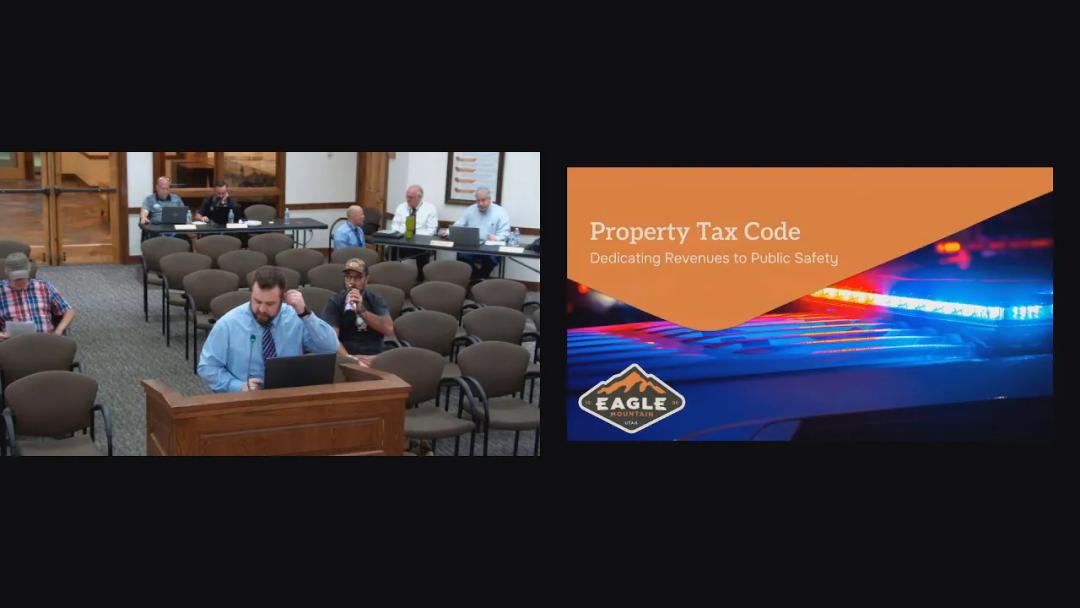
The Eagle Mountain City Council held a work session at 4:00 PM and a policy session at 7:00 PM on September 1, 2026, in the City Council Chambers. The work session included discussions on the Utah Wellbeing Project survey results, the annual community survey, a commercial sign placement, home business standards, and a community garden proposal. The policy session addressed public comments, a consent agenda, and scheduled items including a preliminary plat, retaining wall standards, a rezoning request, and a property tax allocation ordinance. Notable outcomes included approval of a preliminary plat for Gateway Park Phase 3, adoption of updated retaining wall construction standards, denial of a rezoning request for the Pinnacles properties, and enactment of a property tax allocation ordinance. The council also added the Todd A. Black Memorial Wildlife Migration Corridor to the legislative priorities list. Consent Calendar - Change Order 3 for White Hills 4MG Tank (final true-up costs) – approved. - Minutes of August 18 and August 26, 2026 meetings – approved. - Resolution approving Second Amendment to Brylee Farms Phase B Development Agreement – approved. - Resolution to become official member of North Utah County Aquifer Council (NUCAC) – approved. - Ordinance amending Youth Council Member Term Limits (2.45.010) – approved. - Ordinance amending Land Disposals code (Chapter 3.30) – approved. - Note: Item 12.A (Gateway Park Phase 3 Preliminary Plat) was removed from the consent agenda and considered separately. Public Comments & Testimony - Jason Ah You (Eagle Mountain resident): Spoke in support of Gateway Park Phase 3 preliminary plat, announcing a proposed charter school (Ripple Academy) on the site. He stated that over 300 residents have expressed interest and urged council approval. - Anthony Wood (Eagle Mountain resident): Thanked the council for listening to residents during the tax rate discussions and encouraged residents to attend meetings. He shared a story comparing city finances to a family needing a larger vehicle, emphasizing resident responsibility. Discussion Items - Utah Wellbeing Project Survey Results (1.D): Dr. Courtney Flint (Utah State University) presented results from an April 2026 survey (359 responses). Key findings: personal well-being average 3.92 out of 5; community connection is low but linked to participation in events; 50% of respondents have lived in Eagle Mountain 5 years or less; top concerns include traffic, water supply, and water quality; 74% of those with childcare find it difficult to afford. The council discussed using results to improve community connection and address resident concerns. - Annual Community Survey (1.E): Ron Gailey (OnPointe Insights) discussed survey design and proposed adding questions on recreation priorities (e.g., ice skating rink vs. field house), communication preferences, and recreation programs. Council requested refining questions, including on police presence and communication methods. - Eagle Square Commercial Sign (1.A): Planner Steven Lehmitz presented a request to place two signs in the city's right-of-way. Applicant Brett Simpson confirmed sign placement 30 feet from curb, 80 feet from Porter's Crossing, with engineering approval. Council directed staff to bring back an action item with a lease/encroachment agreement, noting the owner assumes risk for future road widening. - Home Business Standards (1.B): Councilmember Clark initiated discussion on expanding home business licenses to include farm-related products (e.g., eggs, honey, baked goods). Staff noted current code limits greenhouse sales. Council requested a code review for home-based businesses to allow greater flexibility for agricultural sales, with an emphasis on trip counts and parking limitations. - Community Garden Presentation (1.C): Community Services Board Chair Jessie Southworth proposed a pilot community garden at Pioneer Park West, with 5-10 raised beds, no city funding or staff time requested. Local gardener Jen Corrington expressed strong community interest. Council supported the idea but requested a policy addressing liability waivers, financial procedures (including a fee structure), signage, and maintenance agreements. The policy is to be brought back for adoption. Key Outcomes - Gateway Park Phase 3 Preliminary Plat (12.A): Approved 4-0 (Councilmember Wood excused) with Condition 1 (lots permitted to front onto arterial/collector streets unless internal streets can be constructed) and omitting Condition 2 (road name change to Wild Blossom Boulevard). Motion by Councilmember Whiting, second by Clark. - Retaining Wall Construction Standards Ordinance (15.A): Approved 4-0 with amendments: removed "multi-family" from section 5.B and added "or" before "institutional" in section 5.B. Motion by Councilmember Wright, second by Whiting. - Pinnacles Rezoning and Master Development Plan Amendment (15.B): Denied 3-1 (Councilmember Clark dissenting). Motion by Councilmember Wright, second by Whiting. The council majority cited concerns about preserving commercial land and the original development agreement; applicant Andy Flamm noted loss of green belt status and lack of commercial demand, but council preferred to maintain the commercial zoning designation. - Property Tax Allocation Ordinance (16.A): Approved 4-0 with correction changing "adoption" to "acceptance" in Section 3.50.110 B. Motion by Councilmember Huish, second by Whiting. The ordinance creates a public safety fund for property tax revenues, with annual reporting and coverage ratios. - Legislative Priorities List (17.A): Approved 4-0 to add "Todd A. Black Memorial Wildlife Migration Corridor" to the list. Motion by Councilmember Wright, second by Clark. - Directives: The Community Services Board will develop a policy for the community garden addressing liability waivers, financial compliance, and signage. Staff will review home business code and bring potential updates. The council will explore justice court options with neighboring cities and prioritize entering municipal code violations into the state’s master offense table. Councilmembers Clark and Whiting will work on agritourism code.
The Eagle Mountain City Council held a lengthy combined work session and policy session on August 18, 2026, dominated by a highly anticipated public hearing and vote on the FY 2026-2027 budget and property tax rate. The council also discussed a business park development agreement, an archery overlay zone, a city staffing analysis, and a policy to dedicate property tax to public safety. In the evening session, after extensive public comment and council deliberation, the council repealed a previously approved property tax increase and approved a lower increase, adopted the annual budget with amendments, and approved items related to the Mid-Valley Community Reinvestment Project Area. Consent Calendar - Approved routine items including minutes from previous meetings, a bond release for The Towns at Brylee Farms Phase B, and a resolution accepting the city's Fiscal Year 2025 audited financial statements. - A resolution awarding the bid for the EMC 6.0 MGD Wastewater Treatment Facility Expansion (GMP-2) was removed from the consent agenda by Councilmember Wood to allow for a full public presentation. It was later approved unanimously. Public Comments & Testimony - General Public Comment: George Reid requested additional stop signs on Ira Hodges to address speeding and improve safety. Joy Rasmussen opposed data centers and requested a moratorium. Tiffany Walden requested the city establish its own police department. - Public Comment on Property Tax Increase and Budget (Items 13.A, 13.B, 13.C): Over 25 residents spoke. A majority voiced opposition to the increase, citing financial strain on fixed incomes, families, and renters. Jen Hackett called the city's communication "misleading at best" and demanded specific project lists. Melissa Bradley condemned the council for dismissing seniors and criticized the mayor for his use of Facebook. Duncan Searcy requested a pause on the new City Hall study. A minority, including Gary Fewkes and Tony Castillo, supported an increase for public safety investments and recognized the council's difficult position, urging them to address long-deferred infrastructure needs. Discussion Items - Pony Express Business Park (Work Session): Planner Steven Lehmitz presented a proposal seeking a development agreement to allow construction closer to a wash than code allows due to space constraints. Councilmembers expressed strong concerns about erosion and foundation stability, with many indicating they were not inclined to waive the code standards. - Archery Overlay Zone (Work Session): Intern Ethan Jacobsen proposed a code amendment to allow archery ranges by incorporating them into the existing outdoor shooting overlay zone. Council supported the framework and discussed age restrictions and safety standards referencing USA Archery guidelines. - City Staffing Analysis (Work Session): Intern Addison Cragan presented a plan to survey comparable cities on staffing levels versus workload for parks, streets, water, and fire services. Council requested additional metrics such as team structures, seasonal labor usage, fleet services, and the number of schools. - Property Tax Funding Policy (Work Session): Director Evan Berrett presented a draft ordinance and an alternative financial policy to dedicate property tax revenue to public safety with a target coverage ratio. Councilmembers strongly supported codifying this in city ordinance over a financial policy to maximize transparency and accountability to residents. - Council Opening Statements (Policy Session): Council and the mayor made lengthy statements addressing public anger, violent threats, communication failures, the rationale for the tax increase, partnerships with data centers, and a commitment to future transparency. Key Outcomes - Property Tax Increase (Resolutions 13.A & 13.B): Voted 4-1 (Wood dissenting) to repeal the previous increase. Voted 4-1 (Wood dissenting) to approve a new rate of 0.000900, exceeding the certified tax rate of 0.000530, resulting in a 69.81% increase (approx. $2,132,876) in property tax revenue over the prior year exclusive of new growth. - FY 2026-2027 Budget Adoption (Resolution 13.C): Voted 4-1 (Huish dissenting) to adopt the budget totaling $363,992,973, amended to remove $1 million for rodeo grounds relocation and $2.5 million for land acquisition, with the remaining balance drawn from reserves. - Mid-Valley Community Reinvestment Project Area (Items 14.A, 14.B, 14.C): Approved the Interlocal Cooperation Agreement for incremental sales taxes (unanimous), the Participation Agreement (4-1, Wood dissenting), and the Project Area Plan (unanimous, contingent on RDA approval). - Overland Master Development Agreement (Item 14.D): Approved the 5th Amendment (4-1, Wood dissenting). - Wastewater Treatment Facility Expansion: Awarded the GMP-2 contract to MGC Contractors, Inc. (Unanimous). - Street Naming Ordinances (Items 12.A & 12.B): Unanimously approved code amendments to ensure consistent street names on plats for improving emergency services navigation. - Next Steps: Staff directed to finalize the property tax/public safety code, compile the staffing analysis, improve budget transparency communications, and develop a plan to fix existing disparate street names.
On August 10, 2026, at 3:30 PM, the Eagle Mountain City Council held a special session to consider and approve the Fiscal Year 2026 Community Development Block Grant (CDBG) Annual Action Plan. The meeting was called to order at 3:32 PM by Mayor Jared R. Gray, with Councilmembers Melissa Clark and Brett Wright present in person, and Councilmembers Craig Whiting, Rich Wood, and Zachory Huish appearing electronically. City staff and consultant Elizabeth McNannay also participated. The sole substantive agenda item was a resolution to authorize submission of the plan to the U.S. Department of Housing and Urban Development (HUD) by the August 14, 2026 deadline. Discussion Items Resolution – FY2026 CDBG Annual Action Plan Affordable Housing Coordinator Kiara Polee presented the Annual Action Plan, which identifies how the city will use CDBG funds for the upcoming program year in accordance with the 2025–2029 Consolidated Plan. The city receives entitlement funds for households below 80% of area median income. Staff had completed the required public participation process. Key funding allocations proposed were: - 15% for public services (automatic cap set by HUD) - 20% for administration (automatic cap) - $200,000 for housing preservation and development (flexible) - Remaining funds for public service facilities, neighborhood improvements (including ADA and sidewalk upgrades, senior improvements), and other eligible activities. Polee noted that the city is transitioning CDBG management in-house after previously contracting with Mountainlands Association of Governments (MAG). Consultant Elizabeth McNannay (Resource Consultants) was brought in to help address compliance issues with HUD, particularly cleaning up past program years. Councilmembers asked about her role, fees, and whether a dedicated city staff person is needed. McNannay stated her hourly rate is $130 for herself and $65–$80 for her staff, billed in 15-minute increments, paid from CDBG administrative funds. She emphasized she is not a long-term solution but a short-term specialist to train staff and resolve past issues. Councilmember Zachory Huish inquired about the cost and duration; McNannay estimated that for Eagle Mountain, annual consulting costs might be $30,000–$40,000, lower than the $80,000+ for Utah County. Polee acknowledged that a dedicated part-time staff person might be needed long-term, as CDBG management is complex. Key Outcomes - Motion and Vote: Councilmember Melissa Clark moved to approve the resolution, seconded by Councilmember Brett Wright. The motion passed unanimously with all five councilmembers (Clark, Wright, Whiting, Wood, Huish) voting yes. - Adjournment: The meeting adjourned at 3:51 PM following a motion by Councilmember Rich Wood, seconded by Councilmember Clark, with unanimous consent. - Next Steps: The approved Annual Action Plan will be submitted to HUD by the August 14, 2026 deadline. The council will continue to evaluate staffing needs for CDBG administration and may consider hiring a part-time staff person or extending the consultant contract through the end of the five-year plan in 2028.
The Eagle Mountain City Council held a special session on August 6, 2026, at 6:00 PM (MDT) in the City Council Chambers and via Zoom. The primary purpose was a public hearing on a proposed property tax increase (Truth in Taxation) followed by a resolution to approve the increase. After over three hours of public testimony and council deliberation, the council unanimously approved a property tax rate of 0.001500, representing a 183.02% increase over the certified tax rate, generating approximately $5,591,594 in additional revenue for Fiscal Year 2026-2027. Public Comments & Testimony - The public hearing opened at 6:07 PM and closed at 9:00 PM. Over 50 individuals spoke in person, virtually, or submitted written comments. The overwhelming majority opposed the 220% originally proposed increase, citing financial strain on families, lack of transparency, and concerns that the revenue would fund non-public-safety projects. Key themes included: the city's messaging shifted from "100% for public safety" to freeing up general fund dollars; frustration over tax breaks for data centers (Meta, QTS) while residents face large increases; calls for a phased, smaller increase; and demands for itemized budgets. - Several speakers expressed support, including Matt Everett and Jeff Ruth, who argued the increase was necessary for public safety and infrastructure maintenance. Charlotte Ducos and Jacob Moore acknowledged the need but urged a more moderate approach. - Many residents shared personal stories of fixed incomes, medical debt, and the fear of being priced out of their homes. Discussion Items - After the public hearing, council members addressed the public's concerns. Councilmember Huish acknowledged failures in communication and transparency. Councilmember Wood apologized for poor messaging and noted the city's challenges with growth and state-imposed tax caps. Councilmember Whiting emphasized that skepticism of government is healthy and explained the need to shift public safety funding to property taxes to stabilize revenue. - City Manager Benjamin Reeves and Sheriff Mike Smith also spoke, highlighting understaffing (city employees at one-third the normal level for similar-sized cities) and the need for additional deputies. Mayor Gray provided updates on data center contributions, including a $5 million commitment from QTS for Pony Express road improvements and projected annual revenue of $2.7 million from QTS to the city. - Councilmembers debated the appropriate tax rate. Councilmember Whiting initially proposed 0.001500, while others considered 0.001100 or 0.001700. After discussion, the council agreed on 0.001500, which yields $5.59 million (a 183% increase) and lowers the average homeowner impact to approximately $250–$268 per year (about $0.70 per day). - Future policy proposals were discussed, including a city code requiring annual review of the tax rate to avoid large jumps, and segregating the property tax revenue into a dedicated public safety fund. Key Outcomes - Motion by Councilmember Whiting, seconded by Councilmember Wright: Adopt a property tax rate of 0.001500 for Fiscal Year 2026-2027, exceeding the certified tax rate of 0.000530, resulting in an increase in ad valorem property tax budgeted revenue of approximately $5,591,594 (183.02% above the prior year, exclusive of new growth). The motion passed unanimously (5-0). - The meeting adjourned at 10:38 PM. - The council committed to bringing back policies for annual tax rate reviews and potential fund segregation at a future meeting.
The Eagle Mountain City Council held a work session at 4:00 PM and a policy session at 7:00 PM on August 4, 2026, in the City Council Chambers. The council discussed updates to the Towns at Brylee Farms Phase B, the Healthy Utah Community designation, LBiSat property line-of-sight concerns, and a consolidated project list. The policy session included appointments, introductions, public hearings on the CDBG Annual Action Plan, Scenic Mountain rezoning, and the Transportation Master Plan and Impact Fee Facilities Plan (TMP/IFFP). All votes were unanimous. Consent Calendar - Approved the July 21, 2026 meeting minutes. - Approved the site plan and development agreement for the Eagle Mountain Chapel and Recreation Building. - All consent items passed unanimously. Appointments & Introductions - Youth Council: KJ Call appointed as Youth City Council Mayor; 17 youth council members appointed, all until the next youth council election. Oaths administered. - Miss Eagle Mountain Royalty: Trieste Smith (Miss Eagle Mountain), Brighton Haws (Miss Teen Eagle Mountain), and Emeline Smith (Miss Teen 1st Attendant) introduced their community service initiatives focusing on civic engagement, wildlife conservation, and first aid training. Public Comments & Testimony - Duncan Searcy (resident): Expressed concern over the proposed 220% property tax increase, questioning transparency and the burden on residents living paycheck to paycheck. Urged the council to delay the increase until future revenues materialize. Public Hearings Program Year 2026 HUD CDBG Annual Action Plan (Public Hearing Only) - Charlotte Ducos (resident): Requested consideration of CDBG funds for a community center at Cedar Valley High School, including showers, pantry, and adult education, to serve at-risk populations. - Council scheduled a special virtual meeting on August 10, 2026, at 3:30 PM to take action on the plan, as the agenda did not allow action that evening. Consultant Elizabeth McNannay answered council questions. Ordinance – Rezoning Scenic Mountain (Public Hearing) - Senior Planner Robert Hobbs presented: The rezone updates 200+ parcels from outdated zones to current ones, matching the General Plan. No public comments. - Motion: Councilmember Whiting moved to approve the General Plan Amendment per the chart of affected properties and the rezoning per the proposed map. Substitute motion by Councilmember Wright to separate the General Plan amendment and zoning was accepted. Passed unanimously. Ordinance – Transportation Master Plan (TMP) and Impact Fee Facilities Plan (IFFP) (Public Hearing) - Assistant City Engineer David Salazar presented: Major updates include removing landscaped medians on major corridors, adding turn lanes, updating functional classifications (adding a principal arterial), and revising cost estimates. Key projects: Silver Lake connections to the new high school, Ranches Parkway widening (two phases), Pony Express improvements, and Lake Mountain Corridor (formerly Mid Valley Road) now a UDOT facility named with council input. - Public Testimony: - Quinn Linde (principal of new high school in Saratoga Springs): Supported the Silver Lake Parkway connection to improve traffic access and safety for students; provided data on inadequate access points at Utah high schools. - Melissa Powers (resident, Evans Ranch): Expressed strong support for the TMP, especially the Silver Lake connection, to connect neighborhoods and improve safety. - Ben Perez (resident): Supported the plan, highlighting pedestrian safety concerns at the Silver Lake roundabout near the elementary school. - Council Discussion: Debate on median removal on Ranches Parkway. Councilmember Huish favored retaining some median for aesthetics; Councilmember Wood and others supported removal for safety and maintenance, with a promise to enhance side landscaping. Council directed staff to design a corridor landscape plan and bring it back for review. - Motion: Councilmember Wright moved to adopt the TMP and IFFP with staff recommendations plus the addition of E 1000 N as Minor Collector from Pony Express Pkwy to East Expressway and removal of the Canyon Wash connection. Passed unanimously. Discussion Items (Work Session) 1.A. Towns at Brylee Farms Phase B Update - Applicant Greg Wall presented revised townhome plans: extended garage depth to 24 feet (496 sq ft, down from 600 sq ft in three-story units) to improve market appeal. Council requested additional benefit, such as increased garage size in other units or extra parking. Wall agreed to explore and return with a proposal. 1.B. Healthy Utah Community Designation - Deputy City Manager Steve Mumford reviewed nine implemented strategies (e.g., Turkey Trot, bike/pedestrian master plan, food pantry, gun locks) and three new strategies for the next three years (destigmatize mental health, trail wayfinding, adaptive sports). Council expressed support and directed staff to submit the application to Get Healthy Utah by the deadline. 1.C. LBiSat Property – Maintaining Clear Lines of Sight - LBiSat CEO Rodger Lyman and President Cory Wofford presented concerns that nearby development (e.g., QTS, city water treatment) could obstruct satellite look angles (10-degree minimum). Community Development Director Brandon Larsen noted existing RTI overlay allows 50-foot heights. Council acknowledged the issue but noted difficulty restricting adjacent property owners; suggested LBiSat negotiate with neighbors or consider raising antennas. Staff will facilitate communication with QTS. 1.D. Consolidated Project List - City Manager Ben Reeves presented a comprehensive list of over 200 projects across departments (public works, transportation, parks, facilities, public safety, community development). Council directed staff to prioritize projects by department and provide estimates of man-hours and funding sources. Councilmember Wood suggested some projects (e.g., ice skating rink) may be deprioritized. Staff to return with ranked list for council feedback. Key Outcomes - Approved appointments of Youth Council Mayor and members. - Scheduled special council meeting for August 10, 2026, at 3:30 PM (virtual) to act on CDBG Annual Action Plan. - Adopted the Scenic Mountain rezoning and General Plan amendment unanimously. - Adopted the Transportation Master Plan and Impact Fee Facilities Plan with amendments (adding E 1000 N and removing Canyon Wash connection) unanimously. - Directed staff to prioritize and rank the consolidated project list, bringing back a prioritized list with resource estimates. - Directed staff to design a corridor landscape plan for Ranches Parkway that enhances side landscaping after median removal. - Directed staff to facilitate discussions between LBiSat and QTS regarding line-of-sight concerns. - Closed session held for litigation, personnel, real property, and security matters (twice: during work session and after policy session). Meeting adjourned at 9:41 PM.