OPENPUBLICA · PUBLIC MEETING RECORD
Record of Proceedings
Eagle Mountain City Council Meeting: Budget, Transmission Lines, and Community Service Projects - September 15, 2026
City Council — Tuesday, September 15, 2026
BodyEagle Mountain, Utah
SessionCity Council
DateTuesday, September 15, 2026
StatusFILED
Video Record
STREAMING COPY IN PREPARATION — RECORDING AVAILABLE FROM THE ORIGINAL SOURCE
Transcript — Verbatim
Speaker numbers apply only to this recording. Names come from transcript evidence. “Possibly” marks uncertain attribution.
Discussion Breakdown — Share of Meeting
Engineering And Infrastructure17%
Procedural15%
Public Engagement11%
Parks and Recreation11%
Public Safety8%
Transportation Safety7%
Ethics And Conduct7%
Fiscal Sustainability6%
Budget Equity Analysis4%
Summary of Proceedings
Eagle Mountain City Council Meeting: Budget, Transmission Lines, and Community Service Projects - September 15, 2026
The Eagle Mountain City Council convened for a Work Session at 4:01 PM and a Policy Session at 7:03 PM on September 15, 2026. The meeting featured discussions on transmission line code requirements, project recommendations from the Community Services Board, a public hearing on the first FY 2026-2027 budget amendment, and training on the Open and Public Meetings Act (OPMA) and ethics laws. Councilmembers Zachory Huish and, for the Policy Session, Rich Wood were excused.
Consent Calendar
- The Consent Agenda was approved with a 3-0 vote. It included Change Orders #6 and #7 for the Midvalley Road Extension; approval of the September 1, 2026, meeting minutes; approval of site plans for Spring Run Plaza Lot 1 and Lot 2, with the added condition that the Shared Parking and Maintenance Agreement be filed with staff for Lot 2; a resolution approving a $40,000 lobbying agreement with Utah Public Solutions LLC; and a resolution approving a reimbursement agreement with Spring Run Parkway Partners II, LP.
Public Comments & Testimony
- Breanne Salazar expressed concern about prayers at city council meetings, requested the property tax increase not be approved, and asked that the city stop allowing additional data centers.
- Joy Rasmussen voiced concerns over continued data center development, requested a city resolution to prohibit additional data centers, and requested the repeal of the property tax increase, stating the city's information pamphlet was inaccurate.
- Missy Perry requested the city council listen to resident concerns and provide a detailed line-by-line budget to justify expenditures.
- During the public hearing on the budget amendment, Breanne Salazar questioned the practice of employees taking city vehicles home and the cost of transportation bids and park improvements. Joy Rasmussen requested the council not pass the budget due to insufficient details. Missy Perry requested the council consider reducing expenditures before raising taxes rather than adding non-essential items.
Discussion Items
- Code for Transmission Lines (Work Session): Community Development Director Brandon Larsen presented on state code requirements for public utility transmission lines. He explained that while the city could impose conditions in an overlay zone, state law requires the city to pay the utility's "actual excess cost" for any such conditions. Councilmembers concluded it was not financially viable to pursue an overlay zone and decided instead to negotiate route preferences directly with the utility provider.
- Community Services Board Recommendations (Work Session): Board Chair Jessie Southworth presented a prioritized project list: ADA ramp installations (~$4,450/ramp), trail signage addressing 39 issues, benches at Smith Ranch Park (~$1,000/bench), increased rodeo grounds maintenance, wildlife-themed utility box art ($1,000-$1,500/box), and a disc golf partnership with Firefly. The council expressed general support for the ideas and directed staff to work with the Parks Manager to assess feasibility and create a prioritized implementation plan.
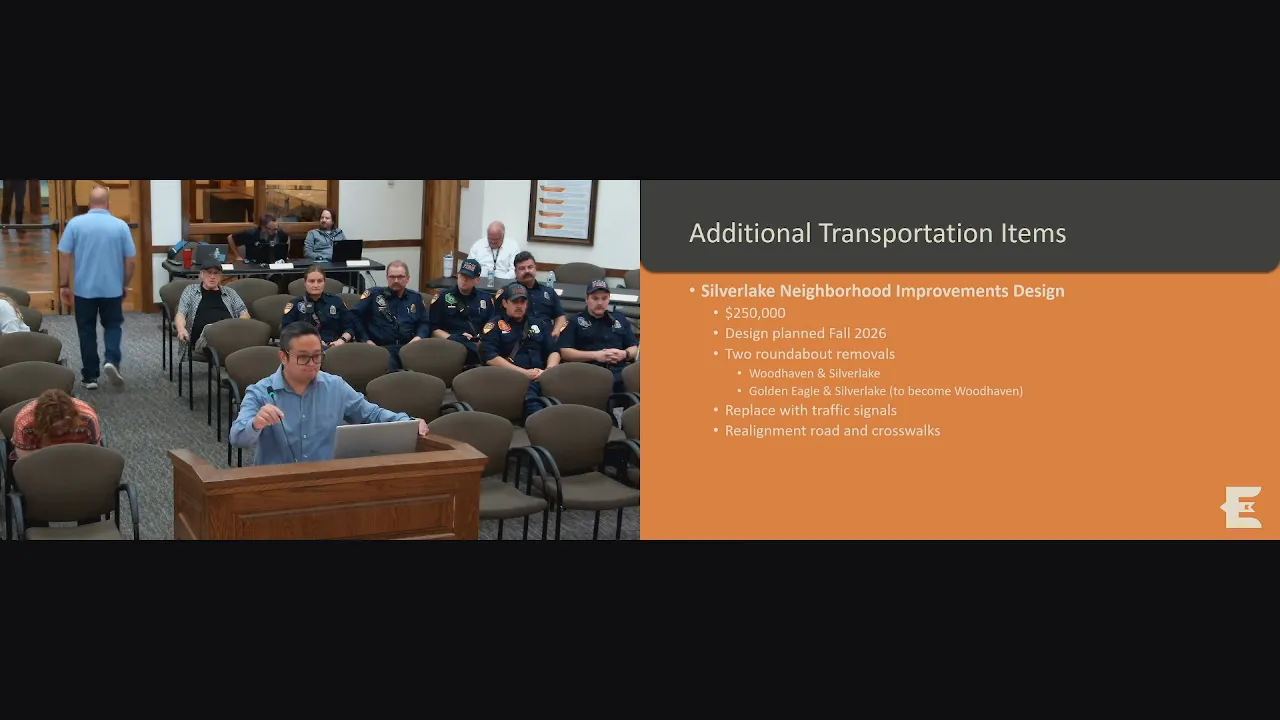
- First Amendment to FY 2026-2027 Budget (Policy Session): Budget Manager Terrence Dela Peña presented the amendment, noting over 90% of capital requests were project rollovers. New items included $1.8 million for Pony Express widening Phase 1 (construction), $250,000 for Phase 2 (design), and $250,000 for Silver Lake neighborhood improvements (design). Staff addressed questions regarding vehicle take-home policies for on-call personnel, the cost of professional engineering design for road projects, and the legal limitations on using specific funds (e.g., impact fees) for different purposes.
- OPMA & Ethics Training (Policy Session): City Attorney Marcus Draper provided the required annual training on the Open and Public Meetings Act and the Municipal Officers' and Employees' Ethics Act. He reviewed hypothetical scenarios concerning quorums, predetermined actions via serial communication, gift prohibitions (safe harbor under $50), and disclosure/recusal requirements, and outlined the city's standards for civil discourse.
Key Outcomes
- Transmission Lines: The council opted not to pursue a code amendment for an overlay zone for transmission lines, choosing instead to negotiate directly with the utility provider on route preferences.
- Community Services Actions: Staff was directed to assess and prioritize the Community Services Board's project recommendations in coordination with the Parks Manager.
- Budget Amendment: The First Amendment to the Fiscal Year 2026-2027 Annual Budget was approved with a 3-0 vote.
- Consent Agenda: Approved with a 3-0 vote, including a specific added condition for the Spring Run Plaza Lot 2 site plan.
- Closed Session & Adjournment: The council voted 3-0 to enter a closed session at 9:17 PM for discussions on pending litigation, real property, and personnel, and formally adjourned the meeting at 10:22 PM.
Meeting Transcript
Okay, and we're recording. All right. It is four hundred one on September 15th, and we will call this work session to order. I want to start off by excusing Zach. He had some other obligations today, Councilmember Hewish, and just make sure is Councilmember Wood online. Okay, and Councilmember Wood is also online. So glad you could join us. And uh we'll start right off with the first item one A discussion for transmission lines. And um Brandon, yeah. Thank you, Mayor. Um I think I don't need to be labor, kind of the background on this. Um we know there's uh we know about the uh transmission line project that goes from Spanish Four Canyon to the Mercer substation. We uh you can see the preferred route. Even zooming in a little bit better, you can see it it runs here in the yellow, and that takes us right through the our ag zone. Um so we came to you a couple months ago to get uh get council's feedback and see how you wanted us to handle. We've got this project, this transmission line project, we've got data centers that need power, and so we're like what how do we how should we handle this situation? We need transmission lines to go through that area, even though transmission lines aren't allowed in the ag zone. So you the uh we were tasked uh staff was to prepare an overlay zone. So we we uh we're gonna start working on that, and then found out that Spanish Fork City had uh went through a similar process of actually establishing an overlay zone for the same purpose to give them control of where that transmission line uh would go through their city, and then I talked, I spoke with their community development director to find out kind of some background of why they did the overlay zone and then found out that they repealed that overlay zone or abandoned it uh, you know, several months later. So long story short, what it came down to is there's uh there's state requirements in the way that really um are a little bit of a challenge to work with. And so that's from what I gathered from Spanish for my discussion with Spanish Fork City, is they uh became more aware of the state code requirements related to cities and uh and the locate and permitting the and having a say in the the location of transmission lines. And the yes, there is an ability for uh there is an ability for uh for local municipalities to have to be able to permit these and and place conditions on them. But the uh I it looks like one of the big keys here is providing safe, reliable, excuse me, safe, reliable, and adequate service to customers. If another authorized, if otherwise off authorized by law, local government may require or condition the construction of a facility in any manner if the requirement or condition doesn't impair the ability of the public utility to provide safe, reliable, adequate service to its customers um so we have the ability what it really comes down to is oftentimes cities end up having to pay uh the actual excess cost there's whatever it our if our requirements cost the utility additional money we have to pay for it oftentimes now there are some ways that that that doesn't happen there is uh a board and I'll get to that in a second but oftentimes it it appears uh that that we end up paying what the again the code the state code calls um actual excess cost there's a process that's uh cities can um you can go through this process with the utility and have them give you the estimate give you an estimate of how much it's gonna cost and you ask for competitive bids but ultimately it comes down to this uh what once those actual excess costs are known and the uh there isn't like it says in AMB the the uh utility commission or the uh the utility facility review board doesn't intervene in some fashion to uh absolve the city from having to pay then we end up paying the excess costs so there's your definition of actual excess cost um it it can even include uh right of ways you can see on the the screen there um this chat it's uh sub or section two of 5414 talks kind of lays the groundwork for cities and how they can interact in this process of requiring conditions and so forth and have and permitting these transmission lines last uh the last bit of language there you can read that there any requirement or condition in any permit authorization approval or exception um that imposes an actual cost shall be considered waived you you basically have 30 days to it if you're required to pay you have to um you have to make that payment within 30 days um before the construction of the facility to avoid a um anyway it if if you don't pay it in a timely fashion then your right to actually have a say actually is waived so um there is a board like I said the board of uh you the utility facility review board it is your three utility commissioners plus two other members I think uh the utility company and then city gets to choose somebody from a group of of people at the state uh government level to participate in the process and uh they they'll hear you know disputes between utilities and cities basically about um you know excess cost questions and so forth so um I just want you to be aware of this um as we can prepare an overlay zone we just want you to be aware of Spanish forks uh Spanish forks situation uh kind of the their experience with it and we wanted you to be aware of the state code requirements and so with that I'll I'll let you I'm here to answer any questions. Is it okay if I ask a question? I'm just wondering, does it make any sense to the council to continue to pursue an overlay zone knowing that this is already highly regulated at the state level? I mean, it's really, um in my opinion, it's a question of do we want to impose some some additional regulations and are we willing to pay for them. That that's what I'm hearing that that's my interpretation of what we just uh read through. Is if we feel strongly that we want the the the power towers to be covered to look like pine trees and it costs a hundred thousand dollars per per pole extra, are we willing to pay that? I mean, and I don't know uh that's a really kind of a silly example, but uh as I listen to this, those were my thoughts. I don't know what the rest of you think. So part of the reason for doing the overlay zone was so that we could direct where those transmission lines would go, right? Just instead of because if we didn't want to just put it willy-nilly and then and then and then that anywhere the ag it could go, and then we we we lose control of that. So that was part of the reason for the overlay. So is it placing an additional condition on the utility if we're telling it where it needs to go? Um making sure I'm still on there.
SUMMARIZED BY OPENPUBLICA AI
TRANSCRIPT VIA PUBLIC VIDEO
openpublica.com
openpublica.com