OPENPUBLICA · PUBLIC MEETING RECORD
Record of Proceedings
Eagle Mountain City Council Meeting Work and Policy Sessions Summary - October 6, 2026
City Council — Tuesday, October 6, 2026
BodyEagle Mountain, Utah
SessionCity Council
DateTuesday, October 6, 2026
StatusFILED
Video Record
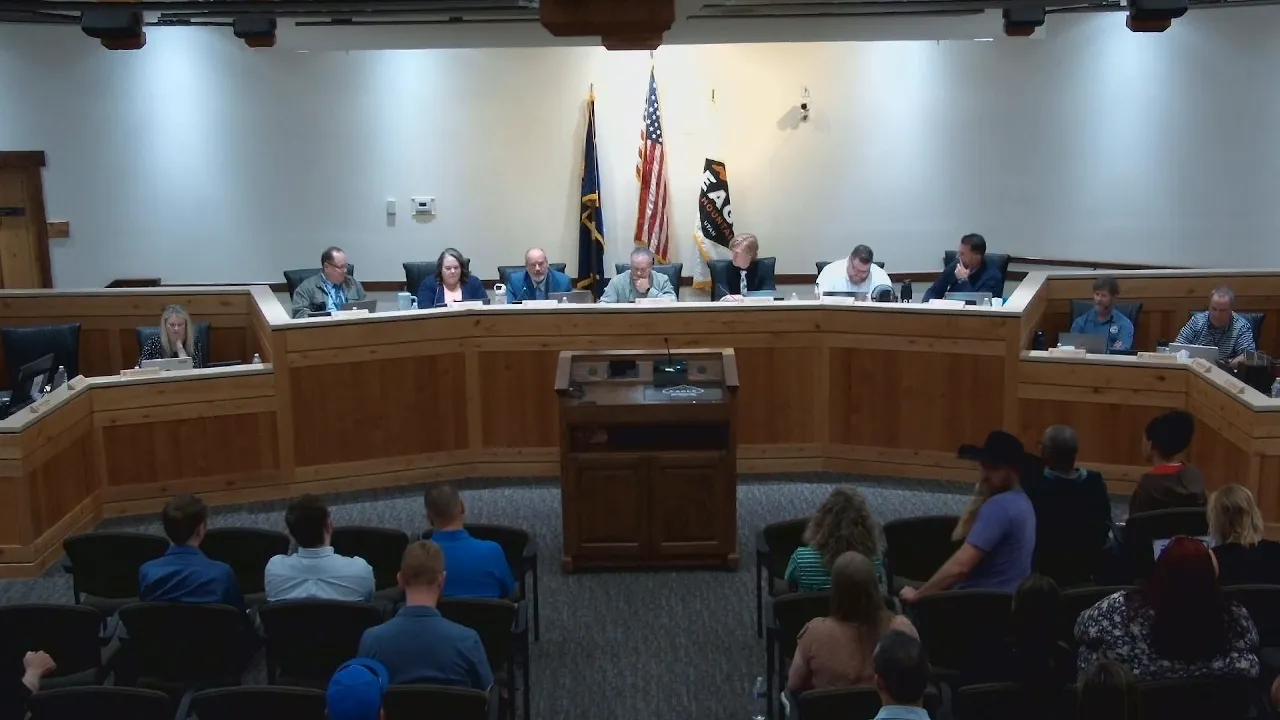
STREAMING COPY IN PREPARATION — RECORDING AVAILABLE FROM THE ORIGINAL SOURCE
Transcript — Verbatim
Speaker numbers apply only to this recording. Names come from transcript evidence. “Possibly” marks uncertain attribution.
Discussion Breakdown — Share of Meeting
Land Use Planning20%
Transportation Safety20%
Public Safety15%
Procedural10%
Engineering And Infrastructure8%
Fiscal Sustainability6%
Environmental Protection4%
Public Engagement3%
Water And Wastewater Management3%
Summary of Proceedings
Eagle Mountain City Council Meeting Summary - October 6, 2026
The Eagle Mountain City Council convened on October 6, 2026, for a Work Session at 4:00 PM followed by a Policy Session at 7:00 PM. Key topics included an extensive review of fire service finances with UFA/UFSA, a tabled rezoning and development agreement for the Corrigan Farms data center project, adoption of updated impact fee facility plans for water and wastewater, the adoption of a community garden policy, code amendments for archery and residential standards, and a comprehensive citywide speed study presentation. Several items were tabled for further refinement.
Consent Calendar
- The consent agenda was approved, but Items 10.A (Firefly NPA 8 Phase A Bond Release), 10.B (Firefly NPA 8 Phase B Bond Release), and 12.D (Community Garden Policy) were removed for separate votes.
- Bond Releases (10.A, 10.B): Approved (4-0, Councilmember Wright abstaining due to a conflict of interest from owning rental property in the affected area).
- Community Garden Policy (12.D): Approved (4-1, Councilmember Wright dissented, expressing concerns about costs, resource requirements, water usage, and the appropriate role of government).
- Remaining consent items (Minutes, Bond Releases, Resolutions for the Ranches Parkway Interlocal Agreement, Smith's Purchase Agreement, and Pioneer Addition Phase II land purchases) were approved unanimously.
Public Comments & Testimony
- Brett Jones: Requested the city consider installing a streetlight at the intersection of Pony Express and Shadow Drive to increase safety for pedestrians and drivers, especially with winter approaching.
- Maverick Bocchicchio: Expressed strong opposition to data center and natural gas power plant development, citing concerns over air quality permits, CO2 emissions, water usage, and temperature increases.
- Amy Lawson (Tooele Cares): Requested the City Council deny the Corrigan Farms rezoning application and support a statewide moratorium on new data center development.
- Jay Johnson and Janielle Smith: Expressed significant safety concerns about high-speed commuter traffic on Lake Mountain Road, noting it has become a dangerous shortcut. They requested a high-visibility crosswalk, speed feedback signs, and enforcement.
- Kacie Jenson: Expressed concerns about pedestrian safety at major intersections (Eagle Mountain Blvd and Pony Express) and requested the city invest in pedestrian safety infrastructure and public transportation.
- Jacinto Moreno: Expressed concerns about the Corrigan Farms rezone, the power consumption of existing data centers, and requested improved lighting on bicycle paths.
- Casey Vokes (Public Hearing on 14.A): Stated support for property owners' rights to rezone their land but raised concerns that data centers should be required to pay their full share of the costs they create for the community.
- Brett Simpson, Pony Express Land Development (Public Hearing on 15.A): Questioned the timeline for when the city would sell water for residential developments again, given the updated Water IFFP and the city's policy of reserving water for commercial and industrial uses. The council responded that the decision to reserve water for commercial/industrial use remains in place.
Discussion Items
- UFA/UFSA Overview (Work Session): Fire Chief Dominic Burchette and CFO Tony Hill presented a detailed financial history of Eagle Mountain's participation in the Unified Fire Service Area since 2013. They reviewed revenue growth (from $1.6M in 2013 to $10.9M in 2026), expenditures (from $2.1M to $12M), staffing increases (from 3 full-time firefighters to 14), station upgrades, and debt service payments. The presentation highlighted a current $1.1 million shortfall and the implications for the city if it decides to separate from UFSA, including ongoing bond obligations for the fire stations. Council expressed strong appreciation for the high level of service provided.
- RV Parking Code Amendment (Work Session): Discussion was deferred. Councilmembers Huish and Whiting were directed to work with staff to find a more nuanced approach to the code, balancing property rights with preventing commercial storage operations in residential areas. The item was moved to a future meeting.
- Chaplain Services (Work Session): City Manager Ben Reeves proposed recognizing a volunteer chaplain program to serve as a resource for city staff and residents. Council was broadly supportive, noting no downsides, and requested it be scheduled for a future formal action.
- Investment Portfolio Update (Work Session): Jace Richards (Meeder Investment Management) reported the city's portfolio is valued at $51.2 million with a 4.3% yield. Council discussed the sources of these funds (taxes, fees, bond proceeds) and the importance of maintaining adequate reserves (targeting a 35% reserve ratio). Councilmember Wright requested future presentations include benchmarking against the 2-year Treasury and the Utah Public Treasurers' Investment Fund (PTIF).
- Corrigan Farms Rezone (14.A) and Development Agreement (14.B): A public hearing was held where applicant Regan Peck stated the property was intended for a data center. The Development Agreement was tabled (3-2 vote) due to unresolved issues: the energy source (natural gas), the lack of a specific end-user, the 20-year term length, and concerns over liability for a sewer lift station. The rezone was subsequently tabled unanimously, linked to the resolution of the Development Agreement.
- Speed Study Results (16.A): Hales Engineering presented results from 35 citywide locations. Recommendations included speed limit changes (lowering Airport Road to 40, raising Porter's Crossing to 30) and a variety of traffic calming measures (speed tables, radar feedback signs, lateral shifts, bulb-outs, and law enforcement pull-outs). Council focused heavily on school zone safety, prioritizing speed tables over speed cushions. Council expressed strong interest in exploring pedestrian tunnels or bridges on major arterial roads. City Manager Ben Reeves suggested the council prioritize these projects in a work session and budget $1-1.5 million for implementation.
- Legislative Priorities (17.A): Council voted unanimously to add a requirement for staff to provide the City Council with quarterly updates on the city's Central Utah Water Conservancy District (CUWCD) water assets.
Key Outcomes
- Corrigan Farms Rezone (14.A) and Development Agreement (14.B): TABLED (Dev Agreement 3-2, Rezone Unanimously). The items will return to a work session for further negotiations on energy sources, term length, and infrastructure liabilities.
- Land Disposal Applications (13.A & 13.B): DENIED unanimously. Council chose to retain the properties for potential public benefit, such as trail connections, parking, or open space.
- Culinary Water Impact Fee Facility Plan (15.A): APPROVED unanimously. Updated costs from $73.2 million to $109.1 million to include growth in the Spring Run/Talons Cove area.
- Wastewater Master Plan and Impact Fee Facility Plan (15.B): APPROVED unanimously. Updated costs from $193.7 million to $259.4 million.
- Archery Code Amendment (15.C): APPROVED unanimously, establishing standards for outdoor archery ranges.
- Fencing/Screening Code Amendment (15.D): TABLED unanimously. Staff to return with a more specific scope for barbed wire fencing applications, likely limited to specific uses.
- Residential Standards Table Amendment (15.E): APPROVED unanimously, legally conforming existing smaller lots and substandard setbacks in the RC zone.
- Master Site Plans Code Amendment (15.F): TABLED (4-1). Staff will work with individual councilmembers to address concerns about allowing plat approvals before master site plan approvals.
Meeting Transcript
All right, we'll go ahead and get started. Welcome everybody to the uh work session, the Eagle Mountain City Council meeting October sixth. It's four o'clock, and we'll go ahead and get started. The uh first item on our agenda is um a discussion, an overview of UFA and UFSA, and Chief Perchett's here with his army. I don't know who else is coming up, but we'll welcome you to the podium and anyone else that needs to join Ken as needed. Well, thank you, and mayor. Uh thank Mayor and Council for giving us a few minutes. Um the reason that we're here today is just to present on the history since when uh Eagle Mountain joined UFSA and the fire district, and subsequently joining UFA and just talk through some of those numbers. We're going to talk about uh the cost, the revenue, the apparatus, and the facility upgrades, just to give you all awareness as you're making these next decisions for your city. Um, tonight, Tony and I, Tony Hill, our CFO, uh, we'll be here to walk through all of that with you, and happy to answer any questions that you may have. And that commitment tonight is it's it goes beyond just tonight. So, if there's other questions, we're available to help you answer those. We understand that the decisions that you're going to be making here are going to be difficult and challenging, and there's going to be a lot of questions. So we're happy to happy to be here for you and answer any questions that you have. So uh, with the slide. Oh, here it is. I didn't realize it was going off my computer, so I apologize. Neither did I while you're pulling that up, I'm just I was going to say this in a minute, but I I'm going to jump backwards. I skipped item one A, and I did not mention why, but I knew why, and I forgot to mention it. Uh I'm switching the order on those, but then David Stroud called in uh he was not gonna be here, so we wanted to move that item to 1020. I do want to have a short discussion if there's anything that we can uh at least give direction. So I'll come right back to that for the council. Okay, now that we're all set up with this, Tony is gonna take over to first talk about the the revenue and the expense side of things, and then I'll take it back from him after that. All right, thanks, Chief Mayor. It's good to see you, council. Thank you, as Chief said, for just a few minutes today to um just go over a little bit of history and and uh answer any questions that you may have. So um I'm gonna take the first three or four slides um and Chief will go from there. So Eagle Mountain joined the service area uh UFSA and UFA in 2012, and so the first year that UFSA, which is the taxing side of the of the uh agreement of the two organizations that Eagle Mountain's a part of uh was in 2013, and so you can see in 2013 UFSA collected 1.6 million dollars in revenue, and the revenue is mostly made up of property tax. Um there is a little bit of other revenue, some motor vehicle fee in lieu and some impact fees that go into this number, but um it's when we when you see these numbers, it's generally the property tax. And so it was 1.6 million in 2013, and you can see where it is now in 2026, um, up to 10.9 million. So as you're all aware, right, you are down here, lots of growth in in property tax in that time. Um the next slide is the expenditures, and I went the wrong way, and you can see it's of course a very similar pattern there. And so the the expenditures are mostly made up of the UFA member fee payment, uh, which covers the staffing at the station as well as the apparatus, so the engines, trucks, and ambulances that are at your three stations. Uh there are some miscellaneous other expenses as well. There's bond payments for fire station construction, there's capital maintenance on our current on the current stations, and then some other admin costs. So you can see there again, similar pattern, um started with 2.1 million in total cost in 2013, and it's up to a little bit over 12 million now in 2026. Um the next slide we have kind of puts those two things together, and so you can see the the green line is the revenue or the total available revenue, and then the yellow line or the yellow, the red line is the expenses. Um early on the expenditures were higher than the revenue.
SUMMARIZED BY OPENPUBLICA AI
TRANSCRIPT VIA PUBLIC VIDEO
openpublica.com
openpublica.com