OPENPUBLICA · PUBLIC MEETING RECORD
Record of Proceedings
Eagle Mountain City Council Work and Policy Session - October 20, 2026
City Council — Tuesday, October 20, 2026
BodyEagle Mountain, Utah
SessionCity Council
DateTuesday, October 20, 2026
StatusFILED
Video Record
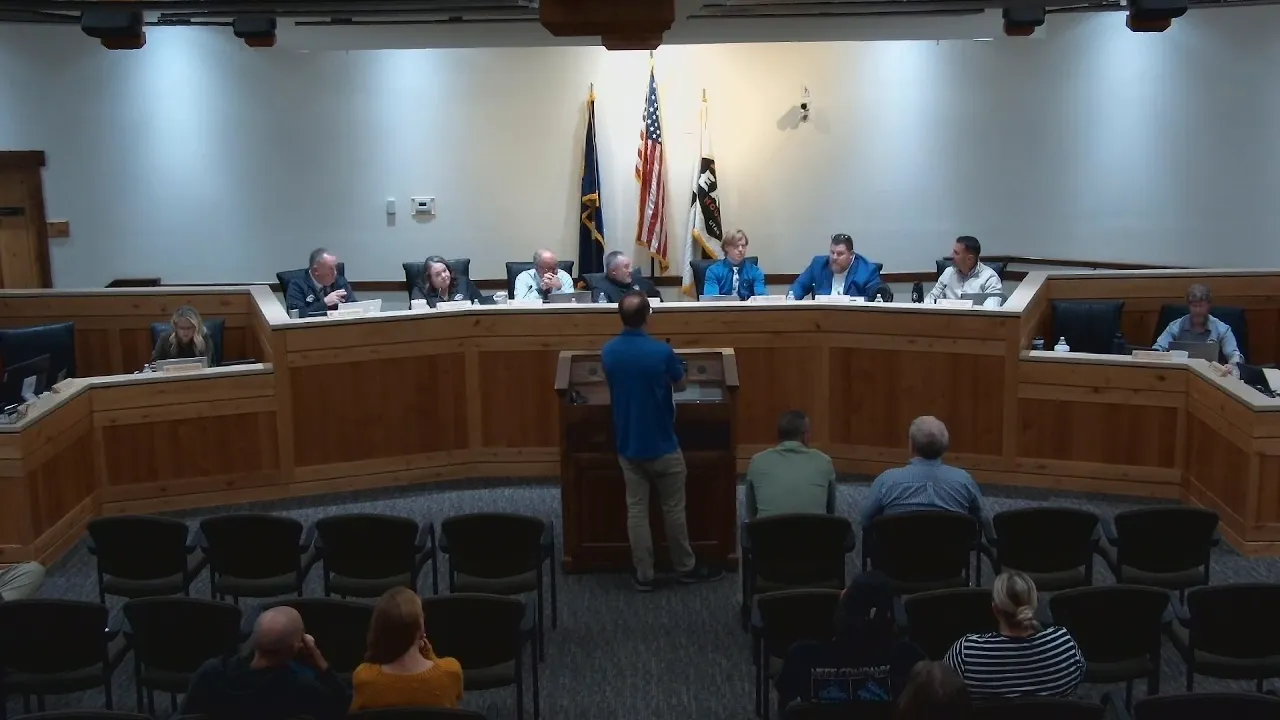
STREAMING COPY IN PREPARATION — RECORDING AVAILABLE FROM THE ORIGINAL SOURCE
Transcript — Verbatim
Speaker numbers apply only to this recording.
Discussion Breakdown — Share of Meeting
Land Use Planning28%
Procedural19%
Environmental Protection9%
Community Engagement7%
Fiscal Sustainability6%
Public Engagement6%
Engineering And Infrastructure6%
Technology and Innovation5%
Affordable Housing3%
Summary of Proceedings
Eagle Mountain City Council Work and Policy Session - October 20, 2026
The Eagle Mountain City Council met on October 20, 2026, for a Work Session from 4:01 PM to 5:17 PM and a Policy Session from 7:04 PM to 8:32 PM. Mayor Jared Gray presided. City Manager Ben Reeves and Deputy City Manager Steve Mumford participated remotely due to the ICMA Conference. Discussions included the Mortgage Assistance Program (MAP) funding, Alternative Energy Overlay Zone revisions, the Corrigan Farms development, a land disposal application, and a Wildland-Urban Interface (WUI) ordinance.
Consent Calendar
- Councilmember Brett Wright recused himself from voting on Items 10.B, 10.C, and 10.D (Firefly NPA 8 Phase A, Plats 3, 4, and 5) due to a conflict of interest from owning rental property in the area. These items were removed from the main consent agenda and voted on separately, passing with a 4-0 vote.
- The remaining consent agenda was approved unanimously. This included bond releases, change orders, meeting minutes, and resolutions.
- Resolution 13.A recognizing the Eagle Mountain Community Chaplain Program was adopted. Lyman Gifford, an interfaith chaplain, introduced himself and his wife and provided an overview of chaplain services.
- Resolution 13.D approving the Quicksilver Solar Community Reinvestment Project Area Interlocal Agreement was adopted.
Public Comments & Testimony
- No members of the public spoke in person.
- Two written comments were received: Jill Jones requested a community saltwater pool, and Jeff Lister submitted a comment regarding the Golden Eagle sidewalk widening project.
- No public testimony was offered during the public hearing for the Wildland-Urban Interface (WUI) ordinance (Item 16.A).
Discussion Items
- MAP Funding Capacity and Tier Prioritization (1.A): Affordable Housing Coordinator Kiara Polee reported a 139% year-over-year increase in applications. Of the total $1.2 million allocated for FY2027, approximately $350,000 has been used, leaving roughly $840,000. The City Council discussed improving application prioritization for Tier 3 (general public) applicants. Councilmember Rich Wood proposed a weighted lottery system based on Area Median Income (AMI) to give lower-income applicants a better chance. Councilmembers largely agreed this approach was preferable to segmenting by profession. The council requested staff provide projections on future funding capacity and explore the possibility of an ADU revitalization grant program.
- Alternative Energy Overlay Zone (AOZ) Revisions (1.B): Evan Berrett presented revisions including: disassociating the AOZ from the RTI overlay, defining SMR facilities without long-term waste storage, requiring air dispersion modeling for natural gas, and shifting site plan approval authority from the DRC to the City Council. Councilmember Craig Whiting advocated strongly for removing dry steam and flash steam geothermal technologies from the code due to high water consumption and visual concerns (steam clouds), preferring to limit the zone to binary and enhanced geothermal systems. A 2-gigawatt cap on natural gas was also discussed. The council directed staff to incorporate the feedback and bring the revised code back for formal consideration.
- Corrigan Farms Development Agreement (1.C / 14.B): City Attorney Marcus Draper reviewed changes to the agreement based on previous council feedback. Key changes included removing the on-site natural gas power plant provision (requiring a separate future application under the AOZ), reducing the term from 20 to 10 years, and clarifying that the developer bears operational and maintenance costs for any connected lift stations. Councilmember Wood stated he remained opposed to granting entitlements without a specific end user.
- Land Disposal Application (15.A): City Recorder Lacie Messerly presented an application from residents to purchase approximately 40 feet of an 80-foot-wide city-owned open space corridor behind homes in Eagle Park Phase I. The council debated the appropriate width, the lack of a city-wide plan for such spaces, and fair treatment of residents. Councilmember Craig Whiting suggested having the Community Services Board review the property.
- Wildland-Urban Interface (WUI) Ordinance (16.A): Long Range Planner Elizabeth Fewkes explained the proposed code amendments necessitated by state law (HB 215). The changes allow vegetation removal for defensible space in WUI zones and require WUI designations on final plats.
Key Outcomes
- Corrigan Farms Rezone (14.A): The ordinance rezoning the 41-acre parcel to the RTI Overlay Zone passed unanimously.
- Corrigan Farms Development Agreement (14.B): The ordinance approving the development agreement passed 4-1. Councilmember Rich Wood dissented.
- Land Disposal Application (15.A): The council voted unanimously to table the resolution. They directed the Community Services Board to review all open space between houses in the area related to this application and report back with a plan and recommendations.
- Wildland-Urban Interface Ordinance (16.A): The ordinance amending the municipal code passed unanimously.
- Legislative Priorities (17.A): John Magness updated the council on the Todd Black Memorial Wildlife Corridor renaming. The council directed staff to bring a resolution for the name change at the next meeting.
- Special Meeting Scheduled: A special meeting was scheduled for November 10, 2026 at 5:00 PM at the Public Works building to review speed study results.
Meeting Transcript
All right. So we're going to go ahead and get started October twentieth. It is four oh one PM, and we're going to have our uh start a work session. Did want to excuse some of our staff is uh out of town, and uh I do know that our city manager Ben is online participating as well as others, I'm sure. Um yeah, and they're working they're at the ICMA conference and uh working in Southern California, so we appreciate them joining us online. We'll go ahead and get started. This first item is uh the discussion about the map funding capacity and the tier prioritization. And I believe that's curage. So uh main things that we want to talk about today are just our funding capacity and the tier prioritization. Um just as a reminder, I just provided a report to you guys going over how we closed out this last fiscal year. Um so we had a huge jump from the beginning to the end of the year. We increased by about a hundred and thirty nine percent in applications. Um so while we had two hundred and eighty one over the full year, two hundred of those were just from the second part of the year. So the demand is there. We're definitely serving the community. And some of those discrepancies in the approvals and closings were just that some of those closed simply after the fiscal year. So demand right now just for this current year has been increased again from the last year. But as you can see, we can only fund about one to three grants per month. That's obviously going to depend on their tier status and how much we're funding. But you can see that we're getting many more applications than just the one or three that we can fund. And so what we're doing right now is we're rolling over the additional grants to still give folks the opportunity if funds open up and they can only roll over for three months. Most of those guys are all of our tier threes because obviously the general applicants are taking priority after our tier ones and twos. And so yes. So about half of them are going to tier threes, the general app the general public. Quick question. Remind me which tier military falls into. They're tier two. So is it can I ask a question? Yeah, please. My question is really regarding the tier one and tier two. Are we there tier one and tier two applications that we're receiving that we're unable to process? Absolutely not. Okay. So the question today is just to kind of discuss if tier threes continue to represent that half mark, they are getting a large amount of the fund. Do we want to continue the approach of rolling folks over and allowing them to continue? And or looking at capacity a little bit different. One item for discussion would be prioritizing within our tier three applicants. And so looking at ways that maybe we are, you know, putting our skilled trade workers or however we want to determine those folks. Do we want to start to do anything in that nature? Or do like, yeah, how do you guys want to with the overflow and limited funds? And sorry, I'll we'll answer those in a second. Uh broader RDA discussions, which we've kind of talked about in past conversations, other ways that we can use RDA funds. Um we did talk about uh home revitalization program, which uh depending on how we wanted to use RDA funds, we could split it with other funding mechanisms. The major thing would be a staffing capacity for for that kind of a project to be pushed forward. Um,
SUMMARIZED BY OPENPUBLICA AI
TRANSCRIPT VIA PUBLIC VIDEO
openpublica.com
openpublica.com