Everett City Council Community Health and Safety Committee Meeting – April 2, 2025
STREAMING COPY IN PREPARATION — RECORDING AVAILABLE FROM THE ORIGINAL SOURCE
Everett City Council Community Health and Safety Committee Meeting – April 2, 2025
The Community Health and Safety Committee met on April 2, 2025, to receive a presentation from the Everett Police Department and Flock Safety on a proposed Drone as a First Responder (DFR) program. The committee heard details on the technology, pilot program costs, privacy protections, and potential benefits, followed by discussion and questions from council members. No formal vote was taken; the committee directed staff to proceed with public outreach and a pilot phase.
Discussion Items
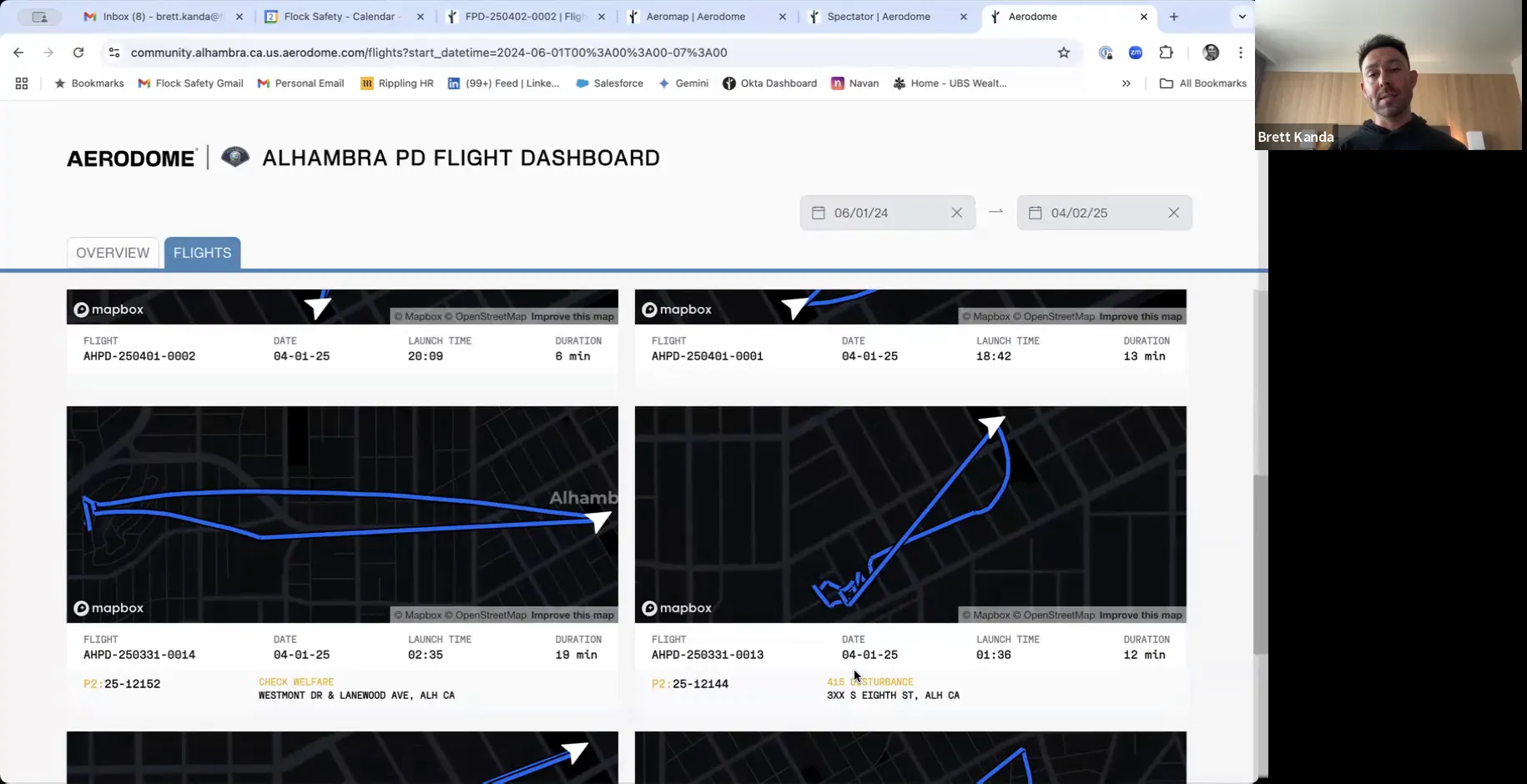
- Drone as a First Responder (DFR) Presentation: Chief DeRoos, Captain Robert Getz, and representatives from Flock Safety (Garrett Thompson and Brett Conda) presented a live demonstration of the DFR system. The program would deploy two drone docks (one at the South Precinct and one at the North Precinct) to provide near‑continuous coverage of Everett 24/7. Key features include: an average response time of approximately 86 seconds (vs. over four minutes for priority‑one calls); the ability to resolve at least 20% of calls without sending a ground unit; integration with existing license‑plate readers and computer‑aided dispatch; and safety de‑confliction via ground‑based radar. The drones are limited to 400 feet (FAA maximum) and will not be used for routine patrol, random surveillance, immigration enforcement, or facial recognition. A public‑facing dashboard will show flight logs, call types, and metrics, but not live video.
- Funding Structure: Flock Safety offered a one‑year pilot at no cost for the first drone dock. A second dock is offered at a heavily reduced rate of $50,000 (available in non‑general fund sources). Year‑two costs are estimated at approximately $300,000 per year; the department plans to pursue grants, public‑private partnerships, and other non‑general‑fund sources. The agreement includes an opt‑out clause after the first year at no further cost to the city.
- Stakeholder Positions: Councilmembers expressed support for the program, citing potential improvements in officer safety, response times, and evidence‑gathering. Councilmember Zarlingo noted the need to evaluate the trade‑off between technology and officer staffing. Police leadership emphasized that the DFR program would not replace officers but would serve as a force multiplier. The department also highlighted community engagement efforts, including a virtual public meeting scheduled for April 3, 2025 at 6:30 p.m.
Key Outcomes
- The committee received the presentation and discussion. No formal motion or vote was taken.
- Staff were directed to continue public outreach and proceed with the pilot program, contingent on council authorization for the mayor to sign the two‑year agreement with Flock Safety.
- The department will report back to the committee after the pilot with data on response times, calls handled, and community feedback.
- The next committee meeting will consider an opioid spending plan briefing (May) and legislative impacts briefing (May/June), among other pending items.
Meeting Transcript
Good evening, everyone, and welcome to the Health Healthy and Community and Safety Community meeting of uh April 2nd, 2025. Tonight, um I'm excited to uh have uh our police department here to talk about a new program, a new product that we hope will um that we're able to get eventually and also to be able to help with uh the needs of our police department. So tonight I'd like to introduce Chief DeRos, who will then uh introduce the presenters. Thank you. Yes, uh thanks. Thanks for having me, Councilmember Tui and and Councilmember Zarlingo. Uh, we're here to talk to you today about uh drone as a first responder program. We already have drones here in Everton have had for several years, but this is the new technology available to us uh that both Captain Robert Getz and some representatives from Flock Safety, the company we want to partner with, are here to explain in a little more detail. There's a lot to it, even though we've already have drones. This is a lot different. So this technology is really expanding and changing rapidly. So I'm going to quickly turn it over to Captain Robert Getz, and he's going to get us kicked off, and then there'll be plenty of time, we hope, for some questions at the end. Thank you, Chief. Uh, thank you, council members, for allowing me to present uh this evening. Um the format for this evening is I'm going to go over just a quick synopsis of what we uh would like ultimately the council uh permission for the mayor to sign an agreement on. Um and then I want to turn it right over to the our friends from Block Safety to provide you with a demonstration of the product itself. So again, very excited to introduce uh the program drone as a first responder. Today we are here uh to brief you on the next chapter of cutting edge technology available to us, produced by a company you know and that we trust, Block Safety. Introducing drone as a first responder into our community response options allows us to continue our commit commitment to modern and effective policing that improves the safety and the security of our community. This DFR solution aims to enhance our existing highly successful drone program by deploying two strategically placed drone docks, providing nearly continuous city coverage 24-7. The program aims to enhance real-time situational awareness and rapid response capabilities, which during a time of limited officer resources serves as a force multiplier. De-escalation is very important to law enforcement, uh, both in the past and in the future. And we believe the use of this product through for de-escalation will be critical. You will see some of that in the demonstration from Flock. And we'll get to talk about some of those stories afterwards during the QA session. It'll allow our officers to have improved decision making uh through real-time data through uh again, you'll see this in the demonstration. Um, but but having information at the scene more quickly than we've had it in the past is going to be critical for their safety and ultimately for the safety of our community. It's going to increase, we hope, the speed at which we apprehend criminal suspects. It's definitely going to help us in the in the area of search and rescue. We'll talk a little bit more about that as well. There's so much more and so many more possibilities. We've just had two examples over the last week that we'll talk about at the end of this uh presentation that I think are really compelling for the use of this product. Improving police efficiency and response time is one of the benefits of this program that we've seen across other programs in the United States that have been using this DFR. In responding while responding in the in the response area, the three and a half mile radius from the dock. It's been reported that there's about an 86-second response time from call to arrival on scene for the drone. Our priority one calls now, today, I should say in 2024. That those are calls that are of the highest priority for us to respond to. Our response times are just over four minutes. Agencies that have used DFR programs have the ability to, or they've reported the opportunity to resolve at least 20% of their calls where they didn't have to have a ground unit respond. We'll talk about what that looks like as well. But if we can experience just half of that in a response year, that will allow us the opportunity to redeploy assets in areas that are critical to public safety. Addressing community concerns are one of the most important parts or aspects of my responsibility as the project manager. Again, utilizing unmanned aircraft systems is not new to us, drones. They're not you to us. We've had drones for at least three or four years here in the department. In advance of that, we wrote a policy. That policy was written in consultation with the ACLU, the Department of Justice, COPS at the Cop's Office, and the International Association of Chiefs of Police. Why did we do that? Because we want to understand that our community members recognize the need for their civil liberties to be protected. Here's some things that our drones will not be used for.
openpublica.com