Parks & Built Environment Committee Meeting – April 9, 2025
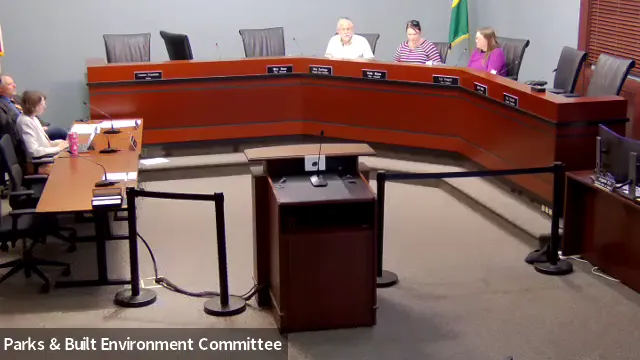
STREAMING COPY IN PREPARATION — RECORDING AVAILABLE FROM THE ORIGINAL SOURCE
Parks & Built Environment Committee Meeting – April 9, 2025
The Parks & Built Environment Committee of the Everett City Council met on April 9, 2025, at 5:00 PM in City Council Chambers. Councilmembers Vogley, Ryan, and Sarlingo were present, along with Mayor Jennifer Gregerson and attorney David Hall. The committee discussed two main agenda items: the vacant storefronts policy development process and Crime Prevention Through Environmental Design (CPTED) policy. Key outcomes included plans for a June town hall on vacant storefronts and a request for staff analysis of CPTED integration into city code.
Vacant Storefronts Policy Development Process Discussion
- Councilmember Vogley opened the discussion by referencing photos of vacant storefronts presented at a prior meeting and introduced the goal of defining the process, stakeholders, and next steps for policy development.
- Mayor Gregerson reported that planning staff have not yet begun work on code changes because they are focused on the comprehensive plan, scheduled for council adoption on June 11, 2025. After that date, staff will be able to work on vacant storefronts policy.
- The Public Works Department has a summer intern who will conduct a census of storefronts and perform outreach to property owners, starting in May. The intern will send letters informing owners of existing code requirements rather than conducting door-to-door enforcement.
- Councilmember Ryan proposed holding a roundtable or town hall in June (in lieu of the regular committee meeting) with stakeholders such as the Downtown Everett Association, property owners, business owners, the Chamber, and planning/code enforcement staff. The purpose would be to identify barriers to filling vacancies and gather input on code revisions.
- Councilmember Sarlingo suggested a phased approach: first, use the intern to survey the worst offenders and gather perspectives from other cities; then, after obtaining feedback from the Downtown Everett Association, take targeted enforcement actions based on current code. He emphasized the need for specific, actionable steps.
- Councilmember Ryan countered that a listening session first would help ensure the policy addresses real barriers (e.g., building code compliance, change-of-use issues) and avoids unintended harm to property owners.
- Councilmember Vogley expressed strong support for a town hall, stating she would help with invitations and groundwork. The committee agreed to aim for a June 11 outdoor town hall (location TBD) as a replacement for the regular committee meeting.
CPTED Policy Discussion
- The committee reviewed a code example from the City of SeaTac that codifies Crime Prevention Through Environmental Design (CPTED) principles, including lighting, visibility, landscaping, and building facade requirements for new development and major renovations.
- Councilmember Vogley noted that many CPTED elements likely already exist in Everett’s code but are scattered across different sections. She raised concerns about nuisance properties, particularly vacant houses along Lombard Street, and asked whether buffer zones or SODA (Solicitation Ordinance District) zones could trigger enhanced CPTED enforcement or specialized lighting standards.
- Councilmember Ryan observed that the SeaTac code applies to new construction and large expansions, and suggested that simply creating a one-page summary of CPTED principles (and where they appear in existing code) could help property owners and streamline enforcement.
- Councilmember Sarlingo questioned the legal mechanisms for holding property owners responsible for repeated police calls and code violations. Mayor Gregerson confirmed that code enforcement can issue fines and file liens, and that extreme cases (e.g., drug abatement) can lead to demolition with a lien on the property.
- The committee discussed the need for cross-departmental coordination between code enforcement, police, and planning, especially for properties in high-crime buffer zones.
Key Outcomes
- Vacant Storefronts: The committee will hold a public town hall in June (likely June 11) to hear from downtown stakeholders. The summer intern will conduct a storefront census and initial outreach in May. Staff will provide an update at the May committee meeting.
- CPTED Policy: Councilmember Vogley will request from staff a comprehensive analysis of how CPTED principles are currently integrated into Everett’s municipal code, and a report on whether buffer zones or SODA zones can be paired with additional CPTED requirements (e.g., enhanced lighting, landscaping standards). The committee will also explore ways to enhance code enforcement processes for nuisance properties.
- The next committee meeting (May) will include updates on the intern’s work, feedback from the Downtown Everett Association, and continued discussion of CPTED policy options.
Meeting Transcript
Okay. Welcome everybody to our um sorry, now I've just forgotten what we're called. Uh parks and built environment committee of April 9th, 2025. And uh you are here with myself, Councilmember Vogley, Councilmember Paula Ryan, and Councilmember Ben Sarlingo. Um we're coming back today with some vacant storefronts policy development process discussion. And um, if we all seem a little bit like different than other committee meetings, is because we're not used to sitting up here for committee meetings, and here we are. So uh I like to say things out loud, and there I've done it. Um so uh also we'll have step to head policy discussion. So we will start with the vacant storefronts, policy development process discussion. And our goal is for the committee to talk about the process, stakeholders, and how we might want to advance this topic. So um I know last month I brought forward some photos that we looked at, and um and here we are again. And I brought those photos again because I found them in all of my notes. Um so how do we want to? And I guess we're also here with gosh, this is weird. Uh Jennifer Gregerson, and um, and of course, attorney David Hall. So we're gonna get this all comfortable, totally comfortable. I thought I could add as you start your discussion that um planning staff are haven't started work on any uh changes or proposals for um the language that's in our code around vacant store funds because they're still focused on the comprehensive plan. And so that's scheduled for council adoption in I think on July June 11. And so after that is when they would be able to put some time into this. Um the public works department does have a summer intern who's going to do kind of a census of the storefronts and do some outreach to probably some of the storefronts that council member Vogley brought photos of last month um to inform them about sort of the existing code and you know, put a little time into just a um uh a touch point, I guess, to try to seek some improvement. Uh so that's kind of the status from the staff point on the issue. And I talked with council member Ryan about how you guys might discuss if there's like you already said this, but the you know, inviting stakeholders or other or other information you'd want as you as you consider um policy goals around vacant storefronts. So thank you. Um and we for some reason I thought that we were also having somebody else here this month, but I think I'm just remembering incorrectly. We did make change, I mean we've changed the agenda a little bit, maybe from when we talked about it last. And so um and that's why you said something about June 11th and the comp plan. And yeah people are really busy right now. Okay. Um we also uh just to start putting more out there, uh, got some emails. This is weird looking at each other down the line. Okay, I'm just putting that out there right now. I want to go back to the table. Um uh let's see, we got some emails last week at council, well, not at council, but previous to council about some uh houses that could also be um granted it's not downtown storefronts, you know, houses or houses where people live and not do business necessarily. Um so we might put those into our conversation on um septed, which is the next thing. It all just really goes together. And so if I'm confusing, sorry, but all of these things are really pertinent to each other and they all mean something to each other. So um it sounds like what you just said, Jennifer, was that folks are going to be notified, you know, conversationally um by some staff at administration for uh some downtown stuff. goes together and so if I'm confusing sorry but all of these things are really pertinent to each other and they all mean something to each other so um it sounds like what you just said Jennifer was that folks are going to be notified you know conversationally um by some staff at administration for uh some downtown stuff um and we had discussed yes please I was gonna maybe this is exactly where you're going let's get around table maybe even around a table okay great thanks um how for how do you know when the intern will be starting and finishing I think that our various intern programs start in like in May um so and it's a summer intern so and it's probably someone from either someone from a college actually I guess I don't know which one it is but um yeah so over the summer July 5th or 6th longer than that um uh and then the the follow up wouldn't it's not like the intern's gonna have to knock on the door and try to ask for compliance it'd be a letter to the property owner uh kind of based on like here's what we here's what we've seen so great yeah I think um I know that the downtown Evert Association I think they keep an inventory as well or at least a running list of who's where and who's coming and whatnot so that might be a good collaboration opportunity. I guess I uh I would envision that um I I love the idea of doing the inventory and then notifying folks who are out of compliance but we would also between those two steps there would need to be an update to the code so that the code's current with the work that we're doing so the then the property owners are being notified of current code not code that's going to be changing in a month or so after that if that makes sense so um like we have code right now we're planning on updating the quote code so we should update the code before we inform um uh property owners that they're out of compliance because that would just be out of date information if we did that so um I think it would be great if for our uh June 11th meeting to do a table ish round or rectangular shaped discussion uh here at the committee meeting uh with some of the stakeholders that we had discussed uh like property owners um business owners downtown Evert association um maybe small business alliance um folks from planning or code enforcement to uh help with like some of the technical aspects of it uh so that we can identify some of the barriers to filling vacancies or suggestions from the downtown community on ways that vacancies can be filled and that would help to inform what the policy development would look like that we would then do then business owner or building owners would be informed of the new policy based off of those informed discussions is is can ask a question just as I'm getting up to speed here yes is is the focus of the policy on filling vacancies or is that what to do with the storefronts of stores that are vacant because the existing ordinance um focuses on what owners have to do to act to make their spaces look more active than they really are when they're vacant. They've got to put a display in the window they've got to you know do some kind of art on the window and I know when we adopted that ordinance 15 years ago when I drafted the the concern was whether we would have the enforcement capacity and obviously um that has been the obstacle so far but um I'm just curious whether you're looking at enforcing that um requirement and maybe modifying the requirement or whether you you mentioned actually filling vacancies which seem like two different I mean obviously related things. I think a little bit of both that same ordinance has a requirement for building owners to notify the city within 30 days or something and I think we'd all decided that's a bit too stringent. And then there was also a few sections about a vacancy tax wouldn't be something that it's my understanding folks aren't uh willing to pursue at this time. So right um so and then there might be we might hear from building owners that some of the facade requirements for uh window wraps and other things might be um too uh too difficult to comply with or maybe not the right approach of some sort so I I think it's a little bit of both um I think I mean the overall kind of like counselor Vogoli was mentioning the septe requirements and vacant storefronts are are the same because it is about vibrant life breathed spaces and encouraging that and supporting that so um yeah I think it'd be and I know that uh downtown every association too they're really focused on this as well so not duplicating efforts with what they're doing and knowing what they're doing and then hopefully complementing that instead of conflicting with it I think would be helpful. Even having the new chamber. Yeah. Um and I know that we've had a big presentation, but um and to answer your question, I think it's more so towards um revamping the code that we have about what to do with what is there. Yes, it's all of it, but like even, you know, it reads central business district. We don't have that. We have Metro Everett. Um, so you know, there's some language differences.
openpublica.com