Community Health and Safety Committee Meeting – May 2, 2025: Opioid Response and EMS Fleet Update
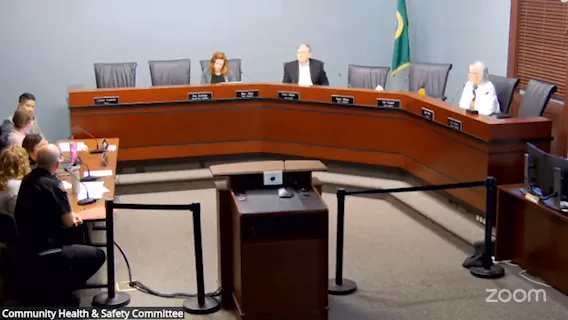
STREAMING COPY IN PREPARATION — RECORDING AVAILABLE FROM THE ORIGINAL SOURCE
Community Health and Safety Committee Meeting – May 2, 2025
The Community Health and Safety Committee met on May 2, 2025, to receive updates on the city's opioid response and spending plans, as well as a proposal to use opioid settlement funds for a new Fire EMS ambulance. Committee members Councilmembers Tuohy (chair), Bader, and Fosse were present. Staff from Community Development and the Fire Department provided briefings, and future agenda items were discussed.
Discussion Items
-
Opioid Response and Spending Plans Briefing – Julie Willie, Community Development Director, and Chelsea Monroe, Opioid Program Manager, presented an overview of the city's opioid response efforts. They outlined six work categories: education/prevention, crisis response, treatment/recovery, advocacy/policy, compliance with settlement fund requirements, and partnerships/collaboration. Key achievements included the EMOT street medicine team (launched June 2024, served over 600 individuals in its first year) and the alternative response (CARE) team. Councilmember Bader asked about treatment entry rates; Monroe noted that approximately 30% of the 300–400 people served at the time of a prior update had entered treatment or recovery, but that many clients need repeated engagement and not all require detox. The street medicine team focuses on the hardest-to-reach population (rough sleepers). Willie then reviewed the opioid spending plan: the city anticipates $8.7 million in settlement funds from 2022 to 2038, with a large upfront payment in 2024. To date, only $60,000 of the $309,000 allocated for the EMOT program had been used, as state grants covered most of the cost. The city has hired a program manager (partially grant-funded). Future education/prevention efforts will include school partnerships, leveraging state mandates and county resources. A community event, the play No Place to Grow Old, is scheduled for May 12, 2025. Willie also highlighted that federal funding for the CARE team is uncertain beyond October 2025, and opioid funds could potentially support that team.
-
Fire EMS Vehicle Replacement Update – Fire Chief Dave DeMarco presented a request to use opioid settlement funds to purchase a new ambulance (cost $350,000) to address wear and tear on EMS vehicles from the high volume of opioid-related calls. He noted that orders currently take two years for delivery, so ordering now would align with a planned fleet expansion in the late 2020s. Chief DeMarco also reported on the department's buprenorphine pilot program: 34 people have agreed to receive doses, with 44 total doses administered. The program requires patient consent and a follow-up meeting with a social worker. The committee discussed legal restrictions on opioid fund use (broadly allowed for prevention, treatment, and first responder support) and the need for comparative data on Everett's overdose burden. No formal action was taken; the request will likely return as a resolution.
-
Emphasis Patrols (Loud Exhaust) – Chief DeMarco briefly shared results of a recent operation targeting altered exhaust systems. Over three days, six officers worked four-hour shifts (24 total patrol hours), making 35 stops and issuing 23 infractions (19 related to exhaust violations). A future operation is planned. Councilmembers praised the effort as important for quality of life.
-
Future Agenda Items – Committee staff Jennifer outlined pending items for the June meeting: a briefing on the SODA (Solicitation of Alcoholic Beverages) ordinance renewal (including a requested analysis of success metrics), an update on the automated traffic safety camera program, and a legislative wrap-up from the city's lobbyists. Councilmember Fosse requested that the SODA discussion include how the program measures success.
Key Outcomes
- No votes were taken. The committee received the opioid response and spending plan briefings and discussed the potential allocation of opioid funds for a new ambulance and for sustaining the CARE team. Further discussion and a formal proposal are expected at a future meeting.
- The committee noted the upcoming SODA ordinance renewal briefing and requested performance metrics be included.
- The next Community Health and Safety Committee meeting is scheduled for June 2025.
Meeting Transcript
Welcome to the community health and safety council committee meeting for May 7th, 2025. I'm Councilmember TUI, and with us uh this afternoon, we have Councilmember Bader and Fosse. Uh today we're going to have we have two things on the agenda. And the first one is the opioid response and spending plan briefing from staff. And so I'd like to uh turn it over to uh staff member Julie Willie. Oh, sorry. Again, haven't been here for a while. Lots of changes. It's usually a red light. So my apologies. I'm Julie Willie. I'm the community development director. And I have Chelsea Monroe here with us today. She has our opioid program manager. And we want to obviously come periodically and kind of give you an update on what we're doing regarding our opioid response as well as just kind of keep you updated as to what we know about the spending and the income and the availability and such. So Chelsea's going to start with giving an overview of kind of some of the response that we've been doing. And then you have a couple handouts with you. One of them is the opioid response, the other one's an opiate spending plan. So we're going to start with the one that says opioid response. So thank you, Julie, and good evening. Nice to see you all. It's been a few months since we were here briefing you on the mayor's task force and the recommendations and reports. So I'm glad to be back. During that time, we had shared that one of our next steps and goals was for me, uh Julie and team to work on what our spending and response plan was. So I'm excited that we're here to talk about that tonight. The document in which I'm referencing is the one titled Opioid Response Plan, which is the blue colored one. And so I am really proud of the work that we've been able to accomplish. I know at the last meeting we talked about, and I think we'll continue to mention this epidemic didn't happen overnight. And while we've had a lot of progress, it is one that's going to continue to take time and collaboration and partnership and little ones are going to go a long way. So I'm excited to share some of those with you tonight. But the opioid response plan is really uh was developed to ground us in the work that we're going to be doing moving forward. And so how we created this was we took the four buckets of work that were identified and created in the mayor's uh drug crisis task force, which were education and prevention, crisis response, treatment and recovery and services, and then advocacy and policy. And so you'll see those are um the four main response categories there. But we also recognize that um part of the obligation that we have as a city with receiving opioid settlement funds is to make sure that we're aligned with the opioid settlement um fund management practices and um policies. And so really felt like that was a core focus of making sure we're compliant and following those guidelines. So we added that as a fifth. Um and then recognizing the ongoing need for uh partnerships and collaborations that is going to remain front and center because again, we can't do this work alone. And so that's kind of rounding out that sixth bucket of work there. And so um, we feel really strongly that um these six buckets will uh ensure that we're implementing the strategies that were both identified through the task force that the community and staff wanted, um, but also fulfilling the other requirements, as I mentioned and keeping um keeping us grounded in the work that's happening with the community. So um there's a lot that's listed here in our um our thought is that this will be the document that we work to update and present to you to keep you informed of the work that's happening. Um there's a lot on here, but a few that I just wanted to highlight. Um, when we were here last August, we had just launched the emote street medicine team. Um, June 30th will be um one year into that project. And they have worked with over uh 600 folks. We just submitted um our quarterly report to the healthcare authority, really proud of the work that they've done and continue to do. Um, the care team, the alternative response team has officially um kicked off and they um have done a phenomenal job and kind of pivoting their work um and again remaining nimble and responsive to what the community needs are. So um we're engaging with task force members. I know that's something that I have found um both a lot of fulfillment in because it's easy to say, hey, we're gonna do a task force and then check a box and file it away, but really looking at what folks' individual interests are and staying engaged and staying connected to the work because they are allies and champions for us um in the community. Um, and then we're also working with our partners to uh be have more presence on social media, both through education um and awareness, working with uh Snowhomish County has invested some great resources um through different marketing campaigns and leveraging some of that work that they're doing, but then sharing it on the city socials. Um, and so making sure that we're working with communications to consistently get that information out.
openpublica.com