Parks & Built Environment Committee Meeting - May 14, 2025
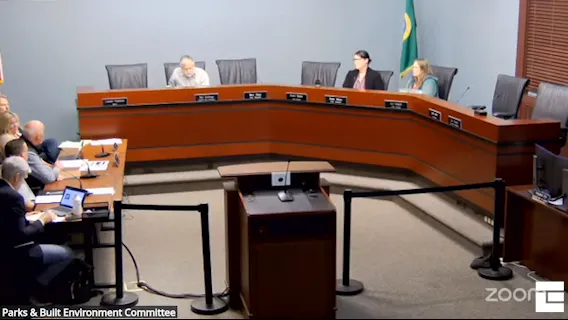
STREAMING COPY IN PREPARATION — RECORDING AVAILABLE FROM THE ORIGINAL SOURCE
Parks & Built Environment Committee Meeting – May 14, 2025
The Everett City Council Parks & Built Environment Committee met on May 14, 2025, at 5:00 PM in Council Chambers. The agenda featured two lengthy staff briefings: an update on the Vision Zero comprehensive safety action plan and the Economic Development Year in Review. No public comments were heard, and no formal votes were taken.
Discussion Items
-
Vision Zero Update: City Traffic Engineer Corey Hertz presented the progress of the Safe Streets for All grant-funded plan to eliminate serious injuries and fatal crashes. Key data points: 9,730 reported crashes (2019–2023) on Everett streets, including 54 fatal and 215 serious injury crashes. Pedestrian crashes accounted for 31% of severe crashes and 50% of fatal crashes. A high-risk network has been developed, identifying priority corridors (e.g., Evergreen Way, Broadway) and intersections (e.g., Evergreen & Airport, 4th Ave & 100th St). The draft plan is expected to be ready for public comment in September, with a council briefing to follow. A speed policy case study on Holly Drive and 16th Street recommended keeping Holly at 30 mph and reducing 16th Street to 25 mph (subject to engineering judgment). Steven Fickenshire, chair of the Transportation Advisory Committee (TAC), shared a personal story about being hit by a drunk driver and emphasized the need for enforcement alongside infrastructure changes. Councilmembers asked about e‑bike speeds, photo enforcement revenue use, traffic calming, and specific trouble spots like the curve near Corbin Park.
-
Economic Development Year in Review: Dan Ernesty, Economic Development Director, presented a forward-looking overview, highlighting 11 “areas to watch.” Key items: the downtown multi-purpose facility (design and funding package ongoing, council briefing on May 28 and decision on June 11); clean energy leadership (Helion, Zap Energy, TerraPower); health sciences growth (McKesson, Kaiser Permanente $300M expansion, a Japanese‑backed incubator); South Everett transformation (strategic plan briefing on June 25); Port of Everett ship repair and lifestyle developments; aerospace and aviation expansions (ZeroAvia, Amazon Kuiper, Z21); and downtown’s “ascendancy” (new businesses, creative district designation, historic Everett Theatre purchase, Arena reaching >$100M annual economic impact). Councilmembers expressed enthusiasm and asked about a specific building (Snohomish 911) and the status of new ferry construction bids.
Key Outcomes
- The Vision Zero draft safety action plan will be released for public comment in September 2025, with a council briefing to accompany it.
- The downtown multi-purpose facility project will have a council briefing on May 28, 2025, with a decision requested on June 11, 2025.
- The South Everett economic development strategic plan will be presented to council on June 25, 2025.
- Both briefings were received as informational; no formal actions were taken.
Meeting Transcript
Great. Good evening, everybody. Thank you for joining us this evening. Today is May 14th. It is 5 p.m. We are here in Council Chambers. Welcome to the Parks and Built Environment Council Committee meeting tonight. Tonight we have two agenda items, some uh lengthy briefings from staff, in-depth briefings for some ongoing work that we're doing here at the city. And I think I'm excited for very informative evening. Uh so first on our agenda, we have a vision zero update briefing from staff. And I uh see a few staff folks here. So uh if you could introduce yourself real quick and uh share your title for the record and uh kick off the briefing, that'd be great. Great thing. Great, thank you, uh, Councilmember Ryan. Um, thanks for the opportunity to come uh brief you on where we're at with Vision Zero, our comprehensive safety action plan to eliminate serious injuries and fatal crashes in Everett. Uh, I'm Corey Hertz, City Traffic Engineer. And with me today is I'm Stephen Pickenshire. I'm the chair for the traffic advisory committee. Yeah. All right. Do we have a slide presentation? Okay. Thank you. So I guess I can get started while she's bringing up the slides. Um, as we uh probably heard uh back in 2023, Everett was awarded a 788,000 Safe Streets for All grant to create a comprehensive safety action plan, our vision zero plan for Everett. Um Vision Zero is this is a safety action plan uh with comprehensive data-driven approach to effectively evaluate and list proven strategies and uh for projects uh for adoption of the city and future planning and outcomes. Robust data collection and analysis of the city's roadway has been conducted and a plan developed uh with high risk network to propose safety improvements, mitigation strategies, and design concepts with corridor project recommendations. Final documents will present an actionable plan to improve safety for all rate roadway users and significantly reduce and eliminate uh roadway fatalities and serious injuries. Next slide, please. And next slide, please. Thank you. So crashes in Everett have been following uh general Washington state trends. While overall crashes have been uh following, the severity has been increasing. Um for the past five years of available data, there were 9,730 crashes overall on Everett streets that were reported. These crashes don't include our limited access highways like I-5, Highway 526, and Highway 529 north of the Snow Mish River. So during that time, there were 54 fatal crashes and 215 serious injury crashes. And while these numbers are much smaller, each severe uh severe crash has a huge impact on those injured and their families. So while uh overall the crashes in the state have been trending down, the most severe crashes in the state of Washington are at 30 year highs. So Everett is not alone. So here are the most uh common types of severe crashes in Everett over the past five years. There are pedestrians at 31%, uh, angle or T-bone style crashes at 16%, uh left turn crashes at 13%, uh, and barrier and fixed object crashes at 8%. You'll notice these numbers don't add up to 100%. That's because there's other types of crashes like bicyclists involved and side swipe, um, hitting park cars and things like that. But pretty clearly pedestrians, uh pedestrian crash issue in Everett that we have needs to be solved. So the trend of serious pedestrian crashes follows the overall trend. And when looking at fatal crashes alone, pedestrian crashes make up about 50% of all overall fatal crashes in Everett. When the crash locations are geocoded uh on a map, like the one to the right, uh, it shows that most crashes happen on or near major uh arterial streets like Evergreen Way, Everett Mallway, and Broadway. So the zero death vision acknowledges that one death in our transportation system is unacceptable and focuses on safety and mobility for all users. The wheel you see on the right is a graphical representation of the safe systems approach. The underlying principle is that um to achieve our zero death vision, everyone must accept that fatalities and serious injuries are unacceptable and preventable.
openpublica.com