Everett Parks & Built Environment Committee Meeting - June 11, 2025: Downtown Storefronts and Business Development
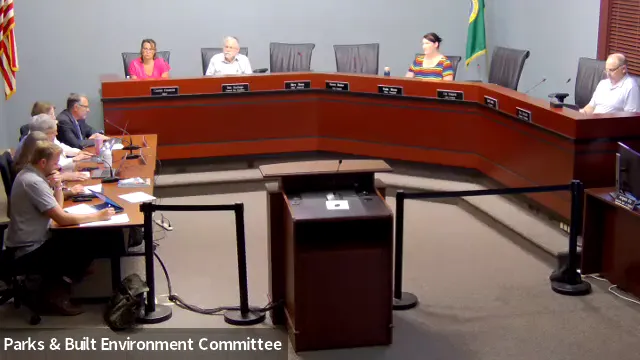
STREAMING COPY IN PREPARATION — RECORDING AVAILABLE FROM THE ORIGINAL SOURCE
Everett Parks & Built Environment Committee Meeting - June 11, 2025: Downtown Storefronts and Business Development
The Parks & Built Environment Committee of the Everett City Council met on June 11, 2025, at 5:00 PM in City Council Chambers. The primary agenda item was a panel discussion on downtown businesses and storefronts, featuring presentations from City Economic Development Director Dan Ernesty, Placemaking Program Manager Tyler Chisholm, and Downtown Everett Association Executive Director Liz Stenning. The discussion focused on vacancy rates, business growth, placemaking efforts, and policy tools to revitalize downtown Everett.
Discussion Items
- Dan Ernesty provided an overview of downtown economic development strategies since 2018, emphasizing housing growth (1,500 units built/under construction, 1,000 in pipeline) and the need for 5,000 units to achieve critical mass. He highlighted the city's support for the Downtown Everett Association, strategic business recruitment (e.g., Apex), and placemaking.
- Tyler Chisholm described his role in placemaking, including special events that generated $13 million in downtown spending in 2024, public art installations, and a "dirty airplanes" approach to addressing maintenance issues. He discussed the creative district designation process, which will bring state funding and signage, and noted that a survey is open through mid-summer at everettwa.gov/creativedistrict.
- Liz Stenning presented data: the downtown ground-floor vacancy rate is 7%, considered healthy. Since 2021, 78 new businesses have opened; in 2025, seven have opened and nine more are planned. Visitor numbers reached 5.5 million in 2024, up from 3.9 million in 2020, and time spent downtown is increasing. Top visitor origins include zip codes 98201, 98203, and Lake Stevens. She noted the success of storefront grants (40 businesses funded over three years) and the upcoming renewal of the Business Improvement Area (BIA) and a downtown vision plan.
- Councilmembers discussed the calculation of vacancy rates, noting that some spaces appear vacant but may be leased or used for storage. Councilmember Zarlingo raised the importance of connecting with Snohomish County Tomorrow and health department resources for kitchen improvements. The committee also discussed the potential for a creative district to spur activation of long-vacant properties.
- Dan Ernesty noted that parking management, including potential paid parking, may come forward for consideration. The committee thanked presenters and highlighted upcoming events like Salty Sea Days (July 11-12).
Key Outcomes
- No formal votes or decisions were taken; the meeting was informational.
- The Downtown Everett Association will undergo BIA renewal later this year and is developing a downtown vision plan.
- The creative district application is expected to be submitted by the end of 2025, with a survey open through mid-summer.
- The committee will continue to discuss code enforcement, storefront grants, and other policy tools at future meetings.
Meeting Transcript
Okay, good afternoon, late afternoon, everybody. Uh thanks for joining this afternoon. And today is June 11th, 2025. It's 5 p.m. We're here in Everett City Council Chambers for the Parks and Built Environment Council Committee meeting. Uh Councilmember Vogeli, who is a co-chair was not able to join this evening. So listening in in her place will be Council Member Schwab. Thanks for joining. Uh tonight we're working, uh we're we have a panel discussion uh regarding vacant storefront properties in downtown Everett. Uh it's been an ongoing topic for our council committee to uh look into uh vacancy rates downtown and uh different policies that council can put together to address vacancies uh in our downtown core and uh spur development and interest and insights. And so we I know that we have a team that's been working on it uh both internally and peripherally with the city. So uh tonight we have uh some representatives from both of those groups to share more about the work that the city is doing and uh work that the downtown Everett Association is doing as well to uh just address storefront vacancies and also um they can share a little bit more on the data side of things of uh vacancy rates and whatnot. So I want to start with a big picture discussion by uh Dan Ernesty. So if you don't mind introducing yourself for the record and uh sharing what you have for us, so great, thanks. Yeah, thank you very much. This is one of uh I think the most fun topics to talk about with council, and I'm very excited to be here. Um I am I didn't get flowers from anyone, so I assume you forgot, but I'm celebrating my seventh anniversary at the city of Everett right now, and like a month, maybe two months after I came in 2018, the Metro Everett plan was passed. And I can't remember who it was on the on the council panel, but they turned to me who I was sitting in the front row and they say, Okay, Dan, now do something with it, basically. And so that they didn't need that encouragement because I already had recognized that downtown Everett is really the heart of the business and uh residence life in Everett, and it deserves the attention. And and shortly later, shortly after that, I articulated the the real key areas that we should be focused on. And of the of the four areas, downtown was the one uh that would that headed that list because I I believe honestly that as if downtown is super successful, Everett will that will spill over to the entire community. At that time, Metro Everett had been worked on for a number of years, and obviously I'm not the first one to recognize these things. And and the council and the the administration have been working on it as well. And they really used Metro Metro Everett to uh pilot a zoning code that that encouraged growth and encouraged growth in the central core. And the the rethink zoning that happened with the residential and the commercial advanced that. And as you know, the the current uh comp plan update is doing that yet again and and really amplifying the the findings that we we came to in Metro Everett. The issues that were looking to be overcome. The I I will say the the symptoms oftentimes are vacancies in long-term vacancies or lack of activity in downtown. The solutions to those symptoms sometimes are are more difficult to uh ferret out. And so as a city, we set uh at least in the economic development office, focus specifically on housing downtown as one of the things that we could really work on to help that. Um I I've said this before. Um downtown Everett and downtown Ballard are similar in that they were both built about the same time in the early 20th century. They both have very similar architects, they're both have about three miles of single family bungalows with really nice uh street gutter curb sidewalk and alley access to a lot of that, you know. As you understand, the difference, there's many differences to from between Ballard and Everett, but one of the big things is Ballard is quite small. And the commercial strip is basically just two streets, fairly short streets, Ballard Avenue and Market. Uh, Everett is quite large. And I think what we've all experienced is boy, there's a lot of great things in downtown, but there's it's diluted, you know, it might be several blocks between that, between them. So in the evening, maybe you feel like you're the only person walking down the sidewalk or or whatever. Whereas a place like Ballard has the advantage of having such a concentrated commercial area that the people that are activating it are seen pretty easily, and they're they're right there. Um the other thing that's really interesting about downtown Everett versus uh, I'll just say South Everett, but it's really a lot of mid and South Everett is the let me just let me just back up a minute. If you think of where Evergreen and Everett Mall Way connect in South Everett, there's lots of certain kind of retail and uh business activity that are going on there, which is very typical suburbia in many ways. Um, you have a Target, you have a Walmart, you have uh Chick-fil-A, you have uh Dick's opening soon, you know, nearby tomorrow, by the way, the ribbon cutting is very exciting. Um the the way chain businesses determine where to go is basically by drawing a circle around a particular site and counting how many rooftops are in that and what the disposable income is in there. Now, if you do that same thing in downtown Everett um versus South Everett, you get two really different results because downtown Everett, a lot of that circle is water or Snowmish County slough. And so even though there's a lot of affluence and there's a lot of you know, really engaged residents and businesses in downtown Everett, they tend not to be the national chains. Um they tend to be, if you know, I mean, there's franchises like Subway around the corner, but they tend to be um more local businesses. And and uh obviously there's a couple grocery stores, and those those are are different in their demographics, but because of that, the downtown lends itself to a more curated approach to the the retail and the and the dining approach than the South Everett, where you can say, yeah, well, it's pretty obvious we've got a lot of traffic here. You you're gonna have so many cars go by you every day, they're on their way to jobs at Boeing, they're on their way to this, that, and the other. And it's it's it's just quite different. And so our approach to downtown has been different.
openpublica.com