Everett Parks & Built Environment Committee Housing Strategy Briefing - August 13, 2025
STREAMING COPY IN PREPARATION — RECORDING AVAILABLE FROM THE ORIGINAL SOURCE
Everett Parks & Built Environment Committee Housing Strategy Briefing - August 13, 2025
The Parks & Built Environment Committee of the Everett City Council met on Wednesday, August 13, 2025, at 5:00 PM in the City Council Chambers. The primary agenda item was a housing strategy briefing from staff, featuring Community Development Director Julie Willie and Housing Project Manager Frank Hong. The presentation introduced a draft 10-pillar strategic framework for housing over the next five years, with detailed action items to be presented in September 2025. No votes were taken; the session was informational.
Discussion Items
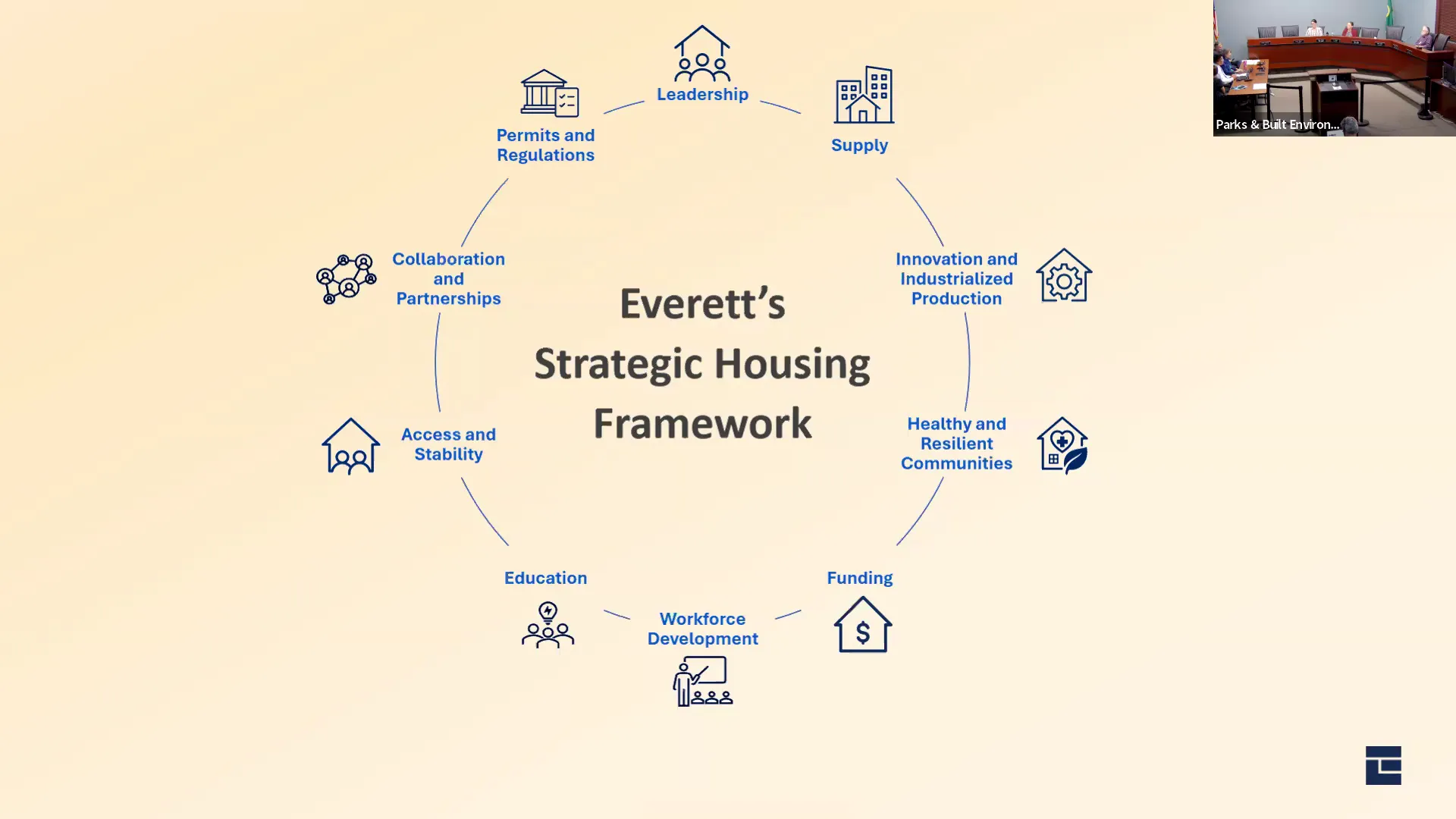
- Housing Strategy Framework Overview – Frank Hong presented a 10-pillar framework covering: leadership, supply, innovation/industrialized production, healthy and resilient communities, funding, workforce development, education, access and stability, collaboration and partnerships, and permits/regulatory environment. The framework is intended to guide long-term housing policy and will be complemented by specific action items for 2026.
- Data and Growth Projections – Staff cited that Everett is expected to grow to approximately 179,000 residents (57% increase from 2020), requiring roughly 38,600 additional housing units and 2,400 temporary shelter beds. Currently, 58% of Everett renters are cost-burdened (spending more than 30% of income on housing).
- Prior Efforts and Transition – The strategy builds on the 2020-21 Rethink Housing Action Plan (14 of 18 action items completed) and incorporates recent work from the 2044 Comprehensive Plan, Consolidated Plan, Fair Housing Assessment, and the 2025 Affordable Housing Solutions Plan (focused on 0–50% AMI).
- Councilmember Questions and Comments – Councilmember Zarlingo asked about state mandates for higher-income housing and the balance between affordable and market-rate units. Frank Hong noted that while the city must zone for all income levels, it can encourage market-rate development through tools like the multifamily tax exemption. Councilmember Vogeli raised concerns about regional coordination, asking how growth targets compare to neighboring communities and how city actions (e.g., permitting staffing, tax exemptions) interact with overall housing supply. Councilmember Rhyne discussed homeownership barriers, citing data that 23% of ownership parcels in Everett are held by entities owning multiple properties, potentially reducing opportunities for first-time buyers. He also mentioned short-term rentals as a related issue. Staff acknowledged these concerns and indicated they are being explored.
- Walk-on: Stadium Priorities Resolution – Councilmember Rhyne introduced a rough draft resolution titled "Support of the Everett Multi-Use Event Center and Declaration of Priorities." It covers priorities such as economic development, environmental standards, community benefits, transportation, labor standards, and oversight. Committee members were asked to review and provide edits by the following Friday, after which it would go to administration and legal for review before a full council vote.
Key Outcomes
- The housing strategy briefing was informational; no votes were taken. A more detailed presentation of specific action items is scheduled for September 2025.
- The committee will consider feedback on the stadium resolution draft, with a deadline of August 22, 2025, for edits.
- Future agenda items were noted: an update on the manufactured home overlay zone (going to Planning Commission in September) and a request from Councilmember Rhyne for an update on park ranger services and park fencing/gates, following the voluntary separation of park rangers nearly a year prior.
Meeting Transcript
Now that the recording is in progress, welcome to the City of Everett Parks and Built Environment Council Committee meeting of August 13th, 2025. We're here in the Everett City Council chambers. We only have one item on our agenda, and I bet it will be awesome because it's about housing. So I will tell you what that is. And it is the housing strategy briefing from staff. And it looks like we have some awesome staff without name placards. So I'm going to allow you to introduce yourselves so I don't get it wrong. Take it away. Good afternoon. I am Julie Willie. I'm the community development director. And Frank Hong, our housing project manager is here with us today. And he's going to get most of the airtime. And so you will have the pleasure of learning from Frank and the work that he has done over the course of the last what year and a half to really look at what we've done around housing in the last several years regarding rethinking housing in regards to housing directives and housing for all, certainly in regards to our 2044 comprehensive plan and our consolidated plan to address the individuals in need. And every one of those reports obviously has pointed to the direction of housing. So Frank, alongside of that work, has been really trying to understand what other opportunities exist within the city of Everett and within our region, our state, and our federal environment, as well as building partnerships and relationships and strategizing. And so tonight we've asked Frank to share kind of his vision for our 10-point strategy, a framework by which we will kind of bucket all of our future housing work into. And then next, probably at a council full in the full briefing, kind of talk a little bit more specifically about the initiatives that he also or we also have been working to move um move forward. So I think it'll be an opportunity for you to learn and to ask questions and to kind of co-create. And then hopefully we can quickly move into action for 2026. So with that, Frank Hong Share. Thank you, Julie. Oh, sorry. I forgot one more thing. Another thing that we're doing kind of internally as a staff team is working to kind of better align our community planning and economic development efforts. So we've kind of moved some of Frank's work a little bit closer to community development because he's already really aligned with planning and has a great relationship with the planning department. But we wanted to also remember the funding and the affordability and our other residents that were also working to ensure shelter and housing options for all. So that's been a really cool opportunity, as well as thinking about it from economic development level. So Frank kind of like floats through all three of our divisions to really bring you know housing as a united force. So that's just also something we wanted you to note. Now I now I've remembered everything. Thank you very much, Julie. One second. Okay. Well, good afternoon, everyone. Good to see you all again. Uh, here today, uh, we're just going to provide you with a sort of very high-level introduction to the next five-year housing strategy that we're working on as a department. It's still in a very draft phase, and uh, hopefully through the next few months, we'll get something prepared at the end of this year to take it into 2026. The strategy. Oops. The strategy uh comprises two main components, a long-term housing strategic uh strategic housing framework that uh will govern our sort of roadmap for housing for there's really no timeline to that. And in addition to that, there's more targeted action items that will come back again at Julie mentioned in September to discuss further. So I wanted to ground you. I'll go into details of each of these pillars uh later on, but just wanted to help everybody anchor uh what we're talking about today. And this is the strategic framework that I mentioned, consists of 10 pillars that's pretty comprehensive and cohesive, and there are 10 pillars that are in many ways interrelated to support a thriving and sustainable housing environment for Everett. But before we get into those, each individual pillar, I also just wanted to take a step back and help you understand how we sort of came to this uh place. As you all know, housing is a foundation for so many other issues from public safety, public health, education, community and social cohesion, economic mobility and infrastructure and transportation and each one of these again, vitally important. You need housing to have safe place to stay, housing so that when you have a safe place to stay, you can pursue your educational goals, et cetera. So understanding that housing is so critical in so many ways, I think is a good reminder for us as we move forward because oftentimes we get caught up in maybe just the numbers, thinking housing is just a supply, but it just it's so much more. And um, short speaking to the choir here, you all you folks know that.
openpublica.com